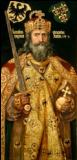
 On 25 December 800 Charlemagne was crowned first Holy Roman Emperor by Pope Leo III in Rome.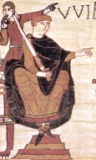
On 25 December 1066 William the Conqueror (William I) was crowned at Westminster Abbey.
Tags: December

People who know me, will have realised that I have a particular interest in St Albans and anything connected to the town or the saint.. After I had previously looked at the goings-on at the Abbey and its cells, I am planning to turn my attention to the civilian population in the middle ages. As the civilian population would have been very much at the receiving end of the two battles fought in their midst, irrespective of who won that battle, I recently read two books dealing with these battles. Read the rest of this entry »
Tags: Hertfordshire, St Albans
On 25 December 800 Charlemagne was crowned first Holy Roman Emperor by Pope Leo III in Rome.
On 25 December 1066 William the Conqueror (William I) was crowned at Westminster Abbey.
Tags: December
 Death of Anne of York, Countess of Surrey. She was the seventh child and fifth daughter of Edward IV and Elizabeth Woodville.
Tags: Edward IV, Elizabeth Woodville, Family, November
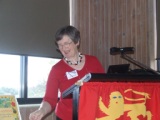
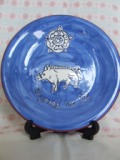 The last meeting of the year was held on 11 December 2010. The Sydney Mechanics’ School of Arts meeting room was filled to capacity with old members and new, and friends visiting from other branches.
Introductory remarks were made by the chairperson Judith who welcomed new members Rosemary and Peter Ingle as well as Jenny Savage, who was visiting from the UK, followed by the treasurer’s, librarian’s and webmaster’s reports – all being from our dedicated Dorothea who assured us that everything is in good shape. The social secretaries, Xavier and Jane, reported that they are busy planning the March luncheon and will have details for us at the next meeting in February. Julia Redlich reminded everyone that the deadline to register for the Melbourne Richard III conference to be held next August is late January.
Our program for the day was an excellent in-depth study of medieval pottery entitled Water, Earth and Fire: Medieval Pottery in Europe presented by Dorothea whose grasp of the subject was impressive.
Just before breaking for afternoon tea, Julia Redlich treated us to a delightful theatrical offering about a school play gone wrong which had everyone laughing and remembering similar disasters from their own thespian efforts during long-ago school days.
After the break we had a very challenging contest of identification of Ricardian landmarks, emblems, flags and statues offered by Judith, and the raffles were drawn with many people going home happy with their winnings, and purchases from the Bring and Buy table which had been laden with goodies. The next meeting will be on 12 February 2011, with invited guest speaker Penny Bishop presenting her work on the Plagues and Pestilences in the Middle Ages.
Tags: NSW Branch
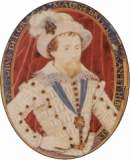
We continue our series of the opinions of James VI of Scotland /James I of England.
If only his view had prevailed 400 years ago, when the use of tobacco in Europe was still quite new. In Britain, Sir Walter Raleigh (c. 1552 – 1618) is credited with making tobacco popular.
A custom loathsome to the eye, hateful to the nose, harmful to the brain, dangerous to the lungs, and in the black stinking fume thereof nearest resembling the horrible “Stygian smoke of the pit that is bottomless”. (A Counterblast to Tobacco, 1604)
Tags: Scotland
 With thanks to Karen, who brought this to my attention.
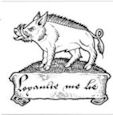
The 2010 Winners of Leicestershire’s favourite museum objects have just been announced. These objects were chosen by public vote from the top 100 items on the ‘Leicestershire Revealed’ website which showcases the county’s finest museum objects.
There were two joint winners: the silver boar badge which one of Richard III’s supporters lost at Bosworth over 500 years ago and the British toy Action Man, which was designed and produced in Coalville. The boar can be seen at Leicestershire County Council’s Bosworth Battlefield Visitor Centre and the Action Man at Snibston Discovery Museum.
For the Ricardian, the boar badge is obviously the more interesting winner. I can easily identify with the reason given by a woman who voted for the Bosworth Boar: “It conveys as strong a message now as it must have done when its owner wore it into battle.”
However, the reason given by a man for voting for the Action man, “Action Man is still popular – he has his own army of collectors!”, can easily be made to suit Richard as well: “Richard III is still popular – he has his own Society of fans!”
David Sprason, Leicestershire County Council’s Cabinet Member for Adults and Communities, sums it up:
Both of these items reflect Leicestershire’s true history and identity and show just how wide and vast the county’s history is. On the one hand we have a truly remarkable badge which tells us so much about the battle that was pivotal in shaping the future of England and on the other; we have one of last century’s most iconic toys that was enjoyed by people all over the world.
It is great to see that finally after more than 500 years Richard’s badge is victorious and enjoys the support it deserves!
You can read the full article here, there are also pictures of winners.
Tags: Bosworth, Richard III
Another talk which was presented at the NSW Mini-Convention in May 2010.
 One of my volunteer jobs is to sort and price donated books for Lifeline Northern Beaches Bookfairs. I love the serendipity of it and was delighted one day to come across a modern rendering of William Caxton’s The Description of Britain which was originally published in 1480. I thought “Wow – this came out and was for sale during the lifetime of our Richard when he was Duke of Gloucester. It contains a general view of the Britain with which Richard would have been familiar. Read the rest of this entry »
Tags: Books
 We received a Christmas message from John Ashdown-Hill, who used to be responsible for Group and Branch Liaison in the Richard III Society. We were so pleased to get it – especially as he says he’s writing a new book! What is the subject next time I wonder? And good to know The Last Days of Richard III is soon coming out as an e-book.
John and the useful flow of information that he used to send is sorely missed. All of us in NSW wish him a very happy Christmas, too.
During Richard III’s short reign there were only three vacancies for bishops, and it is remarkable that two of these went to Thomas Langton. Langton ticked all the right boxes with Richard: Richard preferred Cambridge men to those from Oxford – Langton had studied at Pembroke Hall in Cambridge, though he also was provost of Queen’s College in Oxford; Langton had studied further in Italy, in Padua and Bologna, and shared Richard’s interest in learning and humanistic scholarship.
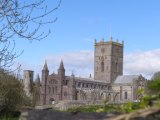
St David’s Cathedral (© Isolde Martyn)
In May 1483 the Bishop of St David’s, Richard Martin, died and Richard as protector suggested Thomas Langton for the vacancy. He must have proved a very able man and, when in February 1485 the see of Salisbury fell vacant, it was again Thomas Langton who was promoted [1]. Read the rest of this entry »
Tags: Cambridge, Church, Contemporaries, Richard III