Archive for May, 2013

This article is by Stephen Lark, a Ricardian friends from Ipswich, Suffolk.  We thank Stephen for making it available to us.  It was first published in the Journal of the American Branch of the Richard III Society, Ricardian Register, Vol.43, No.2 (June 2012).

Thomas Stafford was executed on this day in 1557.

Introduction

This is the story of Richard’s controversial and, consequently, short-lived great great nephew. Genealogical tables can be included, showing his Clarence and Stafford descent, also his relationships with the Hastings family (William, Lord Hastings, and the Earls of Huntingdon).

He is of particular interest as the first proven legitimate Yorkist to initiate a rebellion against the Tudor regime and I feel passionately that he does not deserve his present relative obscurity. I shall attempt to answer some of the mysteries surrounding his life and actions.

Beginnings

Thomas Stafford was born between 1530 and 1533, in about 1531, according to the original DNB, or 1533 in the new edition. At this time, four of Henry VIII’s key advisers (Cromwell, More, Cranmer and the recently deceased Wolsey) all bore the forename Thomas, which may explain his parents’ choice.

His father was Henry Stafford, only son of Edward, 3rd Duke of Buckingham and Eleanor Percy. His mother was Ursula Pole, only daughter of Sir Richard Pole and Lady Margaret Plantagenet (daughter of George, Duke of Clarence). Thomas’ parents married in February 1519, expecting to succeed to the Duchy but this did not happen because Edward was executed in 1521 for “treasonable utterances”.

He is supposed to have said that, were the King to die childless, he would seek the throne and to have consulted a fortune-teller about this. Burke’s says that he was executed “for his vanity and loquacity”. Shakespeare, in Henry VIII portrays him as a plotter, as did the recent ITV film.

His attainder was reversed soon afterwards and Henry was recreated Baron Stafford in 1548.

Thomas was the ninth of fourteen children born to Henry and Ursula Stafford during a 44-year marriage. Many of these, as was usual, died in infancy, including Henry, the eldest. Another Henry was, the eldest surviving son and became the 2nd Baron; Edward became the 3rd Baron and progenitor of the senior branch ever since; Richard was the father of Roger (Froyde) Stafford (an old man deprived of the title under Charles I, for his poverty, after it had passed to him on the initial failure of Edward’s male line).

Dorothy married Sir William Stafford of Grafton (a very distant cousin whose grandfather Sir Humphrey Stafford had been executed in 1486), becoming the mother of William Stafford (1554-1612), a later rebel. For further Stafford genealogy, see Robinson or the author’s Stafford Line (Mid-Anglia Group, 2004). The Buckingham and Grafton lines separated some time in the thirteenth century but Sir William and Dorothy’s marriage partially reunited them.

During Thomas’ childhood, his paternal aunt, Margaret Stafford (Lady Bulmer), was executed with her husband (1537) for their part in the “Pilgrimage of Grace”, his maternal grandmother and uncle (Margaret Pole, Countess of Salisbury (1541) and Henry Pole, Baron Montagu (1539)) both beheaded.

He grew up knowing that his father’s family was one of the oldest in England, his earliest known ancestors being born in the tenth century and, also being of Beaufort stock, were closely related to the Tudor monarchs. His mother’s father was of Lancastrian stock and her mother, as daughter of the Duke of Clarence, was of the Yorkist royal line.

He would also have become aware how dangerous this combination of ancestry could be.

Travels

Little is known of his education but Thomas toured Europe in the early fifties, including Paris (1550), Rome (where he was to visit his uncle, Cardinal Reginald Pole), Venice (where he stayed until summer 1553) and Poland, where King Sigismund Augustus received him, writing to Queen Mary to suggest that the young man be restored to his grandfather’s Duchy, although his brother, Henry, was alive and was knighted in 1553.

In Rome, Cardinal Pole tried to re-convert Stafford to Catholicism. In Venice, Stafford was permitted to view the jewels of St. Mark and the armoury halls; furthermore he and two servants were permitted to carry arms.

Thomas returned to join the Wyatt conspiracy (probably under Henry of Suffolk in the Midlands), being briefly imprisoned in the Fleet – at the same time, Stafford’s cousin, Francis of Huntingdon, and his son, Lord Henry Hastings, were detained in the Tower. He then developed a violent objection to Mary’s Spanish marriage although it is not known whether, like Edward Courtenay (12th Earl of Devon), he considered himself as an alternative suitor.

He declared that she had forfeited the throne, thereby ignoring the claims of Princess Elizabeth, Mary Stuart as a descendant of Margaret Tudor, any remaining descendants of Henry VII’s daughter Mary (i.e. Lady Catherine Grey) and his own brother, Sir Henry.

On his release, Thomas travelled to Fontainebleau, residence of Cardinal Pole, who refused to meet him again, embarrassed at his objection to Mary’s choice of husband, moving on to the Low Countries to mix in extreme Protestant circles, which emphasised his belief that he was destined for greater things.

He had a seal made, consisting of the undifferenced royal arms, tantamount to claiming the throne and, therefore, a treasonable act. Thomas fell out with many of his fellow exiles, such as his brother-in-law Sir William Stafford (Hicks calls him Sir Robert), attempting to assassinate Sir William Pickering (April 1554) and, after further imprisonment in Rouen (1556), left for Dieppe.

Scarborough Castle

After his restoration, Edward IV granted Scarborough Castle to the Duke of Gloucester who visited it in 1484. Perkin Warbeck promised it to his “aunt”, Margaret of Burgundy. Robert Aske led a siege during the Pilgrimage of Grace in 1536 but troops led by Sir Ralph Evers withstood it. The castle was located in the Catholic north-east of England, accessible by sea but easily defensible.

Thomas Stafford and his band of thirty-five men sailed in two ships from Dieppe on 18 April (Easter Sunday), landed on the Yorkshire coast, sailed up to the undefended Scarborough Castle on 25 April and took the garrison completely by surprise. He warned that the Spanish marriage would enslave the English people, that Scarborough and other castles would be ceded to the Spanish, proclaimed himself Lord Protector and announced his intention to reclaim his grandfather’s title (a pretext employed by Henry of Bolingbroke in 1399, Richard of York in 1460 and Edmund of Suffolk in 1502).
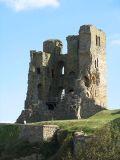
The keep of Scarborough Castle (photograph by Stephen Montgomery, obtained through Wikimedia Commons)

However, the rebellion failed to gather momentum and the local militia acted swiftly. Under Henry Neville, Earl of Westmorland (Thomas’ uncle), they retook the castle. Many of the rebels (who included four Scots) were summarily hanged (hence the phrase “Scarborough warning”, meaning none at all) and others were executed across Yorkshire. Thomas was taken to London and tried for treason, beheaded at Tower Hill on 28 May and buried at St. Peter ad Vincula. With the other executed rebels, he was attainted. Two of his party were pardoned.

The DNB (both editions) says that he was drawn, hanged and quartered but, his father having been restored to the Barony nine years earlier, this seems unlikely. John Strype (1643-1737) confirms that Stafford was beheaded, his work being re-published in 1822, names many of the co-conspirators and includes both Stafford’s and Mary’s proclamations: “May 28: Stafford was beheaded on Tower Hill”.

As a consequence of the rebellion, Queen Mary declared war on France, during which the French took Calais, England’s last possession on the continent.

Five years later, Elizabeth almost died from smallpox.  Lord Henry Hastings (now the 3rd Earl of Huntingdon), together with Lady Catherine Grey, was on the shortlist of successors considered by Parliament – a Yorkist heir who would have inherited the throne peaceably and went on to serve Elizabeth at the highest level for twenty-three years.

Mysteries

Early sources claimed that the Scarborough raid had official French backing because Thomas was a continental Protestant and England’s Catholic Queen was married to a Spaniard. According to Hicks, this is unlikely, as Henri II would have wished to avoid provoking an Anglo-Spanish alliance. Other theories, such as Thomas as a “stalking horse” or victim of Tudor provocation, are also rejected; indeed the reports you may read can be taken at face value.

Both DNB editions, Burke’s and the Complete Peerage all claim that Thomas had a surviving elder brother. His parents’ first son, Henry, died very young and Thomas’ other brother by that name (later the second Baron) seems to have been born by 1527 and Edward (3rd Baron) in 1536. These three “standard sources” do not correspond perfectly and interpretation is important.

There is a little scope for confusion but, having exchanged e-mail with Professor Hicks during which he summarised one of his sources (1534 pedigree: British Library MS 6672 f.193), Thomas’ position in the family has probably been finalised. However, he claimed on several occasions to have been born before Sir Henry. This seems to be analogous to the Lancastrian fantasy (of Henry III’s sons) that formed the basis to their claim.

Sources

Dictionary of National Biography (Entry by A.F. Pollard, 1897).
New Dictionary of National Biography (Entry by Michael Hicks, 2004).
The Staffords (J.M. Robinson, 2002).
The Earlier Tudors (J.D. Mackie, 1952).
The Tower of London: The Official Illustrated History (Edward Impey & Geoffrey Parnell).
Elizabeth I: A Study of Power and Intellect (Paul Johnson, 1974)
Ecclesiastica Memoria (John Strype, volume 3 part 2, 67-9, 513-9, 1721-33).

Tags: , ,

27
May

MISINFORMATION AND THE MEDIA

   Posted by: Dorothea Preis    in News, Richard III in the Media

Thank you to Judy, who found the article, which sparked this post.
May we suggest to “Telegraph reporters” to do their homework and spend a bit more time proof reading?  In a recent article in the (UK) Telegraph about the find of a boar badge found in October on the Thames foreshore, their reporters inform us that these “badges in the form of the animal were ordered for the king’s cremation in 1485”.  Eh, what?!

King Richard III was not cremated as the recent find of his skeleton proofs beyond doubt.  Even the present reporter goes on to mention this in his article.  Nor is it likely that Henry Tudor, who had just assumed the crown by invading England and fighting Richard at the Battle of Bosworth, where Richard was killed, would order badges of his opponent’s emblem to celebrate his cremation.

So we suspect the reporter meant to say “coronation”.  And that’s where the homework comes in.  As any reference work, even Wikipedia (generally not the most reliable source), could have told them, Richard was crowned on 6 July 1483.  He was killed two years later at the Battle of Bosworth on 22 August 1485.

This is an article which deals with a topic of special interest for me and it was easy to spot the mistakes.  However, it makes you wonder how much more misinformation we are fed by our media, either by negligence, as in this case, or on purpose.  Unless we happen to know better, we would take this misinformation as fact.  Quite a scary scenario!

You can find the article here.  It does contain a very good photograph of the boar badge.

Tags: , ,

27
May

NEW RICARDIAN ARTWORK

   Posted by: Dorothea Preis    in News

The Richard III Society has commissioned new artwork from the Queen’s Scribe, Andrew Jamieson.  The new design is used on a variety of merchandise available from the Society.

Our branch has for a long been very grateful to Andrew to be able to use his artwork in our documents or on our website with his permission, which was of course credited to him.  Therefore we feel very strongly about spreading the word on this new merchandise.

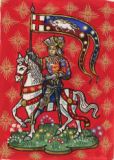
The design commissioned by the Society of Richard III mounted on his horse is full of meaning.  He is armoured as a warrior, but holds a scepter in his hand to show his kingship.  His horse wears Richard’s armourial bearings, a white boar is running alongside him and above him flies his standard.  His crowned shield is surrounded by a garter.  On the grass we find forget-me-nots, white roses for York and broom flowers and pods for Plantagenet.

You can see the picture and all details of ordering any of the merchandise here.

Note: The illustration above is another depiction of Richard III by Andrew Jamieson.  It does not show the new artwork.

Tags: , ,

25
May

MUSIC FOR A KING

   Posted by: Dorothea Preis    in News

Niclas von Popplau reports after his visit to Richard III in spring of 1484 that the king employed a choir which performed ‘the loveliest music I have ever heard in all my life’*, so we can guess that Richard appreciated good music.

Therefore I am sure he would also appreciate the music which is now written in his memory. Here are two examples.

Graham Keitch wrote a beautiful choral piece ‘In memoriam Ricardus Rex’.  Listen to it here.  And a little hint for all who attend the Australasian Convention in July, it might very well feature there as well.

The Richard III has hosted an orchestoral piece by Robert Draper.  You can find out more about this and of course listen to it on the website of the Richard III Society here.

Enjoy!

*Livia Visser-Fuchs, ‘He hardly touched his food, but talked with me all the time:  What Niclas von Popplau really wrote about Richard III’, The Ricardian, Vol.XI, No.145 (June 1999), p.526

Tags: , ,

24
May

CONTEMPORARY VIEWS OF MR SHAKESPEARE

   Posted by: Dorothea Preis    in News, Richard III in the Media

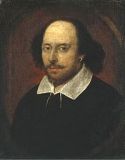
My Google alert found for me an article in the Daily Mail, quoting the views of Mr Shakespeare’s plays from his “contemporaries”.  They also voice their opinion on Richard III.  Thank you, R.B. from Warwick, for putting the record straight!  Though I can also understand Mary P. from Worcestershire.

These opinions from “Ye Internette” are quoted in an article by Craig Brown,a British satirist.  According to his Wikipedia entry he “characteristically [combines] viciousness and honesty”, but don’t fear, he seems to have a good opinion of Richard III.

So if you need something a bit lighter on this grey winter day (at least here in Sydney), read all the opinions here.

Tags: , ,

21
May

Richard Buckley on Richard III

   Posted by: Dorothea Preis    in Greyfriars Dig, News

ArchaeologyAnother find by our friend Renate – what would we do without her!

On 25 April 2013, Richard Buckley, the lead archaeologist of the Greyfriars Dig, gave a talk on the dig and the discovery of Richard’s remains at the Tower of London.  I am sure you all feel you know all about the project by now, it is an interesting review, which puts some details into bigger context.  You can listen to it here.

Tags: , ,

17
May

The White Queen

   Posted by: Helen Cox    in Bookworm

The White Queen

Literature Matters:  The White Queen

The White Queen by Philippa Gregory, World Book Night edition, 2013

I only read this book because my local library gave me a free copy on World Book Night – and by the time I’d finished, I was sincerely glad I hadn’t paid for it.

The underlying story is good (based on the incredible life of Elizabeth Woodville, Queen of Edward IV, it could hardly be anything else); and two pages of bibliographic references show that the author has done her homework. That she has drawn from some of the more lurid sources isn’t surprising – this is, after all, a romantic novel – thus we see Elizabeth waylaying Edward for their first meeting as a supplicant clutching the hands of her two little boys; and shortly after, the hackneyed ‘death before dishonour’ scene in which she grabs his dagger and threatens to cut her throat rather than be seduced. The heroine and her mother are both shown as practising witches, capable of whistling up storms, causing Richard of Gloucester to lose the use of his arm and, of course, ensnaring Edward; and throughout, Elizabeth harks back to her supposed descent from the French water-goddess Melusina. (The legend of Melusina and her ducal lover crops up periodically, in passages intended to echo Elizabeth and Edward’s relationship. I found these chokingly annoying, but luckily they appear in italics so can be easily spotted and skipped without detriment to the main narrative).

The bulk of the story is told in the first person, present tense, by Elizabeth Woodville. This gives The White Queen a certain freshness and immediacy, although the style is difficult to carry off plausibly in this genre, and I wasn’t overly impressed by Gregory’s attempt. The early chapters are riddled with references to Edward as a ‘boy’; and while he might have been five years Elizabeth’s junior, I can’t imagine her (or any 15th century lady) using the term for a man well into his majority – let alone for a proven warrior who had reigned as king for three years by the time the story starts. Much of the dialogue is clunky and full of over-explication; this may be necessary to communicate the background history to the reader, but it makes for some pretty unlikely conversations between characters of the time. And Gregory wins my personal award for ‘Most Excruciating Bit of Dialogue in Any Historical Novel’ with Jacquetta, Duchess of Bedford’s remark to Cecily, Duchess of York, regarding the latter’s son George, Duke of Clarence: ‘…what would one call him?’ She pauses to wonder what one would call Cecily’s favourite son, then she finds the words: ‘An utter numpty.’ Unbelievable! Bad enough to employ such a grotesque anachronism; even worse to deliberately draw attention to it as though it’s clever and funny. (I guess Gregory thinks it is; she must be laughing all the way to the bank to have fans who pay good money to read such ghastly stuff).

To me, the best parts of The White Queen were the lively battle scenes (possibly because they’re not told in Elizabeth’s voice), the imaginative resolution of the ‘Princes in the Tower’ mystery and Elizabeth’s relationship with Richard III in the closing chapters. But altogether I found it an unsatisfying experience which left me baffled as to why this author is so popular – she’s certainly no Jean Plaidy or Antonia Fraser. Her graceless prose has nothing beautiful to wallow in, nothing substantial to get the teeth into; her sentences are short, her language so basic that (bar a modicum of sex and violence) she might be writing for children. Maybe that’s the appeal – it’s quick, simple, undemanding bland pulp. But if The White Queen is a fair representation of Gregory’s work, it’ll be the first and last of it I read – and I sure as hell won’t be watching the forthcoming TV adaptation!

Conclusion? Don’t waste your money. Buy David Baldwin’s non-fiction biography of Elizabeth Woodville instead; it beats this hands-down for readability and interest.

The above was first published on 16 May 2013 on Helen’s website ‘Helen Rae Rants!‘.  We thank her for permitting us to publish it here as well.

Tags:

13
May

Richard III on Trial For Murder

   Posted by: Dorothea Preis    in News

We are very grateful to Dr Phil Stone, Chairman of the Richard III Society, for sharing this information with us.

The Rainham Theatrical Society (RaTS)
are putting on a production of the play

“Richard III on Trial For Murder”

by Michael Bennett

(Mike runs the Richard III Museum in Monk Bar, York)

Performances are on July 18, 19, 20 and 25, 26, and 27

at

the Oasthouse Theatre, Stratford Lane, Rainham, Kent.

The Oasthouse Theatre is situated just off the A2, a few hundred yards past St. Margaret’s Church going towards Sittingbourne. Parking is available in Hidson’s car showroom car park on the A2.

Tickets are £7.50 and can be booked on-line here.

Tags: ,

11
May

RICHARD’S TEETH

   Posted by: Dorothea Preis    in Greyfriars Dig, News, Research

Some of you may have seen a – rather disappointing – article in The (British) Telegraph recently about research into Richard’s teeth.

The author, Richard Gray, starts with the fanciful description that Richard was killed by blows which were so heavy that they  “drove the king’s crown into his head”.  However, Bob Woosnam-Savage explained at the conference in Leicester that Richard could only have suffered the injuries that killed him after his helmet had been removed and also explained by what kind of weapon.

Mr Gray then states that Richard suffered from bruxism or teeth grinding.  For him, this confirms Shakespeare’s portrayal of Richard as “anxious and fearful” and that the reason might be that “he was wracked with guilt over the fate of the Princes in the Tower, who he is accused of murdering to assume the throne”.

Richard Gray based his article on research by Dr Amit Rai, a London dentist, which was published in the British Dental Journal.  It is hardly surprising that Shakespearean flights of fancy are lacking in the original article.

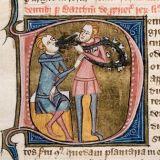
Dr Rai starts with some general information on dentistry in the middle ages.  Dental treatment would have been carried out by skilled barbers or surgeons, though monks were the dentists of the time, but they were not allowed to shed blood.

A professor of medicine and surgery at Bologna earlier in the 15th century, Giovanni de Arcoli, published guidelines of how to look after your teeth, some of which are still familiar to us, for instance that you should clean your teeth after eating, should avoid sweets or not break hard things with your teeth.  To clean your teeth you should use a thin piece of wood “somewhat broad at the ends, but not sharp-pointed or edged”.  Brushes with bristles were only introduced to Europe from China after Richard’s lifetime.

Then Dr Rai looks in more details at Richard’s teeth.  He does find indeed tooth surface loss, which might be the result of stress related bruxism, but thinks it is more likely that it was caused by dietary abrasions and erosion.  He explains that this erosion is not severe, which indicates a more affluent member of medieval society, who would have eaten food made from more finely milled flour.  This is also confirmed by the findings that the individual had eaten a diet rich in seafood – again something that would be expected of someone of a higher social status.

Three teeth were missing, which Dr Rai attributes to caries.  There are signs that the gaps where these teeth would have been have closed, indicating that they had been removed by a barber or surgeon earlier in Richard’s life.  For Mr Gray this was the result of a diet “rich in carbohydrates and sugar”.  Dr Rai, who had just explained that the teeth indicate a protein-rich diet, only mentions that caries would have been more likely in more affluent persons.

Some teeth show mineralised deposits, which probably are a build up of tartar.  As there is less of this on certain teeth than on others, it might indicate that Richard followed Giovanni de Arcoli’s guidelines on cleaning teeth, with a piece of wood, not a brush.

The left central incisor was also missing, which Dr Rai thinks could have been knocked out when Richard was killed “by some of the most advanced military weapons of the time” – not his own crown.

On the whole, Richard’s teeth give us a good idea of the dental hygiene people in those time would have used.

The difference between the information published in a daily paper, with its sensationalist interpretations, and that in a peer reviewed scientific journal is striking.  There is little doubt, which article is more reliable.

Reference:

Rai, A., ‘Richard III – the final act’, British Dental Journal, Vol.214, No.8 (27 April 2013), pp.415-417

Gray, Richard, ‘King Richard III’s teeth and jaw reveal monarch’s anxious life and violent death’, The Telegraph (1 May 2013).  Date accessed:  2 May 2013

Tags: , , ,

8
May

LEICESTER CAR PARKS

   Posted by: Dorothea Preis    in News

Is finding a parking space in Leicester even harder?  We didn’t have a car with us, when we visited Leicester, so I can’t say whether parking is a problem.  However, as this is the case in most towns, I guess it also goes for Leicester.

First the archaeologists from the University of Leicester dug up one car park, looking for the traces of the Greyfriars church and came up trumps by finding the remains of Richard III.  During the dig, the team found found four burials in the church.  One of them is a 600-year old stone coffin, with lead lining, which is believed to belong to Sir William Moton, a 14th century knight.  He died in 1362 and is thought to have also been buried in the Greyfriars church.  The archaeologists have now applied for an exhumation licence for this stone sarcophagus.

It is believed that Sir William was born and lived in Peckleton, approx. 14 km west of Leicester.  He had been married twice, first to a Joan, with whom he had a son called Robert, and then to an Elizabeth.

Starting in July, they plan to extend the dig to a site next to the car park, in order to find out more about the church and medieval Leicester in general.  Richard Buckley, who also led last year’s dig which uncovered Richard III, said:

This will be a great opportunity to confirm the plan of the east end of the Grey Friars church to learn more about its dating and architecture, and will give us the chance to investigate other burials known to be inside the building.

However, the Greyfriars site is not the only cemetery to be dug up by the archaeological team from Leicester University.  They also dug in the car park at the junction of Oxford and Newarke Streets, which is about to be developed, and found a Roman cemetery dating from around 300 AD.  Leicester was a thriving town during the Roman occupation of Britain.  The Jewry Wall was part of the Roman baths, and remains of other public buildings were discovered next to it.  The Jewry Wall Museum shows interesting displays of Roman artefacts found in the area.

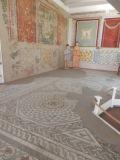
Roman walls and mosaic floor in the Jewry Wall Museum, Leicester (photograph by D Preis)

This car park is on land which was outside of the Roman town, as burials were not allowed within the limits of a town.  Cemeteries usually developed close to main roads, as was the case here.  In previous excavations in the area, other burials had been found, which indicate a Christian tradition bodies were buried in a supine position, facing east with little or no goods buried alongside them.
The finds at the present site indicate a more varied background.  The archaeologists found 13 burials altogether.  The people were of various ages and either sex and were buried in a variety of burial traditions.  Many of the graves contained personal items, from finger rings to hob-nailed shoes.  One grave seems to be that of a Christian:  the person was buried facing east and had a finger ring with what could be the Christian Iota – Chi monogram, the Greek initials for Jesus Christ.

Next to it is a grave which indicates a more pagan burial:  the body is on its side in a semi-foetal position and the removed head placed next to its feet.  It also contained two pottery jars with offerings for journey to the afterlife.

That these graves were found in such close proximity reflects the variety of belief systems which were found in Leicester at that time.

In addition to the Roman remains, the archaeologists hope to get more information on the medieval southern suburbs of Leicester, as they also found remains of quarries, cess-pits and rubbish pits.

References:

Maev Kennedy, ‘Richard III archaeologists to return to Leicester site in search of lost knight’, Guardian.co.uk (30 April 2013).  Date accessed:  6 May 2013

Peter Warzynski, ‘Turns out Richard was not the only one buried here…’, This is Leicestershire (26 April 2013).  Date accessed:  26 April 2013

King Richard III archaeology team bids to extend search at historic search site’, University of Leicester, Press Release (30 April 2013).  Date accessed:  5 May 2013

King Richard III archaeological unit makes new discovery under a car park in Leicester’, University of Leicester, Press Release (3 May 2013).  Date accessed:  5 May 2013

Tags: ,