Posts Tagged ‘Medieval Life’

7
Sep

I can see clearly now…

   Posted by: Dorothea Preis    in Medieval Miscellany

Tommaso da Modena, Hugh of Provence (1352)

Recently Susan Higginbotham of the American Branch of the Richard III Society made a remark that Robert Dudley, Earl of Leicester, purchased a number of pairs of “spactakells” for himself during the years 1584 to 1586.[1]  Reading this, squinting at my computer screen because I had forgotten my own reading glasses somewhere else, made me wonder whether Richard III approx. 100 years before Dudley would have had access to glasses.  He might very well have needed them, had he been allowed to grow old.  Presbyopia, where the ability to focus on near objects is dimished, is one of the symptoms caused by the natural course of aging.[2]

The oldest known lens was found in the ruins of ancient Nineveh and was made of polished rock crystal, an inch and one-half in diameter.  However, these early lenses do not seem to have been suitable as a reading aid, they are referred to for burning holes in parchment and for erasing writing from wax tablets.  Pliny mentions them for cauterizing wounds.[3]

The first step to help sufferers of presbyopia was the reading stone, which was in use during the 12th and 13th centuries.  This is a crude plano-convex shape with a simple wooden frame which could be laid against a manuscript in order to magnify even the tiniest letters, basically something like a magnifying glass today.

The first eyeglasses were created around 1286-1287 by an unknown artisan likely from Pisa, Italy.   We know this from documents by two monks, associated at the St. Catherine of Alexandria Monastery, who also promised to keep the invention secret – fortunately they did not succeed.  Possibly the artisan had held lenses in front of each eye simultaneously and, by connecting the handles of the two glasses with a rivet, he created the first reading glasses.

From Italy spectacle making spread during the 14th century to the Low Countries and from there to Germany and France.   Customs records from London show that from the 14th century onwards, spectacles were being imported from the Low Countries in bulk, before being produced in England in the late 15th.  A Paul van de Bessen (an immigrant from the Low Countries?) made spectacles in Southwark around 1458-9.  The 1547 inventory of Henry VIII’s estate includes horn spectacles.  The Worshipful Company of Spectacle Makers was established in 1629.[4]  Their motto was “A blessing to the aged”.[5]

The earliest glasses discovered thus far are an incomplete pair of rivet spectacles from around 1330 which were found under the floorboards of the nun’s choir-stalls at  Kloster Wienhausen in northern Germany. Similar finds dating to the early 15th century have also been made in London.[6]

While researching this topic I came across the depiction and description of the Orders of Angels Window in All Saints, North Street, in York.  This stained glass window from the 15th century shows the Nine Orders of Angels, where a representative angel of each order leads a procession of mortals of the appropriate rank in medieval society, starting with a group of top level clerics down to some working men and women.  There is a labourer with a spade, a tanner with his tools, a woman with a basket and also a man holding up a pair of spectacles to his eyes.[7]  You can see this endearing detail of the window here.  It is interesting that it is the labourer who is depicted with the glasses, the typical user would have been an educated elderly resident of a monastery or another member of the literate minority.[8]

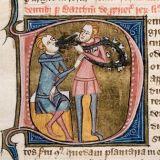
The first artistic depiction of eyeglasses was the above 1352 portrait of Hugh of Provence by Tommaso da Modena.  The author of the New York Carver page says of this painting:

Then, as now, the wearing of eyeglasses somehow evoked an air of thoughfulness, and the use of spectacles as a subject detail – in both medieval and early Renaissance painting – would soon come to symbolize a wealth of education and wisdom…[9]

Surely this would be an apt description of Richard III.

Notes:

1    Susan tells us that this information comes from Simon Adams’ edition of Robert Dudley’s household accounts from 1584-1586.  Robert Dudley, Simon Adams (ed), Household Accounts and Disbursement Books of Robert Dudley, Earl of Leicester.  Camden Fifth Series (No. 6), Cambridge University Press, 1995, ISBN-13: 9780521551564.
2   “Presbyopia”, Wikipedia, accessed 6 Sept 2010. http://en.wikipedia.org/wiki/Presbyopia
3    Drewry, Richard D, “What Man Devised That He Might See”, Teagle Optometry, accessed 6 Sept 2010.
4   “Rivet Spectacles – The Earliest Style”, Antique Spectacles and other Vision Aids: The On-Line Museum and Encyclopedia of Vision Aids, accessed 6 Sept 2010.  This page also includes a great number of pictures.
5    Drewry
6   “Eyeglasses Through the Ages”, Antique Spectacles and other Vision Aids: The On-Line Museum and Encyclopedia of Vision Aids, accessed 6 Sept 2010.  See also:  “Chart of Known Examples”, Antique Spectacles and other Vision Aids: The On-Line Museum and Encyclopedia of Vision Aids, accessed 6 Sept 2010.
7     “The Stained Glass of All Saints”, All Saints Church, North Street, York, accessed 6 Sept 2010.
8    “Rivet Spectacles – The Earliest Style”
9    “Medieval Inventions: Eyeglasses”, New York Carver – Medieval stone, art, architecture…and the Middle Ages, accessed 6 Sept 2010.

Tags: ,

30
Aug

O is for Oranges

   Posted by: Lynne Foley    in Medieval Miscellany

A yummy Scrabble Talk on the letter “O”.

The 14th August meeting – and my scrabble letter talk drawing nigh – I was visited with inspiration when Kim brought home some oranges in the shopping.  Could this fruit be the basis of a talk?

My research revealed that oranges are first heard of growing wild in China and later cultivated there, from where they found their way to India. The Moors are thought to have planted oranges across North Africa in the first century AD.  Oranges were also known to the Romans, who imported the young trees to the port of Ostia.  But with the fall of Rome in the fifth century AD, the  Roman trade and cultivation of oranges died out for centuries.

Oranges were introduced into Spain and by the 13th century, orange groves could be found from Seville to Granada, and eventually, the fruit found its way to England.

Patio de los Naranjos (“Orange Tree Court”), Cathedral, (former Great Mosque), Córdoba, Spain (photo D Preis)

One source states that in medieval times, fresh fruit was viewed with some suspicion, mostly considered as being fit only for the poor.[1]  Monastic gardens, and the gardens of the aristocracy as we know from Dorothea’s talk, grew a wide range of fruit though I have not found a reference to oranges.[2] However, in the book  Noble Lovers, there is an illustration from a Flemish manuscript dating from about 1500, Roman de la Rose, entitled ‘Dreamer enters the Garden,’ which shows orange trees, centre rear.[3]

Medieval oranges were not the sweet oranges of our time. They were bittersweet – if you were to mix equal quantities of orange and lemon juice, this would be an approximation of the taste.  By the fifteenth century, although the sweet orange was making its appearance, it was not used in cookery until the following century – therefore, all the recipes from Richard’s time, would refer to bittersweet oranges.[4]

There are recipes for the candying of fruit – this was done by using honey, but by the mid-sixteenth century, sugar took over as the crystallising agent, still used today.

I must mention Johannes Bockenheim (or Buckenhen,) cook to Pope Martin V who in the 1430s, wrote an  ‘original ‘cookbook.  A feature of this book was to specify the destined consumer of a dish by social class including prostitutes as well as princes – or by nationality, even down to the provinces of a country.[5]

I would like to share with you his recipe for Orange Omelette:

Take eggs and break them, with oranges, as many as you like; squeeze their juice and add to it the eggs with sugar; then take olive oil or fat, and heat it in the pan and add the eggs.[6]

The modern version of this recipe follows the original closely, specifying 6 eggs, 2 oranges, 1 lemon and 2 tablespoons each of sugar, olive oil and salt.

So, for whom did Bockenheim feel this dish was suitable?  Ruffians and brazen harlots.  I am not suggesting that any of the present company falls into either category, but for those planning an evening of debauchery in the future, Orange Omelette, The Medieval Kitchen assures us, will provide an unusual and pleasant dessert.[7]

There is a recipe found in The Good Huswifes Handmaid for Cookerie in her kitchen, complied in 1558, for an apple and orange tart, which from reading the recipe, sounds delicious.[8]

Histoire et culture des orangers, by A Risso and A Poiteau, 1872

The food settled, what about something to drink? The original recipe for Orange Wine, admittedly from a much later period, featured in Hannah Glasse’s The Art of Cookery, published in 1747, calls for 12 pounds of the best powder-sugar, and the juice and rinds of 50 oranges, but not the white part of the rinds…

Again, there is a modern version of this recipe, beginning with 150g each of icing sugar and sugar.  Such amounts of this substance make me shudder, but perhaps the other ingredients balance this out – 12 large glasses of wine can be obtained from this recipe.[9]

I have found a few recipes in which oranges, rather than being a main ingredient, are used in sauces, such as chicken with orange sauce, and in a weak honey drink, known as Small Mead.[10]

In conclusion, oranges were not unknown in Richard’s day, and may have graced his table in various ways, such as in pies, sauces, or candied.  I would ask you to recall for a moment, Bockenheim’s classification for Orange Omelette…I think this a dish eminently suitable for Henry VII.

Notes:

1.    Middle Ages Food – Fruit
2.    Preis, Dorothea,  Medieval Gardens.  Talk given to NSW Branch, Richard III Society, 2010
3.    Owen, D. D. R., Noble Lovers.  NY Universty Press, 1973, facing page 64.  You can find the picture online here.
4.   Fruit in Medieval Europe
5.    Redon, O. et al,  The Medieval Kitchen. University of Chicago   Press, 1998, p. 185
6.    ibid.
7.    ibid., p. 115
8.    The Good Huswifes Handmaid for Cookerie in her kitchen
9.    Historical Foods, “Orange Wine Recipe”
10.    Webbed by Gregory Blount of Isenfir

Tags:

23
Aug

Treason

   Posted by: Jane Roberts    in Medieval Miscellany

Another Scrabble talk in form of a PowerPoint presentation, this time on the letter “T”.

Treason doth never prosper, what’s the reason?
For if it prosper, who dare call it treason
.*

* Sir John Harington, Epigrams

Origins in Roman and Germanic Law
•    Treason Laws in England in the later middle ages had roots in Germanic and Roman Law
•    German – betrayal or breach of trust by a man against his lord (treubruch).  Direct lord rather than hostility towards the king
•    Roman – insult to those with public authority (maiestas – greatness, dignity, majesty)
•    Concepts that were inherited from the Roman concept:

  • plots as well as open acts
  • trials after death
  • damnation of memory
  • confiscation of property
  • denial to heirs of inheritance

Early Anglo-Saxon laws
•    First reference to treason appears to be in law of Alfred the Great.
•    Separated plotting against lord from plotting against king.

Achievement of absolutism
•    Notion of the king as supreme in temporal matters within a kingdom (emperor)

  • Fealty as compared to obedience
  • Fealty was reciprocal
  • Homage – tacit acceptance of ‘right’ to disobey

•    The Law of Treason in England in the Later Middle Ages – J.G. Bellemy

Treason Act 1351 (25 Edw. 3 St. 5 c 2)
•    Codification of the common law.
•    High Treason

  • Disloyalty to the Sovereign
  • Penalty – hanging, drawing and quartering (man) or drawing and burning (woman)
  • Property  – to Crown

•    Petty Treason

  • Disloyalty to a Subject  (murder of a superior)
  • Penalty – hanging and drawing (man) or burning (woman)
  • Property – immediate Lord

•    “when a man doth compass or imagine the death of our lord the King, or of our lady his Queen or of their eldest son and heir; or if a man do violate the King’s companion, or the King’s eldest daughter unmarried, or the wife the King’s eldest son and heir; or if a man do levy war against our lord the King in his realm, or be adherent to the King’s enemies in his realm, giving to them aid and comfort in the realm, or elsewhere, and thereof be probably attainted of open deed by the people of their condition:. . . and if a man slea the chancellor, treasurer, or the King’s justices of the one bench or the other, justices in eyre, or justices of assise, and all other justices assigned to hear and determine, being in their places, doing their offices: and it is to be understood, that in the cases above rehearsed, that ought to be judged  treason  which extends to our lord the King, and his royal majesty”
•    Last used to prosecute William Joyce in 1946 for collaborating with Germany in WWII.

Richard III
•    October 1469 – Constable of England

  • Treason involving raising war against Sovereign

•    April 1483 – Actions of Earl Rivers and Richard Grey not treason – Richard not then Protector
•    Compare Hastings in June 1483

Henry VII
•    Battle of Bosworth – 22 August 1485
•    Henry VII backdated his reign to 21 August 1485
•    Consequently Henry could charge with treason those who fought for Richard.
•    Treason Act 1495  (11 Hen. 7, c. 1)
–    An Acte that noe person going wth the Kinge to the Warres shalbe attaynt of treason

Tags:

21
Aug

Heaven & Hell in the Late Middle Ages

   Posted by: Xavier de Saint Simon    in Medieval Miscellany

The following was presented as a PowerPoint presentation as a Scrabble talk for the letter – yes, you guessed it! – “H”.

Questions?
•    What did the church have to say about those concepts?
•    How did the laity imagine heaven and hell?
•    How the great schism influenced the system of beliefs?
•    Who went to heaven and who went to hell?
•    How did those concepts influence political decisions?
•    What other concepts were available?
•    Should Richard III have been afraid to where he would end up in the after life?
•    Should Henry the VII have been afraid to where he would end up?
•    Could you choose where you ended up?

What did the church have to say about those concepts?
•    At the core of church doctrine as to where individuals will go in the afterlife.
•    Solemn offering of liturgy more important than personal religion.
•    Coming out of the grand schism, the papacy is reclaiming moral authority in triumphant ways.
•    Recognised the existence of purgatory officially at the Second Council of Lyon (1274) and the Council of Florence (1438–1445).
•    All are accountable to punishment or salvation until the last judgement when all will be saved except the pope whose automatic sanctity should save him de facto?

How did the laity imagine heaven and hell?
•    Those were physical locations in the sky and underground.
•    They were very real!
•    Unquestioned existence
•    Every life decision had to be weighed with this two afterlife options.
•    Indulgences the only respite?
•    Importance of relics and helping the church for redeeming

How the great schism influenced the system of beliefs?
•    Although still very powerful and respected, the church after the great schism has created the germ for dissent.
•    The multiplication of indulgences left the poor and rich question their value.
•    The church doesn’t know it yet, but it has offered the future reformers all the weapons they need to undermine its power.
•    Helped to start heresies (Wycliff’s lollards)

Who went to heaven and who went to hell?

To Heaven:
•    The meek
•    The good kings
•    The monks
•    The pope?

To hell:
•    The rich
•    The bad kings
•    The bad priests
•    The pope?

How did those concepts influence political decisions?
•    Religion was always a part of political intrigue and decision.
•    Any ruler needed tacit church approval to exert its power.

What other concepts were available?
•    Past heresies did not survive.
•    Closest heresy was from John Wycliff who created the Lollard movement.
•    The concepts of heaven and hell are still ever present in their doctrine, just the church’s role and some dogma such as transubstantiation are questioned?

Could you choose where you ended up?
•    The church accommodates the rich with indulgences and reassures the poor by promising heaven.
•    The importance of donations to the church in exchange of salvation if you could not have a perfect Christian life

Points for Discussion
•    Should Richard III have been afraid to where he would end up in the after life?
•    Should Henry the VII have been afraid to where he would end up?

Tags:

13
Aug

Medieval Menu for Spring

   Posted by: Julia Redlich    in Medieval Menu

Celebrate the coming of warmer weather with a tasty platter of easy to serve “Hedgehogs”, followed by “Blanc Manger“, creamy chicken-filled pastry cases (just as delicious with rabbit) and salad. End with a spicy “Tansy Cake with Peppermint Cream“.

Tags:

21
Jun

Book Review: The Last Days of Richard III

   Posted by: Dorothea Preis    in Bookworm

A review of John Ashdown-Hill’s latest book, The Last Days of Richard III, is now available on our website.  You can find it in the “Must Read” section on our Book Shelf or click here.

Tags: , , , ,

20
Jun

Meet Queen Eadgyth

   Posted by: Dorothea Preis    in News

John Ashdown-Hill alerted us to an interesting discovery in Germany.  As it is a story with both English and German angles, and a peaceful one as well, I was particularly fascinated by it.  It has nothing to do with Richard III or his time, but took place approx. 500 years before he was born, about the same length of time which separates us from Richard.  It is the story of Eadgyth, a princess from Wessex, and Otto I, King of East Francia.

Eadgyth (the modern equivalent would be Edith) was born in 910, the granddaughter of Alfred the Great and half-sister of Athelstan, the first king of a united England.  In 929 King Heinrich I (the Fowler) of East Francia sent a delegation to England to find a bride for his then 17-year–old son Otto (born 23 November 912).  Relations between East Francia and Wessex were close, as both regarded the Danes as a common enemy.   So Athelstan sent two of his half-sisters to Germany, Otto married Eadgyth, while her sister went on to Burgundy and married the brother of King Rudolf II.[1] Read the rest of this entry »

Tags:

10
Jun

Sweet and Spicy

   Posted by: Julia Redlich    in Medieval Menu

Those of you who missed out on the jars of Autumn Chutney that were on sale at the recent New South Wales Branch of the Richard III Society’s May conference might like to make some yourself.

Very simple!  This amount makes about 3kg, so your might want to halve it if you’re not into major catering supplies.

Find the recipe in ‘About’ or here.

Tags: ,

27
Apr

Share our Medieval Banquet

   Posted by: Julia Redlich    in Medieval Menu

While looking through my cookbooks to see if there was anything I could make for the Bring and Buy Stall for our Conference on 15 May, I thought it might be an idea to have some medieval menus on the website.  The aim is to make them seasonal make them seasonal.

Here is a winter menu – Pease Pudding, Crustade of Chicken, Pears in Wine Syrup – and in case we haven’t had enough to drink – Hippocras.   These recipes are tried and tested and should go well.

Enjoy!

Tags: ,

1
Apr

Happy Easter

   Posted by: Dorothea Preis    in News

Happy Easter!

In Richard’s time Easter was equally important as Christmas.  It came after the six weeks of Lent, a period of fasting, when people had to go without foodstuffs like meat and eggs.  Obviously their chickens were not aware of this and continued to lay eggs.  These were boiled and put aside for children to search and find them on Easter morning.  This tradition represented how the disciples were looking for the risen Jesus in his grave. Richard and Anne’s son Edward would probably have enjoyed an Easter egg hunt, possibly followed by a game of egg rolling.  Though these would have been real eggs, not the candy variety most children today regard as Easter eggs.

Easter Sunday would start with a church service at dawn, a tradition which is still alive in many churches, after which everyone was looking forward to a hearty meal and a day off work.  Probably Richard would have invited his friends, families and servants to a special feast at Middleham.

We would like to wish all our readers a very happy Easter.  We hope you enjoy the holidays and look forward to a free day and a feast.

Note: For more information click here.

Tags: