Archive for September, 2010

6
Sep

Lady Stanley Opens Her Purse

   Posted by: Julia Redlich    in Ricardian Places

Another gem from Sir Frederick Treves’ Highways and Byways of Dorset .
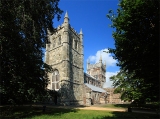
Wimborne Minster – Church of St Cuthburga (© Copyright Mike Searle and licensed for reuse under this Creative Commons Licence.)

Not so far from Bloxworth (about 12 kilometres east)  is the much larger town of Wimborne Minster, and it is here in the impressive ecclesiastical building that Sir Frederick remarks on the many interesting tombs. It seems his favourite is “the beautiful monument to John Beaufort and his wife, Margaret”.

John was the grandson of John of Gaunt, and his wife was Margaret Beauchamp. “The effigies,” writes Sir Frederick, “were prepared by the direction their daughter, Lady Margaret Tudor, mother of Henry VII. The two lie side by side, he a burly fighting man in full armour, she a slender and pretty woman, in robes of state. She wears a veil under her coronet and a jewel on her breast. Their two right hands are firmly clasped together, and so natural is the action that the impression remains that it was thus they died. He has taken off his gauntlet the better to hold her hand , while the empty glove is pressed to his cuirass.”

It seems that their daughter, who – as we all know became Lady Stanley a couple of husbands down the track – was anxious to portray her parents in the best possible light. If only they were as serenely happy as portrayed in Wimborne Minster.

Bibliography:

Sir Frederick Treves, Bart. GCVO, CB, LL.D, Highways and Byways of Dorset.  Macmillan & Co. Ltd, 1906. No ISBN.

You can find a photograph of the grave here (scroll down to the bottom of the page).

Tags: ,

4
Sep

To our friends in New Zealand

   Posted by: Julia Redlich    in News

On behalf of all the members and friends of the New South Wales Branch of the Richard III Society, may we offer all the New Zealand Branch members our concerns and thoughts for you all, and hope that none of you have been badly affected by the Christchurch earthquake.
We shall be thinking of you and hope that all is well.

God bless and Loyaulte me lie.

4
Sep

Treves versus Morton

   Posted by: Julia Redlich    in Quotes, Ricardian Places

Following the reference to Cerne Abbas by Sir Frederick Treves in his book Highways and Byways of Dorset, Ricardians will be interested in this comment about another Dorset village.

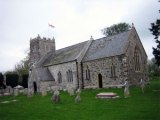
Bloxworth Church (© Copyright John Lamper and licensed for reuse under this Creative Commons Licence.)

Sir Frederick, after some kindly comments about the little church in the village of Bloxworth, goes on to make some not so kindly ones about one of its former rectors.

A very famous rector of Bloxworth was John Morton, Cardinal Archbishop of Canterbury in the time of Henry VII. For a prelate, he led a most adventurous life, not without the usual episodes of imprisonment in the Tower and flight to Flanders. He comforted Edward IV when that king lay dying, and was the stoutest advocate of Henry’s marriage to Elizabeth of York, whereby the red rose and the white became blended in the rose of Tudor. As Bishop of Ely he takes his part in Shakespeare’s play of Richard III, wherein occurs “the incident of the strawberries”, as described by Sir Thomas More, once a page in his household.

Describing how the Duke of Gloster [sic] had asked Morton for some strawberries from his garden at Holborn, Sir Frederick tells that the Bishop replies, ‘Gladly my lord quoth he, would God I had some better thing as ready to your pleasure’.”

Sir Frederick’s comment: “These are indeed ready words for a crafty plotter like the Bishop, who wished the Duke of Gloster [sic] to perdition, and who had no “better thing” in store for him – if he had his way – than the dungeon or the headsman’s axe.”

Bibliography:

Sir Frederick Treves, Bart. GCVO, CB, LL.D, Highways and Byways of Dorset.  Macmillan & Co. Ltd, 1906. No ISBN.

Tags: ,

2
Sep

Meeting Old Friends

   Posted by: Dorothea Preis    in News

Last week my husband attended a conference in Hobart in Tasmania.  So I went along for some sightseeing.  Visiting St David’s Cathedral I admired the beautiful stained glass windows.  One of them showed St Alban, which after my recent work on St Albans in Hertfordshire was like meeting an old friend.

Saint Alban was the first martyr of Britain (executed in c. 304). His story has often been told, among others by the Venerable Bede.[1]  According to this, Alban was a Romano-British citizen of Verulanium, who gave shelter to a Christian priest, called Amphibalus, during a persecution of Christians.  He was so impressed by what this man had to say that Alban converted to Christianity.  When Roman soldiers came to search his house for the priest, he pretended to be him and was arrested.  During the trial he stood firm to his new faith and was beheaded.[2]  However, en route to his execution he performed several miracles like stopping the water of the river to flow and causing a spring of water on the hill, where he was beheaded (hence the street name ‘Holywell Hill’).  His original executioner converted to Christianity on the spot and the man who eventually did the deed was punished by blindness.  Unfortunately all this did not help Amphibalus, who along with some others was a few days later stoned to death.[3]

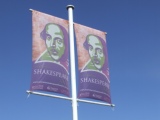
At the time we were there, the Australian Shakespeare Festival was taking place in Hobart.  Unfortunately we did not have time to visit any of the vents, but William was looking down on us from a great height all over the city, which was like running into another old friend.

Notes:

1.    “St Alban”, Catholic Encyclopedia – New Advent.  (accessed 23 May 2010)
2.    “The Story of St Alban”, The Cathedral and Abbey Church of St Alban.  (accessed 24 May 2010)
3.    “St Alban”, New Advent

Tags: , ,

1
Sep

Cerne Abbas, Dorset

   Posted by: Julia Redlich    in Ricardian Places

Cerne Abbas is a small village in central Dorset. In 1998 it had a population of 780, that had fallen to 732 by 2001. The peace of such a small settlement could have been why it was voted Britain’s Most Desirable Village in 2001. (As my mother’s family comes from Cerne, it has always been a most desirable place for me!)

Abbot’s Hall Porch, Cerne Abbey (© Copyright Chris Downer and licensed for reuse under this Creative Commons Licence)

From earliest times, Cerne Abbey, founded in AD 987, was the cornerstone around which the village grew. The Domesday Book (1087) tells there was enough cultivated land for 20 ploughs and 26 villeins. The Abbey remained the focal point of the area for over 500 years until Henry VIII’s Dissolution of the Monasteries in 1539 brought about its surrender. Most of the buildings were destroyed, but the Abbot’s Porch and the Guesthouse still remain, as does St Augustine’s Well, blessed allegedly by the saint himself. The parish today is centred on St Mary’s Church which was built in the late 13th century by the Abbey for the local people. Read the rest of this entry »

Tags: , ,