LEICESTER CAR PARKS
Is finding a parking space in Leicester even harder? We didn’t have a car with us, when we visited Leicester, so I can’t say whether parking is a problem. However, as this is the case in most towns, I guess it also goes for Leicester.
First the archaeologists from the University of Leicester dug up one car park, looking for the traces of the Greyfriars church and came up trumps by finding the remains of Richard III. During the dig, the team found found four burials in the church. One of them is a 600-year old stone coffin, with lead lining, which is believed to belong to Sir William Moton, a 14th century knight. He died in 1362 and is thought to have also been buried in the Greyfriars church. The archaeologists have now applied for an exhumation licence for this stone sarcophagus.
It is believed that Sir William was born and lived in Peckleton, approx. 14 km west of Leicester. He had been married twice, first to a Joan, with whom he had a son called Robert, and then to an Elizabeth.
Starting in July, they plan to extend the dig to a site next to the car park, in order to find out more about the church and medieval Leicester in general. Richard Buckley, who also led last year’s dig which uncovered Richard III, said:
This will be a great opportunity to confirm the plan of the east end of the Grey Friars church to learn more about its dating and architecture, and will give us the chance to investigate other burials known to be inside the building.
However, the Greyfriars site is not the only cemetery to be dug up by the archaeological team from Leicester University. They also dug in the car park at the junction of Oxford and Newarke Streets, which is about to be developed, and found a Roman cemetery dating from around 300 AD. Leicester was a thriving town during the Roman occupation of Britain. The Jewry Wall was part of the Roman baths, and remains of other public buildings were discovered next to it. The Jewry Wall Museum shows interesting displays of Roman artefacts found in the area.
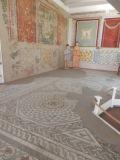 Roman walls and mosaic floor in the Jewry Wall Museum, Leicester (photograph by D Preis)
This car park is on land which was outside of the Roman town, as burials were not allowed within the limits of a town. Cemeteries usually developed close to main roads, as was the case here. In previous excavations in the area, other burials had been found, which indicate a Christian tradition bodies were buried in a supine position, facing east with little or no goods buried alongside them.
The finds at the present site indicate a more varied background. The archaeologists found 13 burials altogether. The people were of various ages and either sex and were buried in a variety of burial traditions. Many of the graves contained personal items, from finger rings to hob-nailed shoes. One grave seems to be that of a Christian: the person was buried facing east and had a finger ring with what could be the Christian Iota – Chi monogram, the Greek initials for Jesus Christ.
Next to it is a grave which indicates a more pagan burial: the body is on its side in a semi-foetal position and the removed head placed next to its feet. It also contained two pottery jars with offerings for journey to the afterlife.
That these graves were found in such close proximity reflects the variety of belief systems which were found in Leicester at that time.
In addition to the Roman remains, the archaeologists hope to get more information on the medieval southern suburbs of Leicester, as they also found remains of quarries, cess-pits and rubbish pits.
References:
Maev Kennedy, ‘Richard III archaeologists to return to Leicester site in search of lost knight’, Guardian.co.uk (30 April 2013). Date accessed: 6 May 2013
Peter Warzynski, ‘Turns out Richard was not the only one buried here…’, This is Leicestershire (26 April 2013). Date accessed: 26 April 2013
‘King Richard III archaeology team bids to extend search at historic search site’, University of Leicester, Press Release (30 April 2013). Date accessed: 5 May 2013
‘King Richard III archaeological unit makes new discovery under a car park in Leicester’, University of Leicester, Press Release (3 May 2013). Date accessed: 5 May 2013
Leave a reply