Archive for the ‘News’ Category

5
Jun

THE JUNE GENERAL MEETING

   Posted by: Julia Redlich Tags: ,

A reminder for our next general meeting on Saturday, 8 June, at 2pm.  The speaker will be Ben Cross, talking to us about ‘Medieval Thought and Philosophy’.  We are so grateful to Ben for finding time for us – he has been frantically busy recently and is shortly to leave for Oxford to complete his PhD thesis on this subject.  However, as we all know, it is those who are the busiest who find the time to fit in something extra.

At every June meeting, we like to make a point of marking the anniversary of the birth of Richard III’s queen, Anne Neville, on 11 June 1456. This means there will be something special to enjoy at our afternoon tea.

Obviously this is a meeting that can’t be missed. See you there!

27
May

MISINFORMATION AND THE MEDIA

   Posted by: Dorothea Preis Tags: , ,

Thank you to Judy, who found the article, which sparked this post.

May we suggest to “Telegraph reporters” to do their homework and spend a bit more time proof reading?  In a recent article in the (UK) Telegraph about the find of a boar badge found in October on the Thames foreshore, their reporters inform us that these “badges in the form of the animal were ordered for the king’s cremation in 1485”.  Eh, what?!

King Richard III was not cremated as the recent find of his skeleton proofs beyond doubt.  Even the present reporter goes on to mention this in his article.  Nor is it likely that Henry Tudor, who had just assumed the crown by invading England and fighting Richard at the Battle of Bosworth, where Richard was killed, would order badges of his opponent’s emblem to celebrate his cremation.

So we suspect the reporter meant to say “coronation”.  And that’s where the homework comes in.  As any reference work, even Wikipedia (generally not the most reliable source), could have told them, Richard was crowned on 6 July 1483.  He was killed two years later at the Battle of Bosworth on 22 August 1485.

This is an article which deals with a topic of special interest for me and it was easy to spot the mistakes.  However, it makes you wonder how much more misinformation we are fed by our media, either by negligence, as in this case, or on purpose.  Unless we happen to know better, we would take this misinformation as fact.  Quite a scary scenario!

You can find the article here.  It does contain a very good photograph of the boar badge.

27
May

NEW RICARDIAN ARTWORK

   Posted by: Dorothea Preis Tags: , ,

The Richard III Society has commissioned new artwork from the Queen’s Scribe, Andrew Jamieson.  The new design is used on a variety of merchandise available from the Society.

Our branch has for a long been very grateful to Andrew to be able to use his artwork in our documents or on our website with his permission, which was of course credited to him.  Therefore we feel very strongly about spreading the word on this new merchandise.

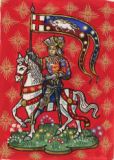
The design commissioned by the Society of Richard III mounted on his horse is full of meaning.  He is armoured as a warrior, but holds a scepter in his hand to show his kingship.  His horse wears Richard’s armourial bearings, a white boar is running alongside him and above him flies his standard.  His crowned shield is surrounded by a garter.  On the grass we find forget-me-nots, white roses for York and broom flowers and pods for Plantagenet.

You can see the picture and all details of ordering any of the merchandise here.

Note: The illustration above is another depiction of Richard III by Andrew Jamieson.  It does not show the new artwork.

25
May

MUSIC FOR A KING

   Posted by: Dorothea Preis Tags: , ,

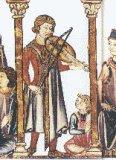
Niclas von Popplau reports after his visit to Richard III in spring of 1484 that the king employed a choir which performed ‘the loveliest music I have ever heard in all my life’*, so we can guess that Richard appreciated good music.

Therefore I am sure he would also appreciate the music which is now written in his memory. Here are two examples.

Graham Keitch wrote a beautiful choral piece ‘In memoriam Ricardus Rex’.  Listen to it here.  And a little hint for all who attend the Australasian Convention in July, it might very well feature there as well.

The Richard III has hosted an orchestoral piece by Robert Draper.  You can find out more about this and of course listen to it on the website of the Richard III Society here.

Enjoy!

*Livia Visser-Fuchs, ‘He hardly touched his food, but talked with me all the time:  What Niclas von Popplau really wrote about Richard III’, The Ricardian, Vol.XI, No.145 (June 1999), p.526

24
May

CONTEMPORARY VIEWS OF MR SHAKESPEARE

   Posted by: Dorothea Preis Tags: , ,

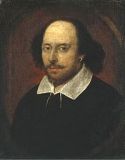
My Google alert found for me an article in the Daily Mail, quoting the views of Mr Shakespeare’s plays from his “contemporaries”.  They also voice their opinion on Richard III.  Thank you, R.B. from Warwick, for putting the record straight!  Though I can also understand Mary P. from Worcestershire.

These opinions from “Ye Internette” are quoted in an article by Craig Brown,a British satirist.  According to his Wikipedia entry he “characteristically [combines] viciousness and honesty”, but don’t fear, he seems to have a good opinion of Richard III.

So if you need something a bit lighter on this grey winter day (at least here in Sydney), read all the opinions here.

21
May

Richard Buckley on Richard III

   Posted by: Dorothea Preis Tags: , ,

ArchaeologyAnother find by our friend Renate – what would we do without her!

On 25 April 2013, Richard Buckley, the lead archaeologist of the Greyfriars Dig, gave a talk on the dig and the discovery of Richard’s remains at the Tower of London.  I am sure you all feel you know all about the project by now, it is an interesting review, which puts some details into bigger context.  You can listen to it here.

13
May

Richard III on Trial For Murder

   Posted by: Dorothea Preis Tags: ,

We are very grateful to Dr Phil Stone, Chairman of the Richard III Society, for sharing this information with us.

The Rainham Theatrical Society (RaTS)
are putting on a production of the play

“Richard III on Trial For Murder”

by Michael Bennett

(Mike runs the Richard III Museum in Monk Bar, York)

Performances are on July 18, 19, 20 and 25, 26, and 27

at

the Oasthouse Theatre, Stratford Lane, Rainham, Kent.

The Oasthouse Theatre is situated just off the A2, a few hundred yards past St. Margaret’s Church going towards Sittingbourne. Parking is available in Hidson’s car showroom car park on the A2.

Tickets are £7.50 and can be booked on-line here.

11
May

RICHARD’S TEETH

   Posted by: Dorothea Preis Tags: , , ,

Some of you may have seen a – rather disappointing – article in The (British) Telegraph recently about research into Richard’s teeth.

The author, Richard Gray, starts with the fanciful description that Richard was killed by blows which were so heavy that they  “drove the king’s crown into his head”.  However, Bob Woosnam-Savage explained at the conference in Leicester that Richard could only have suffered the injuries that killed him after his helmet had been removed and also explained by what kind of weapon.

Mr Gray then states that Richard suffered from bruxism or teeth grinding.  For him, this confirms Shakespeare’s portrayal of Richard as “anxious and fearful” and that the reason might be that “he was wracked with guilt over the fate of the Princes in the Tower, who he is accused of murdering to assume the throne”.

Richard Gray based his article on research by Dr Amit Rai, a London dentist, which was published in the British Dental Journal.  It is hardly surprising that Shakespearean flights of fancy are lacking in the original article.

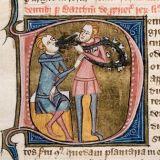
Dr Rai starts with some general information on dentistry in the middle ages.  Dental treatment would have been carried out by skilled barbers or surgeons, though monks were the dentists of the time, but they were not allowed to shed blood.

A professor of medicine and surgery at Bologna earlier in the 15th century, Giovanni de Arcoli, published guidelines of how to look after your teeth, some of which are still familiar to us, for instance that you should clean your teeth after eating, should avoid sweets or not break hard things with your teeth.  To clean your teeth you should use a thin piece of wood “somewhat broad at the ends, but not sharp-pointed or edged”.  Brushes with bristles were only introduced to Europe from China after Richard’s lifetime.

Then Dr Rai looks in more details at Richard’s teeth.  He does find indeed tooth surface loss, which might be the result of stress related bruxism, but thinks it is more likely that it was caused by dietary abrasions and erosion.  He explains that this erosion is not severe, which indicates a more affluent member of medieval society, who would have eaten food made from more finely milled flour.  This is also confirmed by the findings that the individual had eaten a diet rich in seafood – again something that would be expected of someone of a higher social status.

Three teeth were missing, which Dr Rai attributes to caries.  There are signs that the gaps where these teeth would have been have closed, indicating that they had been removed by a barber or surgeon earlier in Richard’s life.  For Mr Gray this was the result of a diet “rich in carbohydrates and sugar”.  Dr Rai, who had just explained that the teeth indicate a protein-rich diet, only mentions that caries would have been more likely in more affluent persons.

Some teeth show mineralised deposits, which probably are a build up of tartar.  As there is less of this on certain teeth than on others, it might indicate that Richard followed Giovanni de Arcoli’s guidelines on cleaning teeth, with a piece of wood, not a brush.

The left central incisor was also missing, which Dr Rai thinks could have been knocked out when Richard was killed “by some of the most advanced military weapons of the time” – not his own crown.

On the whole, Richard’s teeth give us a good idea of the dental hygiene people in those time would have used.

The difference between the information published in a daily paper, with its sensationalist interpretations, and that in a peer reviewed scientific journal is striking.  There is little doubt, which article is more reliable.

Reference:

Rai, A., ‘Richard III – the final act’, British Dental Journal, Vol.214, No.8 (27 April 2013), pp.415-417

Gray, Richard, ‘King Richard III’s teeth and jaw reveal monarch’s anxious life and violent death’, The Telegraph (1 May 2013).  Date accessed:  2 May 2013

8
May

LEICESTER CAR PARKS

   Posted by: Dorothea Preis Tags: ,

Is finding a parking space in Leicester even harder?  We didn’t have a car with us, when we visited Leicester, so I can’t say whether parking is a problem.  However, as this is the case in most towns, I guess it also goes for Leicester.

First the archaeologists from the University of Leicester dug up one car park, looking for the traces of the Greyfriars church and came up trumps by finding the remains of Richard III.  During the dig, the team found found four burials in the church.  One of them is a 600-year old stone coffin, with lead lining, which is believed to belong to Sir William Moton, a 14th century knight.  He died in 1362 and is thought to have also been buried in the Greyfriars church.  The archaeologists have now applied for an exhumation licence for this stone sarcophagus.

It is believed that Sir William was born and lived in Peckleton, approx. 14 km west of Leicester.  He had been married twice, first to a Joan, with whom he had a son called Robert, and then to an Elizabeth.

Starting in July, they plan to extend the dig to a site next to the car park, in order to find out more about the church and medieval Leicester in general.  Richard Buckley, who also led last year’s dig which uncovered Richard III, said:

This will be a great opportunity to confirm the plan of the east end of the Grey Friars church to learn more about its dating and architecture, and will give us the chance to investigate other burials known to be inside the building.

However, the Greyfriars site is not the only cemetery to be dug up by the archaeological team from Leicester University.  They also dug in the car park at the junction of Oxford and Newarke Streets, which is about to be developed, and found a Roman cemetery dating from around 300 AD.  Leicester was a thriving town during the Roman occupation of Britain.  The Jewry Wall was part of the Roman baths, and remains of other public buildings were discovered next to it.  The Jewry Wall Museum shows interesting displays of Roman artefacts found in the area.

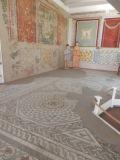
Roman walls and mosaic floor in the Jewry Wall Museum, Leicester (photograph by D Preis)

This car park is on land which was outside of the Roman town, as burials were not allowed within the limits of a town.  Cemeteries usually developed close to main roads, as was the case here.  In previous excavations in the area, other burials had been found, which indicate a Christian tradition bodies were buried in a supine position, facing east with little or no goods buried alongside them.
The finds at the present site indicate a more varied background.  The archaeologists found 13 burials altogether.  The people were of various ages and either sex and were buried in a variety of burial traditions.  Many of the graves contained personal items, from finger rings to hob-nailed shoes.  One grave seems to be that of a Christian:  the person was buried facing east and had a finger ring with what could be the Christian Iota – Chi monogram, the Greek initials for Jesus Christ.

Next to it is a grave which indicates a more pagan burial:  the body is on its side in a semi-foetal position and the removed head placed next to its feet.  It also contained two pottery jars with offerings for journey to the afterlife.

That these graves were found in such close proximity reflects the variety of belief systems which were found in Leicester at that time.

In addition to the Roman remains, the archaeologists hope to get more information on the medieval southern suburbs of Leicester, as they also found remains of quarries, cess-pits and rubbish pits.

References:

Maev Kennedy, ‘Richard III archaeologists to return to Leicester site in search of lost knight’, Guardian.co.uk (30 April 2013).  Date accessed:  6 May 2013

Peter Warzynski, ‘Turns out Richard was not the only one buried here…’, This is Leicestershire (26 April 2013).  Date accessed:  26 April 2013

King Richard III archaeology team bids to extend search at historic search site’, University of Leicester, Press Release (30 April 2013).  Date accessed:  5 May 2013

King Richard III archaeological unit makes new discovery under a car park in Leicester’, University of Leicester, Press Release (3 May 2013).  Date accessed:  5 May 2013

5
May

WHERE WILL RICHARD END UP NEXT?

   Posted by: Julia Redlich Tags: ,

I read this in the Sunday Telegraph today:  on the television page about the American remake of House of Cards, which premieres on showcase on Tuesday.

It is a remake of the English1990 Westminster-based drama of deceit and dissemblance. In the original Ian Richardson played Francis Urqhuart, who was nicknamed FU – his character was based on Richard III in Macbeth…

I know Richard did some pretty amazing things in Scotland, but going back a few hundred years to be part of the Macbeth saga is mind-boggling.  Of course, I expect all he wanted to do was show some support for another historical character grossly maligned by Shakespeare!  Perhaps we can ask Philippa to investigate any suitable car parks near Dunsinane where Macbeth may be lying.

PS. I sent a short note to the Sunday Telegraph about Richard and Macbeth. Very short, but never miss an opportunity to say something about ‘Good King Richard’.

Note:  Sydney’s other Sunday paper, the Sun-Herald , gets it right and says that the role of FU was “based on Shakespeare’s Richard III and Macbeth”.