Archive for the ‘News’ Category

4
Aug

Royal Devotion and Gold – a personal account

   Posted by: Dorothea Preis Tags: , ,

We started our recent trip to Europe in the UK and the first item on my agenda was visiting an exhibition at Lambeth Palace Library:  ‘Royal Devotion: Monarchy and the Book of Common Prayer’.   Not being Anglican, rather than the Book of Common Prayer the drawcard for me was a book which predates the Reformation (and hence the Book of Common Prayer) – Richard III’s Book of Hours.

I had pre-booked my ticket for the first slot in the morning after the day of our arrival.  After a pleasant walk along the river, I arrived early and had enough time for a quick look at the beautiful front garden and the shop of the Garden Museum in the old St Mary’s church next door.
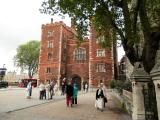
Lambeth Palace Gatehouse (© Dorothea Preis)

Then I joined a growing number of hopefuls waiting outside the main entrance of a brick gatehouse – which I found out later was built by John Morton.  However, it turned out these were members of an arts’ fund and waiting for a tour of the Palace, whereas the entrance to the exhibition was at the side of the complex.  Here a much smaller group of maybe 8 or 9 people was waiting and punctually at 11 the small door opened and we were admitted.

We were each handed a beautifully illustrated exhibition brochure and then our group was lead into the library (I was able to take some photos outside, but photography was not permitted in the exhibition itself) with some explanations on the building and its history.  Though the building itself is neo-Gothic, it creates the right atmosphere for viewing medieval books.
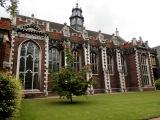
Lambeth Palace Library (© Dorothea Preis)

We were left to view the exhibits at our own pace and it was nice to be able to do so without being crowded.  The exhibition is displayed in 10 cases, the first of which was the most interesting to me, covering “Public & Private Devotion before the Reformation”.

The first book exhibited is the Chichele Breviary (MS 69), which belonged to Archbishop Henry Chichele (c.1362–1443).  It is one of only two books of his which are known to have survived to this day.

The second was the book I really wanted to see:  Richard III’s Book of Hours (MS 474).  A book of hours “was the private book of devotions of the layman in the later Middle Ages and the Renaissance”.  [Sutton and Visser-Fuchs, p.2]

It was open on the calendar page and I could read the entry for 2 October (or rather what the explanation card next to it said, as the original entry was somewhat cut when the book was rebound in the 16th century):

hac die natus erat Ricardus Rex Anglie III apud ffoderingay anno domini Mcc [cc lij]
on this day was born Richard III King of England AD 1452 near Fotheringhay (own translation)

This was added by Richard himself, obviously after 6 July 1483, as he refers to himself as king.  His handwriting is large, though tidy and even.

The manuscript was not made for Richard, but was produced c.1420 for an unknown owner.  As Sutton and Visser-Fuchs state it is “a very useful, solid, unflamboyant and English manuscript for his daily use”. [Sutton and Visser-Fuchs, p.2]

It is believed that he had the book with him at Bosworth and that it was found there after the battle.  In his speech at the opening of the exhibition, the Archbishop of Canterbury remarked:

There’s a personal book of ours belonging to Richard III in this library which does not seem to have brought him a great deal of good fortune, though he carried it at the Battle of Bosworth.

Henry Tudor gave the manuscript to his mother Margaret Beaufort, who seems to have made some half-hearted attempt to scratch out his name at various places, though fortunately not this one.

Standing next to a book, which Richard held in his hands, and seeing his handwriting was certainly a special and moving moment for me.  It was probably the closest I would ever get to the king I have been studying for some time.

The rest of the of the exhibition contained various other beautiful and interesting books, most having some royal connection, from the centuries up to an order of service from the wedding of Prince William and Catherine Middleton in Case 8.  Coming from the Cologne area, I was pleased to meet Hermann von Wied, Archbishop of Cologne from 1515 to 1547, in Case 2.

However, before leaving the library I returned to Case 1 for a last glimpse of King Richard III, represented by his book.

Afterwards I made my way to the Goldsmiths’ Hall to visit another exhibition:  ‘Gold:  Power and Allure’, featuring more than 400 gold items from 2500 BC to the present day.  One of the exhibits was the Middleham Jewel, which is normally on display in York.

The gold lozenge-shaped jewel was found in September 1985 near Middleham Castle. It is beautifully engraved and a large sapphire is mounted on the front.  It is estimated that it was made between 1450 and 1475, certainly for a wealthy person.  Whether there is any connection to Richard III is not known, though it has been speculated that it might have belonged to Richard’s mother, Cecily Nevill.  It was beautifully displayed with both the front and back being visible.

Due to time pressure, I didn’t pay the exhibition the attention it deserved, though I spotted an Angel from the time of Richard’s reign.

I would like to take this opportunity to thank the Facebook page of the Richard III Society for alerting me to both these fascinating exhibitions.

Bibliography:

Duffy, Eamon, Marking the Hours: English People and Their Prayers, 1240-1570.  Yale University Press (2006).  ISBN 9780300117141, p.33

Sutton, Anne F. & Visser Fuchs, Livia, The Hours of Richard III.  Alan Sutton Publishing Ltd (1996).  ISBN 0750911840

‘HRH Prince Charles opens exhibition at Lambeth Palace Library’, The Archbishop of Canterbury (1 May 2012).  URL:  http://www.archbishopofcanterbury.org/articles.php/2469/hrh-prince-charles-opens-exhibition-at-lambeth-palace-library Date accessed:  14 June 2012

‘The Middleham Jewel ‘, The Richard III Society.  URL:  http://www.richardiii.net/2001_archive.htm Date accessed:  3 Nov. 2010

Karl, Werner, ‘Ananizapta and the Middleham Jewel’, Sammelblatt des Historischen Vereins Ingolstadt, 110. Jahrgang (2001), S.57 ff.  Available at URL:  http://www.ingolstadt.de/stadtmuseum/scheuerer/ing/ananiz05.htm Date accessed:  20 March 2010
3
Aug

Come along to Scrabble at our new home!

   Posted by: Julia Redlich Tags:

The next meeting will be on Saturday,  11 August 2012, featuring this year’s “Scrabble Speakers”.  Judy, Moya and Cynthia have something to say about medieval matters starting with the letters M, V and L.  What are the medieval topics they will have found to illustrate their letters? All will be revealed at the meeting!

As many of you know, we have been searching for a new venue for our general meetings for quite some time.

However, thanks to Carol who suggested we look at a hall in The Rocks area, we have found a new venue. It is not the hall suggested, but the smaller place adjoining called The Harry Jensen Centre,  17 Argyle Street, Millers Point.

Those of us who have been there think it will suit us admirably. It is the right size for our meetings – and there will be no other groups meeting there, so plenty of room for afternoon tea and no excessive noise from neighbouring gatherings!

Other bonus points:
a)    Buses stop outside the door.
b)    The entry is via a ramp, a big help for those with mobility problems.
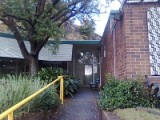
c)    The garden outside is a delightful addition (see attached).
d)    Toilets (disabled ones too) are easy to access.
e)    We can return to our second Saturday in the selected months for all our general meetings.

We hope you will enjoy our general meetings as much as ever – and the committee would ask you to help the usual suspects in clearing up afterwards. We must show we are welcome tenants who care for the area.

19
Jun

Ricardian Publications

   Posted by: Dorothea Preis Tags: ,

Our postman just delivered the June 2012 Ricardian Bulletin and the 2012 Ricardian.  This was the first time with changed distribution arrangements.  In the past we received the publications for our branch members in bulk and then distributed them locally.  Now the Society is trialling direct postage to overseas members, hoping that this approach will save costs and time.

We hope that your copies arrive timely and in good condition.  If there are any problems, please let the Society know either directly (the address is on a feedback note on the back of the sheet of paper with your address) or you can let me know (webmaster@richardiii-nsw.org.au) and I will pass your message on.

Don’t forget that this issue of the Ricardian Bulletin includes the first contribution from the Australasian Correspondent.  However, this is just one of the many fascinating items.  I can’t wait to read the report on the search for Richard’s grave in Leicester.  I better go and put the kettle on for some good reading!

The June branch meeting of the NSW Richard III Society was held on Saturday, 9 June 2012, at the Sydney Mechanics’ Institute. Chair Judith Hughes welcomed all attendees and began by summarising the wonderful Ricardian mini-conference that was held recently in Mittagong, with her special thanks to all of those who had worked so hard to make it the success it was.

Judith then reported on the official book launch for University of Melbourne Professor Stephanie Trigg’s Shame and Honor: A Vulgar History of the Order of the Garter, which several branch members had been able to attend the evening before, hosted by the Sydney branch of the Australian Heraldry Society. The distinguished guest speakers had been fascinating and the amply illustrated book appears very worthwhile reading.

The Treasurer’s report presented by Judy was brief but reassuring, as she reported the branch to be solvent, helped along by proceeds from the recent sale of the last remnants of the branch library at the mini-conference.

Dorothea presented the Webmaster’s report, saying that Annette Carson’s article about Edward V was a recent highlight.  She thanked those members who do contribute to the website on a regular basis, but once again reminded members that more items were needed that would be of interest to the many visitors to our popular website.

Julia presented the Secretary’s report, which included the exciting news that the committee may have found a new affordable, attractive and convenient venue in The Rocks for our branch meetings; details are yet to be finalised and will be widely reported when arrangements have been confirmed.

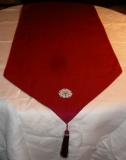
Julia then displayed the lovely table runner with Ricardian colours and insignia, which was a gift to our branch from the Victoria branch at the Mittagong mini-conference.

Julia introduced Yvette Debergue, who is the course leader along with member Isolde Martin, for the University of Sydney Centre for Continuing Education classes focusing on the Plantagenets. She has been able to negotiate with the university administration to offer a 10% discount for Society members who register for the courses. The next all day program is on 30 June 2012 and includes lunch. For more information go to the following link: http://cce.usyd.edu.au/course/TPLG

Kevin sent his apologies for missing the meeting due to illness. But had he been present he would have reminded us that the Winterfest Medieval Fair is coming up on the weekend of 30 June/1 July in Parramatta. Some members may once again brave the cold weather to make their way there this year, though nothing has been organized yet as a group.

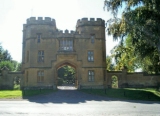
As our scheduled guest speaker unfortunately had to cancel, our branch chair, Judith, came to the rescue with a very interesting presentation about the life and times of Sudeley Castle, the Gloucestershire Castle that was once the home of Katherine Parr, the last wife of King Henry VIII.

The Gatehouse of Sudeley Castle (Photograph taken by Jennifer Luther Thomas; obtained through Wikimedia Commons.)

Dorothea and Lynne also reviewed books they had read recently.  Dorothea spoke about Sumerford’s Autumn by branch member Barbara Gaskell Denvil and Lynne shared her thoughts of the classic The Betrayal of Richard III by V B Lamb with us.

The next meeting will be on Saturday, 11 August 2012, featuring this year’s ‘Scrabble Speakers’, who will be speaking on various medieval topics.

31
May

Events, Events, Events

   Posted by: Dorothea Preis Tags: , ,

There is more happening in the UK than the Queen’s Diamond Jubilee and the Olympics later in the (northern hemisphere) summer.

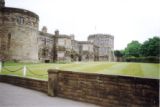
This coming weekend, the Red Wyvern Society will hold a medieval event of ‘Living History at Skipton Castle’, North Yorkshire, 2 to 4 June 2012.  This historical re-enactment society usually portrays the Clifford household, who were Lords of Westmorland and Craven.  The venue, Skipton Castle, belonged to the Clifford family, but for ten years it belonged to Richard, duke of Gloucester, later Richard III, before it was returned to the Cliffords after 1485.

The event is set to include many aspects of medieval life, including arms and armour, there is a trebuchet, there is a ‘Knight School’ and ‘Dinner is served’ at 14h00.  Members of the public will be able to mingle with medieval people, see and handle reproductions of medieval equipment and take part in some of the demonstrations.  To view the full programme, click here.

The following weekend, there is a two day academic symposium at Wingfield, Suffolk, ‘1362:  Celebrating 650 years of Wingfield Church and College’, on 9 and 10 June 2012.  The aim is to celebrate the 650th anniversary of the foundation of Wingfield Church and College and explore the history of Wingfield, Sir John Wingfield, and the de la Poles.

Richard III’s sister, Elizabeth, duchess of Suffolk, is buried in Wingfield church together with her husband, John de la Pole, duke of Suffolk. Their son, John de la Pole, earl of Lincoln, was Richard’s heir presumptive after the death of Richard’s son, and was probably born at nearby Wingfield Castle.

The speakers are all well-known, including Dr Rowena E. Archer, Sally Badham, Professor Mark Bailey, Professor Eamon Duffy, Dr John Goodall, Dr Robert Liddiard, Edward Martin, and Professor Diarmaid MacCulloch.  Dr Archer will be talking about the always fascinating Alice Chaucer; and Dr Goodall, whom we know as the author of The English Castle: 1066-1650 and God’s House at Ewelme, will concentrate on the architecture of Wingfield.  The complete programme can be viewed here.

Unfortunately we just missed a weekend of Anglo Saxon activities, ‘Hands on Saxon’, which took place in Verlamium Park in St Albans, Hertfordshire, 26 and 27 May 2012.  The reason for the event was to commemorate the 1,000th anniversary of the first written recorded use of the word “Hertfordshire” in the Anglo Saxon Chronicle.  In 1012 the town had approx. 500 inhabitants.  It was dominated by the Saxon Abbey and three churches marked its boundaries, St Michael’s in the west, St Peter’s in the North and St Stephen’s in the South.

1000 years later, some 4,000 people enjoyed historical displays depicting Saxon times, discovering what people wore, how they cooked and what their homes were like.  You can read a review here.

The above photograph shows Skipton Castle (© Dorothea Preis)

21
May

WORTH HERALDING

   Posted by: Julia Redlich Tags: ,

Just a short reminder that it is not too late register interest if you want to attend the launch of Professor Stephanie Trigg’s book Shame and Honour: a Vulgar History of the Order of the Garter, organised by the Australian Heraldry Society.

The date is Friday, 8 June 2012; the venue: the Sydney Mechanics School of Arts, 280 Pitt Street, Sydney; the time: 5.45 for 6.30. Entry is by gold coin, there will be light refreshments beforehand – and there will be one of the Heraldry Society’s great raffles.

Those of us who attended the fascinating talk by Professor Stephanie Trigg on “Ladies of the Order of the Garter” a couple of years ago won’t want to miss this.

If you want to be there, please contact Stephen Szabo, Secretary of Australian Heraldry Society, by June 5. You can reach him by email: secretary@heraldryaustralia.org

Members of The NSW Branch of The Richard III Society were saddened to hear of the passing of long time member Harold Bruce Cadell.

A funeral service in thanksgiving for the life of Harold was held at Harold’s parish church, the beautiful St John‘s Anglican Church, Darlinghurst, on Tuesday, 15th May 2012, and was attended by members of the various groups with whom Harold was affiliated over the course of his long life, including several current members of the NSW Branch of the Richard III Society.

It was a beautiful service and fitting for such a quiet, generous and gentle man. The minister conducting the service spoke warmly and well of Harold, the Christian gentleman , who had been such a loyal and well loved member of the parish community for many years and one whom he obviously knew well. The eulogy was given by a long time friend and work colleague, from whom we learnt so much of the working and social life and success of Harold. It was a beautiful classical Anglican Service and was organised at the behest of the trust company, who handled Harold’s estate.

We were quite chuffed when we were talking to the representative of the trust company at the wake, after explaining who we were, and she said: “ Ah yes, Richard III. I know from Harold how badly maligned he was by those Tudors. ”

Two members of our branch, who probably had known Harold the longest were unfortunately unable to attend.  They had suggested that white roses (for the House of York) should be included as they were so close to Harold’s heart. Thus two beautiful sprays of white roses were brought into the church and placed strategically on either side of the coffin. Unfortunately they had been initially forgotten and so those two sprays of white roses were all that could be hastily collected at the last minute from a quick run around the various florists in the area. Our thanks go to the organisers for so quickly and unobtrusively rectifying this oversight. White roses were then handed out to the congregation at the close of prayers around the coffin as it lay in the hearse prior to departure.

We then went across the road to a lovely intimate little café for the wake, where we were plied with copious platters of scrumptious sandwiches, savouries, desserts and tea and coffee. It was all done so beautifully, white table cloths, silver service, white crockery, that Harold – the epitome of fine dining and good taste (those of us who were his guests at lunches can attest) – would have approved.

It was here that we learnt complementary facts concerning Harold’s very active and interesting life. Apparently he began work at the Maritime Services Board as a very junior clerk at the age of 15 in 1935 and worked his way through the ranks to become Secretary of the Board for several years prior to his retirement, which occurred over 45 years later. The words constantly used in reference to Harold were integrity, sincerity, principled, unassuming, generous, kind, unaffected, loyal, steadfast and uncomplicated – all of with which we of the RIII Society who knew him so well concur.

Until recently, he had been a full member of the Society and used to anticipate with hardly concealed impatience the arrival of his quarterly Ricardian Bulletin and the Ricardian and the Chronicles of The White Rose. He used to attend meetings and social events regularly and warmly admitted his debt of gratitude to members for their kindness in keeping him in the loop and informing him of current branch news. Many of us were the recipients of his gracious thank you notes in his beautiful copperplate script. He truly was a man for others.  It was a privilege and a pleasure to know him.

In later years he used meet up with branch members to escort them to the church services for Bosworth Memorial Service or Queen Anne’s demise before enjoying lunch with many other members at a favourite Italian restaurant nearby. Harold always used to congratulate the staff on the fine food and the service and express his gratitude for their providing us with such a good open private room for our functions and ensure we left a suitable tip.

It wasn’t long after this that we learnt that, regrettably, he had had to go into care since he’d had several bad falls in the street.

He will be sadly missed by all of us who knew him.

R.I.P.

On Saturday 12 May 2012 the Richard III Society NSW Branch held their eagerly anticipated biannual mini-conference in the Southern Highlands, at the Mittagong RSL.

A few of us, who had travelled to Mittagong the day before, met up for an informal dinner in the club’s bistro, being happy meeting old friends and making new ones.

The event was attended by both Sydney-based regulars (some of whom braved the long journey on buses replacing the usual trains) and other members, some coming from as far away as the ACT and Victoria.  We were especially pleased to welcome Michael, the chairman of the Victoria branch, and his wife Yvonne, as well as Gillian and Bruce from the South Australian branch.

The presentations were very diverse, with competent speakers from a wide range of backgrounds. David Mee spoke on ‘Medieval Coins’ and brought examples of types of coinage from across the centuries, including one from the era of Richard III.

Judith Hughes spoke on ‘Eleanor Talbot, the Spurned Queen’, being the hapless lady the self-serving young Edward IV secretly wed then ignored for the rest of her life, whilst making a public life with Elizabeth Woodville, with whom he had his large brood.

Karen Clark spoke on ‘John Nevill’s Feud and the Destruction of a Family’, an area of particular expertise and one on which she is writing a book. Her detailed grasp of the generations of family members and their competition was impressive. The Percy family still survives, although the Nevilles are long gone, she mentioned in conclusion.

Kevin Herbert spoke on the ‘Royal Relicts’ – the widows of the kings. His handout was chockfull of details worth knowing, and his presentation a highlight of the day.

Lynne Foley and Dorothea Preis critiqued Ricardian books they had recently read.  Lynne favourably reviewed Margaret of York: The Diabolical Duchess by Christine Weightman. Dorothea told us about the recently published Richard III by David Baldwin, which has its good points, but does not offer much new for someone well versed in the period. Her wise counsel saved us all some cash and precious time by knowing which books we could safely skip.

Doug and Leslie McCawley spoke about their favourite Ricardian books, having been invited on short notice to replace a speaker who had to cancel. They chose the ever-popular Daughter of Time by Josephine Tey, The Sunne in Splendour by Sharon Penman, and Some Touch of Pity by Rhoda Edwards.

Julia Redlich spoke about how Richard III has been presented on stage across time.

Helen Portus and Denise Rawling spoke on ‘Richard III the Posthumous Hunchback’, getting audience members to question what we accept on face value in the media, and encouraging us to be discerning consumers of received opinions and so-called histories.

Ann Chandler gave us a comprehensive (and tricky) 4-page quiz to complete during the day, then graded the results and announced the winners. The more cowed amongst us did not hand our quizzes in, admitting defeat early on!  Our congratulations went to Karen for winning by achieving 47 out of 50 possible points.

In addition to the speakers, other attractions included a Bring and Buy table, the sale of the books from the lamented dissolution of the once fine branch library, Ricardian pens, bags and brooches for sale, and best of all the opportunity to catch up with friends in a leisurely manner.

At the conclusion of the day, the representatives of the Victoria branch surprised us by presenting the NSW branch with a beautiful table runner in Yorkist murrey adorned with white roses.  We were delighted and would like to give a big ‘thank you’ to our friends from Victoria!

A number of attendees chose to stay for the weekend so the festivities continued after the conference proper with dinner out and a day to explore the attractions of the area. The weather was sparklingly clear and cool, and the venue well chosen. Thanks to the organisers for another successful and pleasurable branch event.

Leslie McCawley

Members, who decided to stay on at Mittagong, as well as several partners met up on Saturday evening for dinner with lots of interesting talk and laughter on a wide variety of topics.  We discovered that most of us were addicted to Phryne Fisher on Fridays and Miss Marple on Tuesdays – how we loved the fact that Mrs Lancaster was the baddie in a recent episode!  Other topics were the Richard III of Horrible Histories, medieval and more modern jewellery.  We wondered why so often in information for the general public there seems to be nothing of historical interest before the Tudors came along – quite contrary to what actually happened.

We all enjoyed the food and, when consulting with the delightful waitstaff, we learned that the chef was new. Yvonne from the Victoria branch immediately told them that they were never to let him go! Although it wasn’t a formal Ricardian banquet, the Man Himself was not forgotten in a loyal toast – and the three fingered salute from Horrible Histories.

Dorothea Preis and Julia Redlich

Sunday morning saw us enjoying a long leisurely breakfast. Some farewells were said to those who had to return home, then the rest of us prepared for our excursion to the small Southern Highlands town of Robertson.
One group opted for the swiftest way thanks to SatNav; the other decided on the Scenic Route – and what a reward that was: sunshine, blue skies, green fields, magnificent mansions and extensive gardens behind imposing gates – and the trees wearing their most wonderful autumn colours of red and gold.

Colour was also important in discovering the others at our destination, something made simple by spotting Kevin wearing the super-long scarf in Ricardian colours that Alex had made for our sales table!

It was the monthly market day, so wandering around the stalls was a must. Chilly winters mean the locals are knitters beyond compare! The quality of the huge choice of items from sweaters to babywear and beanies was wonderfully enticing, as were the book selections – and as for the vegetable displays …

The obvious choice for lunch was the Fantastic Robertson Pie Shop, where justice was done to piping hot pastries with a mind-boggling range of fillings. One group then went on an antiques exploration, the other chose to return to Mittagong, put their feet up with the Sunday papers and gather strength for return to the everyday life after yet another rewarding Ricardian weekend.

Julia Redlich

The two photographs from the conference © Bruce Laughton; the photograph of the table runner © Julia Redlich.

9
May

Vale, Harold Cadell

   Posted by: Isolde Martyn Tags:

We regret the passing of an enthusiastic and loyal member of the NSW Branch, Harold Cadell, on 4 May 2012.

Harold Cadell was a member of the Sydney Branch from its early days and always stout in defending Richard III’s reputation. He was a courteous and well-read man, but in latter years, age got the better of him and he no longer could come along to meetings. Those who knew him will remember him as a kindly and quiet presence, with just that tad of flamboyance that was rather fun.

His funeral will be held on Tuesday, 15 May 2012, in Darlinghurst.

The NSW Branch would like to extend our sympathy to his family and friends.

The NSW Branch of the Richard III Society met on 21 April 2012 at our current venue, the Sydney Mechanics’ Institute, but in her welcoming comments our Chairperson Judith explained that at this venue we would now need to take out public liability insurance.  Secretary Julia is investigating quotes from several sources for reasonable insurance costs, however, we may need to find an alternative venue if necessary. Carol suggested a hall in The Rocks area that could be considered.

The mini-conference in Mittagong on Saturday 12 May 2012 was discussed, and thanks offered to the committee members who had worked so hard to put together a fascinating program. With about 35 registrants, including many members from outside Sydney, who usually do not get to attend Ricardian events, it is going to be a great day of learning and socialising.

Minutes from the February meeting were taken as read.  Julia presented the Secretary’s report, as well as a report on behalf of Treasurer Judy who is in the UK. Dorothea presented the Webmaster and Librarian’s report. The branch is financially sound and the branch website at www.richard-III.nsw.org.au continues to receive many visitors. Just a reminder that it could always use more creative input from members, such as Ricardian book reviews, comments on articles posted, etc. It is the addition of interesting new items that brings in new visitors and makes the website come in second in world-wide Google searches, which is excellent.

The Librarian reminded us that the library books would be offered for sale at the mini-conference, along with the various Ricardian items we have available. Sales Officer Lynne reported that new stock of attractive Ricardian items should be available by then, as well.

Other happy news was that former members Xavier and Jane had recently had a baby boy, and members expressed their joy (and the wish that we could have him at meetings so that we could all hold and admire him in turn.)

Members were invited to the Australian Heraldry Society book launch for Professor Stephanie Triggs’ Shame and Honor: A Vulgar History of the Order of the Garter, on Friday 8 June at 6:00 for 6:30 pm start at the Mitchell Theatre, here at the Sydney Mechanics Institute. The featured guest will be Dr Paul Giles, Challis Professor of English at the University of Sydney. A gold coin donation is requested. Guests are requested to RSVP  by 5 June 2012 to secretary@heraldryaustralia.org.  For more information visit http://www.heraldryaustralia.org/

It was also noted that the University of Sydney has several medieval themed courses on offer in the next few months in the Centre for Continuing Studies with member Isolde Martyn as one of the presenters.  For more information visit  http://cce.usyd.edu.au/courses/Humanities/Medieval+History

Our speaker was our own Dorothea Preis who presented a well-researched program about Richard III and Learning, which covered in fascinating detail the colleges he founded and funded, and the learned men he surrounded himself with (and yes in that era they were all men, usually Archbishops and other very accomplished clergy educated at Cambridge or Oxford). Hopefully Dorothea will be posting her very worthwhile presentation on the branch website for online visitors to enjoy.

The next meeting will be on Saturday, 9 June 2012, and the program will be Myths of the Middle Ages presented by Daniel Hill.