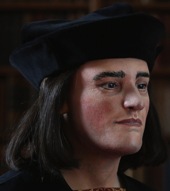
 Helen Cox, the author of the forthcoming new evaluation of the Battle of Wakefield (see here), let us know that a half-hour programme on the Battle of Towton has just been broadcast on BBC 1, as part of a series called ‘A History of the World’. Helen and a number of other Towton Battlefield Society/Frei Compagnie re-enactors feature in this programme.
She also informed us that the programme would be available on the BBC iPlayer (here). We were so thrilled to think that now we would also be able to watch programmes like this, but alas the BBC iPlayer for TV is available to the UK only. Why this discrimination?
Tomorrow, 20 May, BBC2 will broadcast in its ‘History Cold Case’ series a programme on the skeleton of a man found at Stirling Castle who died after a jolly joust. That would also be interesting, if only we could watch it!
Recently the National Geographic Channel commissioned a series called The Mystery Files, which is also showing on this channel here in Australia. The objective of the series is to re-examine the legends surrounding a number of famous and infamous figures from history.
One episode, entitled Royal Murder, is of particular interest to Ricardians as it deals with the Princes in the Tower. As the Chairman of the Richard III Society, Dr Phil Stone, informed us the Society assisted with background information as well as suggesting a number of academic contacts who could be interviewed. One of those chosen to take part was Lynda Pidgeon, whom we all know as the research officer of the Society.
Phil emphasised what a refreshing change it was to come across a popular programme maker prepared to examine historical events with an open mind rather than accepting the usual premise and twisting the facts to fit.
The programme has been screening on the National Geographic Channel in Australia for a while, the next showing is due on Monday 24 May 2010 at 14h30. If you do not have access to Pay TV, don’t despair. Phil has kindly send a copy of the DVD of the episode to our branch and members (of the NSW and QLD branches) are welcome to borrow it from Julia.
You can find out more on the Mystery Files website or check the time of the next showing on the Australian National Geographic Channel website.
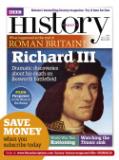 The March issue of the BBC History Magazine has finally arrived on Australian shelves. As I had heard that it contains extensive coverage of the new location of the Battle of Bosworth it was impatiently awaited. So when I popped into my local newsagent the other day, the first thing that caught my eye was the picture of our man – Richard III – on the cover of the magazine.
The magazine shows the most important finds like the silver gilt boar badge, which might show the area where Richard fell, as well as others. There is also a discussion about the use of guns in the battle and a description of how the actual location was found (with maps).
Other articles which caught my eye in the magazine is an evaluation by Leanda de Lisle (The Sisters Who Would Be Queen) of Jane Grey, where the author argues that it was her firm religious stance that sealed her fate. Linda Porter examines the relationship between Henry VIII and his last wife, Katherine Parr. And there are several articles covering the 16ooth anniversary of the end of Roman Britain in 410 AD.
This issue is certainly well worth buying and keeping.

A recent article in The Australian (1) alerted me to a new production of Shakespeare’s Richard III by the Melbourne Theatre Company, which according to the reviewer is outstanding.
So I decided to find out a bit more. Instead of setting it in a historical context (and as the historical accuracy of the play is questionable at best, this makes a lot of sense), the play takes place in the boardrooms of the corporate world. “Set as a contemporary political thriller, this gripping production dissects the corruption of power in testing times; when peace is abandoned and enemies mount in the minds of the paranoid.”(2) Should politicians like George W Bush come to mind when watching the “spin and chicanery” in this performance this is not unintentional, the director Simon Phillips explains. He does, however, not limit the analogy to one particular politician, as ”A lot of politicians try to hide their dirty laundry in the same way that Richard does, someone with ‘neither pity, love nor fear’.”
The director did intentionally not set the play in a totalitarian state as it was often done, as this “allows people to put everything at arm’s length from contemporary life because nobody identifies with them today. But I believe the play has so much to offer the modern sensibility.” (3)
In line with the modern setting the media are playing the role of the nobles of the play, while Buckingham is Richard’s ruthlessly ambitious PR man. However, the stage belongs to Richard, as it should in this play, and it is him that the audience is interested in, as one reviewer says “we can’t but be moved by him”.
I particularly liked the comment on Richmond’s overthrow of Richard: “his [Richmond’s] promises of peace uneasily echo Richard’s empty words at the beginning of his reign, hinting that the cycle of violence is by no means over.”(4) Whatever your opinion of the historic Richard, these words are certainly true for the historic Richmond (ie. Henry Tudor).
The play runs until 12 June – maybe we should consider a little trip south?!
Notes:
1. The Australian.
2. Melbourne Theatre Company.
3. The Age.
4. The Australian.
Posted by: Dorothea Preis Tags: Family
John Ashdown-Hill, responsible for Branch and Group Liaison of the Richard III Society, informed us that the annual commemoration of Richard III’s and Anne Neville’s niece, Blessed Margaret Pole (Margaret of Clarence, Countess of Salisbury), will this year be held in the chapel of Farleigh Hungerford Castle, Somerset at 6 pm on Saturday 29 May.
He also told us that a film has been made about Margaret’s life. The DVD runs for 30 minutes and is priced at £9.99. It is called BLESSED MARGARET POLE and is available from a Catholic film company, Mary’s Dowry Productions. So far we haven’t heard from any one who has seen this film, but it certainly sounds interesting. For more information and a preview of the film click here.
 This year marks the 550th anniversary of the death of Richard Duke of York and his son Edmund Earl of Rutland at the Battle of Wakefield on 30 December 1460. Though they were initially buried at Pontefract, their bodies were later exhumed and brought in with great ceremony to Fotheringhay.
Chief mourner at this procession was the Duke’s youngest son Richard Duke of Gloucester (later Richard III). He rode at the head of his father’s effigy, followed by the lords of the land, including the Earl of Northumberland, Lord Stanley and Lord Welles. They were to stay with the body throughout, attend all the services and masses en route, and have the privilege of standing and kneeling within the barriers of the hearse. The courtege was also accompanied by officers at arms, the kings of arms and many poor men on foot. The procession travelled along the Great North Road (now A1) and rested overnight at Doncaster, Blyth, Tuxford le Clay, Newark, Grantham, Stamford and finally at Fotheringhay. At night sixty men with torches kept guard around the hearse.
This year Wakefield Historical Society will retrace that journey on the anniversary dates of 21st-29th July. Each day will include visits to places of interest and a chance to walk some stretches of the original route. Each evening will include a performance of a medieval Vespers of the Dead, in the church where the body rested if possible, as well as a talk by an invited lecturer.
You can find out more on the fascinating webpage of the Wakefield Historical Society. You can order the book by Anne F Sutton & Livia Visser-Fuchs The Reburial of Richard Duke of York, 21-29 July 1476, which is mentioned on the webpage, from the Richard III Society (go to ‘Publications’, then ‘Books, Monographs and Booklets’, then ‘Books by the Richard III Society’).
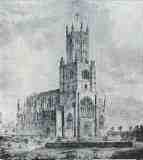
The above illustration is a drawing of Fotheringhay Church c. 1850.
 This is the title of an exhibition which opens on 17 May at Lambeth Palace’s Great Hall. It celebrates the 400 years since the library’s beginning in 1610. However, also much older documents will be exhibited.
The library owns its origins to Richard Bancroft, an Archbishop of Canterbury, who bequeathed his extensive collection of books, both printed and manuscripts, to his successors forever. Lambeth Palace is the official residence of the Archbishop of Canterbury.
Among the highlights of the exhibition are:
- A Gutenberg Bible (Mainz, 1455), the first book printed in Western Europe from movable metal type
- The 12th century Lambeth Bible, regarded as one of the monuments of Romanesque art
- The 9th century Macdurnan Gospelbook, manufactured in Ireland during the early Middle Ages and owned by King Athelstan of Wessex (reigned 924-939), a masterpiece of Insular book production
- Some unique witchcraft tracts
- A letter issued by Pope Leo X in 1516 for the rebuilding of St Peter’s in Rome
- A copy of the warrant for the execution of Mary Queen of Scots and an accompanying letter from the Privy Council
- Papers relating to the divorce of King Henry VIII and Catherine of Aragon
However, the most fascinating exhibit for Ricardians will be King Richard III’s Book of Hours, a 15th century manuscript, which was in his tent at the Battle of Bosworth on 22 August 1485.
If you find yourself anywhere near London during the period 17 May to 23 July 2010, this is a must-see exhibition. It is a great pity that London is a bit too far for a casual outing for us from down-under, as this event would fit in perfectly as a follow-on to our mini-conference on 15 May, the topic of which will be ‘Books and Bookmakers’.
For further information click here and here.
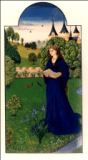
Illustration: Queen © Andrew Jamieson, www.medieval-arts.co.uk

Happy Easter!
In Richard’s time Easter was equally important as Christmas. It came after the six weeks of Lent, a period of fasting, when people had to go without foodstuffs like meat and eggs. Obviously their chickens were not aware of this and continued to lay eggs. These were boiled and put aside for children to search and find them on Easter morning. This tradition represented how the disciples were looking for the risen Jesus in his grave. Richard and Anne’s son Edward would probably have enjoyed an Easter egg hunt, possibly followed by a game of egg rolling. Though these would have been real eggs, not the candy variety most children today regard as Easter eggs.
Easter Sunday would start with a church service at dawn, a tradition which is still alive in many churches, after which everyone was looking forward to a hearty meal and a day off work. Probably Richard would have invited his friends, families and servants to a special feast at Middleham.
We would like to wish all our readers a very happy Easter. We hope you enjoy the holidays and look forward to a free day and a feast.
Note: For more information click here.
 The March edition of the Ricardian Bulletin contains a note about a cheese called “King Richard III”. Apparently it is like a very creamy Wensleydale cheese with a wonderful mellow taste. It is a cow’s milk cheese with a mild flavour with a slight bite.
Wouldn’t it be a Ricardian gourmet experience if we could team up this cheese with some of our South Australian ‘Battle of Bosworth’ wines from McLaren Vale? These wines get their name from the family name of the owners of the estate, Bosworth, and remember the battle where “the last of the Plantagenet Kings, Richard the III, was slain by Henry Tudor, becoming the last king of England to die in battle”. This historic battle is combined with their “modern day Battle of Bosworth [which] saw us convert our ‘Edgehill’ vineyard to organic viticulture nearly 10 years ago” (Battle of Bosworth Wines website).
For our Ricardian meal the ‘White Boar’ has just the right ring to it. Such an international culinary combination would make a meal fit for a king.
To find out more about Battle of Bosworth wines click here.
And to read up on King Richard III cheese click here.
The recent discovery of the actual site of the Battle of Bosworth made headlines around the world. It now seems that we might also have to rethink the location of the Battle of Barnet.
The Battle of Barnet was fought on Easter Sunday, 14 April 1471, between Edward IV, who had returned from exile in Burgundy, and the Yorkists on the one side, and the Earl of Warwick and the Lancastrians on the other. This was the first battle in which the then 18 year-old Richard, Duke of Gloucester, fought and some think that he commanded the vanguard. Visibility was greatly reduced due to a thick mist. This mist seems to have lasted until the present, because the exact location of the site is still being disputed. The reason is that so far no archaeological evidence has been found, possibly because researchers were looking at the wrong spot and had concentrated on the registered site in Hadley Green. Read the rest of this entry »