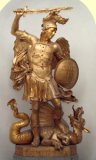
Today is Michaelmas, or the day of St Michael and All Angels. This is one of the feast days which are often mentioned in medieval sources as it used to be one of the quarter-days in England. By Michaelmas the harvest had to be completed, so it became the day when rents had to be paid, magistrates and councils were elected and on manors the peasants elected a reeve. It was also a Holy Day of Obligation, meaning the faithful were obliged to attend mass.
The date of Michaelmas, 29 September, is about the time of the (northern hemisphere) autumn equinox, when the nights were getting longer and Michael came to be seen as the protector against the forces of the dark. Many monasteries and churches, often near the sea, were dedicated to him.
Michael is one of the archangels and his name means “Who is like God?”. St Michael is said to be the captain of the heavenly armies and is therefore generally pictured in full armour, carrying a lance and with his foot on the neck of a dragon (based on Revelation 12, 7). You can distinguish him from St George, who is often shown in a similar pose, by his wings.
The traditional meal for Michaelmas would be roast goose. The geese had fed on the stubble of the fields after the grain had been harvested. In some places there was also a tradition of special large loaves of bread just for this day. Carrots were a traditional accompaniment to the goose.
Michaelmas Term is still the name of the first term of the academic year at many British universities and some schools.
As an illustration for this day I simply couldn’t resist the photo of a statue by Wilhelm Rottermondt (1701 – 1755) of the Archangel Michael at my alma mater, Bonn University, and therefore is of personal significance.
Bibliography:
“Michael and All Angels”, The Mission of St. Clare, accessed 21 Sept.2010
“Michaelmas”, Alice’s Medieval Feasts & Facts, accessed 21 Sept. 2010
“Michaelmas Day”, The Old Foodie, accessed 21 Sept. 2010
“September, 29th”, Hillman’s Hyperlinked and Searchable Chamber’s Book of Days, accessed 21 Sept. 2010
Photograph of St Michael at Bonn University taken by Michael Jaletzke; obtained through Wikimedia Commons.
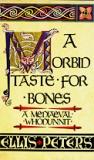 Birth of Edith Pargeter, author of historical and detective fiction.