Posted by: Dorothea Preis in News
 This is the title of an exhibition which opens on 17 May at Lambeth Palace’s Great Hall. It celebrates the 400 years since the library’s beginning in 1610. However, also much older documents will be exhibited.
The library owns its origins to Richard Bancroft, an Archbishop of Canterbury, who bequeathed his extensive collection of books, both printed and manuscripts, to his successors forever. Lambeth Palace is the official residence of the Archbishop of Canterbury.
Among the highlights of the exhibition are:
- A Gutenberg Bible (Mainz, 1455), the first book printed in Western Europe from movable metal type
- The 12th century Lambeth Bible, regarded as one of the monuments of Romanesque art
- The 9th century Macdurnan Gospelbook, manufactured in Ireland during the early Middle Ages and owned by King Athelstan of Wessex (reigned 924-939), a masterpiece of Insular book production
- Some unique witchcraft tracts
- A letter issued by Pope Leo X in 1516 for the rebuilding of St Peter’s in Rome
- A copy of the warrant for the execution of Mary Queen of Scots and an accompanying letter from the Privy Council
- Papers relating to the divorce of King Henry VIII and Catherine of Aragon
However, the most fascinating exhibit for Ricardians will be King Richard III’s Book of Hours, a 15th century manuscript, which was in his tent at the Battle of Bosworth on 22 August 1485.
If you find yourself anywhere near London during the period 17 May to 23 July 2010, this is a must-see exhibition. It is a great pity that London is a bit too far for a casual outing for us from down-under, as this event would fit in perfectly as a follow-on to our mini-conference on 15 May, the topic of which will be ‘Books and Bookmakers’.
For further information click here and here.
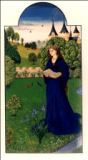
Illustration: Queen © Andrew Jamieson, www.medieval-arts.co.uk
Tags: Books, Bosworth, Richard III
 Next Saturday, 10 April 2010, our April General Meeting will be taking place at our usual venue, the Sydney Mechanics’ School of Arts. The speaker will be Kevin Herbert asking “What’s in a Name?”
And the names are ones we know well: Richard and Duke of Gloucester, and it is an absorbing survey of people throughout history – with royal connections – who have been called Richard or ennobled by the title Duke of Gloucester. What a tragic, haunted lot these characters were! And how different from the present day shining example set by the Society’s Patron HRH Richard, Duke of Gloucester.
Kevin gave this talk (although abbreviated) at the Perth convention last year.
Looking forward to seeing you on Saturday at 2 pm.
Tags: NSW Branch
Posted by: Dorothea Preis in News

Happy Easter!
In Richard’s time Easter was equally important as Christmas. It came after the six weeks of Lent, a period of fasting, when people had to go without foodstuffs like meat and eggs. Obviously their chickens were not aware of this and continued to lay eggs. These were boiled and put aside for children to search and find them on Easter morning. This tradition represented how the disciples were looking for the risen Jesus in his grave. Richard and Anne’s son Edward would probably have enjoyed an Easter egg hunt, possibly followed by a game of egg rolling. Though these would have been real eggs, not the candy variety most children today regard as Easter eggs.
Easter Sunday would start with a church service at dawn, a tradition which is still alive in many churches, after which everyone was looking forward to a hearty meal and a day off work. Probably Richard would have invited his friends, families and servants to a special feast at Middleham.
We would like to wish all our readers a very happy Easter. We hope you enjoy the holidays and look forward to a free day and a feast.
Note: For more information click here.
Tags: Holiday, Medieval Life
Posted by: Dorothea Preis in News
 The March edition of the Ricardian Bulletin contains a note about a cheese called “King Richard III”. Apparently it is like a very creamy Wensleydale cheese with a wonderful mellow taste. It is a cow’s milk cheese with a mild flavour with a slight bite.
Wouldn’t it be a Ricardian gourmet experience if we could team up this cheese with some of our South Australian ‘Battle of Bosworth’ wines from McLaren Vale? These wines get their name from the family name of the owners of the estate, Bosworth, and remember the battle where “the last of the Plantagenet Kings, Richard the III, was slain by Henry Tudor, becoming the last king of England to die in battle”. This historic battle is combined with their “modern day Battle of Bosworth [which] saw us convert our ‘Edgehill’ vineyard to organic viticulture nearly 10 years ago” (Battle of Bosworth Wines website).
For our Ricardian meal the ‘White Boar’ has just the right ring to it. Such an international culinary combination would make a meal fit for a king.
To find out more about Battle of Bosworth wines click here.
And to read up on King Richard III cheese click here.
Tags: Food & Drink
Posted by: Dorothea Preis in News
 The recent discovery of the actual site of the Battle of Bosworth made headlines around the world. It now seems that we might also have to rethink the location of the Battle of Barnet.
The Battle of Barnet was fought on Easter Sunday, 14 April 1471, between Edward IV, who had returned from exile in Burgundy, and the Yorkists on the one side, and the Earl of Warwick and the Lancastrians on the other. This was the first battle in which the then 18 year-old Richard, Duke of Gloucester, fought and some think that he commanded the vanguard. Visibility was greatly reduced due to a thick mist. This mist seems to have lasted until the present, because the exact location of the site is still being disputed. The reason is that so far no archaeological evidence has been found, possibly because researchers were looking at the wrong spot and had concentrated on the registered site in Hadley Green. Read the rest of this entry »
Tags: Barnet, Battles, Edward IV, Richard III, Wars of the Roses
Just a short reminder that this coming Sunday, 21 March, we will be commemorating the death of Queen Anne. We are meeting at 12.15 at the Duke of Gloucester at the corner of Frenchmans and Clovelly Road in Randwick. Looking forward to seeing you there.
Posted by: Dorothea Preis in News
Not much on the face of it, that’s why an article mentioning both aroused my curiosity. It’s on a blog called Conservative History Journal. The blogger’s political convictions do not come into this article, so any Ricardian, irrespective of your own political sympathies, can enjoy its message on King Richard III.
The blogger, who calls himself Tory Historian, tells us that he went a while ago to Leicester to visit an exhibition of German Expressionist works and also explored the city. While we know that the city of York remembered with “great heaviness” “our good king Richard [who was] piteously slain and murdered”, we learn that King Richard III also enjoys a lot of loyal following in the city where his body was taken after the Battle of Bosworth. We don’t know where the body ended up after the dissolution of the monasteries and it might have been “thrown into the ditch just outside [the city] in the charming way those Tudors behaved”. Ricardians can surely share that sentiment towards the Tudors! Read the rest of this entry »
Tags: Art, Bosworth, Henry Tudor, Richard III
Posted by: Dorothea Preis in News
In January the team of conservators at Salisbury Cathedral, Wiltshire, made a surprise discovery: when removing the Henry Hyde Monument from a wall in order to repair and clean it, they found hidden behind the monument the remains of some beautifully written English text. The monument marks the grave of Sir Henry Hyde, who was executed in 1650 by Parliament for supporting King Charles I and was erected soon after 1660.
There are several lines of a large textual inscription, which had subsequently been whitewashed over making it difficult to read but the good gothic lettering is clearly visible. Due to the age of the monument the writing was originally thought to be from the 16th century, when the nave was fitted out with high pews for people to sit in to listen to the ‘new’ sermons preached there. Inscriptions of the bible, the Word of God, would have been written on the inside walls of the building following the Reformation, having been translated into English in Cranmer’s bible. Read the rest of this entry »
Tags: Church, Medieval Life
As newcomers to the Richard III Society my husband and I are still learning the basics of the 15th century milieu, and the lore surrounding Richard Plantagenet, Duke of Gloucester. Having read two Ricardian books together, The Sunne in Splendour by Sharon Penman and Josephine Tey’s The Daughter of Time, we were very sympathetic to a man treated unjustly over 500 years ago, and had wanted to join with others to learn more about him and celebrate the known achievements of his brief reign. Read the rest of this entry »
Tags: Richard III, Sources
Posted by: Dorothea Preis in News
The Times informed us today that the real location of the Battle of Bosworth has finally been uncovered. Today it was revealed that the battle took place “round the back of Alf Oliver’s arable farm, just off the old Roman road from Atherstone to Leicester in a field as featureless as any in England”. The newly identified site is approx. 2 miles from the Bosworth visitor centre on Ambion Hill. To get there you drive south and west from the visitor centre, passing a farm enterprisingly selling “battlefield beef”.
Glenn Foard, the archaeologist who headed the team searching for the true battlefield site, explained: “My best guess is that Richard’s last charge came down the Roman road there”, pointing to where occasional cars passed one side of the field. “He is then driven back into the mire and killed somewhere near here.”
Mr Foard also showed a gilt solid silver boar, which was found by Carl Dawson, a retired university lecturer with a metal detector. Only 1½in (38mm), it is a thing of beauty: a snarling beast rippling with muscle definition and with gilded highlights on its tusks, tail and bristles. As we know, the boar was the emblem of Richard III. Only one similar one is known, in the British Museum. He went on to point out: “If we were looking for any artefact at all and if there’s any location we might want to find that artefact, then it’s the white boar badge of Richard III next to the marsh. This is almost certainly from a knight in Richard’s retinue, who rode with him to his death on that last charge.”
Following the article are several comments on it. Two are particularly poignant pointing out how different history would have unfolded had Richard III won the day instead of the usurper Henry Tudor.
So now we know where “on this day [22 August 1485] was our good king Richard piteously slain and murdered to the great heaviness of the city [of York]”.
Loyaulte me Lie.
Note: read the full article from The Times as well as the comments here. You can watch a video of the site on the BBC website, which also includes a picture of the found boar badge and a map showing the new location. Thank you to our friends from the American branch for bringing this to our attention.
Tags: Bosworth, Henry Tudor, Richard III