 We first heard on the Ricardian grapevine about a new analysis the Battle of Wakefield and a fresh perspective on Richard of York’s final battle on 30 December 1460. The book by Helen Cox is due to be published later this month.
On her website Helen tells us that historians have for a long time tried to reason why the Duke of York would have taken on the much stronger Lancastrian forces in this battle. Some believe that the Duke was reckless and stupid, an ageing commander past his prime who made a bad decision – or that he charged out in blind fury because the enemy had sent heralds to insult him. Others think he made a heroic but futile attempt to rescue some of his foragers who were under attack; or that he didn’t realise how big the Lancastrian army was, because many of their troops were cunningly hidden in nearby woodland, waiting to charge out and ambush him.
Helen says that she has never been convinced by these theories, which aren’t well supported by contemporary reports of the battle. So in The Battle of Wakefield Revisited she has tried to pull together and re-examine all the surviving historical and archaeological evidence relating to the encounter. She promises us a far simpler and more plausible explanation of why the Duke of York rode out to face his enemies that day.
The book will be launched on 31 May 2010 at Mickelgate Bar in York. Helen and her husband Mick will be there in costume to sell and sign copies. What a pity that we won’t be able to join them!
So we contacted Helen, to find out how we would be able to get hold of copies of this fascinating new study. She informed us that the book will be available online from York Publishing Services £12.00 sterling plus p+p (at today’s exchange rate approx. Aus $20 plus p+p).
She also told us that writing the book was a real labour of love for the past 18 months. She is fortunate enough to live only a mile from the Duke of York’s castle at Sandal, so she regularly visits it and often thinks of him and her favourite of his sons. And I’m sure you can all guess who that is!
Keep an eye on Helen’s website for further information and developments.
Tags: Battles, Books, House of York, Richard Duke of York, Richard III
We just heard from Joan Szechtman that her book This Time was named finalist in the General Fiction/Novel category for the 2010 Next Generation Indie Book Awards.
Congratulations, Joan! We are thrilled for you.
This nomination is very well deserved indeed. We hope that it helps to promote the real Richard III as well as Joan’s book.
For a review of This Time have a look on our Bookshelf in the Ricardian Library or click here.
Tags: Books, Richard III
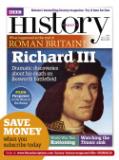 The March issue of the BBC History Magazine has finally arrived on Australian shelves. As I had heard that it contains extensive coverage of the new location of the Battle of Bosworth it was impatiently awaited. So when I popped into my local newsagent the other day, the first thing that caught my eye was the picture of our man – Richard III – on the cover of the magazine.
The magazine shows the most important finds like the silver gilt boar badge, which might show the area where Richard fell, as well as others. There is also a discussion about the use of guns in the battle and a description of how the actual location was found (with maps).
Other articles which caught my eye in the magazine is an evaluation by Leanda de Lisle (The Sisters Who Would Be Queen) of Jane Grey, where the author argues that it was her firm religious stance that sealed her fate. Linda Porter examines the relationship between Henry VIII and his last wife, Katherine Parr. And there are several articles covering the 16ooth anniversary of the end of Roman Britain in 410 AD.
This issue is certainly well worth buying and keeping.
Tags: Battles, Henry Tudor, Richard III
Skipton Castle in North Yorkshire (for a map, click here) is of special Ricardian relevance for me because this is where I first heard of the existence of the Richard III Society. However, that is not the only connection between the castle and Richard III – it actually belonged to him.
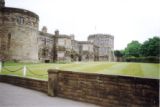
Skipton Castle (photograph by Dorothea Preis)
The history of the castle goes back to William the Conqueror, who granted the land around Skipton to Robert de Romille, who built the first wooden castle on this site. A castle at Skipton is first mentioned in 1130. The wooden structure was replaced by a stone castle between 1194 and 1241. Read the rest of this entry »
Tags: Castles, Richard III, Yorkshire
Posted by: Dorothea Preis in News
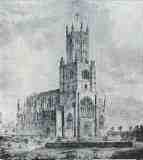 This year marks the 550th anniversary of the death of Richard Duke of York and his son Edmund Earl of Rutland at the Battle of Wakefield on 30 December 1460. Though they were initially buried at Pontefract, their bodies were later exhumed and brought in with great ceremony to Fotheringhay.
Chief mourner at this procession was the Duke’s youngest son Richard Duke of Gloucester (later Richard III). He rode at the head of his father’s effigy, followed by the lords of the land, including the Earl of Northumberland, Lord Stanley and Lord Welles. They were to stay with the body throughout, attend all the services and masses en route, and have the privilege of standing and kneeling within the barriers of the hearse. The courtege was also accompanied by officers at arms, the kings of arms and many poor men on foot. The procession travelled along the Great North Road (now A1) and rested overnight at Doncaster, Blyth, Tuxford le Clay, Newark, Grantham, Stamford and finally at Fotheringhay. At night sixty men with torches kept guard around the hearse.
This year Wakefield Historical Society will retrace that journey on the anniversary dates of 21st-29th July. Each day will include visits to places of interest and a chance to walk some stretches of the original route. Each evening will include a performance of a medieval Vespers of the Dead, in the church where the body rested if possible, as well as a talk by an invited lecturer.
You can find out more on the fascinating webpage of the Wakefield Historical Society. You can order the book by Anne F Sutton & Livia Visser-Fuchs The Reburial of Richard Duke of York, 21-29 July 1476, which is mentioned on the webpage, from the Richard III Society (go to ‘Publications’, then ‘Books, Monographs and Booklets’, then ‘Books by the Richard III Society’).
The above illustration is a drawing of Fotheringhay Church c. 1850.
Tags: House of York, Richard III, Wakefield, Wars of the Roses
Posted by: Dorothea Preis in News
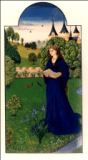 This is the title of an exhibition which opens on 17 May at Lambeth Palace’s Great Hall. It celebrates the 400 years since the library’s beginning in 1610. However, also much older documents will be exhibited.
The library owns its origins to Richard Bancroft, an Archbishop of Canterbury, who bequeathed his extensive collection of books, both printed and manuscripts, to his successors forever. Lambeth Palace is the official residence of the Archbishop of Canterbury.
Among the highlights of the exhibition are:
- A Gutenberg Bible (Mainz, 1455), the first book printed in Western Europe from movable metal type
- The 12th century Lambeth Bible, regarded as one of the monuments of Romanesque art
- The 9th century Macdurnan Gospelbook, manufactured in Ireland during the early Middle Ages and owned by King Athelstan of Wessex (reigned 924-939), a masterpiece of Insular book production
- Some unique witchcraft tracts
- A letter issued by Pope Leo X in 1516 for the rebuilding of St Peter’s in Rome
- A copy of the warrant for the execution of Mary Queen of Scots and an accompanying letter from the Privy Council
- Papers relating to the divorce of King Henry VIII and Catherine of Aragon
However, the most fascinating exhibit for Ricardians will be King Richard III’s Book of Hours, a 15th century manuscript, which was in his tent at the Battle of Bosworth on 22 August 1485.
If you find yourself anywhere near London during the period 17 May to 23 July 2010, this is a must-see exhibition. It is a great pity that London is a bit too far for a casual outing for us from down-under, as this event would fit in perfectly as a follow-on to our mini-conference on 15 May, the topic of which will be ‘Books and Bookmakers’.
For further information click here and here.
Illustration: Queen © Andrew Jamieson, www.medieval-arts.co.uk
Tags: Books, Bosworth, Richard III
Posted by: Dorothea Preis in News
 The recent discovery of the actual site of the Battle of Bosworth made headlines around the world. It now seems that we might also have to rethink the location of the Battle of Barnet.
The Battle of Barnet was fought on Easter Sunday, 14 April 1471, between Edward IV, who had returned from exile in Burgundy, and the Yorkists on the one side, and the Earl of Warwick and the Lancastrians on the other. This was the first battle in which the then 18 year-old Richard, Duke of Gloucester, fought and some think that he commanded the vanguard. Visibility was greatly reduced due to a thick mist. This mist seems to have lasted until the present, because the exact location of the site is still being disputed. The reason is that so far no archaeological evidence has been found, possibly because researchers were looking at the wrong spot and had concentrated on the registered site in Hadley Green. Read the rest of this entry »
Tags: Barnet, Battles, Edward IV, Richard III, Wars of the Roses
Posted by: Dorothea Preis in News
Not much on the face of it, that’s why an article mentioning both aroused my curiosity. It’s on a blog called Conservative History Journal. The blogger’s political convictions do not come into this article, so any Ricardian, irrespective of your own political sympathies, can enjoy its message on King Richard III.
The blogger, who calls himself Tory Historian, tells us that he went a while ago to Leicester to visit an exhibition of German Expressionist works and also explored the city. While we know that the city of York remembered with “great heaviness” “our good king Richard [who was] piteously slain and murdered”, we learn that King Richard III also enjoys a lot of loyal following in the city where his body was taken after the Battle of Bosworth. We don’t know where the body ended up after the dissolution of the monasteries and it might have been “thrown into the ditch just outside [the city] in the charming way those Tudors behaved”. Ricardians can surely share that sentiment towards the Tudors! Read the rest of this entry »
Tags: Art, Bosworth, Henry Tudor, Richard III
 As newcomers to the Richard III Society my husband and I are still learning the basics of the 15th century milieu, and the lore surrounding Richard Plantagenet, Duke of Gloucester. Having read two Ricardian books together, The Sunne in Splendour by Sharon Penman and Josephine Tey’s The Daughter of Time, we were very sympathetic to a man treated unjustly over 500 years ago, and had wanted to join with others to learn more about him and celebrate the known achievements of his brief reign. Read the rest of this entry »
Tags: Richard III, Sources
Posted by: Dorothea Preis in News
The Times informed us today that the real location of the Battle of Bosworth has finally been uncovered. Today it was revealed that the battle took place “round the back of Alf Oliver’s arable farm, just off the old Roman road from Atherstone to Leicester in a field as featureless as any in England”. The newly identified site is approx. 2 miles from the Bosworth visitor centre on Ambion Hill. To get there you drive south and west from the visitor centre, passing a farm enterprisingly selling “battlefield beef”.
Glenn Foard, the archaeologist who headed the team searching for the true battlefield site, explained: “My best guess is that Richard’s last charge came down the Roman road there”, pointing to where occasional cars passed one side of the field. “He is then driven back into the mire and killed somewhere near here.”
Mr Foard also showed a gilt solid silver boar, which was found by Carl Dawson, a retired university lecturer with a metal detector. Only 1½in (38mm), it is a thing of beauty: a snarling beast rippling with muscle definition and with gilded highlights on its tusks, tail and bristles. As we know, the boar was the emblem of Richard III. Only one similar one is known, in the British Museum. He went on to point out: “If we were looking for any artefact at all and if there’s any location we might want to find that artefact, then it’s the white boar badge of Richard III next to the marsh. This is almost certainly from a knight in Richard’s retinue, who rode with him to his death on that last charge.”
Following the article are several comments on it. Two are particularly poignant pointing out how different history would have unfolded had Richard III won the day instead of the usurper Henry Tudor.
So now we know where “on this day [22 August 1485] was our good king Richard piteously slain and murdered to the great heaviness of the city [of York]”.
Loyaulte me Lie.
Note: read the full article from The Times as well as the comments here. You can watch a video of the site on the BBC website, which also includes a picture of the found boar badge and a map showing the new location. Thank you to our friends from the American branch for bringing this to our attention.
Tags: Bosworth, Henry Tudor, Richard III