Another talk which was presented at the NSW Mini-Convention in May 2010.
 One of my volunteer jobs is to sort and price donated books for Lifeline Northern Beaches Bookfairs. I love the serendipity of it and was delighted one day to come across a modern rendering of William Caxton’s The Description of Britain which was originally published in 1480. I thought “Wow – this came out and was for sale during the lifetime of our Richard when he was Duke of Gloucester. It contains a general view of the Britain with which Richard would have been familiar.
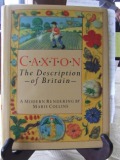
The book that I have was translated into modern English by the University of London’s Marie Collins and was published in 1988 by Guild Publishing by arrangement with Sidgewick & Jackson. Virginia Davis, also from the University of London. provided the background to the historical sources of The Description of Britain. Caxton was not the author of the book’s content but based it on a 14th century Middle English translation of part of the Latin Polychronicon meaning many stories or a universal history. Polychronicon was written by a monk at St Werburgh’s Monastery in Chester by the name of Ranulf Higden who was arguably the most knowledgeable and well read chronicler of the period. As the monk who was in charge of the monastic library and scriptorium at his Benedictine Monastery, Higden had access to a vast number of manuscripts.
In turn he derived his information from earlier surviving writers such as Gildas (c.490 to 570), Bede (c.673 to 735), William of Malmsbury (c. 1095 to1143), Geoffrey of Monmouth (c. 1100 to 1154) and Gerald of Wales (c. 1145 to 1214). The works of most of these writers are currently available in modern English from Penguin books. The Description of Britain also refers to the Domesday Book, William the Conqueror’s great survey of the land-owning and agricultural resources of England.
Very few medieval books could be described as the work of only one author. Modern scandals and lawsuits about literary plagiarism would have struck Caxton and his contemporaries as eccentric. Indeed the acknowledgement and quoting of the respected authorities gave a new work added weight and status.
Originally, Higden’s work would have circulated primarily in monastic circles by way of copied manuscripts but its fame grew quickly and the Polychronicon became widely popular. The popularity of medieval works in the days before printing can be measured by the number of manuscripts which survive and this yardstick reinforces other evidence for the popularity of the Polychronicon. It was so popular that Edward III summoned Higden to appear at the royal court in 1352.
The dissemination of this work was further increased from 1387 when an Oxford scholar named John Trevisa translated it into English. Book 1 of the Polychronicon was a miscellany of information concerning Britain. As well as history, it included geographical and topographical information, architectural descriptions and stories of miracles and wonders.
Caxton did rearrange the chapters of Book 1 into a logical order so as to produce a coherent structure.
Caxton’s production of The Description of Britain was a business venture to exploit that new technology of the day, the printing press. Caxton’s selection and arrangement of material is fascinating because it tells us what he, as an astute businessman, thought English readers wanted to know. It is a mixture of fact and fiction, of myth and legend, of knowledge and of invented explanations of the inexplicable. It also gives us an idea of what the intelligent and literate late medieval Englishman or woman knew of their country. And The Description of Britain was a considerable financial success.
In his preface, Caxton explains that whilst a number of the common chronicles of England have been printed at Westminster and elsewhere there exists no description of this island and “its nobility and excellence are not well known, I therefore intend to give in this book the description of Britain and its attributes”.
The Description of Britain is divided into 29 chapters. The first fifteen chapters deal with Britain and England, names which are frequently used interchangeably, chapters 16 to 20 deal with Wales, Scotland has only chapter 21 to itself but does get a mention in some of the chapters on Britain, and Ireland is described in chapters 22 to 29. I think that Scotland’s problem was that it wasn’t visited and written about by Gerald of Wales.
Some chapters are extremely short, almost as if they are the outline of an idea waiting to be fleshed out. For example Chapter 8 is entitled Famous Rivers and Streams but says that three famous rivers run through Britain; by way of them merchants from overseas come by ship to Britain from all kinds of nations and countries. These three rivers are the Thames, the Severn and the Humber. And that is it – no other rivers and no streams. The longest chapter is that on Bishoprics and Sees which is perhaps unsurprising considering the number of clerics responsible for the book’s contents.
Of all the groups of people discussed in The Description of Britain, the Britons receive the greatest coverage and most of it favourable. Higden, in Chapter 14 entitled “The Number and Kinds of People Who Have Inhabited Britain” states that the Britons first inhabited this island in the eighteenth year of the Prophet Eli, or in the eleventh year of Silvius Posthumus, King of Latium, that is forty three years after the destruction of Troy. Chapter 12 states that the Kingdom of Britain remained undivided as a single kingdom for the Britons from the time of the first comer, Brutus, until the time of Julius Caesar.
The Romans receive surprisingly little coverage considering they occupied a large part of Britain for some four hundred years. Chapter 12 notes that this land was a tributary of Rome from the time of Julius Caesar to that of Serverus but later they ceased to reign in this country because it was far from Rome and because of the considerable trouble they had in other areas. The Romans would have been much chagrined by Chapter 7’s description of the King’s Highways. These are named as the Fosse Way, Watling Street, Ermine Street and Icknield Way and are attributed to Belinus, son of Moliuncus, thirteenth king of the Britons.
The Scots and Picts are not so well regarded. They are seen as responsible for breaking up the undivided Kingdom of Britain by making war on the country with a great force of men of arms for a long time. In Chapter 14, Gerald of Wales describes a later falling out between the Scots (originally from Ireland) and the Picts. He says that the Scots who had come with the Picts, saw that the Picts were nobler in heroic deeds and finer fighters, though they were fewer in number than the Scots. Then the Scots, made envious by that, turned to their native treachery which they often practised. They invited all the Pictish leaders to a feast and when they were merry and had drunk a great deal, they fell upon them and killed them. The Scots profited by this false act of treason for they took the whole county calling it Scotland after themselves.
The Saxons are viewed in a fairly neutral way although it is acknowledged that they took over the land after the Britons had asked for their help to deal with attacks from the Scots and the Picts, and drove the Britons to the west of the country. According to Alfred of Beverley, the Danes subsequently harried the country for about two hundred years from the time of King Egbert to that of Saint Edward.
The Normans are not mentioned often and not in a positive way. In Chapter 9, for example, which deals with Ancient Cities and Towns, William of Malmsbury tells us that York is a great city on both sides of the River Ouse. It looked as beautiful as Rome until King William the Conqueror destroyed it and the surrounding countryside with fire and flame, so that a pilgrim seeing it now would weep if he had known it in former days. In Chapter 13 on Bishoprics and Sees, Higden makes the point that at the beginning of Holy Church in England, bishops ordained their sees in lowly simple places suitable for contemplation, prayers and devotion, but in the time of William the Conqueror it was proclaimed by decree of canon law that bishops should come out from small towns into great cities. And so the see of Sherbourne was moved to Salisbury, that of Selsey to Chichester and so on.
Higden describes the Welsh as the noble race descended from Priam’s blood following the tradition that the Britons were descended from displaced refugees from Troy. However, the Irish, says Gerald of Wales are the descendents of Noah’s grandchild, Casera. In Chapter 27 which deals with The Nature and Ways of the Irish they are given a really bad press. Solinus says that the people of this country are barbarians, prone to aggression and great fighters. They wear primitive clothing, do very little work and are poorly supplied with provisions. Moreover they do not use saddles, boots or spurs but urge on their horses with a rod trimmed at the upper end. Despite all the listed shortcomings of the Irish, Solinus does concede that they are very skilled musicians.
Whilst the English are seen to have many positive virtues, Higden notes that they practise gluttony, they despise what is theirs and praise what belongs to others and are scarcely ever pleased or content with their own condition. They are blundering and hasty before the deed and wiser after it.
All the countries in The Description of Britain enjoy productive agricultural activities to a greater or lesser degree. Chapter 3 describes “Britain’s Excellence and Attributes” and quotes Bede’s observations that Britain is pre-eminent in bringing forth trees, fruit, cattle and beasts and in some places vines grow. According to William of Malmsbury, there is a great abundance of small fish, salmon and eels – so much in fact that in some places people feed their swine with fish. A now unknown writer named Basileus says that this island is rich in veins of metal such as brass, iron, lead, tin and silver. Caxton, with his background as a merchant notes that Flanders greatly prizes the wool of this country and Holland the skins and pelts all kinds of animals.
Chapters 4, 20 and 28 describe “The Marvels and Wonders of Britain, Wales and Ireland” respectively, but of all the wonders listed the principal ones readily recognised by us today are the hot wells at Bath, Stonehenge on the Salisbury Plain, the mountains of Snowdonia and Glendalough around the oratory of St Kevin. An example of one of the marvels is William of Malmsbury’s statement to take heed of what great radiance of God’s mercy has been vouchsafed to the English since they turned to the true faith, so that amongst no people in any region are there found so many human bodies undecayed after death. An interesting snippet from Chapter 6 examining “Britain’s Adjacent Islands” is Gerald of Wales story that there was once a dispute as to whether the Isle of Man belonged to Ireland or Britain. So poisonous snakes were taken over there and because they survived, the island was deemed to belong to Britain. Chapter 11 discusses the “Laws and their Names” and it is fascinating to see the names and the purpose. For example Stallage – a customary extraction for a place in the street during a fair, Schewing – this regulates the display of merchandise and Forstalling – this governs the penalty for injury or hinderance perpetrated on the King’s highway.
Chapter 15 discusses the languages of Britain and outlines a debate which resonates down to the present day. John Trevisa comments that after the Black Death, a schoolmaster called John Cornwall altered the practice of grammar-school teaching and substituted construing in English for construing in French. Now in 1385, other schoolmasters follow his practice. They have abandoned all use of French in schools and always practice construing in English. In one respect they gain an advantage, namely that children learn their grammar more quickly, but in another way there is a disadvantage; for now they neither learn nor know any French which is a hindrance for people who have to travel overseas. Neither Ranulf Higden nor William Caxton write about contemporary events or society. Marie Collins contends that Higden’s interests were in the origins of Britain not in contemporary 14th century society but I suspect that both men felt on safer ground to stick with the dim, distant past.
To conclude I will quote Caxton’s own epilogue, “Here ends the Description of Britain containing England, Wales and Scotland. Because Ireland is under English rule and has remained so for a very long time I have added its description to that of Britain. I have taken the whole from the Polychronicon of Ranulf Higden. Because it is necessary for all Englishmen to know the special nature, endowments and marvels of these countries, I have printed them, following the translation of John Trevisa, who at Lord Berkley’s request translated the entire Polychronican into English. This was finished by me, William Caxton, on the eighteenth day of August in the year of our Lord God 1480, in the twentieth year of the reign of King Edward the Fourth”.
Tags: Books
Leave a reply