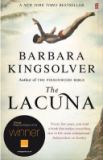
 Barbara Kingsolver, The Lacuna. Faber and Faber Ltd, London, 2010. ISBN 9780571252671 (pbk)
Barbara Kingsolver has written another great book. She is an author with an amazing ability to whisk the reader away to another time and place, and once the reader is there they become totally engrossed.
Her previous novel The Poisonwood Bible was the story of an American missionary who drags his wife and daughters to the African Congo, amid the turmoil and bloodshed of the 60s, where he tries to enforce his religious beliefs upon the native population, who have their own gods and idols, and resent his sermons and interference.
Her new novel is set in Mexico in the late 30s and 40s and is the story of a young boy, Harrison, and his flighty mother who uproots him from his home in Washington DC to follow her current paramour to his hacienda on a small island off the Mexican coast. The boy is encouraged by his mother to keep a journal of his travels and so he begins a series of notebooks and diaries.
After several of his mother’s affairs end in disappointment they travel to Mexico City, where the boy Harrison finds himself working as a plaster mixer and later as cook and typist to the household of artists (and communists) Diego Rivera and his wife Frida Kahlo, who become his second family.
When his friend and mentor Leon Trotsky, who was seeking political asylum in Mexico and staying with his friends the Riveras, is brutally assassinated in their home, Harrison flees back to the US, only to find himself, due to his friendship with Trotsky and the Riveras, embroiled in the McCarthy era ‘Reds under the Beds’ witch hunt.
By this time he has become a popular author, drawing on his affection for and knowledge of Mexico, creating stories of the ancient Mayan civilisations, but the continuing harassment and threats of treason and possible imprisonment force him to flee once again, back to Mexico.
The unfolding story is told through his stenographer and friend, Violet Brown, and through Harrison’s notes and diaries that he kept as a boy and continued as a young man. But that’s another story in itself!
For some time I have read much fiction and non-fiction, most but not all of it historical, dealing with the Wars of the Roses and English royals, so when a friend lent me this book it was a nice change.
I found this book a very enjoyable read and hard to put down and recommend it highly.
Leave a reply