This is the third part of Win’s talk about Scotland which was presented to our Branch on 9 October 2010.
James III of Scotland reigned 1460-88. He cultivated friendship with England by a marriage being arranged between his son James later IV and Edward IVs 3-year-old daughter the Lady Cecilia. This marriage did not take place as it was cancelled by Edward IV.
 James IV of Scotland
When negotiations broke down skirmishing broke out between the two countries. Read the rest of this entry »
This is the second part of Win’s interesting talk presented to our Branch on 9 October 2010.
On February 4th, 1818, a group of distinguished men, including the Lord Provost of Edinburgh, Senior Legal Representatives, the Commander in Chief of the Army and Sir Walter Scott, the poet and author, gathered outside the sealed door of the Crown Room in Edinburgh Castle.
Scott’s pleas to the Prince Regent, later George IV, had resulted in a Royal Warrant permitting him and Officers of the State to open the Crown Room. Masonry was removed from the doorway. Inside was a great oak chest.
They approached it apprehensively because there was a strong suspicion that the chest would be empty and that the Honours had been spirited away. Read the rest of this entry »
This is the first part of the fascinating talk Win presented to our Branch on 9 October 2010.
The Stone of Destiny and the Honours of Scotland that is the present Regalia have separate histories as they were never used together in a coronation.
The Stone of Destiny is the block of sandstone on which the ancient Kings of Scotland were crowned at Scone until it was stolen by King Edward I who took it to London where it was housed in Edward the Confessor’s chair until it was returned in 1996 except for a brief period in 1950 when four young Scottish Nationalists repossessed it.
The myth of the origin of the Stone is traced back to Biblical times when it is supposed to have been the pillow on which Jacob rested his head when he dreamed of the angels climbing up their heavenly ladder. It was acquired by Scota, daughter of a Pharaoh of Egypt and brought to Ireland and then to Scotland by Kenneth M’Alpine who became King of the Picts and Scots in 843 AD. Read the rest of this entry »
It is amazing how sometimes strands of seemingly unrelated interests come together. This happened when I was planning a trip to Europe for next year to attend the “Blood and Roses” Special Interest Weekend in Oxford in March, an event at Christ Church College in association with the Richard III Society. Afterwards I was thinking of spending a few days in Germany visiting sites of personal interest, after all I would be in the area, so to speak.
During my recent research into St Albans I had read that a church in Cologne is said to hold relics of St Alban.[1] At the time I didn’t pursue this any further, but now that a visit to Cologne is on the cards I decided to find out more. Read the rest of this entry »
Historical novelist Felicity Pulman gave this delightful talk at the one day convention of the NSW Branch of the Richard III Society in Sydney on 15 May 2010. You can find out more about Felicity here.
Richard III was the last of the Plantagenet line, whereas my sphere of interest and expertise lies with the progenitors of the line: the Empress Matilda, daughter of Henry I, and her second husband, Geoffrey of Anjou, he who wore the planta genet, the sprig of broom in his hat that served to name a dynasty.
Let me start with a brief history. Matilda was born in 1102. Henry’s son, William, heir to the throne of England, was born in 1103. But he drowned in the White Ship disaster in 1120, leaving Matilda as Henry’s only legitimate heir. Read the rest of this entry »
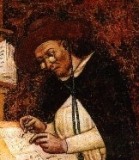 Tommaso da Modena, Hugh of Provence (1352)
Recently Susan Higginbotham of the American Branch of the Richard III Society made a remark that Robert Dudley, Earl of Leicester, purchased a number of pairs of “spactakells” for himself during the years 1584 to 1586.[1] Reading this, squinting at my computer screen because I had forgotten my own reading glasses somewhere else, made me wonder whether Richard III approx. 100 years before Dudley would have had access to glasses. He might very well have needed them, had he been allowed to grow old. Presbyopia, where the ability to focus on near objects is diminished, is one of the symptoms caused by the natural course of aging.[2] Read the rest of this entry »
Following the reference to Cerne Abbas by Sir Frederick Treves in his book Highways and Byways of Dorset, Ricardians will be interested in this comment about another Dorset village.

Bloxworth Church (© Copyright John Lamper and licensed for reuse under this Creative Commons Licence.)
Sir Frederick, after some kindly comments about the little church in the village of Bloxworth, goes on to make some not so kindly ones about one of its former rectors.
A very famous rector of Bloxworth was John Morton, Cardinal Archbishop of Canterbury in the time of Henry VII. For a prelate, he led a most adventurous life, not without the usual episodes of imprisonment in the Tower and flight to Flanders. He comforted Edward IV when that king lay dying, and was the stoutest advocate of Henry’s marriage to Elizabeth of York, whereby the red rose and the white became blended in the rose of Tudor. As Bishop of Ely he takes his part in Shakespeare’s play of Richard III, wherein occurs “the incident of the strawberries”, as described by Sir Thomas More, once a page in his household.
Describing how the Duke of Gloster [sic] had asked Morton for some strawberries from his garden at Holborn, Sir Frederick tells that the Bishop replies, ‘Gladly my lord quoth he, would God I had some better thing as ready to your pleasure’.”
Sir Frederick’s comment: “These are indeed ready words for a crafty plotter like the Bishop, who wished the Duke of Gloster [sic] to perdition, and who had no “better thing” in store for him – if he had his way – than the dungeon or the headsman’s axe.”
Bibliography:
Sir Frederick Treves, Bart. GCVO, CB, LL.D, Highways and Byways of Dorset. Macmillan & Co. Ltd, 1906. No ISBN.
A yummy Scrabble Talk on the letter “O”.
 The 14th August meeting – and my scrabble letter talk drawing nigh – I was visited with inspiration when Kim brought home some oranges in the shopping. Could this fruit be the basis of a talk?
My research revealed that oranges are first heard of growing wild in China and later cultivated there, from where they found their way to India. The Moors are thought to have planted oranges across North Africa in the first century AD. Oranges were also known to the Romans, who imported the young trees to the port of Ostia. But with the fall of Rome in the fifth century AD, the Roman trade and cultivation of oranges died out for centuries. Read the rest of this entry »
Another Scrabble talk in form of a PowerPoint presentation, this time on the letter “T”.
 Treason doth never prosper, what’s the reason?
For if it prosper, who dare call it treason.*
* Sir John Harington, Epigrams
Origins in Roman and Germanic Law
• Treason Laws in England in the later middle ages had roots in Germanic and Roman Law
• German – betrayal or breach of trust by a man against his lord (treubruch). Direct lord rather than hostility towards the king
• Roman – insult to those with public authority (maiestas – greatness, dignity, majesty)
• Concepts that were inherited from the Roman concept: Read the rest of this entry »
The following was presented as a PowerPoint presentation as a Scrabble talk for the letter – yes, you guessed it! – “H”.
 Questions?
• What did the church have to say about those concepts?
• How did the laity imagine heaven and hell?
• How the great schism influenced the system of beliefs?
• Who went to heaven and who went to hell?
• How did those concepts influence political decisions?
• What other concepts were available?
• Should Richard III have been afraid to where he would end up in the after life?
• Should Henry the VII have been afraid to where he would end up?
• Could you choose where you ended up? Read the rest of this entry »