Archive for the ‘Greyfriars Dig’ Category

ArchaeologyIt seems to be purely by luck that the archaeologists carrying out the dig at Leicester were able to find human remains, which are likely to be those of Richard III,  at all, as they could easily have been destroyed in Victorian times.  It has recently emerged that the head of the remains was found just inches below Victorian foundations.

Site director Mathew Morris said:  “If the Victorians had dug down 30 cm more they would have built on top of the remains and destroyed them.”

The Mayor of Leicester City, Sir Peter Soulsby added:  “They obviously did not discover anything and probably would not have been aware of the importance of the site… If their plans had been just a little different, they could have destroyed a most significant historic find.”

Further information:

Victorian builders came within inches of destroying Richard III bones’, Science Blog.

Body found in Richard III search was almost destroyed’, Science on NBC News.com (16 October 2012).

The Richard III Society has awarded Philippa Langley the Robert Hamblin Award, which was established in 2002 to recognise work of outstanding service by a member.  In addition, she was awarded honorary life membership in recognition of the particular merit of the Greyfriars Dig.

We would like to congratulate Philippa on these awards.  Our branch would like to join all Society members world-wide in thanking her for her tireless work in making this dream come true.

You can read the Press Release of the Richard III Society here.

6
Oct

Media Eye View

   Posted by: Julia Redlich Tags: , ,

Many Ricardians from the New South Wales Branch have been inundated inrecent weeks with cuttings from the UK press and guides to websites.  “ Did you know about this?” is a frequent question and we have kindly replied that “Yes, we did” and refrained from pointing out that even in the southern hemisphere we have internet access, over and above the constant stream of information provided by our contacts in the UK.

However, accompanying article titles on the lines of “we had a hunch it was Richard” only emphasised the opinion of the general public who until now have relied on Shakespeare and Sir Thomas as relaying the gospel truth.  So when you find a headline such as “Was Shakespeare right about the Killer King?” and “The Truth about the Bard’s hunchbacked despot” you can’t blame the sinking of the hearts of countless Ricardians.

Happily in this case we have nothing to fear:  In an article in the UK Daily Express dated 13 September  2012, Julie Carpenter kicks off by saying that Richard has always had a bad press and it is all Shakespeare’s fault and, because “ it is a cracker of a play, it is regularly performed”.  Then she does a swift recap of recent productions that revealed him as bleach-blond psychopath, slithery reptilian brute, and limping menace with a metal leg brace.

So she welcomes the news of the dig at Leicester that may shed more light on the real Richard – or at least make people think more carefully about the damning press he has suffered over the centuries.  She has great quotes from those involved who, by coincidence or deliberate care at their christenings by parents with foresight,  are named Richard.  They includeRichard Taylor of the University of Leicester whose archaeologists discovered the skeleton – “The search for King Richard III has taken a dramatic new turn”.

This is followed by a complimentary look at the Richard III Society, whose belief in the need for the King’s reputation to be rehabilitated, backed up by our Patron HRH Prince Richard, Duke of Gloucester.  Then some great comments from Richard van Allen, the Society’s public relations officer who succinctly sums up the Tudor line of thought,  “Henry Tudor wasnot directly inline and killing a king was a fairly heinous crime  … TheTudors were always very aware that, if you like, they had stolen the throne.”  Hence the anti-Richard propaganda plans.

Richard van Allen also denies that Polydor Vergil’s description of Richard being “little of stature, deformed of body” has no foundation.  “From the age of about 14 he was an active soldier … He was the last warriorking and the lastking of England to lead histroops into battle.”

As for the Princes in the Tower:  “there are many theories but nothing can be proved academically,” says Richard van Allen.  “We don’t actually know what happened to them… Lots of people had a good reason to kill them.”  He also comments on Richard’s concern regarding the laws of the land and his beginning of overhauling them.  “He had the potential to be a very good king”.

He goes on, “Even if the newly unearthed bones are not his, we hope this discovery will attract more interest in Richard and have people asking `what was he like?’  It gives us a chance to say that we have lots of academics of medieval history who overturn the view that he was a villainous murderer.”

That said, it is such a shame that the main illustration for this article is of Kevin Spacey lurching villainously across the stage epitomising the ill-informed general opinion of the last Plantagenet king.  The portrait of Richard, the one with which all Ricardians are so familiar, is a small inset.  I longed to see that someone had selected a picture of the statue in Leicester’s Castle Gardens that shows Richard III as a splendid soldier and upright king.

Loyaulte me lie

PS Perhaps I am too harsh about Killer King and Hunchbacked Despot headlines! A career on countless magazines from high gloss fashion to celebrity gossip has seen me write similar headlines and intros to attract unsuspecting readers and draw their attention to the excellent informative main story.  Let’s hope it works here and introduces more people to the Man Behind the Myth.

You may remember the guest post about the dig in Leicester by Sally Henshaw, the Secretary of the Midlands East branch of the Richard III Society, from about 2 weeks ago.  Sally returned for another visit to the site, after the skeleton was found, and has kindly sent us some photographs of special relevance with the find.

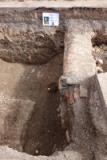
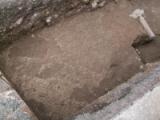
Place where the male skeleton was found between the yellow markers. The head was at the marker at the front of the photo facing the picture of Richard III (facing east). (© Sally Henshaw)


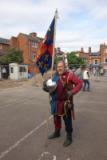
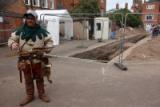
Yorkist retainers keeping watch. (© Sally Henshaw)

The dig and its findings are based on the research by John Ashdown-Hill, which he published in his book The Last Days of Richard III.   It was fitting that it should have been him, who removed the excavated bones from the site. [according to an article in the Daily Gazette, see here]

In the meantime, while we are all waiting for the results of the DNA tests, the Australian media seem to have lost interest in the findings, but not so in the UK, where arguments about where Richard should be re-interred (provided it is established that it is him, of course) and with what kind of ceremony are going backwards and forwards.   I just hope they decide on a place that is quieter and more dignified than Westminster Abbey, though that is where his wife, Queen Anne Nevill, is buried.  I visited the church this July and was fairly horrified – it was not a church but some sort of theme park.

16
Sep

Pause for thought

   Posted by: Dorothea Preis Tags: , , ,

While we are waiting for the outcome of the DNA analysis, it seems to be the right time for some reflection.   This has been the most exciting time for any Ricardian or anyone interested in the period.   We would like to thank everyone concerned, the University of Leicester, Leicester City Council and the Richard III Society for making this investigation possible.  Our special thanks go to Philippa Langley of the Society, whose determination made her dream become reality.

Thanks also go to our friends on the Society Yahoo group, who posted a link to the full 35 minute video on You Tube of the press conference at Leicester, held on 12 September 2012.  This is an unlisted video, but as Richard Taylor of the University of Leicester tweeted the link, I suppose I can share it here.

15
Sep

No, not a hunchback!

   Posted by: Dorothea Preis Tags: , , , ,

It’s good to see that the news about the discovery in Leicester of a skeleton which might indeed be the remains of Richard III (subject to DNA testing) are getting quite a bit of exposure in the Australian media.  Our branch received a few requests for radio interviews and so far we found the interviewers interested in hearing our side of the story.

However, readers who live in the Sydney area, might have seen yesterday’s article in the Sydney Morning Herald with the headline ”Hunchback skeleton may be good fit for a king”.  A friend phoned me to talk to me about a similar article in the Australian (which I don’t read), so the story about the ”hunchback king” seems to have done the rounds.

Wednesday’s press release from the University of Leicester explicitly stated that the man, whose remains they had found, was not a hunchback.  He suffered from scoliosis, a sideways curvature of the spine, which would be hardly noticeable on a clothed person.  Above all it is very well possible for someone with scoliosis to be athletic, which a medieval soldier definitely had be, and Richard was an acknowledged good soldier.  I read that Usain Bolt has scoliosis – hardly the misshapen cripple of Shakespeare’s play.

Well, to cut a long story short, I was pretty annoyed with the story in the SMH.  Sufficiently annoyed to write a letter to set the record straight.  And I am glad that my letter was accepted for publication.  You can read it on the letters’ page of today’s paper or on the digital version here (you have to scroll down a bit).

No, I never thought Richard was a hunchback and if this skeleton is indeed his (and I think that there is a very good chance that it is), then it proves that he was not a hunchback.

12
Sep

Is it Richard?

   Posted by: Dorothea Preis Tags: , , ,

I have been following the press conference at Leicester on Twitter and this report is based on their tweets.  You can also read them on the update from the University of Leicester.

The press conference revealed that two skeletons were found, one of them was female and thus obviously not Richard III.  The male skeleton was found in the choir area, where according to historical records Richard was buried.

This skeleton appears to have suffered significant peri-mortem trauma to the skull, which would be consistent with an injury received in battle, and a metal arrowhead was found between vertebrae of the upper back.   It was near the spine, but not actually embedded in bones.

The man, whose skeleton it is, had spinal abnormalities, but was not a hunchback.  It would be consistent with severe scoliosis, where the spine is curved from side to side [Wikipedia].

The next step is to try to extract DNA from the bones to match it to the DNA of the man, who is descended in the all female line from Richard’s sister.

Philippa Langley of the Richard III Society stated that the aim of the “project has always been about finding out about the real man, not the Tudor myth”.

The findings so far look extremely promising, but DNA analysis will give us the truth at last.  Truth is indeed the “Daughter of Time”.

Editor’s Comment: Sally Henshaw, Secretary of the Midlands East Branch of the Richard III Society, send us the following guest post on the archaeological dig in Leicester.   She and Richard Smith, Chairman of the Midlands East Branch, had the opportunity of a private tour of the site.

Richard Smith and I went to see the dig yesterday and Philippa Langley of the Richard III Society showed us round. We also had a few words with Richard Buckley, lead archaeologist of the project, who we know, as he has given talks to our branch on several occasions.

I took photographs of the first and second trenches as Philippa explained what things were (see below).

Unfortunately we were not allowed to see the third trench as they are working on that one at present. They have found a medieval coin, but as yet have not been able to date it. They have also found pieces of medieval stained glass and brightly painted floor tiles. They hope the choir of the church (where Richard was buried) is located in the car park where they are now digging and not under the building (although it may be possible to dig a trench if it is) It would be awful to have come so far only to find that the part we really need to get at is under a building.

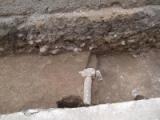
Trench 2:  internal cloister walkway showing the herring bone pattern (© Sally Henshaw)

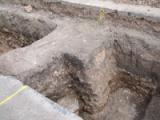
Trench 2: The white part is a rounded step which they are calling the Leicester Step at present, as no one has seen anything quite like it before. (© Sally Henshaw)

Trench 1:  showing where the all cuts across (© Sally Henshaw)

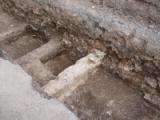
Trench 1:  the white area is a bench they found where the monks would have sat in the chapter house (© Sally Henshaw)

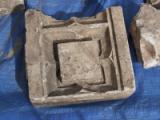
Window tracery (© Sally Henshaw)

Frieze on a choir stall, early perpendicular (?) (© Sally Henshaw)

Plan of the dig (© Sally Henshaw)

12
Sep

Leicester Update 12.9.12

   Posted by: Dorothea Preis Tags: , , ,

Breaking News:

The University of Leicester has just a few minutes ago announced that human remains have been found at the archaeological dig in Leicester and they are talking about other “stunning discoveries”.

More details will be revealed at a press conference at 11 am (British time – that’s 20.00 EST) in Leicester.  Live coverage of whatever is announced will be available on Twitter @uniofleicester.  (Yes, I have just signed up to Twitter, something I never wanted to do, but for news like this it seems to be worth it.)

This find is truly “a dramatic new turn”, as Richard Taylor, Director of Corporate Affairs at the University of Leicester and one of the prime movers behind the project, said.

Philippa Langley from the Richard III Society said: “We came with a dream and if the dream becomes reality it will be nothing short of miraculous.”  How true!

9
Sep

Leicester Update 9.9.12

   Posted by: Dorothea Preis Tags: , , ,

Unfortunately I haven’t (yet?) got an eye witness report from any friend, who attended the open day at the dig in Leicester yesterday.  However, I found this post by Jonathan Calder on the Liberal England site, who has been posting about the dig regularly.  Enjoy!