
Archive for the ‘Greyfriars Dig’ Category

8
Sep

Leicester Update 8.9.12

   Posted by: Dorothea Preis Tags: , , ,

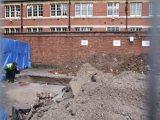
We are grateful to Sally Henshaw of the Midlands East Branch of the Richard III Society, who has kindly supplied us with the above photo, which she took through the barriers at the beginning of the dig.

Great news from Leicester:  archaeologists have found an area of paving, made up of re-used medieval tiles.  This is thought to be the garden of Robert Herrick.  Robert Herrick, alderman and sometime mayor of Leicester, bought the site of the Greyfriars after the dissolution.  Christopher Wren, the father of the architect who built for instance St Paul’s Cathedral, recorded that there was a stone pillar in Herrick’s formal garden with the inscription “Here lies the body of Richard III sometime King of England“.  It is assumed that the stone pillar was on the spot where the choir of the Greyfriars church had been.

The third trench meanwhile revealed large fragments of window tracery as well as bits of lead, as it would have been used in stained glass windows.  The archaeologists think that this might have come from the east window of the church, behind the high altar – which means near the choir, where Richard III was known to be buried.  This is really getting exciting.  To quote Richard Buckley, the lead archaeologist of the project:

Having overcome the major hurdle of finding the church, I am now confident that we are within touching distance of finding the choir – a real turning point in the project and a stage which, at the outset, I never really thought we might reach.

There is more good news.  Although the dig was supposed to finish on Friday, it has now been extended for at least another week, as the prospect of major discoveries becomes more and more likely.

6
Sep

Leicester Update 6.9.12

   Posted by: Dorothea Preis Tags: , , ,

The University of Leicester has confirmed that the church of the Franciscan Friary has been found.  The initial two trenches revealed tiled passageway floors, which are at right angles from each other.  This led the archaeologists to believe that these are remains of the cloister of the friary.  A cloister is a rectangular open space, which is surrounded by covered walkways, so that the monks would remain dry whilst walking around it.  One of the sides of the cloister would often be alongside a church.

On the third side of the cloister remains of a large, one and half metres thick wall were found, which the archaeologists thought could be the south wall of the church itself.  The third trench established that this wall continues and also found remains of a second wall approx. 7.5 metres to the north.   The space in between the two walls has a mortar floor, which was probably originally tiled.  These remains have been confirmed to be of the church.  As lead archaeologist Richard Buckley announced:

The next step – which may include extending the trenches – will seek to gain more information on the church in the hope that we can identify the location of the choir and high altar. Finding the choir is especially important as this is where Richard III is recorded as having been buried.

He admitted that before the dig started he was not all that confident whether they would even be able to find the Greyfriars, as their first trenches could easily have missed the remains, or any remains might have been destroyed by later building activity in the area.  It is certainly not only the team that is excited “by the prospect of further discoveries over the next week or so which may take us closer to our goal”.  I am surely not the only one who checks every morning whether there have been any new developments!

5
Sep

Leicester Update 5.9.12

   Posted by: Dorothea Preis Tags: , , ,

The interest in the dig at the Greyfriars site in Leicester has been unprecedented, not only locally or nationally, but also internationally (our website is a point in case).   In response to this interest the University of Leicester, together with the Richard III Society and Leicester City Council, have arranged an open day for Saturday, 8 September 2012.  The site will be open to the public between 11.00 and 14.00, admission is free and no advance booking is needed.  The search team and Richard III Society member Philippa Langley will be there to show visitors around the site.

Unfortunately for us in Australia it is a tad far to organise a trip to Leicester at such short notice (not to mention the expenses).  However, if any of our readers, and we know we have readers from all over the world, should be able to visit the open day, please do not hesitate to contact us, we would love an eye witness report!

4
Sep

Leicester Update 4.9.12

   Posted by: Dorothea Preis Tags: , , ,

Work at the dig in Leicester did not stop over the weekend.  A third trench, running in a north-south direction, has been dug.  This trench is in the car park of a former school, which is adjacent to the Leicester City Council Social Services car park.  However, I couldn’t help wondering when I saw the photo on the latest news update by the University of Leicester, whether the part of the church, where Richard III was buried, would not possibly turn out to be underneath the building.

Whether Richard’s remains are found or not, the insights the archaeologists gain on the Greyfriars site are fascinating.  At this stage, I am not sure what the plans for the site are, once the dig has been concluded.

1
Sep

Leicester Update 1.9.12

   Posted by: Dorothea Preis Tags: , , ,

As every morning I couldn’t wait today to visit the news update on the Greyfriars project in Leicester.  I was especially curious what the press conference yesterday would have brought.  So here is the latest:

Richard Buckley, the archaeologist leading the dig, stated that “Progress in our search for the body of King Richard III is exceeding our expectations. The first week could not have gone better.”

A part of a wall was found, which could have belonged to the church, but also medieval window tracery, fragments glazed floor tiles as well as of a stained glass window, which might have come from the cloisters walk.  According to the BBC, Richard Buckley concluded that

The dimensions of the walls and the association with certain building materials and tiled floors suggests we are looking at a religious house and a high status medieval building.

One of the walls in particular is getting on for two metres thick and it’s on an east-west orientation, so as far as we can tell, and its still early days yet, it might be one of the walls of the Greyfriars church and if that is the case, we are on the right track.

As at the start of the dig the archaeologists were not even sure, where exactly the friary might have been, this is certainly a find exceeding any expectations.

I have been interested in medieval ceramics for some time, so for me the floor tile fragment was of particular interest.  It is of a type which was limited to high-status buildings and was one of the indications that the discovered remains are those of the church.  A photo of the tile fragment on the page of the University of Leicester.

The team is planning to dig a contingency trench over the weekend to confirm that they have indeed found the church, which would give them a clearer understanding of where to look for Richard’s body.

However, even if the body of the king were not found, the dig is a tremendous boost for our understanding of the historic Leicester.  And as for Richard, it seems to help in publicizing a more balanced viewpoint of Richard III, as a recent article in the Catholic Herald in spite of certain shortcomings shows.

In the Southern hemisphere today marks the first day of spring (though present temperatures could have fooled me).   Maybe the winter of our discontent is over in more ways than the one Shakespeare thought.

31
Aug

Leicester Update 31.8.12

   Posted by: Dorothea Preis Tags: , , ,

It has been established that the remains of walls, which have been found during the dig, are indeed from the medieval period.  The next step is to establish the alignment of these walls.  However, otherwise there is “Relatively little to report right now. Richard III still dead”, as the update from the University of Leicester puts it – short and precise.

We are hoping for more info tomorrow, as there will be a press briefing at 11.00 (UK time) today, which means 20.00 EST in Australia.

ITV has also an interesting article and video on the dig on their webpage.  Their remarks on Richard’s supposed deformities are particular welcome.

30
Aug

Leicester Update 30.8.12

   Posted by: Dorothea Preis Tags: , , ,

Just heard on the trusted Ricardian grapevine – in this case the Facebook page of the Richard III Society – that due to all our emails urging them to make a documentary about the dig,  Channel 4 has changed its mind and is definitely filming the dig and the documentary will be aired in the UK later this year.

Maybe we could start a similar campaign to encourage our ABC (probably the most likely channel in Australia) to buy and show the documentary here.

A big “Thank you” to all our members and friends who contacted Channel 4!

Unfortunately the archaeologists at the dig were not yet able to assess the remains of walls, which were found on Tuesday, any further, as heavy rain stopped the work.

The University of Leicester has included some photos in its latest update on the dig.  You can find a link in their update of 29 August 2012.

29
Aug

Leicester Update 29.8.12

   Posted by: Dorothea Preis Tags: , , ,

The archaeological investigation of the site of the former Greyfriars in Leicester, where Richard III was buried, started at the end of last week.

The project started by using ground-penetrating radar to help find the best places to dig.  Over the weekend machinery was brought in to dig two trenches in the opposite direction of the where the walls of the church are expected to be (running west to east).  As with all archaeological digs, the most recently deposited material is on top, so the researchers will have to dig through several layers till they reach the one where the medieval church is expected to be.

Yesterday the University of Leicester announced that they discovered several remains, which are believed to be medieval walls, but this would need further assessment.  If these remains turn out to be from the walls of the church, this would give the archaeologists vital clues on where are the best places to dig.

The University also announced that the dig is being filmed for “a forthcoming Channel 4 documentary to be aired later this year”.  After the rather negative remarks most of us received when we send emails urging Channel 4 to make such a documentary, irrespective of whether Richard’s remains were found or not, this sounds more positive.

Keep up to date with the latest developments on site at the University of Leicester.

And last but not least, I would like a share cartoon with you which my Google Alert found for me.  Click here, but disregard the hump!

Today we have really exciting news for all our readers!

After being killed in the Battle of Bosworth by the invading forces of Henry Tudor, the body of King Richard III was brought back to Leicester and eventually buried at the church of the Greyfriars, a Franciscan Friary.  Over time the exact location of the friary was lost, but archaeologists think it might be under what is now a carpark.

After long planning, tomorrow, 25 August 2012, a dig is to start at the site to try and establish the exact location of the former Greyfriars church and to find any remains of those, who were buried in the church.

The dig is carried out in cooperation by the University of Leicester and Leicester City Council in association with the Richard III Society.  It is the first ever search for the lost grave of an anointed King of England.

The work of John Ashdown-Hill has established a descendant in the all-female line of Richard’s mother, Cecily of York, in Canada, whose DNA could be used to establish whether any remains are indeed those of the lost – but not forgotten – king.

For more information, as well as a call on Channel 4 to commission a programme on this historic dig, go to the What’s New page of our parent Society.  Please do support the campaign for the programme!

The official page on the project by the University of Leicester can be found here.

You can read a press release by Richard Buckley of the University of Leicester here.

The search for Richard’s DNA is explained in:  John Ashdown-Hill, The Last Days of Richard III.  The History Press, Stroud, 2010.  ISBN 978 0 7524 5404 7 – also available for Kindle