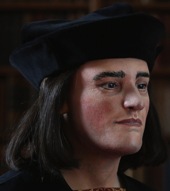
Further to my review of Richard III: The King under the Car Park, I just noticed that one of the authors, Richard Buckley, is one of the nominees for Archaeologist of the Year by the Current Archaeology magazine. These awards are voted for entirely by the public – there are no panels of judges. The vote is also open to non-UK residents, you can make your vote count here.
Archive for the ‘News’ Category
11
Dec
Loyaulté me lie
It is interesting to see what impact the discovery of Richard’s remains had on the arts. Those who attended the Australasian Convention will remember vividly Graham Keitch’s beautiful ‘In memoriam Ricardus Rex‘. However, he is not the only musician to be inspired by what happened in Leicester.
Some time ago, I had the pleasure to listen to a few songs about Richard III by a group called The Legendary Ten Seconds. These songs are part of their new album ‘Loyaulté me lie’, which can now be purchased in mp3 format.
The American branch of the Richard III Society wrote this for the sleeve notes:
In this brilliant collection of songs, the Legendary Ten Seconds reveal the unquenched fighting spirit of the House of York and the steadfast loyalty of Good King Richard. They also bring to life the haunting sadness of death itself. This album is indeed worthy of King Richard III’s motto.
The Richard III Society, American Branch. R3.org (November 2013)
Proceeds from the sale of the music will be donated to a scoliosis charity.
You can download the album from both Amazon.com and Amazon.co.uk or from iTunes.
While these are compositions by modern musicians, the York Waits have recorded a new album ‘The White Rose And The Red: Music From The Age Of Richard III‘ with music from Richard’s lifetime. As one of their members explains: “We know that the Duke of Gloucester, or Richard III as he became, was a cultivated man who employed musicians. “
You can order their new CD via their website.

Our guest speaker for our last meeting of the calendar year will be member Lynne Foley with a presentation about Medieval Jewellery. As it is our Christmas gathering, please bring a bread & butter plate of some Christmas food to share at afternoon tea.
Please note this will also be the last meeting that will be held at the Harry Jensen Centre in the Rocks. Starting in February 2014 we will be returning to the Sydney Mechanics Institute meeting rooms at 280 Pitt Street.
The December issue of the Ricardian Bulletin is starting to arrive in Australia! Congratulations to the Bulletin Committee on a wonderful new issue. Not only the contents are very appealing, but so is the new style with full colour throughout. And it got here extremely quickly, virtually at the same time as for members in the UK.
Hoping yours arrives soon, too. If you are a member of the NSW branch and have not received your copy by 14 December, please let me know at publications@richardiii-nsw.org.au.
Born within the sound of Bow Bells, Eileen became a Ricardian in 1955 after reading Historical Whodunits by Hugh Ross Williams, and she was one of the earliest members of the Sydney Branch around 1981 when the group met in committee members’ houses.
 Eileen performing a sketch (photo by I Martyn)
She had a tremendous sense of fun and 1983 saw the first comic sketch that we did together at the Commemoration Banquet in the Sydney School of Arts with Eileen Junoesque and magnificent in a long wine red velvet mantle and black hat. Other sketches and songs followed through the eighties and nineties including a forty-five minute off-schedule entertainment at the Australian and New Zealand Medieval and Renaissance Conference in Hobart, and a special performance of the ‘Oh no, Thomas More’ song for Professor Tony Pollard.
One of her most memorable roles was a party political broadcast as Boudicca sporting a pudding basin with horns, and carrying a spear. Oh yes, and a yellow wig as well! She also did a political speech as Lady Margaret Beaufort imitating the UK Prime Minister of the time with a Thatcheresque breathy voice. She very much enjoyed being part of Ye Kynge’s Syngers and she was also an eager participant in scenes from Shakespeare and other playwrights, organised by our actor member, the later Peter Ryan, with some of his fellow players.
Besides King Richard, Eileen’s other great passion was enjoying Shakespeare plays.
Despite being badly afflicted by rheumatoid arthritis in her hands and feet, and with responsibility every weekend for her Down Syndrome daughter, she nevertheless never let it stop her from attending meetings and dressing up for the medieval cabarets. Recently, she was delighted to know that some of the songs and sketches were still being used from time to time.
Eileen was 87 when she died at the retirement home on 9 November.
The documentary about finding the remains of Richard III is coming to Australia. It will be screened this Sunday, 20 October, at 20h30 on SBS One. If you have not yet watched the documentary, or would like to see it again, here is your chance.
The follow-up, Richard III: The Unseen Story will be shown the following week, Sunday, 27 October, an hour earlier at 19h30 on SBS One.
The Annual General Meeting of the New South Wales Branch of the Richard III Society was held on Saturday, 12 October 2013, at the Harry Jensen Centre.
Opening remarks were made by Chair Judith, with a review of the branch activities in the past year, a very exciting one for Ricardians. A warm welcome was extended to the new members and visitors present. Thanks were expressed for the work of all the committee members throughout the year, with gifts given to Julia and Kevin – both stepping down after many years of devoted contribution to the branch.
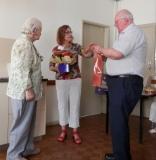
Thank you, Julia and Kevin, for many years of service to the branch!
Judy delivered her report as Treasurer about the financial success of the convention and good finances due to new members. Dorothea told us that the website is attracting more visitors than ever. Lynne reported on Sales. Julia presented her last report as Secretary, which included a look-back at some of the highlights of the branch activities over the past year.
The Committee then officially stepped down, and Carole facilitated the elections for all of the officers of the branch. A number of officers returned unopposed to their roles, including Judith as Chair, Judy as Treasurer, Dorothea as Webmaster and Editor of the Chronicles, Lynne as Sales Officer, and Rosemary as Tea Lady. New faces on the committee included Rachel as Secretary, Angela as Social Secretary, Leslie as editor of the Affinity newsletter, Joan as keeper of the portrait of Richard, and Jacqueline as Deputy Chair. (You can see some of the new – and old – faces here.)
Our scheduled guest speaker was unable to come, so our Chair Judith presented a talk about the innovations encountered by the medieval crusaders when they ventured east. They brought back with them a world of new ideas and treasures including glass, lacquer, porcelain, many new spices, gems like turquoise, pearls and jade, silks and satins, buttons, ivory and ebony, paper, poppy seeds and gunpowder, the concept of the musical scale, the idea of carrying banners and of decorating one’s horses. The works of the great Greek thinkers, such as Aristotle, had been lost with the fall of Rome and during the Dark Ages, but had been preserved by Arabic scholars. These works were now re-introduced to Western Europe, leading to great intellectual development in the 11th and 12th centuries. It was a wonderful talk, illustrated with exquisite examples of gems and objets d’art from Judith’s private collection.
Our next gathering will be our Christmas meeting scheduled for 14 December 2013, when Lynne will be speaking about medieval jewelry.
 The NSW Branch of the Richard III Society wishes to congratulate Dr John Ashdown-Hill, a key member of the Looking for Richard project, to being elected as a Fellow of the Royal Historical Society recently.
This announcement takes a well-deserved front page spot of the website of the Richard III Society.
John’s research was instrumental in establishing where Richard was buried and that his remains had not been thrown into the river Soar during the Reformation, the probable lay-out of the Greyfriars in Leicester and of course in establishing Richard’s mtDNA.
John explained his research at the conference on 2 March 2013 in Leicester, an unforgettable experience for many of us. If you could not be there in person, or would like to listen to John’s presentation again, you can do so here.
Helen Cox, author of two excellent books on the Battle of Wakefield, shares with us her views about the issue of where Richard should be reburied, While she brings some welcome balance to the controversy, we would like point out that these are her views and do not necessarily reflect the views of all members of the NSW Branch or even the Richard III Society as a whole.. We are very grateful to Helen for making this article, which was first published on her blog, Helen Rae Rants!, available to us. You can find out more about Helen on Herstory Writing & Interpretation.
As anyone watching the news, reading the press or visiting social forums will know, the discovery of Richard III’s remains under a car-park in Leicester last year has sparked a war of words as bitterly waged as any medieval battle. Practically from the moment his skeleton was unearthed, the tides of invective began to flow. An early target was Philippa Langley, a long-standing member of the Richard III Society whose years of research, lobbying and fund-raising had enabled the excavation project to go ahead in the first place. ‘Only in it to big herself up and get on TV,’ sniffed some folk of Ms Langley’s painstaking historical detective work. Hmm… is that the rank whiff of sour grapes I smell? Me, I think she deserves a medal for her efforts and the contribution she’s made to Ricardian history.
Worse was to come when the vexed question of where to re-inter the king’s remains arose. The poor Dean of York and President of the Richard III Society received abusive communications from the pro-York camp simply for trying to take a neutral, objective stance on the issue. The Chief Executive of the American Richard III Foundation was derided for her passionate advocacy of York because ‘what’s it got to do with Yanks, anyway?’ The Richard III Society was accused of Machiavellian plotting, cover-ups and withholding information from members. The motives of many individuals concerned with the project, including the Mayor of Leicester, were publicly impugned in such terms that it’s a wonder nobody ended up in court for slander or libel. Venom has dripped from the pages of Facebook and sundry news sites. Altogether, it hasn’t been pretty – and frankly, I’m amazed I’ve escaped the vitriol after some of the stuff I’ve blogged on here. (ie. Helen Rae Rants!)
But now, at last, someone has effectively presented the case for a York re-burial. Yes – in the latest Ricardian Bulletin, (journal of the Richard III Society), David Johnson lays out the reasoning in a well-researched, eloquent letter mercifully free from the inaccuracies and hysterical over-statements that have bedevilled the arguments of some other York supporters.
I might challenge his statement that there is an ‘overwhelming public view that Richard should be laid to rest in [York] Minster’. It depends on the public you’re asking. The Plantagenet Alliance’s on-line petition for a Parliamentary debate on the matter closed with 31,260 names – almost 70,000 short of the 100,000 it needed; another petition for a York re-burial closed with 31,340 names – I’d call that distinctly under-whelming. Meanwhile a rival petition for Richard III to remain in Leicester has 33,247 signatories with three days left yet to run… so I think it’s fairer to say that public opinion is divided.
Otherwise, David Johnson’s letter is highly persuasive. It draws on the Privy Seal Register and Fabric Rolls of York Minster to argue that Richard III’s intention to found a college for 100 chantry priests, with six altars erected within the Minster for their use, parallels his brother Edward IV’s creation of St George’s Chapel at Windsor, and for the same reason – to make a new royal mausoleum. That the sources contain no mention of a tomb, or plans for a chapel to house a tomb, can be explained by the fact that the project was still in its infancy at the time of King Richard’s death.
It’s the best justification I’ve yet seen, and Johnson may well be right that if Richard III had lived out his full span, he would have expected to lie in York Minster. However, one problem is that it still doesn’t prove this was the case; we’re still second-guessing the intentions of someone who died over 500 years ago. And what might those intentions have been on the eve of Bosworth? Richard had the advantage, the ordnance and the larger army of home-grown soldiers to pit against Henry Tudor’s Welshmen and foreigners. I assume he expected to win, kill his rival and hang on to his crown; but it would seem strange if a soldier so experienced in the uncertain fortunes of war hadn’t at least considered the alternatives: that the battle might be indecisive, leaving them both alive to re-group and continue the campaign; or that he would himself die, if not on the field then later, as a defeated captive.
What then of his posthumous fate? Could he trust a new regime to honour his last wishes, if he made them explicit – or to take spiteful pleasure in thwarting them? To what degree, under those circumstances, did Richard III actually care what became of his body, beyond a conventional hope that it would lie in consecrated ground rather than in a mass pit on the battlefield? If he made a will, or issued any form of instruction, it either has not survived or has not yet been found. If he did not, what does that say about his state of mind – that he was sublimely over-confident of victory? That he didn’t want to ‘tempt fate’? Or that if he could not live as King of England, he was not greatly concerned about anything else?
David Johnson ends his letter by saying, ‘one assertion we can make with absolute certainty is that Richard III never chose to be buried in Leicester’. Or can we? It may not have been a positive choice, but one by default; he may have assumed that, in the event of his death, he would end up in a nearby village churchyard (like Lord Dacre of Gilsland, killed at Towton and buried in Saxton) – or in the nearest major settlement to Bosworth…
Of course, I don’t know – but the point is, nobody knows, conjecture as we will. The only things I am certain of is that the battle for Richard III will go on, ironically fought by larger armies than he or any other king could have commanded at the time; and that whether the decision goes with Leicester Cathedral or York Minster, I’ll be shedding no tears (except a few for Richard himself) – I’m just too pleased that he’s going to get a proper tomb somewhere, at last.
 The AGM of the NSW Branch of the Richard III Society will be held on 12 October 2013 at 14h00 at our usual venue, the Harry Jensen Centre, 17 Argyle Street, Millers Point.
As it is every year, the AGM is your last opportunity to renew your subscription. If you haven’t renewed your subscription by sending your Renewal Notice and indication of payment (either by cheque or direct credit) to our treasurer Judy by Friday, 11 October 2013, you will be able to do in person at the AGM. Please make sure that you bring payment AND the filled in Renewal Notice with you.
There will be a few changes to the composition of the committee on the cards, with some members stepping down. We thank them for their tireless work on behalf of all of us. However, we also thank those, who have bravely put up their hands to become part of our branch committee.
And after all the housekeeping, there will be a fascinating talk. Unfortunately our scheduled speaker had to pull out at short notice, but Judith will come to the rescue and tell us about ‘Innovations of the Middle Ages’. This promises to be an interesting topic.
One innovation coming to my mind immediately is Johann Gutenberg and the printing press. We must not forget that Richard III was a strong supporter of printed books, as he explicitly exempted them from the import and export restrictions in the statutes of his only parliament. Incidentally the statutes of the 1484 parliament were not only the first to published in English, but also the first to be printed.
So come along and join us to decide on the future committee of YOUR branch and find out which innovations can be traced to the Middle Ages.
Most Society members should have received their September 2013 Ricardian Bulletin during the last days. Should your copy not have arrived by the AGM, please let our Bulletin coordinator Dorothea know.