Archive for the ‘News’ Category

10
Jan

RICHARD III ON THE ONE SHOW

   Posted by: Dorothea Preis Tags: , , ,

As announced yesterday, last night, or rather early this morning Australian time, The One Show on BBC 1 had a short item on the Greyfriars Dig.  Of course, as soon as possible I sneaked into the BBC iPlayer and watched the programme.  The format of The One Show is light early evening infotainment.  There was an item on car clampers in public car parks and another about an upcoming second series of a TV programme, but after about 20 minutes they came to the car park story I was interested in.

The item on Richard was presented by Dan Snow, who is referred to on the show’s website as “Our history man”.  Initially he had a short rather fat and bend-over man standing next to him, who was supposed to be Richard, so I started fearing the worst.  However, my fears were premature.  The programme itself was objectively presented, scoliosis was explained as a lateral curvature of the spine.  Dan first interviewed Richard Buckley, who explained where they found the remains.  He then had a chat with Michaeil Ibsen, Richard’s great great great …. nephew, at the Bosworth Battlefield Centre.  There were also some re-enactors fighting with each other, the one side proudly displaying their white boars, Richard’s emblem.

After the item the hosts of the show asked Dan of his opinion whether the remains were those of Richard.  Dan said that through his talks with the experts he had been convinced that it is indeed Richard.  He also mentioned that the Minister of Justice is supposed to announce next week, where Richard (if it is him) would be reburied.

Dan also said that Richard had had very bad PR and though “he may have had his nephews killed”, this was fairly insignificant compared to what other kings before and after him were up to.  He also stressed that Shakespeare painted Richard as dark as possible as he lived in Tudor times.

The whole segment finished with a short clip from Richard III with Laurence Olivier.

Though the programme did not offer any new insight to anyone who has been following the developments, it would have been a concise informative item for those who were not approaching it with any special interest.  However, The One Show is not aimed at medieval history buffs, so for its target audience it was not a bad programme.

10
Jan

PATIENCE, PLEASE!

   Posted by: Dorothea Preis Tags: , , ,

ArchaeologyThe University of Leicester has announced that the results of the test being carried out on the human remains found during the Greyfriars Dig will be published in the first week of February.

The tests are being concluded at present and will then be analysed.  A press conference by the University of Leicester has provisionally been scheduled for the first week of February to announce the conclusions of its investigations.

Though this is a bit later than we had maybe originally hoped, at least we now have an a bit more definite date.  The important thing is that the tests are done thoroughly and their results hold up to scrutiny in years to come.  Not that we end up with a situation like with the examination of the bones in Westminster Cathedral, claimed to be those of the Princes, where the results do not hold up to today’s scrutiny.

9
Jan

RICHARD III: HIS ACHIEVEMENTS AS KING OF ENGLAND

   Posted by: Dorothea Preis Tags: ,

Undoubtedly, once the test results of the human remains found during the Greyfriars Dig in Leicester have been announced, a renewed discussion of Richard III’s reign will break out.

In preparation for this, the Richard III Society has issued a Press Release on Richard’s ‘Achievements as King of England’.  It offers an interesting insight into how many of the legal issues we take for granted today go back to Richard’s short reign.  An example for this is shown in an article on ‘Richard III’s Effect on US Laws’.

If only all of our politicians were as genuinely interest in the law and a committed to the fair administration of justice for all!

You can find the Press Release here.

And the article on his effect on US Laws here (and thank you, Renate, for reminding me of this article!).

9
Jan

RICHARD III COMES TO THE BBC

   Posted by: Dorothea Preis Tags: , , ,

Our friends in the UK informed us that ‘The One Show‘ on BBC1 is scheduled to include an item about the Leicester Greyfrairs Dig at some stage during this week.  Unfortunately we do not know exactly when it will be screened, it might be in tonight’s show.

Unfortunately if you are not a resident of the UK, you cannot view BBC programmes on their iPlayer, unless you have a software that disguises your whereabouts (which is free to download off the internet).  It would be good, if we managed to catch it – or if our ABC finds it of sufficient interest to show it here.

5
Jan

TESTS, TESTS, TESTS

   Posted by: Dorothea Preis Tags: , , ,

While preparing a Ricardian Calendar entry about the death of Queen Eadgyth (on 26 January 946), I read again about all the tests which have been carried out on the remains of a woman found in 2008. Thinking of the tests being carried out on the skeleton found in Leicester, kindled my renewed interest in Eadgyth’s remains.

Eadgyth was the first wife of Otto I, king of the East Franks and later Holy Roman Emperor.  She was a daughter of Edward the Elder (870s?–924), king of the Anglo-Saxons.  She was born in Wessex, probably around 910, and married Otto in either 829 or 930.  After her death in 946, she was buried at Magdeburg Cathedral.

Her name is spelled in a number of different ways, one of them being Edith, and as I had an Aunt Edith (well, she was really my dad’s cousin), I will call her Edith in this post.

In late 2008 a lead sarcophagus was found in Magdeburg Cathedral with the inscription ‘Edit regine cineres hic sarcophagvs habet…’  (the salvaged remains of Queen Edith are in this sarcophagus…).  However, this sarcophagus and its inscription only date from 1510, 500 years after Edith’s death, and therefore some skepticism about the truth of this statement was indicated.   The tests have proven that they are most likely indeed those of the Anglo Saxon princess – and that without DNA analysis.

It has been established that the bones in the coffin all belong to the same person.  Unfortunately it is incomplete, the feet, parts of the hands and most of the skull, except for the upper jaw bone, are missing.

  • Morphological and metric analysis of the skeleton showed that it was a woman, who was at the time of her death between 30 and 40 years old (Edith was approx. 36) and who was 1.57m tall.
  • Stress markers reveal that she probably had a serious infectious disease when she was between 10 and 14 years of age (they might also be a result of malnutrition, but this is less likely in a princess).
  • The head of the femur shows that it belonged to a person who spent a lot of time on horseback, which is to be expected in the bones of a medieval noblewoman.
  • Strontium and oxygen isotope analysis show that the woman grew up in Wessex in the area of Winchester.  Up to the age of nine, she constantly moved around in Southern England, but then she remained stationary.  In 919, when Edith was around 9 years old, her mother was divorced and together with her daughter banished to a nunnery.
  • The analysis also revealed that this woman had eaten a high proportion of protein, especially fish, which would be expected of someone following Christian food rules.  The teeth show only little abrasion, which indicates a high proportion of soft food in her diet.
  • The sarcophagus was discovered in the foundations underneath the cenotaph attributed to Edith in the ambulatory of Magdeburg Cathedral.  Several components of an earlier burial were integrated.  The earliest is a simple sandstone sarcophagus, probably from the 10th century, which could very well be Edith’s original coffin.  This sarcophagus has been opened and closed several times, it is known that Edith’s remains were reburied several times.
  • Several fabric remnants were found with the bones, which could be dated by C14 analysis to between the 10th and 16th century, which coincides with the repeated reburials.  Some of the fabric has been dyed red with kermes, a highly valuable dye in the Middle Ages, and some of it is silk, indicating a royal funeral.
  • The lead of the sarcophagus comes from the Harz Mountains near Goslar.
  • The coffin also contained numerous insect remains, as well as oats.  The last are supposed to have been in the stuffing of a pillow, on which the dead had been laid.  There were also fragments of an evergreen juniper plant, which was grown as an ornamental and medicinal plant in medieval gardens.  All this indicates that the dead was treated with all honour when she was reburied in 1510.

All these tests confirm that this is as good as certain that these are indeed Edith’s remains.

Similar tests are being carried out on the remains, which could very well be Richard’s.  As we have seen,even without DNA analysis it is possible to match the results of scientific tests and the known biography of an individual.  Reading what can be found out, certainly heightened my anticipation for the test results of the Leicester remains.

If you can read German, here is a press release about Edith’s test results:  http://www.lda-lsa.de/de/aktuelles/meldung/datum/2010/06/15/identitaet_koenigin_edithas_bestaetigt

You can find out more about Edith in an earlier post about her.

4
Jan

CHEERS, RICHARD AND GEORGE!

   Posted by: Dorothea Preis Tags: , ,

Thank you, Karen!

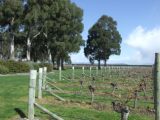
We know from our New Zealand friends that the interest in Richard III and his times is very much alive in their beautiful country.  However, there also seems to be a link between my favourite wine, Sauvignon Blanc from the Marlborough region on New Zealand’s South island.  I just read an article explaining this link.

Vineyard in the Marlborough region of New Zealand (photo by Dorothea Preis)

The largest river in the Marlborough region was named Clarence River in the mid-19th century.  It was thought that it referred to Queen Victoria’s uncle and predecessor, William IV, who had been Duke of Clarence before his coronation.

This accepted version has been discredited by George Holmes, who has investigated many place names and had about 95 spellings on maps changed to reflect his findings.

He suggests that the river had been named after a much earlier Duke of Clarence, one that we all know very well:  Richard’s brother George.  One hint was a tributary, Gloster River, which is named after none other than Richard himself, who before his coronation was Duke of Gloucester.  Mr Holmes intends to petition the New Zealand Geographic Board to correct the spelling of this river to reflect the family relationship.  Another hint was a stream near the mouth of the Clarence River, the George Stream.

The article may create the impression that the names were made up by Shakespeare for his infamous play, but of course we know he used real people and made up a story about them (not very different from many present day movies and TV dramas).  Shakespeare’s drama is referred to in the name of another stream, Murderers Stream, and a nearby hill, Warder, which might originally have been Mt Warden, named after the warden in the Tower of London, where George was imprisoned before his execution.  However, there does not seem to be any reference to George’s supposed execution method, no Malmsey Stream or Mt. Malmsey.

It is thought that the Clarence River was named by Sir Frederick Weld, who established a sheep station with business partner Sir Charles Clifford in the 1840s.  He had also named Lake Tennyson after his favourite poet.

Whether the inspiration came from Shakespeare or the real people behind his misrepresentation, I’ll remember this the next time we have some Sauvignon Blanc and lift my glass to George, Duke of Clarence, and of course to Richard, too.

You can find the article about the Clarence River here:  http://www.stuff.co.nz/marlborough-express/news/8142481/Drama-behind-rivers-name

4
Jan

YOU CAN STILL REGISTER!

   Posted by: Dorothea Preis Tags: ,

The registration period for the 2013 Australasian Convention has been extended.  So if you would like to attend please contact our branch secretary Julia quickly – to ask for more information or to send in your registration.

You do not have to a member of one of the Australasian branches to attend.  Convention is open to all members of the Richard III Society, wherever you live, as well as anyone else interested in the times.  By July we should also know more about the test results from Leicester, so this is an opportunity not to be missed!

The NSW Branch will be hosting the biennial Australasian Convention in 2013.

‘Richard III:  The Man behind the Myth’

Friday 12 to Sunday 14 July 2013

At Novotel, Darling Harbour, Sydney

All members and friends of the Richard III Society are welcome.

Friday, 12 July 2013 (evening): Informal get-together to welcome Interstate/Overseas guests

Saturday, 13 July 2013, from 9h00: full day of presentations with breaks for morning tea, buffet lunch in Dish restaurant, and afternoon tea

19h00: banquet in the Terrace Room (partners and guests welcome)

Sunday, 14 July 2013, from 9h00: further presentations, plus a business session before our farewell buffet lunch in Dish restaurant.

For further information and/or registration please contact the New South Wales Branch per email at info@richardiii-nsw.org.au.

Let’s mark the 530th anniversary of Richard and Anne’s coronation with one big celebration!

3
Jan

PLEASE VOTE!

   Posted by: Dorothea Preis Tags: , , ,

ArchaeologyWe all have been following the dig at the Greyfriars in Leicester with interest and fascination and are impatiently waiting for the results of all the various tests being carried out on the human remains which appear to be Richard’s.

Now it is your chance to contribute to this research project and no, we are not asking for money!

The Leicester dig has been nominated for an award as part of the 5th annual Current Archaeology Awards.  These awards celebrate the projects and publications in this year’s editions of the Current Archaeology magazine, and the people judged to have made outstanding contributions to archaeology.

The awards are entirely voted for by the public, there are no panels of judges.  In the category “Research Project of the Year” you will find the nominee “Richard III: the search for the last Plantagenet king’ – please show your support for this project which has been so close to all our hearts by voting for it.

Voting closes on 15 February 2013.  The winners will be announced at a special awards ceremony on 1 March at Current Archaeology Live! 2013.

Please go to the Current Archaeology website and vote:  http://www.archaeology.co.uk/vote

And should you be lucky enough to spot a copy of Current Archaeology at your local newsagent, and I know they are difficult to find in Australia, there are worse things to spend your money on!

1
Jan

HAPPY NEW YEAR!

   Posted by: Dorothea Preis Tags:

We wish all our readers a very happy New Year, may all your wishes come true.

It cery certainly promises to be an eventful year for Ricardians anywhere.

(Photograph of the fireworks in Sydney taken by Rob Chandler; obtained through Wikimedia Commons)

Archaeology

A big ‘Thank You’ to Renate for finding these links for us!

As you might have guessed, I’m talking about the dig in Leicester for the remains of King Richard III.  It was certainly very carefully planned.  The experts had carefully worked out, where the most likely location of the former church of the Greyfriars and where the best spot to start digging would be.  However, there was also luck involved, as the most likely spot was under a carpark – much easier to dig up than if it had been under some building.

And although it was possible to bring the various parties together – City of Leicester, University of Leicester and Richard III Society, thanks to the relentless efforts of Philippa Langley – money and time was limited, while the area originally covered by the friary of the Greyfriars was huge.  As Richard Buckley, lead archaeologist of the dig, said at the beginning of the project:

I would have loved to have had the time and money to dig numerous trenches and excavate large sections of the area, but that’s the way it goes.  We had to put all our eggs in one basket and pick three spots which we thought would herald results.

And we know by now that they hit the jackpot and found a male skeleton, which looks as if it might be Richard’s (tests to confirm this are being carried out).

We had heard that they had found it quite soon after the start of the project.  However, I had not known until now how soon they actually found the remains.  On the first day in the first spot they started digging, site manager Mathew Morris found a leg, just after scooping away a bit of earth.  They followed the leg  – and found the complete skeleton of an adult male who shows signs of having died violently in a battle and having had scoliosis, a sideways curvature of the spine.  Circumstantial evidence which looks most promising.

The find certainly convinced Richard Buckley, who had been sceptical whether they would find anything before the dig.  Now he says:  “As soon as I walked across and saw the skeleton under excavation with my own eyes, that was good enough for me.  Since then, I’ve made no secret to the fact I think it’s him.”

It sounds too good to be true, but in this case it actually is true.  As Philippa Langley, a screenwriter, said in a radio interview:  “If I had written this in a screen play I think it would have been thrown at me Good planning, good luck or a bit of both and said ‘get real’”.

She was there when he – and she is sure it is him – was found.  The exciting find was also filmed by the crew who was on site for the Channel 4 documentary, due to be broadcast in early 2013.

Here is the article describing the actual find:

‘Review of 2012: A year when digging up a Leicester city centre car park sparked worldwide curiosity’, This is Leicestershire (29 Dec 2012).  URL:  http://www.thisisleicestershire.co.uk/Review-2012-year-digging-Leicester-city-centre/story-17710559-detail/story.html Date accessed:  30 Dec 2012

Or you might like to listen to a BBC radio programme, describing the whole process:
http://www.bbc.co.uk/iplayer/episode/p011xpt1/BBC_Radio_Leicester_Documentary_Richard_III/