22
Jul
22 JULY 1461
 Louis XI becomes King of France. His coronation is on 15 August 1461. Due to his scheming and love for intrigue he became known as ‘The Spider King’.
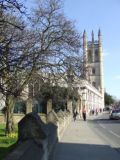
Magdalen College, Oxford (© D Preis)
Not long after his coronation, Richard III visited Oxford University as one of the first stops of his Royal Progress. He stayed for 3 days, 24 to 26 July 1483, at Magdalen College on the invitation by the college’s founder, William Waynflete, bishop of Winchester.
Richard was “honourably received, firstly outside the University by the Chancellor of the University and by the Regents and non-Regents; then he was received honourably and in procession at the College of the Blessed Mary Magdalene by a speech by the lord Founder”. The day after his reception, we see Richard following his own cultural taste. He listened to two debates, one on moral philosophy and one on theology.
I think Hairsine is right when he remarks:
There was certainly no need for a medieval autocrat to sit through not one but two learned debates if he did not find a genuine interest there. One is lead to believe that Richard’s visits to Oxford and Cambridge were welcome interludes from the cares of government.
Richard seems to have been impressed with the debates as well as his welcome and rewarded the participants and Magdalen College handsomely with venison and cash. The whole event was in detail recorded in the Register of Magdalen College, which the anonymous Chronicler ended with the words Vivat rex in eternum, which can be translated as a “may the King live forever!”.
On the last day of his visit, Saturday 26 July, the king toured the university, before travelling on to Woodstock.
Robert C Hairsine, “Oxford University and the Life and Legend of Richard III”, in: J Petre (ed.), Richard III: Crown and People, Richard III Society, 1985, pp. 307-332
Rhoda Edwards, The Itinerary of King Richard III, 1483-1485. Richard III Society, 1983 , p.5
For the interesting history of Magdalen College, you can download an illustrated history book, The Story of Magdalen College Oxford, by Rena Gardiner from the College website.
Dorothea Preis
Louis XI becomes King of France. His coronation is on 15 August 1461. Due to his scheming and love for intrigue he became known as ‘The Spider King’.
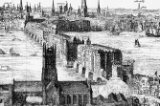 Margaret, George and Richard, the three youngest children of Richard Plantagenet, 3rd Duke of York, and Cecily Neville, stay for a few weeks at the house, which had belonged to Sir John Fastolf, in Southwark, where they are visited every day by their eldest brother Edward, Earl of March (later Edward IV).
Bibliography: Christine Weightman, Margaret of York: The Diabolical Duchess. Amberley Publishing, Chalford, 2009. ISBN 978 1 84868 099 9 (paperback)
Illustration: Old London Bridge in 1616 with Southwark Priory, now Cathedral, in the foreground, by Claes van Visscher
 Battle of Castillon, Aquitaine, the last battle of the 100 Years’ War between the House of Valois and the House of Plantagenet for the French throne. John Talbot, 1st Earl of Shrewsbury, and father of Eleanor Talbot (Butler), is killed.
Bibliography: John Ashdown-Hill, Eleanor – The Secret Queen. The History Press, 2009 ISBN 978-0752448664 (hardback)
Illustration: The Death of John Talbot at the Battle of Castillon, by Charles-Philippe Larivière (1798-1876)
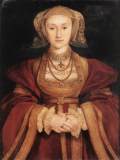 Death of Anna von Kleve (Anne of Cleves), the fourth wife of Henry VIII, at Chelsea Manor. She was not even 42 years old. She was buried at Westminster Abbey.
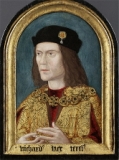 Richard, Duke of Gloucester, receives all the lands in Yorkshire and Cumberland, which had belonged to Richard Neville, Earl of Warwick, from his father’s side.
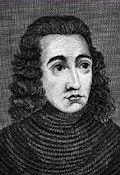 Marriage of George, Duke of Clarence (brother of Edward IV and Richard III), to Isabel Neville, elder daughter of Richard Neville, 16th Earl of Warwick (‘The Kingmaker’), and Anne Beauchamp, at Calais. The ceremony took place in secret, as King Edward IV, had explicitly forbidden the marriage. It was conducted by George Neville, Archbishop of York.
 Battle of Northampton, where John Talbot, 2nd Earl of Shrewsbury, and half-brother of Eleanor Talbot (Butler), met his death on the Lancastrian side. Yorkist victory.
A short description of the various battles of the Wars of the Roses can be found on the website of the Richard III Society.
Birth of William Plantagenet, 4th son of Richard Plantagenet, 3rd Duke of York and Cecily Neville. He died young.
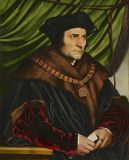 Execution of Thomas More, former Chancellor to Henry VIII, for denying that the king (Henry VIII) was the Supreme Head of the Church of England. He was born on 7 February 1478.
Between c. 1513 and 1518 he wrote The History of King Richard III. The work was not finished and only published posthumously by his son-in-law in 1557. It is not a first-hand account, as he was only aged seven when Richard III fell at the Battle of Bosworth. It is unknown for what purpose More wrote the History, as it contains many obvious untruths, which any reader at the time it was written would have recognized as such. However, his work had a long-lasting influence in blackening Richard reputation. It is therefore perhaps quite ironic that his downfall came on the anniversary of King Richard III’s coronation.
Source: ODNB on Sir Thomas More