28
Mar
END OF MARCH 1484
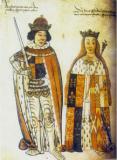 Death of Edward of Middleham, only son of Richard III and Anne Neville
Tags: Anne Neville, Richard III
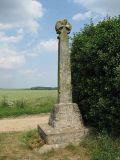
Towton Cross
The Battle of Towton , regarded as “the largest and bloodiest battle ever fought on English soil”, was fought in a snow storm on Palm Sunday, 29 March 1461, between the Lancastrian forces of King Henry VI and the Yorkist forces led by Edward, Earl of March. It has been said that 28,000 men died that day, out of 50,000 to 100,000 soldiers. The result was a Yorkist victory and Edward became king as Edward IV.
In 1996 a mass grave of fallen soldiers was found at Towton Hall. Their remains have been studied by the University of Bradford.
Edward IV had planned to build a memorial chapel at Towton, but it was Richard III, who put this plan into action. The chapel was nearly finished, when he was killed at Bosworth, and the chapel had been lost. Or so it was thought. In October 2013 it was revealed that scientists had found strong evidence of remains of the chapel.
In 2010 fragments of hand held guns and lead shot were found at the battle site, the earliest ever to be found.
James Clark, ‘The Medieval Somme: forgotten battle that was the bloodiest fought on British soil’, The Conversation (13 July 2016). URL: https://theconversation.com/the-medieval-somme-forgotten-battle-that-was-the-bloodiest-fought-on-british-soil-62129 [last accessed 2 March 2020]
Helen Cox, ‘The Battle of Towton is alive and well in Yorkshire’, Herstory Writing & Interpretation.. Link “Towton” on URL: http://helencox-herstorywriting.co.uk/articles/4539783477 [last accessed 2 March 2020]
T. Sutherland & A. Schmidt,’The Towton Battlefield Archaeological Survey Project: An Integrated Approach to Battlefield Archaeology’, Landscapes, Vol.4, Issue 2 (October 2003), pp.15-25. Available at URL: https://www.researchgate.net/publication/238691750_The_Towton_Battlefield_Archaeological_Survey_Project_An_Integrated_Approach_to_Battlefield_Archaeology [last accessed 2 March 2020]
‘Richard III Towton chapel remains are ‘found’’, BBC News York & North Yorkshire (7 Oct 2013). URL: http://www.bbc.co.uk/news/uk-england-york-north-yorkshire-24434795 [last accessed 2 March 2020]
A short description of the various battles of the Wars of the Roses can be found on the website of the Richard III Society.
Dorothea Preis
Tags: Battles, Edward IV, Richard III, Towton, Wars of the Roses, Yorkshire
Death of Edward of Middleham, only son of Richard III and Anne Neville
Tags: Anne Neville, Richard III
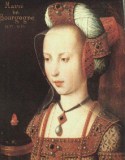 Death of Mary of Burgundy, stepdaughter of Margaret of York (sister of Edward IV and Richard III). More information on Mary here.
Tags: Burgundy, Margaret of Burgundy
 Publication of William Caxton’s translation of Aesop’s Fables, printed at his workshop at Westminster.
Tags: Books
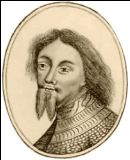 ‘Love Day’ at St Paul’s. An attempt at reconciliation between the opposing Yorkists and Lancastrians, loyal to Henry VI, to resolve the feud resulting from the 1st Battle of St Albans (22 May 1455). Then, on Lady Day (25 March), the King led a “love day” procession to St. Paul’s Cathedral, with Lancastrian and Yorkist nobles following him, hand in hand, among them Richard, Duke of York, with Queen Margaret of Anjou.
Tags: Henry VI, House of York, Margaret of Anjou, Richard Duke of York, Wars of the Roses, Yorkists
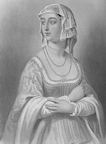 Birth of Margaret of Anjou, daughter of Rene, Duke of Lorraine and Anjou, and niece of King Charles VII of France, at Pont-à-Mousson, Lorraine. Married to Henry VI of England.
Tags: Henry VI, Margaret of Anjou
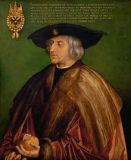 Birth of Maximilian I, Holy Roman Emperor. His first wife was Mary, daughter of Charles the Bold of Burgundy and stepdaughter of Margaret of York. Maximilian was a strong supporter of “Perkin Warbeck” who might – or might not – have been Richard of York.
Rather than going to war, he sought to strengthen his country’s position by diplomatic marriages, which was summed up in the couplet:
Bella gerant alii, tu felix Austria nube.
Nam quae Mars aliis, dat tibi diva Venus.
(Let others wage war, but thou, O happy Austria, marry; for those kingdoms which Mars gives to others, Venus gives to thee.)
Dorothea Preis
Tags: Holy Roman Empire, Perkin Warbeck
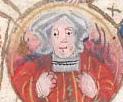
Cecily of York
Birth of Cecily of York, third daughter of Edward IV and Elizabeth Woodville, at Westminster Palace on 20 March 1469.
Married (1) 1484 to Ralph Scrope of Upsall, union annulled in 1486, after accession of Henry VII.
Married (2) before New Year’s Day 1488 to John Welles, 1st Viscount Welles, half-brother of Henry VII’s mother Margaret Beaufort. They had two daughters, Elizabeth and Anne. Welles died on 9 February 1499.
Married (3) to Sir Thomas Kyme of Friskney (in Lincolnshire) in 1502 without Henry VII’s permission and she was banished from court and all her estates were confiscated, though some were returned later. It is not clear whether they had any children.
Cecily died on 24 August 1507 at Hatfield, Hertfordshire.
ODNB ‘Cecily, Viscountess Welles (1469–1507)’ [last accessed online 2 March 2020]
Dorothea Preis
Tags: Edward IV, Elizabeth Woodville
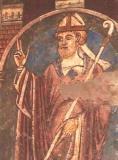 Death of St Cuthbert at Inner Farne Island, off the coast of Northumberland. He is venerated at Durham Cathedral.
He must have had special relevance for Richard III, as the statutes for his college at Middleham, which it has been suggested Richard might have written himself, state that one of the stalls for the priests should be named for St Cuthbert. St Cuthbert’s was one of the principal feast days to be celebrated at Middleham.
Melhuish, Joyce M., The College of King Richard III, Middleham. Richard III Society (nd)
Rollason, David & Dobson, R.B., ‘Cuthbert [St Cuthbert] (c.635–687)’, Oxford Dictionary of National Biography, ]Oxford University Press, 2004 [last accessed online 2 March 2020]
Sutton, Anne F. & Visser Fuchs, Livia, The Hours of Richard III. Alan Sutton Publishing Ltd (first published 1990, paperback 1996)
Dorothea Preis
Tags: Middleham, Richard III, Saints
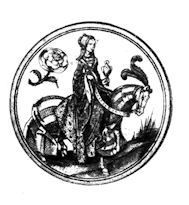 Death of Richard III’s wife Anne Neville at Westminster, probably of tuberculosis. She was buried at Westminster Abbey, but the location of her grave is unknown. It is often said that Richard openly wept at her funeral, though the origin of this assumption is unclear. There is a plaque for her at Westminster Abbey donated by the Richard III Society. Unfortunately it does not get mentioned in the audio guide, so you have to look out for it.
The illustration on the left is from the in memoriam card which accompanied the wreath for Queen Anne’s tomb at Westminster in 2007. (© Richard III Society)
Tags: Anne Neville, Richard III