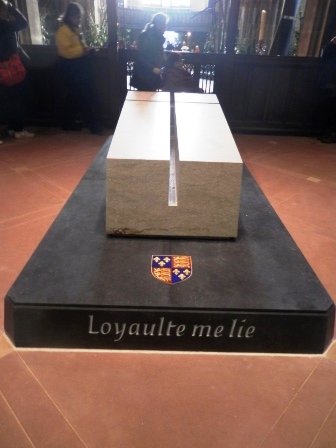
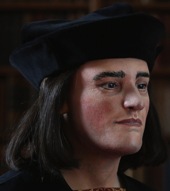
 Thanks to Philippa Langley and John Ashdown-Hill the phrase “Looking for Richard” became part of our lives and enthralled us through the search, discovery and final result. Then came the pride and emotion as we witnessed the re-interment – and acknowledgement of King Richard’s life in Leicester.
But what happens if you aren’t looking for Richard and he – and some historical connections – suddenly turn up when you least expect them, usually through a brief reference is a totally unexpected book.
I changed my mind about Richard’s character at the ripe old age of ten. I’d read the junior history books, seen the Millais’ portrait of those innocent little boys and even accepted the fact that in a pantomime The Babes in the Wood (at the Bournemouth Pavilion for the Dorset Group’s info) the wicked uncle wore black and had a hunchback. Hmm.
Then my sister and I saw a production of The Black Arrow at London’s Old Vic theatre and this was the cue for a major switch. This novel is subtitled A Tale of Two Roses and is set during the Cousin’s War. The young hero, Richard Shelton fighting for the Yorkists, becomes aware of a fierce encounter taking place. One of a small group of fighters is “so active and dexterous … so desperately did he charge and scatter his opponents … but so icy was the ground, one slip and his life would be forfeit.”
Young Richard of course comes to this man’s aid, the fight is won and he is “surprised to find in one who had displayed such strength skill and energy [was] a lad no older than himself – slightly deformed, with one shoulder higher than the other … The eyes, however, were very clear and bold.”
This is his first meeting with the young Duke of Gloucester, and after more fighting, Richard is knighted by the Duke for his valour, and finally, with the Duke’s royal consent, marries his love Joanna. RLS may well have been an early Ricardian …
A few years later, when reading one of English author Angela Thirkell’s delightful novels in which she picks up the descendants and places of Anthony Trollope’s Barchester novels, and sets them in the mid-1900s, I rejoiced to find Mrs Morland praising The Black Arrow.
“Why Stevenson thought so poorly of that book I shall never understand. All my boys loved it … And it was the only thing that made me really interested in Richard Crookback, until I read that book by that clever woman with three names, who proved that Richard didn’t murder the little Princes in the Tower and was a hero all the time and not a villain.”
Well, we all know the name of that book, don’t we? It’s probably on everyone’s bookshelves even after all the years since it was published in 1951.
Another book I loved at about the same age was Maddy Alone, by Pamela Brown. Twelve-year-old Maddy, an aspiring actress, learns about a film being made about a castle near her home. The kindly Bishop who is a family friend, takes her for lunch (with meringues) to soothe her misery at being left behind while her sister and older friends start at drama academy. Afterwards they go for a walk near the castle and he tells her that the film is about the daughter of Arthur, Prince of Wales, and Catherine of Aragon. He has just found some old papers that reveal that “at twelve years old away she fledde, forsook her crown but saved her hedde”. Apparently there was a plan to put her on the throne after Henry VII died, but naturally Henry VIII would have none of it.
There are some pretty valid comments about the undesirability of this particular Tudor and his propensity for an axe and a block to dispense with those he no longer needed in his life!
Richard isn’t mentioned, but I liked the Tudor reference. And, of course, our 12-year-old finds out that the daughter of Arthur is being played by a well-known and glamorous actress and chaos inevitably ensues. Now guess who plays the role at the right age …
Ricardians who are also die-hard fans of detective novels will be familiar with the Inspector Lynley novels, by the American author Elizabeth George, a self-confessed supporter of the last Plantagenet king. Her references to him in many of her books give us enormous pleasure – as does the investigation through to pages to find his name! These are some of my favourites.
The Evidence Exposed:
This is a collection of three novellas, in one of which – I Richard – an interesting theory as to what happened to the Princes and, indeed, whodunit, is presented. With Philippa Langley’s new quest to discover an answer to the age-old mystery, you could appreciate the idea.
Well-Schooled in Murder
Sergeant Barbara Havers asks Lynley why the statue of Henry VII outside a school faces north, not south, towards the school entry.
“He wants us to remember his moment of glory. So he’s looking to the north, in the direction of Bosworth Field.”
“‘Ah. Death and treachery. The end of Richard III. Why does it always slip my mind that you’re a Yorkist… Do you spit on Henry’s tomb whenever you get the chance to slip down to the Abbey?”
He smiled. “Religiously. It’s one of my rare pleasures.”
Missing Joseph:
Lynley speaks to Deborah and Simon St James about the power of tourism: “Don’t people pay to see the Queen of Scots death mask?”
“Not to mention some of the grimmer spots of the Tower London,” St James said. “The Chapel Royal, Wakefield Tower.”
“Why bother with the Crown Jewels when you can see a chopping block?” Lynley added. “Crime doesn’t pay, but death brings them running with a few quid.”
“Is this irony from the man who’s made at least five personal pilgrimages to Bosworth Field on the twenty-second of August?” Deborah asked blithely. “… where you drink from the well and swear to Richard’s ghost that you would have fought for the Yorks?”
“That’s not death,” Lynley said with some dignity, lifting his glass to salute her. “That’s history, my girl. Someone’s got to be willing to set the record straight.”
The Girl in the Photograph, by Kate Riordan, is a recent publication I enjoyed. Set in an old, crumbling English manor, the heroine, living a lonely life there, is convinced that one night the resident ghost is around. The sound of footsteps, drifts of perfume and so on. According to local legend this is none other than Margaret of Anjou who stayed there on her way to join young Edouard, Lancaster Prince of Wales, at Tewkesbury, unaware that his death is imminent. It seems that the author assumed her readers would know exactly who Margaret was as there is no further reference to her back story, the Cousins’ War, or the fact that her companion would have been Anne Neville , the future queen and wife of Richard III.
The uncertainly and mystery about Richard has obviously struck a chord with many authors. One of those in the Golden Age of English Crime Writing was Dorothy L. Sayers who, in Have His Carcase has her noble detective Lord Peter Wimsey on the hunt for the killer of a young man whose body was found stranded on a rock off the Cornish coast. His quest takes him to the offices of theatrical agents where the photograph of the victim reminds one agent of someone who would have made “a good Judas”. “Or a Richard III,” says the other.
Then follows an interesting discussion of the guises Richard portrays in Shakespeare’s tragedy. The man who plots, the man who flies into tempers that, according these two, are as artificial as his love-making to Anne. As he leaves, Wimsey asks the Inspector who is with him what made them think of Richard III.
“Wasn’t he the fellow who made up his mind to be a villain?” to which Lord Peter confesses that he has “something on his mind and can’t seem get it out”. A nice cue to let you read on!
A further visit to a theatrical connection occurs in one of the other-authored sequels to Daphne du Maurier’s Rebecca. In Sally Beauman’s Rebecca’s Tale we meet one of those seeking to find the secrets of Rebecca’s life, and an obscure reference leads him to the memoirs of legendary actor manager Sir Frank McKendrick, who recalls the charming young actress Isabel Devlin who had died shortly after leaving his company.
“I grieved for her. I should add that Miss Devlin’s daughter was also at this time a member of our little “band of brothers” … she was a most unusual and wicked Puck at a very early age and was of great use to us in boys’ roles. I remember her as a swaggering but subtle young Princeling to my Richard III … but we heard no more of her after her mother died.”
Unusual, wicked, swaggering and subtle could all apply to the later mistress of Manderley.
And Shakespeare’s Edward V recalls another childhood book, Noel Streatfield’s Ballet Shoes in which young Pauline’s portrayal of the role leads her on to the fortune that helps her family.
How many other books are there to prove that their authors found him just as significant as Ricardians? Information welcome!
The Black Arrow, by Robert Louis Stevenson, published 1888.
Three Score and Ten, by Angela Thirkell, Hamish Hamilton, 1961
Maddy Alone, by Pamela Brown, Nelson, 1945
The Evidence Exposed, by Elizabeth George, Hodder & Stoughton 1999. ISBN 0 34 075 063 0
Well-Schooled in Murder, by Elizabeth George Bantam, 1990. ISBN 0 553 401 167
Missing Joseph, by Elizabeth George, Bantam, 1993. ISBN 0 553 402 382
The Girl in the Photograph, by Kate Riordan, Michael Joseph, 2014. ISBN 978-0-718-17928-1
Have His Carcase, by Dorothy L. Sayers, Gollancz 1932.
Rebecca’s Tale, by Sally Beaumont, Little Brown, 2001. ISBN 0 316 858 137
Ballet Shoes, by Noel Streatfield, Dent 1936.
Tags: Books, Bosworth, Margaret of Anjou, Princes, Richard III, Wars of the Roses, Yorkists