16
Sep

Pause for thought

   Posted by: Dorothea Preis   in Greyfriars Dig, News

While we are waiting for the outcome of the DNA analysis, it seems to be the right time for some reflection.   This has been the most exciting time for any Ricardian or anyone interested in the period.   We would like to thank everyone concerned, the University of Leicester, Leicester City Council and the Richard III Society for making this investigation possible.  Our special thanks go to Philippa Langley of the Society, whose determination made her dream become reality.

Thanks also go to our friends on the Society Yahoo group, who posted a link to the full 35 minute video on You Tube of the press conference at Leicester, held on 12 September 2012.  This is an unlisted video, but as Richard Taylor of the University of Leicester tweeted the link, I suppose I can share it here.

Tags: , , ,

This was the subject of the lecture organised by The Australian Heraldry Society on Friday evening, 14 September.  The Carmichael Room at the Sydney Mechanics School of Arts – opened to double length – was nicely crowded.  Pre-lecture talk among the Ricardians present buzzed with the news from Leicester of course but, as soon as speaker Robyn Boyer began to talk, we were deep in a world of colourful pageantry and display.  Robyn is a medieval history enthusiast, with degrees of Bachelor of Visual Arts and Bachelor of Arts with Honours in History, currently working towards in PhD in medieval political philosophy at the University of Queensland.  We were definitely in safe hands.

What a fascinating world was opened up.  The information given was accompanied by a wonderful selection of illustrations that included men’s armorial and heraldic garments such as part of the Black Prince’s armour displayed in Canterbury Cathedral near his tomb, and the picture of Edward III formally granting Aquitaine to his eldest son.  Women’s heraldic garments were mainly shown on funeral monuments and effigies and from illuminated manuscripts such as the Luttrell Psalter, as well as garments and textiles that are still in existence.  The quality, colour and detail of the latter was striking.

Chivalry and nobility were all-important in the tapestry of medieval courtly life – although the heraldic motifs, even complete heraldic arms on some costume illustrations are suspect.  A fallacy perhaps in contrast to the fashionable formality in most portraits.

The variety was enormous.  Splendid heraldic horse cloths glowing with colour and design, sideless surcoats that appeared on ceremonial occasions  indicating rank if not royalty.  Brass rubbings showed great design detail as well as a surprising flow of fabric.

Ricardians welcomed the familiar portrait of Queen Anne Neville, sumptuous in her coronation robes, and the interesting brass funeral effigy from 1485 of William Catesby and his wife, Margaret Scrope, at Ashby St Legers in Northamptonshire.

It was an inspiring evening that swept us all along in a world of brilliant colour and rich textures, showing the personalities who wore them from Alfonso, King of Spain to Margaret Ferrers, wife of the 4th Earl of Warwick, from Charles IV and his bride Marie de Luxemburg to Mary, Queen of Scots and Francis of Lorraine.

Tags:

16
Sep

Digging up dirt in Leicestershire

   Posted by: Dorothea Preis   in News

No, I’m not talking about the dig in Leicester at the moment, but rather about the Time Team episode on ‘Groby Old Hall’, which will have a repeat broadcast on ABC1 next week.

The announcement on the ABC website says that “The team visit Groby Old Hall in Leicestershire, once home to the legendary White Queen Elizabeth, the wife of Edward IV.”    The description of Elizabeth Woodville as “White Queen” has strong resonances of Philippa Gregory’s novels, but let’s hope that the research Time Team has done is more in-depth than that of a novelist.

Groby Hall was the property of the family of Elizabeth Woodville’s first husband, John Grey.  Later, it passed to their son Thomas Grey.

In spite of any misgivings about the description, the programme should be interesting to watch.  It is on at 18h00 on 18 September 2012 on ABC1.

The above photograph of Groby Old Hall is © Copyright Mat Fascione and licensed for reuse under this Creative Commons Licence

Tags: , ,

15
Sep

No, not a hunchback!

   Posted by: Dorothea Preis   in Greyfriars Dig, News

It’s good to see that the news about the discovery in Leicester of a skeleton which might indeed be the remains of Richard III (subject to DNA testing) are getting quite a bit of exposure in the Australian media.  Our branch received a few requests for radio interviews and so far we found the interviewers interested in hearing our side of the story.

However, readers who live in the Sydney area, might have seen yesterday’s article in the Sydney Morning Herald with the headline ”Hunchback skeleton may be good fit for a king”.  A friend phoned me to talk to me about a similar article in the Australian (which I don’t read), so the story about the ”hunchback king” seems to have done the rounds.

Wednesday’s press release from the University of Leicester explicitly stated that the man, whose remains they had found, was not a hunchback.  He suffered from scoliosis, a sideways curvature of the spine, which would be hardly noticeable on a clothed person.  Above all it is very well possible for someone with scoliosis to be athletic, which a medieval soldier definitely had be, and Richard was an acknowledged good soldier.  I read that Usain Bolt has scoliosis – hardly the misshapen cripple of Shakespeare’s play.

Well, to cut a long story short, I was pretty annoyed with the story in the SMH.  Sufficiently annoyed to write a letter to set the record straight.  And I am glad that my letter was accepted for publication.  You can read it on the letters’ page of today’s paper or on the digital version here (you have to scroll down a bit).

No, I never thought Richard was a hunchback and if this skeleton is indeed his (and I think that there is a very good chance that it is), then it proves that he was not a hunchback.

Tags: , , , ,

12
Sep

Is it Richard?

   Posted by: Dorothea Preis   in Greyfriars Dig, News

I have been following the press conference at Leicester on Twitter and this report is based on their tweets.  You can also read them on the update from the University of Leicester.

The press conference revealed that two skeletons were found, one of them was female and thus obviously not Richard III.  The male skeleton was found in the choir area, where according to historical records Richard was buried.

This skeleton appears to have suffered significant peri-mortem trauma to the skull, which would be consistent with an injury received in battle, and a metal arrowhead was found between vertebrae of the upper back.   It was near the spine, but not actually embedded in bones.

The man, whose skeleton it is, had spinal abnormalities, but was not a hunchback.  It would be consistent with severe scoliosis, where the spine is curved from side to side [Wikipedia].

The next step is to try to extract DNA from the bones to match it to the DNA of the man, who is descended in the all female line from Richard’s sister.

Philippa Langley of the Richard III Society stated that the aim of the “project has always been about finding out about the real man, not the Tudor myth”.

The findings so far look extremely promising, but DNA analysis will give us the truth at last.  Truth is indeed the “Daughter of Time”.

Tags: , , ,

12
Sep

Leicester Dig – guest post by Sally Henshaw

   Posted by: Dorothea Preis   in Greyfriars Dig, News

Editor’s Comment: Sally Henshaw, Secretary of the Midlands East Branch of the Richard III Society, send us the following guest post on the archaeological dig in Leicester.   She and Richard Smith, Chairman of the Midlands East Branch, had the opportunity of a private tour of the site.

Richard Smith and I went to see the dig yesterday and Philippa Langley of the Richard III Society showed us round. We also had a few words with Richard Buckley, lead archaeologist of the project, who we know, as he has given talks to our branch on several occasions.

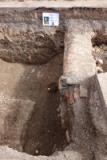
I took photographs of the first and second trenches as Philippa explained what things were (see below).

Unfortunately we were not allowed to see the third trench as they are working on that one at present. They have found a medieval coin, but as yet have not been able to date it. They have also found pieces of medieval stained glass and brightly painted floor tiles. They hope the choir of the church (where Richard was buried) is located in the car park where they are now digging and not under the building (although it may be possible to dig a trench if it is) It would be awful to have come so far only to find that the part we really need to get at is under a building.

Trench 2:  internal cloister walkway showing the herring bone pattern (© Sally Henshaw)

Trench 2: The white part is a rounded step which they are calling the Leicester Step at present, as no one has seen anything quite like it before. (© Sally Henshaw)

Trench 1:  showing where the all cuts across (© Sally Henshaw)

Trench 1:  the white area is a bench they found where the monks would have sat in the chapter house (© Sally Henshaw)

Window tracery (© Sally Henshaw)

Frieze on a choir stall, early perpendicular (?) (© Sally Henshaw)

Plan of the dig (© Sally Henshaw)

Tags: , , ,

12
Sep

Leicester Update 12.9.12

   Posted by: Dorothea Preis   in Greyfriars Dig, News

Breaking News:

The University of Leicester has just a few minutes ago announced that human remains have been found at the archaeological dig in Leicester and they are talking about other “stunning discoveries”.

More details will be revealed at a press conference at 11 am (British time – that’s 20.00 EST) in Leicester.  Live coverage of whatever is announced will be available on Twitter @uniofleicester.  (Yes, I have just signed up to Twitter, something I never wanted to do, but for news like this it seems to be worth it.)

This find is truly “a dramatic new turn”, as Richard Taylor, Director of Corporate Affairs at the University of Leicester and one of the prime movers behind the project, said.

Philippa Langley from the Richard III Society said: “We came with a dream and if the dream becomes reality it will be nothing short of miraculous.”  How true!

Tags: , , ,

9
Sep

Leicester Update 9.9.12

   Posted by: Dorothea Preis   in Greyfriars Dig, News

Unfortunately I haven’t (yet?) got an eye witness report from any friend, who attended the open day at the dig in Leicester yesterday.  However, I found this post by Jonathan Calder on the Liberal England site, who has been posting about the dig regularly.  Enjoy!

Tags: , , ,

8
Sep

Leicester Update 8.9.12

   Posted by: Dorothea Preis   in Greyfriars Dig, News

We are grateful to Sally Henshaw of the Midlands East Branch of the Richard III Society, who has kindly supplied us with the above photo, which she took through the barriers at the beginning of the dig.

Great news from Leicester:  archaeologists have found an area of paving, made up of re-used medieval tiles.  This is thought to be the garden of Robert Herrick.  Robert Herrick, alderman and sometime mayor of Leicester, bought the site of the Greyfriars after the dissolution.  Christopher Wren, the father of the architect who built for instance St Paul’s Cathedral, recorded that there was a stone pillar in Herrick’s formal garden with the inscription “Here lies the body of Richard III sometime King of England“.  It is assumed that the stone pillar was on the spot where the choir of the Greyfriars church had been.

The third trench meanwhile revealed large fragments of window tracery as well as bits of lead, as it would have been used in stained glass windows.  The archaeologists think that this might have come from the east window of the church, behind the high altar – which means near the choir, where Richard III was known to be buried.  This is really getting exciting.  To quote Richard Buckley, the lead archaeologist of the project:

Having overcome the major hurdle of finding the church, I am now confident that we are within touching distance of finding the choir – a real turning point in the project and a stage which, at the outset, I never really thought we might reach.

There is more good news.  Although the dig was supposed to finish on Friday, it has now been extended for at least another week, as the prospect of major discoveries becomes more and more likely.

Tags: , , ,

6
Sep

Leicester Update 6.9.12

   Posted by: Dorothea Preis   in Greyfriars Dig, News

The University of Leicester has confirmed that the church of the Franciscan Friary has been found.  The initial two trenches revealed tiled passageway floors, which are at right angles from each other.  This led the archaeologists to believe that these are remains of the cloister of the friary.  A cloister is a rectangular open space, which is surrounded by covered walkways, so that the monks would remain dry whilst walking around it.  One of the sides of the cloister would often be alongside a church.

On the third side of the cloister remains of a large, one and half metres thick wall were found, which the archaeologists thought could be the south wall of the church itself.  The third trench established that this wall continues and also found remains of a second wall approx. 7.5 metres to the north.   The space in between the two walls has a mortar floor, which was probably originally tiled.  These remains have been confirmed to be of the church.  As lead archaeologist Richard Buckley announced:

The next step – which may include extending the trenches – will seek to gain more information on the church in the hope that we can identify the location of the choir and high altar. Finding the choir is especially important as this is where Richard III is recorded as having been buried.

He admitted that before the dig started he was not all that confident whether they would even be able to find the Greyfriars, as their first trenches could easily have missed the remains, or any remains might have been destroyed by later building activity in the area.  It is certainly not only the team that is excited “by the prospect of further discoveries over the next week or so which may take us closer to our goal”.  I am surely not the only one who checks every morning whether there have been any new developments!

Tags: , , ,