6
Jun

Was Edward V Sick?

   Posted by: Annette Carson   in Medieval Miscellany, Medieval People

The following article by Annette Carson, author of Richard III – The Maligned King, was originally published in the March 2012 issue of Ricardian Register, the journal of the American Branch of the Richard III Society.  We are very grateful to Annette for making it available to our branch as well.

In the course of researching and writing my book about Richard III,1 I was struck by an apparently widespread assumption that the boy Edward V was sickly and, if not despatched by nefarious means, probably died of some kind of illness.

Leaving aside storytelling and wild speculation, there are very few respectable sources to which this misapprehension might be traced. Of these, only one was writing at the time of the events he described, and this was the Italian cleric Dominic Mancini, who reported that ‘like a victim prepared for sacrifice … [Edward] believed that death was facing him’.2

It is generally accepted that Mancini had come to England at the behest of his patron Archbishop Angelo Cato, a key figure in the intelligence-gathering circle of Louis XI of France. His visit coincided with a catastrophic breach in Anglo-French relations, on which Cato was doubtless looking for a first-hand report; instead of which Mancini found himself present during a far more interesting series of events: the death of Edward IV, the accession of his son, Edward V, and the latter’s replacement by Richard III.

Mancini gives a very full description of the twelve-year-old Edward V, his graces and accomplishments, physical appearance, whereabouts and general state of mind. This knowledge is attributed to his access to Dr John Argentine, the physician who attended Edward at his lodgings in the Tower of London after his deposition in the summer of 1483. With such a valuable and free-speaking source of information at hand, Mancini’s report would have been a poor effort indeed if he had not winkled out from the boy’s doctor all possible information about his health – a matter of great interest to the French court in those turbulent times, especially if he was ailing or even quite sick.

Yet Mancini’s comment about Edward’s daily confession ‘like a victim prepared for sacrifice’ is conspicuously devoid of reference to any issue of medical health, on which Argentine would have been the prevailing authority. Rather than suggesting that he was physically ill, it sounds like one of those hints Mancini likes to drop that young Edward was set to meet a sticky end.

Some 25 years later, the French chronicler Jean Molinet also wrote briefly of Edward V, describing him as ‘unsophisticated and very melancholy, aware only of the ill-will of his uncle’, a boy who believed that he and his brother were marked for death. Obviously coloured by the then-current assumption that they had been murdered by Richard III, Molinet’s retrospective account depicts Edward as a pathetic figure but undermines its own credibility with the adjective ‘unsophisticated’, which scarcely chimes with the admiring words of Dominic Mancini, who wrote (presumably quoting the physician Argentine): ‘In word and deed he gave so many proofs of his liberal education, of polite, nay scholarly attainments far beyond his age … his special knowledge of literature, which enabled him to discourse elegantly, to understand fully and to declaim most excellently from any work whether in verse or prose that came into his hands, unless it were from among the more abstruse authors’.3

While mentioning John Argentine, by the way, it need not be taken as significant that Edward’s doctor looked after him during his stay in London, as did also a number of other personal attendants, some of whose names are officially recorded. Rather it may be viewed as a sign of the appropriate care and respect given to his royal person. Indeed, since there is no contemporaneous account of his health, we should probably never have heard of his physician had not Mancini enjoyed Argentine’s confidences.

If Mancini’s observations are deficient in crucial specifics, our next source has even less factual evidence to offer. This is Sir George Buck in his History of King Richard the Third written in 1619, over 130 years later. Buck was Master of the Revels at the court of James I, and one of those seventeenth-century antiquaries who made it their business to delve into ancient papers in order to find documentary evidence about times past. Buck was a firm believer that the pretender known as ‘Perkin Warbeck’ was in fact Edward V’s younger brother, Richard. Of Edward he admitted knowing almost nothing, assuming that he must have fallen ill and died while still residing in the Tower of London: ‘[I think the elder] brother Edward died [of sick]ness and of infirmity (for he was weak and very sickly …)’.4

The best argument Sir George could find to support his theory was that Edward’s siblings did not live to make old bones: ‘their sisters also were but of a weak constitution, as their short lives showed.’ It is difficult to construe what kind of lifespan Buck termed ‘short’ for a woman, when death in childbirth was a constant hazard. Certainly some of the sisters lived into their late thirties, and Catherine, Countess of Devon, is said to have died in 1527, in her late forties. Their half-brother, Edward IV’s illegitimate son Lord Lisle, apparently lived to be nearly eighty.

Another basis for Buck’s theory was that no pretender came forward to represent himself as Edward V. This may be so, but very little is known about what lay behind the pretender later dubbed ‘Lambert Simnel’, crowned in Dublin in May of 1487, and supported by the Earl of Lincoln and Edward’s aunt Margaret of Burgundy (and even, perhaps, by his mother Elizabeth Woodville and half-brother Thomas, Marquess of Dorset). Buck may have fallen into the same error as have historians throughout the ages, i.e. the assumption that what he knew then was all there was to know.

Buck’s is the first recorded suggestion in so many words that Edward fell sick and died. But his book about Richard III cannot be said to have been widely read. Indeed for 350 years the only printed version was one in such a bowdlerized form that, until a scholarly edition of the original was produced by Arthur Kincaid in 1979, it was virtually dismissed by historians.

So, I wondered, could it be that the common supposition about Edward V’s ill-health dates from a source that is much more recent? I am referring to something that attracts considerable scepticism nowadays, and that is Lawrence Tanner and William Wright’s 1933 examination of those skeletal remains currently in Westminster Abbey which Charles II decided, in 1674, on no evidence whatsoever, were those of Edward V and his brother.5

The anatomist Professor Wright, and his dental adviser Dr George Northcroft – both of whom agreed enthusiastically with Charles II – identified evidence of a disease of the lower jaw in the elder of the two skulls present, which is visible in their published photographs. Thirty years later another anatomist, Dr Richard Lyne-Pirkis, gave a talk to the Richard III Society in which he stated it as his opinion, on the basis of those photographs, that it was probably ‘a condition known as osteomyelitis or chronic inflammation of the bone, which was quite a common condition in those days’.6 Osteomyelitis would have been extremely painful and increasingly disfiguring, and was very likely to have proved fatal in those centuries before antibiotics.

Other experts in a variety of disciplines have offered alternative diagnoses, the most popular being osteitis, an unpleasant and painful inflammatory disease, though not necessarily fatal in itself; unless, of course, it deteriorated into osteomyelitis.

The Tanner and Wright report concluded that the child whose skull they named ‘Edward V’ suffered from an extensive, chronic condition which had persisted for some years and had spread so far as to affect the temporo-mandibular joints. From the photographic evidence it can be seen to have produced destruction and malformation of areas of the affected bone. The owner of that jawbone would have suffered from inflamed, swollen and septic gums, as well as constant pain and discomfort. However, the problem remained that the Tanner and Wright examination, using the limited means at their disposal in 1933, failed to establish scientifically whether this owner was prince or pauper, boy or girl.7

It seemed to me that the vague assumptions I had encountered about Edward V’s illness must have been assimilated by a kind of reverse-engineering process: in other words, extrapolating backwards from the Tanner and Wright conclusions and superimposing them on to the remarks of writers like Mancini and Buck.

I have always favoured holding assumption up to the cold light of logic, so I decided to make the question of Edward V’s health, and the apparent link with the bones, one of a number of lines of original research that would be unique to my book.8 My starting point was to look at the phenomenon from the viewpoint of his contemporaries. Had a royal child suffered chronically in this way, it must have given rise to comment and concern. Doubtless he would have needed specially prepared food as the illness progressed and teeth were lost or removed. And he would have endured the never-ending attentions of not one but a team of physicians whose ministrations were probably quite as unpleasant as the disease itself.

Yet there is no contemporaneous hint of anything of the kind relating to Edward’s appearance or behaviour. As Prince of Wales he was constantly visible to members of his household, his retainers and the public at large from the age of three when he was first given his own council at Ludlow. As he grew older he was seen regularly at court and was exhibited by his father, Edward IV, to the gaze of his subjects on numerous public occasions.9

Furthermore, Dominic Mancini’s description of Edward at the age of twelve (shortly before his alleged death) speaks of ‘dignity in his whole person, and in his face such charm, that … he never wearied the eyes of beholders.’.10 If Edward had really been the owner of an infected and disfigured jaw, Mancini would surely have made certain in his report, delivered in December 1483, to remark less on the charm of his face and more on the cruelty and heartlessness of Richard III’s treatment of an ailing boy. This would have been music to the ears of Archbishop Cato and the French court, always looking for vulnerabilities in the English regime, especially as England’s most recent Parliament (under Edward IV) had voted funds for renewed Anglo-French hostilities. Yet Dominic Mancini suggests nothing of the sort.

Written material from the fifteenth century is admittedly scanty, and its paucity cannot be held to prove that Edward V was hale and hearty. However, it is equally incumbent on anyone who speaks of his ill-health to back it up with evidence.

It would be fair to expect an exhaustive examination of Edward V’s life and person in a biographical work, of which the only one yet published was written by Michael Hicks. Yet Hicks mentioned nothing of illness or disfigurement, and instead described him as ‘a very good-looking boy’. He also avoided almost all reference to the bones in Westminster Abbey, and on the two isolated occasions where they were briefly mentioned, he showed no sign of being convinced of their identity.11

To conclude my investigation from the standpoint of logic, I turned my thoughts to consideration of how the chronic ill-health of the Prince of Wales would have influenced the way his own heir presumptive – his younger brother – was raised and trained.

Given that diseases of the jaw were not uncommon in Edward’s day, it would certainly have been known that such a chronic infection could worsen progressively and even lead to death. Emotion played no part where questions of inheritance were concerned, and this was a matter that involved succession to the crown of England. Their father the king would surely have stopped at nothing to secure his Yorkist dynasty.

Yet no provision whatsoever seems to have been made for the younger boy, Richard, to receive appropriate training in kingly responsibility. Instead he remained at his mother’s side, never taking charge of his own household, even after the appointment of his own council in 1477. Neither was he placed under the tutelage of a suitable nobleman to learn the arts of arms and chivalry. In May 1483, when his brother arrived in London as king, Richard lurked with his mother in sanctuary.

Such lack of interest in preparing the younger brother for the possibility of kingship seems to point fairly conclusively, I would suggest, to absence of any concern for the health of the elder.

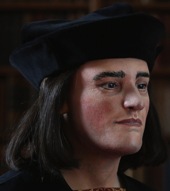
Postscript: There is still considerable room for research into the findings of Tanner and Wright, including the possibility of facial reconstruction, with which I have found it difficult to make progress. I hope to pursue this further now that I have taken up residence again in England.

ENDNOTES

1. Annette Carson, Richard III: The Maligned King (Stroud, 2008, 2009, 2010, 2011).

2. Dominic Mancini, De Occupatione Regni Anglie per Riccardum Tercium Libellus, ed. C.A.J. Armstrong (Gloucester, 1989) p.93.

3. Mancini, p.93.

4. Sir George Buck, The History of King Richard the Third (1619), ed. A.N. Kincaid (Gloucester, 1979) p.140.

5. Archaeologia LXXXIV, 1934.

6. Richard Lyne-Pirkis, Regarding the Bones Found in the Tower; speech given on 27 February 1963.

7. A survey of the principal academic commentaries devoted to the subject of the bones, whether by scientists or historians, can be found in Carson, pp.184-200, from which it will be seen that there is no consensus as to their identity, or sex, or age, or antiquity. What gives rise to most dubiety is that any attempt to calculate the age of the elder child is automatically stymied by the need to adjust computations to take account of retardation of development due to his or her chronic jaw disease, but nobody knows how much allowance to make.

8. For the record, examples of other matters explored in depth and generally overlooked by mainstream biographers include examination and reconstruction of the precise location at the Tower of London where the bones were found; a fresh look at the shifting allegiances which preceded the rebellion of October 1483; questions raised by the death of Edward IV; and Richard III’s proposed second marriage, particularly its implications as reflected in Elizabeth of York’s letter to the Duke of Norfolk.

9. Carson, p.190.

10. Mancini/Armstrong, p.93.

11. Michael Hicks, Edward V (Stroud, 2003) pp.176, 191.

© Annette Carson 2011

Tags: , ,

31
May

Events, Events, Events

   Posted by: Dorothea Preis   in News

There is more happening in the UK than the Queen’s Diamond Jubilee and the Olympics later in the (northern hemisphere) summer.

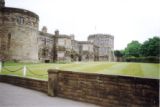
This coming weekend, the Red Wyvern Society will hold a medieval event of ‘Living History at Skipton Castle’, North Yorkshire, 2 to 4 June 2012.  This historical re-enactment society usually portrays the Clifford household, who were Lords of Westmorland and Craven.  The venue, Skipton Castle, belonged to the Clifford family, but for ten years it belonged to Richard, duke of Gloucester, later Richard III, before it was returned to the Cliffords after 1485.

The event is set to include many aspects of medieval life, including arms and armour, there is a trebuchet, there is a ‘Knight School’ and ‘Dinner is served’ at 14h00.  Members of the public will be able to mingle with medieval people, see and handle reproductions of medieval equipment and take part in some of the demonstrations.  To view the full programme, click here.

The following weekend, there is a two day academic symposium at Wingfield, Suffolk, ‘1362:  Celebrating 650 years of Wingfield Church and College’, on 9 and 10 June 2012.  The aim is to celebrate the 650th anniversary of the foundation of Wingfield Church and College and explore the history of Wingfield, Sir John Wingfield, and the de la Poles.

Richard III’s sister, Elizabeth, duchess of Suffolk, is buried in Wingfield church together with her husband, John de la Pole, duke of Suffolk. Their son, John de la Pole, earl of Lincoln, was Richard’s heir presumptive after the death of Richard’s son, and was probably born at nearby Wingfield Castle.

The speakers are all well-known, including Dr Rowena E. Archer, Sally Badham, Professor Mark Bailey, Professor Eamon Duffy, Dr John Goodall, Dr Robert Liddiard, Edward Martin, and Professor Diarmaid MacCulloch.  Dr Archer will be talking about the always fascinating Alice Chaucer; and Dr Goodall, whom we know as the author of The English Castle: 1066-1650 and God’s House at Ewelme, will concentrate on the architecture of Wingfield.  The complete programme can be viewed here.

Unfortunately we just missed a weekend of Anglo Saxon activities, ‘Hands on Saxon’, which took place in Verlamium Park in St Albans, Hertfordshire, 26 and 27 May 2012.  The reason for the event was to commemorate the 1,000th anniversary of the first written recorded use of the word “Hertfordshire” in the Anglo Saxon Chronicle.  In 1012 the town had approx. 500 inhabitants.  It was dominated by the Saxon Abbey and three churches marked its boundaries, St Michael’s in the west, St Peter’s in the North and St Stephen’s in the South.

1000 years later, some 4,000 people enjoyed historical displays depicting Saxon times, discovering what people wore, how they cooked and what their homes were like.  You can read a review here.

The above photograph shows Skipton Castle (© Dorothea Preis)

Tags: , ,

30
May

A surprise appearance of Richard III

   Posted by: Julia Redlich   in Bookworm

Trying to clear out a few books I found a novel by Angela Thirkell. She loved Anthony Trollope’s set of novels about Barsetshire and wrote about 20 of them updating the county and its inhabitants bringing them into the 20th century. I once read they were the best record of middle class England ever written. Now I realise there is another reason why I loved her books.

I picked up her last one – and one which I can’t discard obviously – and towards the end found this:

I felt just like a leper, like the wicked uncle in The Black Arrow who goes about ringing a bell and saying Unclean, Unclean … and why Stevenson thought so poorly of that book I shall never understand. All my boys loved it. They liked it much better than Treasure Island and Kidnapped except for Alan Breck, of course. And it was the only thing that made me really interested in Richard Crookback, until I read the book by that clever woman with three names*, who proved that Richard didn’t murder the little Princes in the Tower, and was a hero all the time and not a villain.

* “that clever woman with three names” is Elizabeth MacKintosh  (1896–1952), a novelist and playwright who wrote under the pseudonyms Josephine Tey and  Gordon Daviot.  The novel referred to in this passage is A Daughter of Time, which she published as Josephine Tey.

Tags: ,

24
May

Margaret of York

   Posted by: Lynne Foley   in Bookworm

Margaret of York

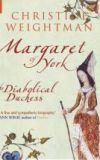
Book Review:  Margaret of York:  the Diabolical Duchess

Christine Weightman, Margaret of York:  The Diabolical Duchess.  Amberley Publishing, 2009.  ISBN 978 1 84868 099 9 (paperback)

This review was first presented at the 2012 NSW Convention in Mittagong.

The book deals with the life and times of Margaret of York, from her childhood to her death in 1503.

The aim of the book as stated by the author, is the examination of Margaret’s political activity, motivation and lifestyle. It is also a study of how a woman living in the second half of the fifteenth century could ensure her personal survival and prosperity.

The survival of many accounts of Margaret’s marriage to Charles, Duke of Burgundy, shows that it was a dazzling affair, dubbed “the marriage of the century.”  John Paston reported that he had seen nothing like it; there had not been such splendour since the court of King Arthur.  On her marriage to Charles the Bold she became the wife of one of the wealthiest rulers of Europe and lived among the riches and pageantry of the Burgundian court.

Margaret was a bibliophile, a more discerning collector than anyone else in her family, and gave books as presents to family and friends.  She had access to the ducal library – Charles himself, had a strong interest in the Classics, but twenty-five books have been identified as being Margaret’s. She was also a patron of William Caxton.

While the primary reason for marriage to Charles was to provide an heir for Burgundy, none eventuated. Charles assured Margaret of his affection, and unlike someone else I could name, he did not try to divorce her, let alone chop off her head. However, Margaret formed a mutually affectionate bond with her step-daughter Mary. After the latter’s untimely death, Margaret worked closely with Mary’s widower, Archduke Maximilian, and was quite involved in the lives of her step-grandchildren.

Margaret lived in tumultuous times. Within a decade of her marriage, she was widowed, when Duke Charles was killed in 1477 during the siege of Nancy. Thrown on her own resources, Margaret was to survive riots, rebellions, plots and counter-plots and political wheeling and dealing – and she was also a key player in politics. This aspect of the book could be a complex and confusing subject but the author makes it intelligible and interesting.

In terms of personality, Margaret is revealed as intelligent, resourceful, persuasive and a good businesswoman. The failure of her brother King Edward to pay the balance of her dowry was the play on her mind all her life and she was unstinting in her attempts to protect, and regain her dower lands. The usurpation of the throne by Henry Tudor saw her lose her profitable trading privileges.

That Tudor had taken the throne with French help, set off alarm bells in Burgundy, particularly when Henry failed to renew the Anglo-Burgundian alliance.  Maximilian would have preferred a Yorkist heir on the throne, indebted to Burgundy, and Weightman contends that Margaret would have given the Archduke her wholehearted support in any attempt to overthrow Henry. Nevertheless Margaret’s motivation for supporting first Lambert Simnel and then Perkin Warbeck are obscure.  Family feeling, politics, or both?  Weightman mentions that the Archduke and his son had a better claim to the throne than Henry, being directly descended from John of Gaunt and his first wife, Blanche.

Margaret was vilified by Tudor historians, who claim that her attempts to overthrow Henry as part of her “malicious and obsessive vendetta against him.” Polydore Vergil for example, claims that Margaret pursued Henry with insatiable hatred and with “fiery wrath.”  Edward Hall referred to her as a spider. Weightman states that the source of these opinions was Henry himself, who wrote to Gilbert Talbot in 1494 of the “great malice the Lady Margaret of Burgundy beareth continually against us…”

In conclusion, I can recommend this book because it brings Margaret to life in her own right, rather than her being brief mentions in other people’s stories.  It shows her participation as a player in the politics of late fifteenth-century Burgundy and England, and her resilience in surviving all the upheavals that came her way. This book is readable and an example of what good biographical writing can achieve in bringing to light a medieval life.

Tags: ,

21
May

WORTH HERALDING

   Posted by: Julia Redlich   in News, News from Other Organizations

Just a short reminder that it is not too late register interest if you want to attend the launch of Professor Stephanie Trigg’s book Shame and Honour: a Vulgar History of the Order of the Garter, organised by the Australian Heraldry Society.

The date is Friday, 8 June 2012; the venue: the Sydney Mechanics School of Arts, 280 Pitt Street, Sydney; the time: 5.45 for 6.30. Entry is by gold coin, there will be light refreshments beforehand – and there will be one of the Heraldry Society’s great raffles.

Those of us who attended the fascinating talk by Professor Stephanie Trigg on “Ladies of the Order of the Garter” a couple of years ago won’t want to miss this.

If you want to be there, please contact Stephen Szabo, Secretary of Australian Heraldry Society, by June 5. You can reach him by email: secretary@heraldryaustralia.org

Tags: ,

Members of The NSW Branch of The Richard III Society were saddened to hear of the passing of long time member Harold Bruce Cadell.

A funeral service in thanksgiving for the life of Harold was held at Harold’s parish church, the beautiful St John‘s Anglican Church, Darlinghurst, on Tuesday, 15th May 2012, and was attended by members of the various groups with whom Harold was affiliated over the course of his long life, including several current members of the NSW Branch of the Richard III Society.

It was a beautiful service and fitting for such a quiet, generous and gentle man. The minister conducting the service spoke warmly and well of Harold, the Christian gentleman , who had been such a loyal and well loved member of the parish community for many years and one whom he obviously knew well. The eulogy was given by a long time friend and work colleague, from whom we learnt so much of the working and social life and success of Harold. It was a beautiful classical Anglican Service and was organised at the behest of the trust company, who handled Harold’s estate.

We were quite chuffed when we were talking to the representative of the trust company at the wake, after explaining who we were, and she said: “ Ah yes, Richard III. I know from Harold how badly maligned he was by those Tudors. ”

Two members of our branch, who probably had known Harold the longest were unfortunately unable to attend.  They had suggested that white roses (for the House of York) should be included as they were so close to Harold’s heart. Thus two beautiful sprays of white roses were brought into the church and placed strategically on either side of the coffin. Unfortunately they had been initially forgotten and so those two sprays of white roses were all that could be hastily collected at the last minute from a quick run around the various florists in the area. Our thanks go to the organisers for so quickly and unobtrusively rectifying this oversight. White roses were then handed out to the congregation at the close of prayers around the coffin as it lay in the hearse prior to departure.

We then went across the road to a lovely intimate little café for the wake, where we were plied with copious platters of scrumptious sandwiches, savouries, desserts and tea and coffee. It was all done so beautifully, white table cloths, silver service, white crockery, that Harold – the epitome of fine dining and good taste (those of us who were his guests at lunches can attest) – would have approved.

It was here that we learnt complementary facts concerning Harold’s very active and interesting life. Apparently he began work at the Maritime Services Board as a very junior clerk at the age of 15 in 1935 and worked his way through the ranks to become Secretary of the Board for several years prior to his retirement, which occurred over 45 years later. The words constantly used in reference to Harold were integrity, sincerity, principled, unassuming, generous, kind, unaffected, loyal, steadfast and uncomplicated – all of with which we of the RIII Society who knew him so well concur.

Until recently, he had been a full member of the Society and used to anticipate with hardly concealed impatience the arrival of his quarterly Ricardian Bulletin and the Ricardian and the Chronicles of The White Rose. He used to attend meetings and social events regularly and warmly admitted his debt of gratitude to members for their kindness in keeping him in the loop and informing him of current branch news. Many of us were the recipients of his gracious thank you notes in his beautiful copperplate script. He truly was a man for others.  It was a privilege and a pleasure to know him.

In later years he used meet up with branch members to escort them to the church services for Bosworth Memorial Service or Queen Anne’s demise before enjoying lunch with many other members at a favourite Italian restaurant nearby. Harold always used to congratulate the staff on the fine food and the service and express his gratitude for their providing us with such a good open private room for our functions and ensure we left a suitable tip.

It wasn’t long after this that we learnt that, regrettably, he had had to go into care since he’d had several bad falls in the street.

He will be sadly missed by all of us who knew him.

R.I.P.

Tags:

On Saturday 12 May 2012 the Richard III Society NSW Branch held their eagerly anticipated biannual mini-conference in the Southern Highlands, at the Mittagong RSL.

A few of us, who had travelled to Mittagong the day before, met up for an informal dinner in the club’s bistro, being happy meeting old friends and making new ones.

The event was attended by both Sydney-based regulars (some of whom braved the long journey on buses replacing the usual trains) and other members, some coming from as far away as the ACT and Victoria.  We were especially pleased to welcome Michael, the chairman of the Victoria branch, and his wife Yvonne, as well as Gillian and Bruce from the South Australian branch.

The presentations were very diverse, with competent speakers from a wide range of backgrounds. David Mee spoke on ‘Medieval Coins’ and brought examples of types of coinage from across the centuries, including one from the era of Richard III.

Judith Hughes spoke on ‘Eleanor Talbot, the Spurned Queen’, being the hapless lady the self-serving young Edward IV secretly wed then ignored for the rest of her life, whilst making a public life with Elizabeth Woodville, with whom he had his large brood.

Karen Clark spoke on ‘John Nevill’s Feud and the Destruction of a Family’, an area of particular expertise and one on which she is writing a book. Her detailed grasp of the generations of family members and their competition was impressive. The Percy family still survives, although the Nevilles are long gone, she mentioned in conclusion.

Kevin Herbert spoke on the ‘Royal Relicts’ – the widows of the kings. His handout was chockfull of details worth knowing, and his presentation a highlight of the day.

Lynne Foley and Dorothea Preis critiqued Ricardian books they had recently read.  Lynne favourably reviewed Margaret of York: The Diabolical Duchess by Christine Weightman. Dorothea told us about the recently published Richard III by David Baldwin, which has its good points, but does not offer much new for someone well versed in the period. Her wise counsel saved us all some cash and precious time by knowing which books we could safely skip.

Doug and Leslie McCawley spoke about their favourite Ricardian books, having been invited on short notice to replace a speaker who had to cancel. They chose the ever-popular Daughter of Time by Josephine Tey, The Sunne in Splendour by Sharon Penman, and Some Touch of Pity by Rhoda Edwards.

Julia Redlich spoke about how Richard III has been presented on stage across time.

Helen Portus and Denise Rawling spoke on ‘Richard III the Posthumous Hunchback’, getting audience members to question what we accept on face value in the media, and encouraging us to be discerning consumers of received opinions and so-called histories.

Ann Chandler gave us a comprehensive (and tricky) 4-page quiz to complete during the day, then graded the results and announced the winners. The more cowed amongst us did not hand our quizzes in, admitting defeat early on!  Our congratulations went to Karen for winning by achieving 47 out of 50 possible points.

In addition to the speakers, other attractions included a Bring and Buy table, the sale of the books from the lamented dissolution of the once fine branch library, Ricardian pens, bags and brooches for sale, and best of all the opportunity to catch up with friends in a leisurely manner.

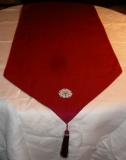
At the conclusion of the day, the representatives of the Victoria branch surprised us by presenting the NSW branch with a beautiful table runner in Yorkist murrey adorned with white roses.  We were delighted and would like to give a big ‘thank you’ to our friends from Victoria!

A number of attendees chose to stay for the weekend so the festivities continued after the conference proper with dinner out and a day to explore the attractions of the area. The weather was sparklingly clear and cool, and the venue well chosen. Thanks to the organisers for another successful and pleasurable branch event.

Leslie McCawley

Members, who decided to stay on at Mittagong, as well as several partners met up on Saturday evening for dinner with lots of interesting talk and laughter on a wide variety of topics.  We discovered that most of us were addicted to Phryne Fisher on Fridays and Miss Marple on Tuesdays – how we loved the fact that Mrs Lancaster was the baddie in a recent episode!  Other topics were the Richard III of Horrible Histories, medieval and more modern jewellery.  We wondered why so often in information for the general public there seems to be nothing of historical interest before the Tudors came along – quite contrary to what actually happened.

We all enjoyed the food and, when consulting with the delightful waitstaff, we learned that the chef was new. Yvonne from the Victoria branch immediately told them that they were never to let him go! Although it wasn’t a formal Ricardian banquet, the Man Himself was not forgotten in a loyal toast – and the three fingered salute from Horrible Histories.

Dorothea Preis and Julia Redlich

Sunday morning saw us enjoying a long leisurely breakfast. Some farewells were said to those who had to return home, then the rest of us prepared for our excursion to the small Southern Highlands town of Robertson.
One group opted for the swiftest way thanks to SatNav; the other decided on the Scenic Route – and what a reward that was: sunshine, blue skies, green fields, magnificent mansions and extensive gardens behind imposing gates – and the trees wearing their most wonderful autumn colours of red and gold.

Colour was also important in discovering the others at our destination, something made simple by spotting Kevin wearing the super-long scarf in Ricardian colours that Alex had made for our sales table!

It was the monthly market day, so wandering around the stalls was a must. Chilly winters mean the locals are knitters beyond compare! The quality of the huge choice of items from sweaters to babywear and beanies was wonderfully enticing, as were the book selections – and as for the vegetable displays …

The obvious choice for lunch was the Fantastic Robertson Pie Shop, where justice was done to piping hot pastries with a mind-boggling range of fillings. One group then went on an antiques exploration, the other chose to return to Mittagong, put their feet up with the Sunday papers and gather strength for return to the everyday life after yet another rewarding Ricardian weekend.

Julia Redlich

The two photographs from the conference © Bruce Laughton; the photograph of the table runner © Julia Redlich.

Tags: , , ,

9
May

Vale, Harold Cadell

   Posted by: Isolde Martyn   in News, NSW Branch News

We regret the passing of an enthusiastic and loyal member of the NSW Branch, Harold Cadell, on 4 May 2012.

Harold Cadell was a member of the Sydney Branch from its early days and always stout in defending Richard III’s reputation. He was a courteous and well-read man, but in latter years, age got the better of him and he no longer could come along to meetings. Those who knew him will remember him as a kindly and quiet presence, with just that tad of flamboyance that was rather fun.

His funeral will be held on Tuesday, 15 May 2012, in Darlinghurst.

The NSW Branch would like to extend our sympathy to his family and friends.

Tags:

9
May

50 Great Ghost Stories

   Posted by: Lynne Foley   in Bookworm

50 Great Ghost Stories, ed. John Canning, Odham’s Books, reprinted 1968. (No ISBN)

Occasionally, one finds matters Ricardian unlikely sources.  50 Great Ghost Stories, edited by John Canning, has two stories by Vida Derry and Frank Usher.

In Derry’s ‘Child Ghosts’, she mentions the Princes in the Tower. She does not accuse Richard, but relates the story that Tyrell was responsible for arranging their deaths according to the narrative of Thomas More. She does not say that More’s work is ‘gospel’ as far as Richard is concerned.

She finds it worth noting that the examination of the bones in 1933 was completed in five days whereas the examination of the remains of Anne Mowbray were still at work three months after they were found, despite protests by Lord Mowbray.

In Usher’s ‘Hauntings Royal’, the first paragraph names Henry VIII, according to popular opinion, as one of the arch-villains of history.  He deals at length with the alleged hauntings by Anne Boleyn, mention the elusive ghosts of Jane Seymour, Sybil Penn (Edward VI’s nurse) and Catherine Howard.  He refers to Henry as “the professional widower” and mentions more than once that unlike his victims, Henry rests peacefully in his grave. The following pages detail more executions and Henry is referred to as the “arch-villain of all these beheadings.”

When discussing the execution of Margaret Pole, Countess of Salisbury, he states “she had a better title to the throne than Henry himself, as his father Henry VII having usurped the throne from its lawful inheritors.”

Ectoplasmic manifestations aside, the book contains many well-known and not so well known ghost stories, and although not a believer, I would still prefer to have a strong light on, and my chair against the wall when reading The Brown Lady of Raynham.

50 Great Ghost Stories, ed. John Canning, Odham’s Books, reprinted 1968. (No ISBN)

Tags: ,

7
May

Richard III as Law Maker

   Posted by: Dorothea Preis   in Medieval Miscellany

As a law maker Richard clearly showed that his view on education was not only a religious duty, but went much further than that.  While trying to limit the activities of foreign merchants in England the statutes of his only parliament included a Proviso, exempting all merchants and craftsmen concerned in the book trade from the scope of the Act.  This was clearly intended to encourage a good supply of books. [Armstrong, p.276]  Books were in his day the most up to date means of spreading ideas and learning.  If he encouraged books, he must have supported the circulation of ideas.

Richard III as Law Maker

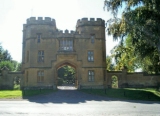
Abbey Gateway, St Albans (© D Preis)

The context between books and education becomes clear in the following example:  Only a few years after William Caxton introduced the printing press to England in the mid 1470s, there was a printing press  in St Albans as well, located in the Abbey Gateway.  This was the third one in England, after Caxton’s in London and one in Oxford.  We don’t know the identity of the St Albans printer, but he was referred to as “sometyme scole master of Saynt Albans”.  [‘Printing in England’]  The press in St Albans produced books between 1479 and 1486, eight of which have survived.  The first six, printed between 1479 and 1483, were Latin university texts.  It has been suggested that they were aimed at purchasers from Cambridge, where at that time no press had been established. [Orme, p.181]

We should not forget, however, that Richard’s appreciation for books was also a personal one.  There are eighteen surviving texts, of which we know for sure that they are connected to him.  In some he signed his name, two are dedicated to him and one has an indirect dedication.  It seems likely that these are just a part of a far more extensive library, though without an inventory it is impossible to draw too many conclusions. [Sutton & Visser-Fuchs, ‘Richard III’s Books’, p.374]  With these surviving books we can be sure that they belonged to him, because he put his name in the text itself.  With others his name might have been on the flyleaf, which has got lost since then, or they might have been marked with his arms, which have since been changed to someone else’s. [Sutton & Visser-Fuchs, ‘Richard III’s Books’, p.381]

From his books, Sutton and Visser-Fuchs conclude that he was “an industrious and committed reader”, who showed a high level of education and literacy.  This lead them to speculate that he could possibly in his early youth , as the youngest son, have been destined for the church, though this would have changed when his father and brother were killed and his brother  Edward became king.  [Sutton & Visser-Fuchs, ‘Richard III’s Books’, pp.384-385]  Considering that many of the learned (church-) men among his close connections had humanist interests, it is surprising that among the books we know he owned there are no works of theology or humanist interest.  All of us who like reading and books, can glimpse a kindred spirit when Sutton and Visser-Fuchs conclude that “He did not collect them [books] as objects but used them for what they could give him and others in the way of instruction, consolation and entertainment”. [Sutton & Visser-Fuchs, ‘Richard III’s Books’, p.385]

I think that all these examples of Richard’s relationships with learning, be it with learned men,  the centres of learning, books ,as well as his activity as law maker shows clearly that learning was something close to his heart.  I would like to close my talk with the words of the anonymous chronicler of Magdalen College in Oxford:  “Vivat rex in eternum!

Bibliography

Books:

Virginia Davis, William Waynflete, Bishop and Educationalist.  Studies in the History of Medieval Religion.  Boydell Press, Woodbridge, 1993. ISBN 9780851153490
Rhoda Edwards, The Itinerary of King Richard III 1483-1485.  Richard III Society, 1983. ISBN 090489309X
Peter Hammond, Richard III and the Bosworth Campaign.  Pen & Sword Military, 2010.  ISBN 9781844152599
Maurice Keen, English Society in the Later Middle Ages, 1348-1500.  Penguin Books, 1990.  ISBN 9780140124927
A. H. Lloyd, The Early History of Christ’s College, Cambridge, Derived from Contemporary Documents.  Cambridge Library Collection, 2010.  ISBN 9781108008976 (First published in 1934)
J.M. Melhuish, The College of King Richard III Middleham.  Richard III Society, London (undated)
Nicholas Orme, Medieval Schools: From Roman Britain to Renaissance England.  Yale University Press, 2006.  ISBN 9780300111026
Jeremy Potter, Good King Richard?  An Account of Richard III and his Reputation.  Constable Books, 1996.  ISBN 9780094688407
Charles Ross, Richard III.  Yale English Monarchs, Yale University Press, 1999, Reprinted 2005.  ISBN 9780300079791
John Stow, A Survey of London, witten in the year 1598 by John Stow.  Whittaker, London, 1842.
Anne F. Sutton & Livia Visser-Fuchs, The Hours of Richard III.  Alan Sutton Publishing Pty Ltd, 1996.  ISBN 9780750911849

Articles:

P.S. Allen, ‘Bishop Shirwood of Durham and His Library’, The English Historical Review, Vol. 25, No. 99 (July 1910), pp 445-456.
Elizabeth Armstrong, ‘English Purchases of Printed Books from the Continent 1465-1526′, The English Historical Review, Vol. 94, No. 371 (April 1979), pp. 268-290.
W. H. G. Armytage, ‘William Byngham: A Medieval Protagonist of the Training of Teachers’, History of Education Journal, Vol. 2, No. 4 (Summer 1951), pp. 107-110
Michael J. Bennett, ‘Education and Advancement’, in:  Fifteenth-Century Attitudes:  Perceptions of society in late medieval England, ed. Rosemary Horrox.  Cambridge University Press, 2008, pp.79-96.  ISBN 9780521589864
Christopher Brooke, ‘Urban church and university church:  Great St Mary’s from its origins to 1523’, in:  Great St Mary’s, Cambridge University’s Church, ed. John Binns & Peter Meadows.  Cambridge, 2000, pp.7-24.  ISBN 0521775027
R.B. Dobson, ‘Richard III and the Church of York’, in:  Kings and Nobles in the Later Middle Age, ed. Ralph A. Griffiths & James Sherborne.  1986, pp.130-154
Rena Gardiner, ‘The Story of Magdalen’, Magdalen College (2003).  URL:  http://www.magd.ox.ac.uk/__data/assets/pdf_file/0010/4303/Illustrated_Magdalen_College_History.pdf Date accessed: 13 July 2010
Robert C Hairsine, ’Oxford University and the Life and Legend of Richard III’, in:  Richard III:  Crown and People, ed. J Petre.  Richard III Society, 1985, pp. 307-332.  ISBN 9780904893113
Rosemary Horrox, ‘Richard III and Allhallows Barking by the Tower’, The Ricardian, Vol.VI, No.77 (June 1982), pp.38-40
Rosemary Masek, ‘The Humanistic Interests of the Early Tudor Episcopate’, Church History, Vol. 39, No. 1 (March 1970), pp. 5-17.
Anne F. Sutton, ‘’A Curious Searcher for our Weal Public’:  Richard III, Piety, Chivalry and the Concept of ‘The Good Prince’’, in:  Richard III: Loyalty, Lordship and Law, ed. P.W. Hammond.  Richard III and Yorkist History Trust, 2000, pp.69-105.  ISBN 9781900289375
Anne F. Sutton, ‘Richard of Gloucester’s Lands in East Anglia’, in:  Richard III and East Anglia:  Magnates, Gilds and Learned Men, ed. Livia Visser-Fuchs.   Richard III Society, 2010, pp.1-30.  ISBN 9780904893199
Anne F. Sutton & Livia Visser-Fuchs, ‘Richard III’s Books Observed’, The Ricardian, Vol.IX, No.120 (March 1993), pp.374-388
Anne F Sutton and Livia Visser-Fuchs, ‘Richard III, the Universities of Oxford and Cambridge, and Two Turbulent Priests’, The Ricardian, Vol. XIX, 2009, pp.95-109
Anne F. Sutton & Livia Visser-Fuchs, ‘’As dear to him as the Trojans were to Hector:’ Richard III and the University of Cambridge’, in:  Richard III and East Anglia:  Magnates, Gilds and Learned Men, ed. Livia Visser-Fuchs.  Richard III Society, 2010, pp.105-142.  ISBN 9780904893199
Barrie Williams, ‘Richard III’s Other Palatinate:  John Shirwood, Bishop of Durham’, The Ricardian, Vol.IX, No.115 (December 1991), pp.166-169
B.P. Wolffe, ‘The Management of English Royal Estates under the Yorkist Kings’, The English Historical Review, Vol. 71, No. 278, Jan. 1956, pp. 1-27.

British History Online:

‘Colleges: Barnard Castle’, A History of the County of Durham: Volume 2 (1907), pp. 129-130. URL: http://www.british-history.ac.uk/report.aspx?compid=39906 Date accessed:  5 November 2010
‘The history of All Hallows Church: To c.1548’, Survey of London: volume 12: The parish of All Hallows Barking, part I: The Church of All Hallows (1929), pp. 1-20. URL: http://www.british-history.ac.uk/report.aspx?compid=100058 Date accessed:  8 April 2012

‘The colleges and halls: Queens’’, A History of the County of Cambridge and the Isle of Ely: Volume 3: The City and University of Cambridge, 1959, pp. 408-415. Online URL: https://www.british-history.ac.uk/vch/cambs/vol3/pp408-415 [last accessed 22 May 2020]

Oxford Dictionary of National Biography:
Cecil H. Clough, ‘Gunthorpe, John (d. 1498)’, Oxford Dictionary of National Biography, Oxford University Press, 2004; online edn, May 2009.  URL:  http://www.oxforddnb.com/view/article/11752  Date accessed:  10 March 2011
Virginia Davis, ‘Waynflete , William (c.1400–1486)’, Oxford Dictionary of National Biography, Oxford University Press, 2004.  URL:  http://www.oxforddnb.com/view/article/28907  Date accessed:  20 Jan.  2011
Michael Hicks, ‘Neville, George (1432–1476)’, Oxford Dictionary of National Biography, Oxford University Press, 2004; online edn, Jan 2008.  URL:  http://0-www.oxforddnb.com.library.sl.nsw.gov.au/view/article/19934  Date accessed:  14 April 2011
Jonathan Hughes, ‘Barowe , Thomas (d. 1499)’, Oxford Dictionary of National Biography, Oxford University Press, 2004.  URL:  http://www.oxforddnb.com/view/article/1503  Date accessed:  10 March 2011
Peter Partner, ‘Wykeham, William (c.1324–1404)’, Oxford Dictionary of National Biography, Oxford University Press, 2004; online edn, May 2009.  URL:  http://www.oxforddnb.com/view/article/30127  Date accessed:  7 March 2011
A.J. Pollard, ‘Shirwood, John (d. 1493)’, Oxford Dictionary of National Biography, Oxford University Press, 2004; online edn, Jan 2008.  URL:  http://www.oxforddnb.com/view/article/25447  Date accessed:  10 March 2011
John A. F. Thomson, ‘Russell, John (c.1430–1494)’, Oxford Dictionary of National Biography, Oxford University Press, 2004; online edn, Jan 2008.  URL:  http://www.oxforddnb.com/view/article/24318  Date accessed:  10 March 2011
D. P. Wright, ‘Langton, Thomas (c.1430–1501)’, Oxford Dictionary of National Biography, Oxford University Press, 2004; online edn, May 2009.  URL:  http://www.oxforddnb.com/view/article/16045  Date accessed: 10 March 2011

Internet sites:

‘Middleham Collegiate Church’, URL:   http://www.britannia.com/tours/yorksmon/middleham.html Date accessed:  27 March 2010
‘St Mary’s Barnard Castle’, URL:   http://www.stmarysbarnardcastle.org.uk/ourparish/43-st-marysbarnardcastle Date accessed: 17 March 2010
‘Church on mission to revamp building’, Teesdale Mercury (2 March 2010).  URL:   http://www.teesdalemercury.co.uk/teesdale-news/story,2513.html Date accessed:  17 March 2010

‘History of the Chapel’, King’s College Cambridge.  URL:   http://www.kings.cam.ac.uk/chapel/history.html [last accessed 22 May 2020]

‘Printing in England from William Caxton to Christopher Barker – An Exhibition: November 1976 – April 1977’, University of Glasgow.  URL:  http://special.lib.gla.ac.uk/exhibns/printing/ Date accessed:  16 April 2012

Part 1 – Richard III and Learned Men

Part 2 – Richard III as the Founder of Collegiate Churches

Part 3 – Richard III and the Universities of Oxford and Cambridge

Tags: , , , , ,