Richard III and the Universities of Oxford and Cambridge

For someone supporting learning and ambitious to provide a more learned clergy in parishes, it would only be natural to have close relations to the two universities at Oxford and Cambridge.

1. Oxford

After his coronation Richard left on a Royal Progress on 21 July 1483.  One of his first stops was Oxford, where he arrived on 24 July and stayed at Magdalen College [Hairsine, p.308] on the invitation of its founder, Bishop Willaim Waynflete.  Though geography certainly played a role, the fact that he visited Oxford so early in his reign, must mean that there was a keen interest as well.

He was not the first royal visitor to Magdalen though.  In September 1481 Edward IV had been staying at Woodstock, where Waynflete visited him and talked him into having a look at his College, which Edward did on 22 September.  He and his entourage arrived after sunset and were welcomed in style.  They spent the night and much of the next day at the College, where Edward listened to a brief speech congratulating him on his arrival and petitioning his support [Magdalen College Register ‘A’, ff.7b, 8, quoted in Hairsine, pp. 325-326].  A statue of Edward on the gate commemorates his visit.

Richard III and the Universities of Oxford and Cambridge

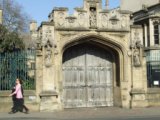
Gate of Magdalen College, Oxford – Mary Magdalen in the middle, William Waynflete on the left and Edward IV on the right. (© D Preis)

Richard’s reception was a grander affair.  He was “honourably received, firstly outside the University by the Chancellor of the University and by the Regents and non-Regents; then he was received honourably and in procession at the College of the Blessed Mary Magdalene by a speech by the lord Founder” (i.e. Waynflete). [Magdalen College Register ‘A’ f.27b, quoted in Hairsine, p.309]

The day after his reception, we see Richard following his own cultural taste. Unlike the short speech, which was given to Edward, he listened to two debates, one on moral philosophy and one on theology.  I think Hairsine is right when he remarks:

There was certainly no need for a medieval autocrat to sit through not one but two learned debates if he did not find a genuine interest there.  One is lead to believe that Richard’s visits to Oxford and Cambridge were welcome interludes from the cares of government [Hairsine, p.309].

Richard seems to have been impressed with the debates as well as his welcome and rewarded the participants and Magdalen College handsomely with venison and cash.  The whole event was in detail recorded in the Register of Magdalen College, which the anonymous Chronicler ended with the words Vivat rex in eternum, which can be translated as a “may the King live forever!” [Hairsine, p.309].

Richard III and the Universities of Oxford and Cambridge

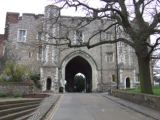
Magdalen College, Oxford (© D Preis)

In the end of October 1483, Richard came for a second visit to Oxford, again staying at Magdalen College, though not much is known about this visit [Hairsine, p.311].  The last documented connection between Oxford University and Richard is in March 1485, when Richard recruited an Oxford graduate into his service [Hairsine, p.317].


2. Cambridge

Richard’s connection to Cambridge lasted over a much longer period compared to the one to Oxford, starting in the mid 1470, when he gave 20 marks to the university in 1475-76.   It seems to have been a very close and cordial relationship from both sides.  On 7 April 1481, the congregation of the university wrote a remarkable letter to the then Duke of Gloucester.  In it they announce that in gratitude for the many favours he had shown them, they would “ask every Cambridge doctor or bachelor of theology who preached at [two places in London famous for their Easter celebrations] to mention Richard by name, to commend him to their listeners, and ask for prayers for his well being,” an honour which had never been granted to anyone before.  In early 1480 or 1481 two representatives of the University travelled to London to see Richard – a six day journey in bad weather.  In 1482 the University staged a procession to celebrate his victory against the Scots. [Sutton & Visser Fuchs, ‘Cambridge’, pp.112-114]

The good relationship continued when Richard became king.  Probably in late June 1483, the University wrote to Richard to ask for his mercy towards one of their graduates, Thomas Rotherham, the Archbishop of York, who was Chancellor at that time.  He had been arrested on 13 June 1483 in connection with the Hastings affair.  Rotherham was released in due course. [Sutton, Visser-Fuchs, ‘Universities’, pp.95-99] Richard visited the University in early March 1484 and was welcomed with a procession and masses.  They also decided to say a special mass every year on 2 May for Richard and Anne.  They promised that as soon as they would hear of his death they would perform a special funeral mass, a promise they kept, as the accounts for 1485 show the expense for candles used at the ‘exequies of King Richard”. [Sutton & Visser Fuchs, ‘Cambridge’, pp.114-115]

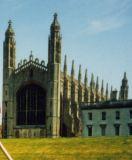
There are especially three institutions in Cambridge, which benefitted from Richard’s generosity and which we can admire today.

2.1 King’s College

On a visit to the King’s College Chapel in Cambridge more than 20 years ago, I bought a postcard showing “The Kings who built the Chapel”.  Though Henry VIII is depicted as the crowning glory, it was the inclusion of Richard which made me buy the card and eventually investigate this subject.

Richard III and the Universities of Oxford and Cambridge

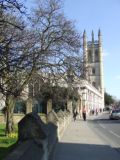
King’s College Chapel, Cambridge (© D Preis)

King’s College was founded by Henry VI in 1441, building work started in July 1446.  When Edward came to power in 1461, the workmen packed up their tools and very little was done to continue during his reign.  This changed dramatically, when Richard became King.  He gave instructions that “the building should go on with all possible despatch” and to “press workmen and all possible hands, provide materials and imprison anyone who opposed or delayed”.  He also sent his own master plumber and glazier to help with the building. This result was that by the end of his reign the first six bays had reached full height, of this the first five were roofed with oak and lead and were in use. The University thanked him for funding and “erecting the buildings of King’s College, the unparalleled ornament of England.”  Drawings of a planned tower still exist, which can be dated to 1484. [‘History of the Chapel’; Sutton & Visser-Fuchs, ‘Cambridge’, pp.116-117]

Henry Tudor was in no rush to continue the project, even though the college complained that the building “begun by royal munificence now stands shamefully abandoned”.  Only later Henry realised that the association with the “royal saint” Henry VI might help with legitimising his reign and decided to finish the chapel with work starting in earnest in 1508. [‘History of the Chapel’]

2.2 Queens’ College

While Richard left his mark on the King’s College Chapel during his reign, his relationship with Queens’ College predates his reign.

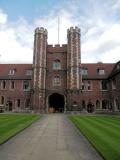
Queens’ was originally founded by Andrew Doket as the college of St Bernard in 1446, one year later Henry VI confirmed this, but as his foundation.  In 1448 a further charter declared it to be the foundation of Margaret of Anjou.  From 1465 onwards, Elizabeth Woodville came to be regarded as a co-founder, which explains the name (Queens’), though there is no evidence that either Margaret or Elizabeth ever gave the college any endowments. During Richard’s reign, when he made further grants to the College, Queen Anne was also considered a founder, but that was “conveniently forgotten when political circumstances changed in 1485”.  Andrew Doket remained as president until his death in 1484 and worked tirelessly for the benefit of the college.  [Sutton & Visser-Fuchs, ‘Cambridge’, pp.121-129; Ross, p. 135]

Richard III and the Universities of Oxford and Cambridge

Queens’ College, Cambridge (© D Preis)


Richard relationship with Queens’ began on 1 April 1477 when he gave the property of Fowlmere, Cambridgeshire, to the college, with the aim to fund 4 priests, fellows of the college, to say prayers for a number of Richard’s living relatives and for the souls of departed.  Among the people to be commemorated in the prayers were – apart from his family – also friends, who had fallen in the battles of Barnet and Tewkesbury.  There were also to be prayers for John de Vere, the 12th Earl of Oxford, executed in 1462 by Edward IV, and his widow, to whom the manor of Fowlmere had belonged.  [Sutton & Visser-Fuchs, ‘Cambridge’, pp.120-124; Ross, p.135]

Richard’s endowment to Queens’ has to be seen in connection with the foundation of his colleges at Middleham and Barnard Castle.  The statutes of his college at Middleham require that, should it not be possible to find a dean from among the 6 chaplains there, this position should be filled by one of the 4 men at Queens’.  This would ensure that Middleham and Barnard Castle had the best religious instruction, liturgy and music available. [Sutton & Visser-Fuchs, ‘Cambridge’, p.120]

Queens’ benefitted greatly from Richard and Anne during his reign.  Anne intended to give estates from her Neville and Beauchamp inheritance to the college, but it had to give all this up when Henry Tudor came to the throne.   Richard also gave the college a silver seal including a boar device, which might have been part of new arms, which survives to today as one of several arms.  [Sutton & Visser-Fuchs, ‘Cambridge’, pp. 126-129]

Queens’ is almost completely constructed of red brick, probably imported from Holland.  The oldest part, which Richard would have known is the Old Court.  Because of the durability of the bricks this court still is almost as it was built [BHO, ‘Queens’].

2.3 Great St Mary’s

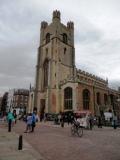
In 1478-79, Richard gave £20 for the rebuilding of the university church, Great St Mary.  Even after his death his support for the church continued to have an effect.  On 21 January 1495, Thomas Barowe, a close associate of Richard and master of the rolls and keeper of the great seal, gave the extravagant amount of £240 to the rebuilding of the church and for “masses, prayers and ceremonies in honour of King Richard III and Dr Thomas Barowe – who were to be enrolled in the list of the university’s benefactors”.  Richard was for a while politely forgotten, but has more recently been restored.

Richard III and the Universities of Oxford and Cambridge

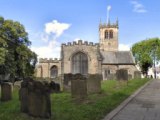
Great St Mary, Cambridge (© D Preis)

The rebuilding of the nave was begun in the late 1470s, at the time of Richard’s gift.  Barowe, who had intended the church as a monument to Richard, would with his gift have secured its completion.  Possibly he was continuing a process initiated by Richard’s gift of £20, as there are records stating that he acted as a messenger to bring gifts from Richard to Cambridge. [Brooke, pp.18-21; Sutton & Visser Fuchs, ‘Cambridge’, p.113]

Part 1 – Richard III and Learned Men

Part 2 – Richard III as the Founder of Collegiate Churches

Part 4 – Richard III as Law Maker (incl. bibliography)

Tags: , , , , ,

5
May

Richard III as the Founder of Collegiate Churches

   Posted by: Dorothea Preis   in Medieval Miscellany

Richard as the Founder of Collegiate Churches

Where we today can come closest to Richard and his patronage of learning is through the centres of learning, which he supported.  There are the two universities, Oxford and Cambridge, but we must not forget the collegiate churches he founded.

The late middle ages saw the foundation of numerous chantries and collegiate churches to provide prayers for the dead.  A chantry was an altar endowed for one or more priests to say Mass for its founder and possibly other patrons.  The size of chantries ranged from a side altar in an existing parish church to separate chapels.

A collegiate church or college was a corporation of secular priests set up for the same purpose as chantries.  Sometimes they were not part of a parish, but most often they were added to an existing parish church.

It was not unusual to have almshouses or schools attached to chantries and colleges [Keen, p.273; Melhuish, p.1].  While Richard followed the fashion for college foundations enthusiastically – in total he was responsible for 10 chantry or collegiate foundations [Ross, p.130] – there is no evidence that schools (or almshouses for that matter) were to be included in the colleges he set up, but this does not necessarily mean that no education took place.  As with all these foundations “Divine service and the ability to sing God’s praise came first, education second, but they were closely interrelated.” [Sutton & Visser Fuchs, ‘Cambridge’, p. 106]  It also needs to be remembered that choristers would need a teacher of grammar and music, who could very well teach other boys as well. [Sutton & Visser Fuchs, ‘Cambridge’, p.120]

1. The College at Middleham

Richard III as the Founder of Collegiate Churches

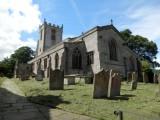
St Mary and Alkelda, Middleham (© D Preis)

In 1477 Richard began to establish two colleges, one at Middleham and one at Barnard Castle, for both of them he procured royal licences on 21 February 1478. [Ross, p.130].

The origins of the parish church of St Mary and St Alkelda in Middleham might date back to Saxon times, but its elevation to college status was Richard’s work.  The college was to consist of a dean, 6 chaplains, 4 clerks, 6 choristers and a sacristan.  One of the clerks was charged with offering perpetual masses for the good of Richard’s living family and the souls of all the faithful departed [Melhuish, pp.1-2].

The statutes for the college are in English, and probably reflect the most detailed indication of Richard’s personal religious taste.  The dean had to have his continual residence at Middleham and it is emphasised that he had to have sufficient learning.  [Dobson, p.141]

Over time Richard settled property on the college, though his last settlement, made shortly before Bosworth, by which he wanted to make the college more financially secure, was not enacted by Henry Tudor. [Melhuish, pp.6-10]

The first dean was William Beverley, who probably came from York and was a Cambridge graduate.   He had been the rector of Middleham before Richard set up the college and then became its first dean.  Richard must have liked him a lot.  When he became king, Beverley’s career took off dramatically.  He was promoted to dean of the king’s chapel of St Stephen’s, Westminster, and dean of St George’s, Windsor, and was granted many other benefices, among them that of dean to the collegiate church of Wimborne in Dorset.  He was also made precentor at York Minster.  Previously this had not been a valuable benefice, but this was changed when Beverley came, which might have been just as well, as he kept this position after Bosworth.  Towards the end of 1493 he contracted the sweating sickness and died.  He requested to be buried either at York Minster or the church at Middleham. [Sutton & Visser-Fuchs, ‘Cambridge’, pp.124-125; Dobson, pp.142-144]

While many of these collegiate foundations became victims of the reformation, the King’s College of Middleham was one of the few exempted from suppression [Melhuish, p.8] and continued as a college until 1845, when a special Act of Parliament had to be passed to abolish it.  Nor is Richard forgotten:  he and his family have a memorial window in the South Aisle and his pennant is flown from the tower on significant dates [‘Middleham Collegiate Church’].

2. The College at Barnard Castle

Richard III as the Founder of Collegiate Churches

St Mary’s, Barnard Castle (© Copyright David Dixon and licensed for reuse under this Creative Commons Licence)

Compared to Middleham, nothing much is known about the college at Barnard Castle, but it has to be assumed that it was planned along similar lines, though on a far grander scale with twelve priests, ten clerks and six choristers.  This would have made it “the most ambitious late medieval chantry establishment in the palatinate of Durham”. [Dobson, p.141]  However, as the only existing document is the licence, it seems likely that it never came into being.  [Ross, pp.130-131; BHO ‘Barnard Castle’]  Nevertheless, Richard carried out extensive alterations to the church of St Mary’s from 1477 until his death in 1485.  If you visit the church today you can come face to face with Richard:  The chancel arch is decorated with Yorkist roses and two portrait heads, believed to be those of Edward IV and Richard.  Outside the church Richard’s badge, the Boar Passant, is carved in the exterior of the East window of the South Transept.  The church’s website remembers him as their “great benefactor”, [‘St Mary’s Barnard Castle’] and a newspaper article said:  “Fate smiled on St Mary’s in Barnard Castle when Richard III came to power”.  [‘Church on mission to revamp building’].

3. The College at York Minster

Richard III as the Founder of Collegiate Churches

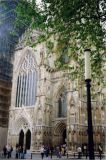
York Minster (© D Preis)

As king, Richard planned an even larger college with 100 priests as an extension to St William’s College at York Minster, which had been founded by George and Richard Neville.   Contemporary information on this project rather limited.  At the time of Richard’s death, six new altars had been constructed within in the minster for the king’s chaplains and the building of their collegiate house had been started and he had given the Minster money, precious relics as well as a magnificent jewelled altar cross.  It is not known whether any of the priests had actually arrived, nor do we know what their exact responsibilities would have been apart from celebrating mass for Richard and his family.  [Dobson, pp.144-146; Ross, pp.130 +132; Sutton, ‘Piety’, pp.85+88, Melhuish, p.14]  Because of his grand plans for the York Minster, it has been suggested that this is where his son Edward is buried.  Richard and – probably – Anne visited York unofficially for three days in the beginning of May 1484, which might have been for their son’s burial. [Hammond, p.31]  It is even possible that he might have planned this chantry to serve as the tomb for himself and his family [Dobson,pp.146-147] with the priests looking after the family’s spriritual needs in this world and the next.

4. The College at St. Mary, Allhallows

Richard III as the Founder of Collegiate Churches

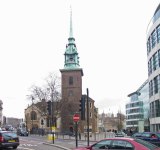
All Hallows by the Tower (© Copyright John Salmon and licensed for reuse under this Creative Commons Licence)

The three previous colleges were all in the North, but Richard also “founded another in the church of St. Mary of Barking, by the Tower of London” [John Rous, History of the Kings of England; quoted in Potter, p.88].  St Mary was a chapel in the churchyard of Allhallows near the Tower of London, which had been founded by Richard I (the’ Lionheart’).

In 1465 Edward IV had had founded a chantry there with two chaplains, who were to pray for the king and his family including brothers and parents.  The chapel was governed by a fraternity, whose warden was John Tiptoft, earl of Worcester, another man of great learning and an early importer of printed books. [Armstrong, p.269]

Richard then wanted to erect a deanery and give it the status of a royal free chapel.  He persuaded Barking nunnery in Essex, to whom the mother church Allhallows belonged, to give up the mother church to the chapel in exchange for a pension.  Like Middleham, it was planned as a college with a dean and six cannons.  Edmund Chaderton was appointed first dean.   He had been treasurer of George Neville and became Richard’s treasurer of the chamber.  He was a trusted administrator and had taken “personal charge of most of Buckingham’s forfeited lands as receiver and surveyor”. [Wolffe, p.10; Ross, p.176]  The canons were to be all university graduates and hold M.A. degrees.  Stow writes about Richard’s “new built“ chapel, but it is doubtful how much building work was actually carried out during the short time.  The chapel only received its status as a free chapel in March 1485.  As soon as Henry VII came to power the Abbess of Barking Nunnery petitioned for the return of the church and regained it.  The chapel was destroyed in 1548 and the area was initially used as a garden plot and later a store house was built there. [BHO ‘All Hallows Church’; Horrox; Stow, p.50]

Part 1 – Richard III and Learned Men

Part 3 – Richard III and the Universities of Oxford and Cambridge

Part 4 – Richard III as Law Maker (incl. bibliography)

Tags: , , , , ,

2
May

Richard III and Learned Men

   Posted by: Dorothea Preis   in Medieval Miscellany

‘Richard III and Learned Men’ is the first part of a talk presented to the NSW branch of the Richard III Society at the general meeting on 21 April 2012.  For reasons of space it will be published in four parts.  An extensive bibliography is to follow with Part IV.

Richard III and Learned Men

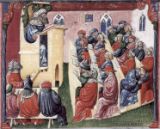
University Class in the 1350s

I particularly liked this picture of a university lecture in the 1350s because of the student having a nap in the front of the picture and others hat the back having a chat – nothing much has changed in the last 700 years.

Last year I drew the letter “E” for one of our branch’s Scrabble talks (you have to prepare a short talk on a Ricardian/late medieval subject beginning with that letter) and looked at ‘Richard III and Education’.  There were certain limitations, I had to have a topic starting with the letter “E” and my time was limited, and the word “education” brought for me the association with little kids learning their ABC.  Therefore I decided to extend it to talk about ‘Richard III and Learning’ in a wider context.

The strongest indication for Richard’s interest in learning we have is his religious activity.  In his day it was not possible to separate learning and religion; the centres of learning, the universities, were basically religious institutions.  During his life he showed a marked support for religious institutions and liked to surround himself with learned men.  Ross says that “there is no good reason to doubt that Richard was a genuinely pious and religious man” [Ross, p.128], but I believe that to see this purely in a religious context is too limited.  My contention is rather that Richard was interested in and actively supported learning, which for him went hand in hand with his faith.

In the following I want to demonstrate this in three areas:  Richard and his connection to a selection of learned men, his connection to the centres of learning and his actions as a law maker.

Richard III and Learned Men

Richard III and Learned Men

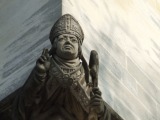
Bust of a bishop on a corner of Magdalen College, Oxford (© Dorothea Preis)

Richard realised that learned men would provide competent counsellors and administrators, and took full taken advantage of this.  As Sutton and Visser-Fuchs say, “The list of … learned men in his employment is a long one”. [Sutton & Visser-Fuchs, Hours, p.80]  Ross remarks on his love to surround himself with graduate scholars and likens him to Henry V, rather than Edward IV.  He sees the praise for him of the Canterbury Convocation of 1484 as the result of his protection of the church and his patronage of learning.  [Ross, p.132] In addition, it can be said that “he may have himself possessed a little more learning that most men of his background”. [Sutton & Visser-Fuchs, ‘Cambridge’, p.119]

The fashion for learning was not new in Richard’s day, it is rather the continuation of a trend which started in the first half of the 15th century with men like William Bingham, and – even earlier – William Wykeham, bishop of Winchester.  Though neither of them had been particularly well educated themselves, they both were alarmed at the lack of educated clergy and teachers and set out to do something about it. [ODNB ‘Bingham’; ODNB ‘Wykeham’]

It has been said that Richard favoured graduates from Cambridge rather than from Oxford [e.g. Ross, p. 132], but the case is not as clear cut as it might seem.  While there was a certain amount of Cambridge graduates among the men near Richard, there were also quite a number of men from Oxford.  In addition, many of learned men in Richard’s service had connections with both universities as well as foreign ones.  [Sutton & Visser-Fuchs, ‘Cambridge’, p.118]

An early direct influence on Richard was probably George Neville, Archbishop of York, who was a well-educated patron of learning and a great benefactor of Oxford University, where he had studied at Balliol College.  He is also regarded as a supporter of the revival of Greek studies.  Several of his associates would later prosper through their association with Richard, for instance John Shirwood, Thomas Langton, Thomas Barowe (though I question his association with Neville) and  Edmund Chaderton. [Sutton, ‘Piety’, pp.87-88; ODNB ‘Neville’]

I would like to introduce six men, who were at their time known for their high degree of learning and also had a more or less close association to Richard.
Richard’s choice for the two bishops he appointed while king is telling:  Thomas Langton of Salisbury and John Shirwood of Durham, both had more or less direct associations with George Neville – and both were known for their learning.  [Sutton & Visser-Fuchs, Hours, p.80]

1. Thomas Langton (c.1430–1501)

Thomas Langton was the brother of a long standing associate of George Neville.  Edward IV seems to have been impressed by him and helped him in his early career.  He also used him in diplomatic missions, a pattern that continued under Richard III.  Richard must have liked him a lot, because he did not suggest him for a bishopric only once but twice:  when in May 1483 the then bishop of St David’s died, Richard as protector suggested Langton for the post; and in early 1485 he secured  his translation to Salisbury.  While he certainly was useful to Richard as a diplomat, it was specifically his learning, which earned him his elevation. [ODNB ‘Langton’; Sutton, ‘Piety’, p.88; Ross, p.133]

Langton accompanied Richard on his progress in August 1483, during which he made his famous remark:

He contents the people where he goes best that ever did prince; …  God hath sent him to us for the weal of us all.  [quoted in Potter, p.127]

2. John Shirwood (d.1493)

John Shirwood came from a family of keen Yorkists.  He was another associate of George Neville, and both he and Richard as duke of Gloucester worked for Neville’s release when he was imprisoned after Barnet.  Shirwood was famous for being one of the earliest English humanists. He had a rare knowledge of Greek and wrote in polished Latin. He had an extensive library containing more than three dozen, mainly printed, works.  He wrote his name in them, usually on the last page, together with the date and place where he had bought them, giving us an idea where he was when.  Richard was personally interested in the County Palatinate of Durham.  And as his books show, Shirwood, who had been in Rome off and on since 1477, spent virtually the whole time of Richard’s reign in Rome, which led some commentators to the conclusion that his absence might have been an added point in favour of his selection.  However, he was in England for Richard’s coronation, and must have impressed Richard on this occasion.  In addition to the bishopric, Richard also recommended him for a cardinal’s hat, so he must have thought quite highly of him.  [ODNB, ‘Shirwood’; Allen; Williams]

3. John Gunthorpe (d.1498)

Another renowned scholar and humanist with close relations to Richard was John Gunthorpe, dean of Wells.  While protector, Richard made him keeper of the privy seal on 10 May 1483, an office he retained throughout Richard’s reign.  Richard also used him on diplomatic missions as he was an eminent Latin and, like Shirwood, Greek scholar. [Ross, pp.133-134; ODNB ‘Gunthorpe’]

4. John Russell (c.1430–1494)

Richard’s choice for his chancellor fell on John Russell, bishop of Lincoln. Russell had studied civil and canon law at Oxford, while both Langton and Shirwood had degrees in theology.  On the one hand Russell was a career civil servant – he had been counsellor of Edward IV – making him a likely choice, but he was also an eminent scholar.  Thomas More was later to describe him as “one of the best learned men undoubtedly that England had in his time.” [quoted in Ross, pp.132-133]  He is known as one of the first to buy printed books on the continent and bringing them into England in 1466. [Armstrong, p.268-269; Masek, p.7]

5. John Doget (d.1501)

All four men chosen by Richard for public office confirm what Ross sees as “an increasing awareness of the importance of humanistic scholarship as a qualification for high office in the clerical establishment of government”.  [Ross, p.134]  However, even with his more private appointments, Richard showed that he valued learning in the men he surrounded himself with.  He selected John Doget as his private chaplain in 1483.  Doget was another noted scholar and author among other things on a documentary on Plato’s Phaedo. [Ross, p.134]

Richard was not alone in striving for a “better education of the clergy and the improvement of services in their localities” [Sutton & Visser-Fuchs, Hours, p.80], nor was he by any means the first.   After the challenge of Lollardy many people saw the need for better educated priests.  It is in this context that we have to see Henry VI’s interest in Eton College as well as university colleges.  It was Henry who had promoted William Waynflete. [Bennett, pp.84-85]

6. William Waynflete (c.1400–1486)

Richard III and Learned Men

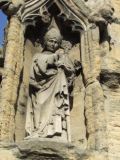
Statue of William Waynflete on the gate of Magdalen College, Oxford (© Dorothea Preis)

The first five men all benefited largely from Richard’s patronage.  However, he also had contact with one, whose career started long before Richard.

William Waynflete was an interesting character, whose “concern with the teaching of grammar … were to dominate his career” [Davis, p.3].  From a gentry background, Waynflete had been  a schoolmaster at Winchester College for 11 years, when he came to the attention of Henry VI, who “head hunted” him for the position of provost of his newly established Eton College.   His association with Henry helped his career tremendously and he became Bishop of Winchester in spring 1447, a position he fulfilled conscientiously. [Davis, pp.13-15]

He also served as Chancellor of England during the difficult time from 1456 to 1460.   As chancellor his main aim seems to have been to establish peaceful relations between both sides, but I think it is correct to say that “Political activities were not Waynflete’s principal concern” [ODNB ‘Waynflete’].

His main motive was the promotion of education and for this purpose he founded St Mary Magdalen College in Oxford on 12 June 1458. [Gardiner]  His college is seen – after William Bingham’s Godshouse in Cambridge – as the second secondary school training-college. [Lloyd, p. 38] He gave valuable gifts of books to the library of his college.  The emphasis was on the college’s responsibility to teaching. [Gardiner].

Part 2 – Richard III as the Founder of Collegiate Churches

Part 3 – Richard III and the Universities of Oxford and Cambridge

Part 4 – Richard III as Law Maker (incl. bibliography)

Tags: , , , , ,

The NSW Branch of the Richard III Society met on 21 April 2012 at our current venue, the Sydney Mechanics’ Institute, but in her welcoming comments our Chairperson Judith explained that at this venue we would now need to take out public liability insurance.  Secretary Julia is investigating quotes from several sources for reasonable insurance costs, however, we may need to find an alternative venue if necessary. Carol suggested a hall in The Rocks area that could be considered.

The mini-conference in Mittagong on Saturday 12 May 2012 was discussed, and thanks offered to the committee members who had worked so hard to put together a fascinating program. With about 35 registrants, including many members from outside Sydney, who usually do not get to attend Ricardian events, it is going to be a great day of learning and socialising.

Minutes from the February meeting were taken as read.  Julia presented the Secretary’s report, as well as a report on behalf of Treasurer Judy who is in the UK. Dorothea presented the Webmaster and Librarian’s report. The branch is financially sound and the branch website at www.richard-III.nsw.org.au continues to receive many visitors. Just a reminder that it could always use more creative input from members, such as Ricardian book reviews, comments on articles posted, etc. It is the addition of interesting new items that brings in new visitors and makes the website come in second in world-wide Google searches, which is excellent.

The Librarian reminded us that the library books would be offered for sale at the mini-conference, along with the various Ricardian items we have available. Sales Officer Lynne reported that new stock of attractive Ricardian items should be available by then, as well.

Other happy news was that former members Xavier and Jane had recently had a baby boy, and members expressed their joy (and the wish that we could have him at meetings so that we could all hold and admire him in turn.)

Members were invited to the Australian Heraldry Society book launch for Professor Stephanie Triggs’ Shame and Honor: A Vulgar History of the Order of the Garter, on Friday 8 June at 6:00 for 6:30 pm start at the Mitchell Theatre, here at the Sydney Mechanics Institute. The featured guest will be Dr Paul Giles, Challis Professor of English at the University of Sydney. A gold coin donation is requested. Guests are requested to RSVP  by 5 June 2012 to secretary@heraldryaustralia.org.  For more information visit http://www.heraldryaustralia.org/

It was also noted that the University of Sydney has several medieval themed courses on offer in the next few months in the Centre for Continuing Studies with member Isolde Martyn as one of the presenters.  For more information visit  http://cce.usyd.edu.au/courses/Humanities/Medieval+History

Our speaker was our own Dorothea Preis who presented a well-researched program about Richard III and Learning, which covered in fascinating detail the colleges he founded and funded, and the learned men he surrounded himself with (and yes in that era they were all men, usually Archbishops and other very accomplished clergy educated at Cambridge or Oxford). Hopefully Dorothea will be posting her very worthwhile presentation on the branch website for online visitors to enjoy.

The next meeting will be on Saturday, 9 June 2012, and the program will be Myths of the Middle Ages presented by Daniel Hill.

Tags: , , , ,

26
Apr

The Battle of Bosworth Field on Radio

   Posted by: Dorothea Preis   in News

BBC Radio 4 will feature a discussion on The Battle of Bosworth Field today (9h00 British time – that is 18h00 EST).

Host Melvyn Bragg will be joined by three well-known historians:  Anne Curry, Professor of Medieval History and Dean of Humanities at the University of Southampton; Steven Gunn, Tutor and Fellow in Modern History at Merton College, Oxford; and David Grummitt, Lecturer in British History at the University of Kent.  All three of them are well-known to all of us through their published work.  In addition had the opportunity to meet Anne Curry as one of the speakers at the Wars of the Roses conference at Oxford last year and hold her in high respect.

The discussion is to concentrate on what actually happened at battle and where it was actually took place.  As Anne Curry was part of the research team that found the battle site in 2009, she should be able to enlighten all of us.

Fortunately listeners outside the UK are able to catch up with BBC radio programmes on iPlayer, so make an appointment with your computer and catch up with this fascinating discussion once it is available.

For more information on the programme:  http://www.bbc.co.uk/programmes/b01ghc43

BBC iPlayer:  http://www.bbc.co.uk/iplayer/radio/bbc_radio_four/20120426

Tags: ,

23
Apr

The Middle Ages at Sydney University

   Posted by: Dorothea Preis   in News

Visiting Sydney University you might feel transported back to the Middle Ages.  And if you want to learn more about this fascinating period have a look at these courses offered by the Centre of Continuing Education of the University of Sydney.  The lecturer is Yvette Debergue, who holds a PhD from the University of Sydney and is a medieval specialist.

The first is a 4 week course on Art and Architecture of the Middle Ages, covering medieval ecclesiastic and secular architecture as well as medieval tapestries and medieval gardens.    The course starts on 3 May 2012, places are still available.
More information:  http://cce.usyd.edu.au/course/AAMA

Yvette Debergue will team up with our branch member Isolde Martyn for a one day event, The Planatgenets, on 30 June 2012.  The course aims to cover the period from Henry II until the Battle of Bosworth.  It should be an interesting day.  I do have, however, certain reservations about recommending books by Alison Weir as course reading.
More information:  http://cce.usyd.edu.au/course/TPLG

And to chase away any winter chills, you might like to meet some Notorious Women of the Middle Ages, a course which will commence on 19 July 2012.
More information:  http://cce.usyd.edu.au/course/NWMA

King Richard is once again making an appearance on stage, courtesy of the Royal Shakespeare Company. This year, the production is part of the World Shakespeare Festival that sees companies from around the world presenting the Bard’s plays in their own language and their own style. A great cultural addition to Britain in Olympic year.

At Stratford on Avon, the production is one of three plays in the series Nations at War. Curated and directed by Roxana Silbert, an associate director of the RSC, the series also comprises King John and a new Mexican play by Luis Mario Moncada called “A Soldier in Every Son – The Rise of the Aztecs”.

Photograph of the Swan Theatre, Stratford on Avon taken by Michelle Walz Eriksson ; obtained through Wikimedia Commons.

The season examines ambition, power, leadership and family loyalties and betrayals, and the combination of politics and personal emotions. Silbert says that at the heart of Richard III is his relationship with his family … the women are central to Richard III. Ricardians who have always recognised the exceptional closeness of the Yorkist Plantagenet family will welcome this concept.

Although Roxana Silbert has had to trim the text (not as ruthlessly as Colley Cibber we hope) and has given it a contemporary setting, the heart and essence of the story are timeless. Richard’s relationship with his family, says Silbert, his ambition and greed are equally timeless.

Richard will be played by Jonjo O’Neill who happens to be the same age as Richard when he was killed. In a play which is totally driven by the central character, she feels that O’Neill can combine the playfulness with a very dark core. “Richard is a tremendously attractive character and his bravado is part of his charisma, but he does some unforgiveable things and that makes our relationship to him very complex”.

The Nations at War series will be presented at the Swan Theatre in Stratford . Anyone lucky enough to be in the UK this northern summer can visit http://www.rsc.org.uk/whats-on/richard-iii/ for more information about the production and the performance dates.

Tags:

14
Apr

A Time for Learning

   Posted by: Julia Redlich   in Meetings, News, NSW Branch News

Don’t forget that the April meeting this year is on Saturday, 21 April 2012 – at the usual place of course: The Sydney Mechanics School of Arts, 280 Pitt Street, Sydney.
The time: 14h00.

The speaker will be Dorothea Preis on “Richard and Learning”. Many of you will remember her talking about this in a Scrabble talk but, with those talks’  time limitations, Dorothea felt that she had barely started on the subject. So, lucky us, this time we get the extended version.  You can count on it being entertaining, well-researched and with illustrations from Dorothea’s collection.

Get ready to put up your hand to give a short Scrabble talk at our August meeting. New members should know, volunteers draw a Scrabble tile and then prepare a talk on a medieval subject beginning with that letter at a meeting later in the year. The talks should be no longer than 15 minutes.

Tags: ,

4
Apr

Medieval Recipes

   Posted by: Dorothea Preis   in Medieval Menu, Medieval Miscellany

Should you be desperate for a new recipe idea to try out over the long weekend, have a look at what the British Library has to offer!  Unicorn sounds pretty special, doesn’t it?

Have a look a at the Medieval and Earlier Manuscripts Blog of the British Library for more information (click here).

(P.S. In case you are wondering, note the date of this post…)

Tags:

1
Apr

Don’t miss Mittagong!

   Posted by: Julia Redlich   in News, NSW Branch News

Thank you to everyone who sent in their registration forms for our day-long conference at Mittagong RSL on Saturday, 12 May. We look forward to seeing you.

If you have suddenly realised that there is a huge blank in your diary that weekend, we don’t have to give the numbers to the RSL until 18 April, so you can let Julia know if you can come by 17 April.

To whet everyone’s appetite: presentations include talks on Eleanor Talbot/Butler, medieval coins, the Neville/Percy feud, Royal Relics – and the previously lauded “Richard III – the Posthumous Hunchback”. A description of Jousting in the time of Richard III will be given by a new member Andrew, who has found time to join us before he heads off to Europe for some serious jousting there.

Of course there will be all the usuals:  a Plantagenet quiz, a raffle with great rewards to win; a book sale; and bring and buy stall. If you are Bringing please make sure you donations are good to look at and not too difficult for Buyers to take home.  That old bar fridge you’re ditching to beat high electricity prices would not be a good idea!

For your $35 you also get morning and afternoon tea and lunch – and the pleasure of Ricardian company.

If you are staying overnight on Saturday please let Julia know if you will be joining those dining at a local Mittagong restaurant, also if you will be part of the expedition to Robertson on Sunday morning. It will be Sunday Markets  in the town that day, plus the galleries and shops to browse through, as well as places for us to enjoy lunch before returning to Mittagong to make our way to our various homes.

Tags: ,