26
Apr

The April General Meeting

   Posted by: Julia Redlich   in Meetings

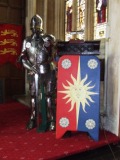
The speaker at our meeting on April 9 was Dorothea Preis, whose report on the “Blood and Roses” special interest weekend held at Christ Church College, Oxford, at the end of March features elsewhere on our website. Luckily for those many members attending we heard about the enlightening papers in much more detail and enjoyed the excellent choice of illustrations and photographs that brought the weekend to colourful life.  When it comes to colour, I suspect most of us were green with envy at what was obviously a time of special interest to Ricardians and Dorothea’s good fortune in participating and meeting other Ricardians from the USA, Canada and the UK. Read the rest of this entry »

Tags: , ,

18
Apr

The Golden Longing

   Posted by: Lynne Foley   in Bookworm

Francis Leary, The Golden Longing, published by James Murray, 1960 (no ISBN)

This book consists of potted biographies of Joan of Arc, René and Margaret of Anjou and Richard III.  Leary’s sympathy for his subjects is obvious.

The most striking feature of the book is the mix of facts with fiction for dramatic purposes.  A reader unfamiliar with the dramatis personae could have a difficult time distinguishing between the two although from time to time, Leary provides footnotes for some of his statements.

He had no liking for the medieval period, and there is rather too much emphasis on blood and death – the least attractive feature of the book. Read the rest of this entry »

Tags: , ,

16
Apr

The Master of Bruges

   Posted by: Dorothea Preis   in Bookworm

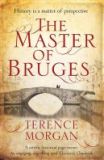
The Master of Bruges

Book Review:  The Master of Bruges (and of London, too!)

Terence Morgan, The Master of Bruges.  Pan Books, London, 2011.  ISBN 978-0-230-74413-4 (paperback)

First I would like to thank Heather, who told me about The Master of Bruges and awakened my interest in it.

This novel purports to be the memoirs of The Master of Bruges, the painter Hans Memling, who lived and worked in Burgundy though he was born in Germany.  From December 1460 to his death in 1494 we share Memling’s loves and adventures and through him we meet many of the people who are of significance to anyone interested in the late medieval period.  Obviously the Burgundian court of the time features strongly:  Charles the Bold, his wife Margaret of York, his daughter Marie and later her husband Maximilian. Read the rest of this entry »

Tags: , ,

15
Apr

Bosworth and Warfare: new finds, new ideas

   Posted by: Dorothea Preis   in News

One of the activities arranged by the Richard III Society are triennial conferences.  These are usually held at UK universities and leading academics in the field of medieval history are invited to present papers.  Triennial conferences are a popular event among Ricardians and are usually fully booked quickly.

The next triennial conference will take place from Friday, 20 April, to Sunday, 22 April 2012.  It will be held at the Burleigh Court Conference Centre at the University of Loughborough in Leicestershire.

Next year’s conference will dealing with ‘Bosworth and Warfare’ and will be looking at new finds and new ideas.  This promises to be an interesting and stimulating weekend, which will offer new insights into the important aspect of late medieval history.

So far three speakers have been confirmed:  Glenn Foard, Project Officer with the Battlefields Trust, will be speaking on the recent discoveries at Bosworth.  Anne Curry, Professor of Medieval History at the University of Southampton, will be looking at the documentary evidence for the battle.  Well-known scholar, Livia Visser-Fuchs, will be taking an in-depth look at one of the men who fought for Richard III at Bosworth, the Spanish mercenary Juan de Salazar.  Other speakers are yet to be confirmed, but all will speak on topics which will focus on recent new discoveries and ideas about the battle of Bosworth in particular and English medieval warfare in a wider context.

The weekend will also include a visit to Bosworth with a guided tour of the battlefield and a visit to the Battlefield Centre, where a number of the new finds from the battle’s new location are exhibited.

More information will be available from the Richard III Society in the UK.

11
Apr

Bosworth Carving at Stowe School

   Posted by: Robyn Bliss   in Ricardian Places

The following article was originally published in Tertian Fever, the journal of the former Queensland Group of the Richard III Society.

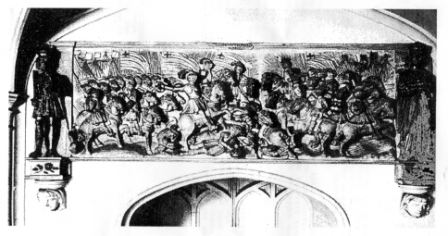
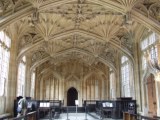
The stone relief of the Battle of Bosworth Field stands over the entrance from the Hall into the Gothic Library at Stowe School.  Probably of late 16th century workmanship and certainly not from 1485, it came from Castle Hedingham, Essex, the seat of the de Veres, Earls of Oxford, reputedly via Gosford, Lord Nugent’s seat.

In the carving, Richard III can be seen prostrate on the ground, clutching his crown, beneath the hooves of the conquering Earl of Richmond’s horse.  On the left side of the relief is a statue of Henry VII and on the right one of his queen, Elizabeth of York.

Over the years many have been impressed by the stone relief.  Mistakenly Horace Walpole thought it was made of wood and is reported to have said:  “But what charmed me more than all I had seen, is the library chimney … over it is an alto-relievo in wood, far from being ill done, of the battle of Bosworth Field … You would adore it.”  King Edward VII was likewise impressed and sent specially to have the relief photographed.  In July 1921 it was sold to Mr H Shaw, the purchaser of the building, for 1000 guineas and saved for the new school in 1922.

Editors’s Note:
Many thanks to J Nichols, Headmaster of Stowe School, for sending the information and photograph to Robyn Bliss for inclusion in Tertian Fever.

10
Apr

Vermeer’s Hat

   Posted by: Judith Hughes   in Bookworm

Timothy Brook, Vermeer’s Hat: The Seventeenth Century and the Dawn of the Global World.  Profile Books Ltd, London, 2009.  ISBN 9781846681202 (pbk)

The famous Canadian  historian Timothy Brook has written an enjoyable account of the beginnings of globalisationin the seventeenth Century.  Brook has authored many books about China and Japan especially of the Ming period.  In his 2008 book “Vermeer’s Hat” he sets out to show the development of trade routes and explores the often fraught relationships in which Europeans found themselves struggling to gain and maintain spheres of influence and trading posts in Asia and the Americas.

Charmingly, Brook evokes the concept of “Indra’s Web” which affirms that everything is connected. He examines five paintings by the seventeenth century artist, Johannes Vermeer and one each by two of his contempories Hendrik Van Der Burch and Leonaert Bramer.

He draws attention to goods which appear in the paintings and discusses how each artefact might have come to Vermeer’s home in Delft and shows how these actually opened doors into the rapidly expanding world and traces the growth of trading companies  like the VOC and East India Company which gave rise to wide spread colonisation by the Europeans.

The painting “The Beaver Hat” which lends its name to the book, explores the history of the soldier’s hat fashioned from beaver pelts bought from North Americans. Money raised from this trade financed voyages in search of new trade routes to China, Japan and the Indies.

The book has informative maps and the paintings are exquisitely reproduced The paintings portray such goods as Murano glass, Turkish carpets and  blue and white china from the kiln town of Jinderzhen in China all of which are traced back to their origins and paid for by silver from Peru.

The book is divided into sections one of the most interesting being the history of how tobacco smoking spread from South America to Europe and thence to the Far East preparing the way there for wide spread opium smoking in China.

Vermeer’s Hat published by Profile Books of London is a rivetting and informative read.  It has an extensive reference section a very informative bibliography and is well referenced.

Tags: ,

8
Apr

The Language of Maps

   Posted by: Dorothea Preis   in News

The Bodleian Library in Oxford is hosting a fascinating colloquium and exhibition called The Language of Maps:  Communicating through cartography during the middle ages and renaissance in June this year.

“Historic maps have broad appeal in contemporary cultures around the world. One reason for this – it might be thought – is because the ‘language of maps’ is universal and straightforward, but is it? How do maps communicate to us? How do they work?’  The colloquium tries to answer these questions and promises to “further our understanding and appreciation of the complexity of medieval and Renaissance maps and map‐making”.

This sounds fascinating to anyone with an interest in our period, and the beautiful setting will just add to it.

To find out more, click here.

Tags:

5
Apr

Remembering Queen Anne

   Posted by: Julia Redlich   in Meetings

The special gathering to remember Richard’s Queen Anne was held on Sunday, March 20th,  ably organised by our Social Secretary Jane Roberts.  Unfortunately there were only a few of us who gathered at North Sydney Leagues Club.  Dorothea was willing, but was already winging her way to London for the Blood and Roses conference, Pat Tomkins was confined to bed by her doctor and Rosemary Burgess was so drenched in the downpour on her way to catch the bus, she decided to abandon the elements and return home.

Those of us who made the venue all right showed that quality not quantity counts on some occasions, and when has any Ricardian event not proved interesting and entertaining?  The Club did us proud with a beautifully decorated table in the raised section of the Bistro.  We might have wished for murrey and blue table napkins, but the red and black of the North Sydney Bears looked striking.  Many thanks to Jan Robson who brought an attractive centrepiece of white roses and Ricardian coloured ribbons.  The food was the Bistro’s best and the desserts were to die for and certainly not to be included in any diet!  What luck that the immense size of the helpings  meant easy division of the spoils to share.

As we left, the sun had come out and blue skies were overhead to cheer us on the way home, our minds still filled with the inspiring and interesting ideas that had been such an important part of the day.

Tags:

4
Apr

Blood and Roses – Special Interest Weekend

   Posted by: Dorothea Preis   in News

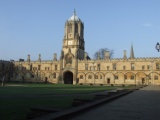
Recently I had the pleasure to attend the Special Interest Weekend on ‘Blood and Roses:  England 1450 – 1485’, which took place at Christ Church College Oxford from 24 to 27 March 2011.  This is the eighth Special Interest Weekend Christ Church is hosting, past events included a variety of topics.

A group of overseas Ricardians – US, Canada and Australia – who had arrived early, met on the Wednesday evening prior to the official start for a highly enjoyable pub crawl and dinner at The Trout.  A big thank-you goes to Dave for organising this.  It was great that Christine, a Ricardian from Stroud in Gloucestershire, could join us for the evening.  Wherever Ricardians meet you can be sure they will have a lot to talk about and enjoy themselves. Read the rest of this entry »

Tags: , , , , , ,

11
Mar

Richard III and East Anglia

   Posted by: Dorothea Preis   in Bookworm

Richard III and East Anglia

A Visit to East Anglia – Book Review:  Richard III and East Anglia

Livia Visser-Fuchs (ed.), Richard III and East Anglia:  Magnates, Gilds and Learned Men, Richard III Society, 2010, ISBN 978 0904 893 19 9

I read about Richard III and East Anglia in a recent Ricardian Bulletin and ordered it.  It contains five of the talks given at the 8th Triennial Conference of the Richard III Society, which took place at Queens’ College, Cambridge, in April 2005.  Queens’ College was an apt venue, as this college was greatly supported by Richard both as Duke of Gloucester and as king.

The contributions cover ‘Richard of Gloucester’s Lands in East Anglia’, the relationship between his family and the Howard and the de Vere family, Richard’s relationship with the University of Cambridge, the relationship between the Earl of Suffolk and Henry VII, but also an interesting article on the ‘Socio-religious Gilds of the Middle Ages’.

In preparation for the Australasian Convention of The Richard III Society in Melbourne in August of this year,  I have been looking at Richard’s attitude to learning and education, the article on his relationship with the University of Cambridge, though the last in the volume, was the first I turned to and was not disappointed.

The book is illustrated with delightful tailpieces, which were inspired by the badges by various of the persons mentioned in the talks, of course Richard’s boar features prominently, as well as manuscripts from his time and secular badges.

This is a book which would be of great interest to any Ricardian and can only be recommended.

You can order it from the Richard III Society in the UK (go to Society Shop on the menu on the left hand side).

Tags: , , ,