Posts Tagged ‘Leicester’

4
Apr

A BATTLE FOR THE CROWN IN LEICESTER

   Posted by: Dorothea Preis    in News

Should you find yourself in Leicester later this month and at a loss of what to do after having finished the Richard III Trail and all its sights, there is a full day of Richard III-themed events to look forward to.

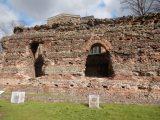
Jewry Wall in Leicester (photograph by D Preis)

When in Leicester, I can only recommend a visit to the Jewry Wall Museum, especially for the beautiful Roman mosaics.  However, on 14 April 2013 in addition to its usual interesting displays, it will also be the setting for a “day of events and activities based around the life and times of King Richard III” under the title ‘Battle for the Crown’.

There will be demonstrations of 15th century warfare and weaponry, dramatic readings from Shakespeare and an exhibition about the Greyfrairs Dig (I am not sure whether this is in addition to the one at the Guildhall).  At 14h00 Michael Morris will be talking about finding Richard’s remains.

According to local legend Richard III stayed the night before moving out to Bosworth at the White Boar Inn, which led the organizers to recreate what his final meal at the Inn might have been like.

We just hope for everyone concerned, organizers and visitors alike, that the weather will be also be in the mood for a party!

You can find more information here.

Tags: ,

22
Mar

A WALKING TOUR OF RICHARD III’S LEICESTER

   Posted by: Dorothea Preis    in Greyfriars Dig, News

For all who cannot get to Leicester to do the Richard III Trail in person, here is a short video that follows the trail.  Even if you have walked around Leicester, it offers inside views of the castle and Wygston Hall, both of which are infrequently open to visitors.

Please note, the video was recorded after the find of the remains, but before they were confirmed to be Richard’s.

http://www2.le.ac.uk/news/blog/2013/march/richard-iiis-leicester-a-walking-tour

Tags: , , , ,

15
Mar

RICHARD III: LEICESTER’S SEARCH FOR A KING

   Posted by: Dorothea Preis    in Greyfriars Dig, News

During my recent stay in Leicester, one of the must-see spots was the exhibition in the Guildhall dedicated to the Greyfriars Dig under the heading ‘Richard III:  Leicester’s Search for a King’.

We went as part of the ‘Richard III Walking Trail’, a plan for which can be obtained from the Visit Leicester Centre.  The trail takes the visitor around eight places, which have connections with Richard III, starting from the site of the Blue Boar Inn and ending with the Guildhall.  Unfortunately, but understandably, No.6 of the tour, the actual Greyfriars site, was not accessible.

We got to the Guildhall later in the afternoon and the queue was not too daunting.  I just turned my back to take another photograph of the Cathedral and we were nearly in.  The real queuing only started inside to see the various displays.

The exhibition details the various aspects of the archaeological research.  Having read extensively about the dig, it did not offer many new insights, but it was nice to see it all ‘face-to-face’.   It also includes 3D prints of Richard’s skull, showing the horrific injuries he suffered, and of the Blue Boar Inn.  Also on display were medieval masonry and bits of tiles found during the dig.

For the general public, who would probably not have been that interested in the dig while it happened, and only heard about it in passing, the exhibition offers a very good insight into the various disciplines which were involved in finding and identifying Richard.

All in all I found the exhibition interesting and well-designed.

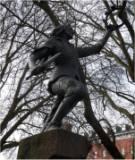
(Photograph of Richard III statue in Castle Gardens, Leicester, by D Preis)

Tags: , ,

13
Mar

WHERE TO RE-BURY KING RICHARD III

   Posted by: Dorothea Preis    in Greyfriars Dig, News

Yesterday the House of Commons debated whether Richard III should be re-buried in Leicester or York, without a final answer in sight.  In this context I find the claim that the “late King’s descendants” support York somewhat misleading, as to the best of our knowledge Richard did not leave any descendants.  These can only be descendants of his brothers and sister.   I would like to quote the conciliatory note by  Jeremy Wright, the Parliamentary Under-Secretary of State for Justice:  “I am sure that we would all agree that wherever the king’s remains are finally laid to rest, they will belong not only to the location, but to the whole nation.”  And not only the “whole nation”, but to everyone who is interested in Richard III.  You can read the full debate here on the website of the British parliament (go to Contents and then the Westminster Hall tab).

Tags: , , , , ,

11
Mar

WHAT ARE THE ODDS?

   Posted by: Dorothea Preis    in Greyfriars Dig, News

ArchaeologyAs so often, with thanks to Renate, who found this article for us.

Not only the archaeologists at Leicester University were kept busy with the Greyfriars Dig, but their mathematicians as well. Undergraduate maths students were asked to calculate what the odds were that Richard’s remains would be found at all.

So far we said that the luck in finding Richard was incredible.  Finding the church of the Greyfriars was already a huge feat.   After all the area to be searched was 13,000 sq ft (roughly 1200 sq m), covered not only by the now famous – rather small – car park, but also buildings, walls and all the other things that go with this, like electrical cables, phone lines, gas pipes and probably drains as well.  Altogether only 17% of the area was open for the dig.

As luck would have it the right portion of the area was only covered by a car park and thus fairly easily accessible.  Then the bit of luck of finding remains which as it turned out were really Richard’s on the first day of the dig.  It was later revealed that while a Victorian wall had destroyed the feet of the skeleton, another construction could easily have destroyed everything as it came to just within 30 cm of Richard’s head.

If you were a betting man or woman, what would you think the odds would be of finding the friary choir, finding a 500-year-old skeleton in it and being able to identify the remains as those of King Richard III?  The mathematics students calculated that the chances of finding Richard were only 0.84%.  And the odds of finding him on the first day of the dig are even lower:  0.0554%.

Dr Clive Rix, a visiting lecturer in the Department of Mathematics, concluded: “The odds of actually finding King Richard III were very low indeed.  Any commercial organisation would be looking for the potential of fairly spectacular returns to justify an investment  with such a low chance of success – but, of course, this was not a commercial venture.”

Someone once summed it all up by saying that it really looked as if Richard had wanted to be found.  I couldn’t agree more.  And the incredibly lucky incidents did not stop there.  A new friend from the conference in Leicester, who lives in the Midlands, told me that one day she was driving along in her car with the radio playing on the same channel that it is always set to.  Suddenly, without her doing anything, it changed to a different channel, just in time for an interview with Dr Phil Stone, Chairman of the Richard III Society.  She assured me that her car radio had never done this before or since.  Maybe the mathematicians could calculate the odds for this happening as well?

Tags: , ,

7
Mar

THE GREYFRIARS DIG: A NEW RICHARD III

   Posted by: Dorothea Preis    in Greyfriars Dig, News

‘The Greyfriars Dig:  A New Richard III?’ was the motto of a conference on the Leicester Dig organised by the Richard III Society, which I had the pleasure to attend in Leicester on 2 March 2013.

A whole day with Richard III!  My Ricardian day started at breakfast in the hotel, when I got talking to two other guests, who as it turned out were also here for the conference.  We made our way together to the University of Leicester and had no problem finding the venue, we just needed to follow the stream of people, many of whom wore Ricardian badges or even Ricardian sweaters.  After being warmly welcomed at reception, we made our way to the bookstall – after all, the chance to purchase some of the excellent Society publications without having to pay postage had to be taken advantage of, though I had to keep the weight limitations of my luggage for the flight back in mind.

Entrance to the Peter Williams Lecture Theatre, University of Leicester (photograph by D. Preis)

The Peter Williams Lecture Theatre was packed with nearly 500 participants, though I heard that there were more than twice as many who had wanted to attend, but could not be accommodated.  So I was glad that I had got my registration in early.  I saw some familiar faces and was able to talk to some, who were old friends via email, but whom I had never met face to face.  Though, due to the amount of people, this was not possible in all cases.

The official part began with a welcome by Dr Phil Stone, Chairman of the Richard III Society.  His announcement that the Greyfrairs Dig had been voted as ‘Research Project of the Year’ was met with general applause.  This prestigious archaeology award is each year decided by a poll of the readers of Current Archaeology magazine, and quite a few of the NSW branch members voted as well.

Dr Stone was followed by the Chair of the conference, the MP Chris Skidmore.  Mr Skidmore is the author of Bosworth: The Birth of the Tudors, which will be published on 23 May 2013.  His research for this book brought him to a deeper understanding of Richard III.  He mentioned that for his book he had examined the manuscript of Vergil’s Anglica Historia in the Vatican archives.  With its corrections, this showed Vergil’s thought process much more clearly than the later printed version, on which present translations are based.  This is just one example of contemporary records being extant in a wide variety of archives, which are not easily available to the wider research community.

He compared Richard III negative image to his own experience, where he is mostly pigeonholed as a Conservative MP.  However, he also warned Ricardians to see Richard as a medieval nobleman, rather than limiting our understanding to those qualities which conform to our present day ideas.  If we were to limit ourselves to these facets of his reign, we would fall into the same trap as his detractors do, just the other way round.

Then Annette Carson and Philippa Langley (Richard III Society) took us in a Q&A style format through ‘The “Looking for Richard Project”’.  Philippa explained what had been necessary to bring the whole project together and about all the hiccups she had faced along the way.  Annette added some more general views on Richard as well as the disappearance of the ‘Princes in the Tower’, stressing that as a disappearance it was a mystery not a murder case.

After a break for morning tea, it was historian Dr John Ashdown-Hill’s turn to talk about ‘The Four Strands of Evidence’.  He also reminded us of how long he had been trying to garner interest and support for an archaeological dig of the Greyfriars site.  The four strands were:  1) evidence that Richard had been buried in the Greyfriars; 2) the similar layout of medieval friaries; 3) dismissal of the misconception that Richard’s bones had been dug up and thrown into the river during the Dissolution and 4) his work in establishing a direct female line descendent of Richard’s mother, Cecily of York.  Dr Stone announced that in acknowledgement of his work, Dr Ashdown-hill had been awarded life membership of the Richard III Society.

‘Richard III, History and Drama’ was presented by Dr Sarah Knight and Dr Mary Ann Lund (University of Leicester).  They looked at how Shakespeare used sources for his play and examined his play in the wider context of other dramatic interpretations of the material during his time.

Then it was time for lunch and more opportunities to make new acquaintances with fellow Ricardians.

Prof Mark Lansdale (University of Leicester) had the unenviable spot to be the first speaker after lunch, but it is highly unlikely that anyone would have nodded off during his fascinating exploration of the ‘Psychological Profile of Richard III’.  He concluded that Richard does not fit the profile of a psychopath, as which he is so often presented.  Instead he suggested that because of the insecurity Richard experienced during his childhood, he showed signs of an intolerance to uncertainty syndrome.  Traits associated with this are piety, a strong sense of right and wrong and loyalty, all traits Richard displayed.  (You can find a summary of his analysis here.)
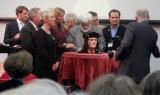
Unveiling the face of Richard III (photograph by D. Preis)

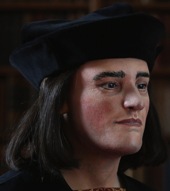
Then our attention was drawn to a square object covered with a velvet cloth.  This was ceremoniously revealed to be the real face of Richard III, the facial reconstruction carried out at the University of Dundee by Prof Caroline Wilkinson.  Prof Wilkinson explained the reconstruction process in general and this one in particular.  This detailed insight into the scientific information on which a reconstruction is based was highly interesting and informative.

The following tea break gave many of us the opportunity to queue up to look into Richard’s face and to take photographs of it.

Then Dr Toby Capwell (Wallace Collection) talked about ‘Harness for the Differently-Abled:  Armour, Scoliosis and King Richard III’.  He speculated on what type of armour Richard might have worn and explained how this could have been designed to accommodate and disguise his scoliosis.

Bob Woosnam-Savage (Royal Armouries) gave a report on how Richard would have suffered the injuries his remains display.  He warned that this was a preliminary report only as the investigation was ongoing and they were continuing to find new evidence.

Sir Peter Soulsby (Lord Mayor of Leicester) looked at ‘The Future of Richard III in Leicester’.  This includes a Richard III Visitor Centre in the old grammar school next to the Greyfriars site as well as a general focus on making historic sites more accessible for pedestrians.  He also suggested thinking about a more appropriate spot for the Richard III statue in Castle Gardens.  This would be very welcome after my own attempts at taking a photograph of it, which were rather disappointing as the sun was always behind the statue.

The conference finished with a ‘Round up and thanks from the Chairman’.

The designers of the proposed tomb, David and Wendy Johnson, were also present, but unfortunately there was no time for them to talk to us.  The sculptor of the tomb, Graeme Mitcheson, showed photographs of his previous work as well as a beautiful carving of Richard’s boar.

I would like to take this opportunity to express my own thanks to all who made the Greyfriars dig and its findings possible, to all the excellent speakers and last but not least to all those who organized this event.  I can only marvel at the organisation which was necessary to make this day with so many participants run smoothly. It all worked out perfectly.

If you were to ask me whether it was worth travelling half-way around the world for one day in Leicester, my emphatic answer would be ‘most definitely!’.

Tags: , , , ,

13
Feb

LEICESTER CONFERENCE: FULL

   Posted by: Dorothea Preis    in Greyfriars Dig, News

Should you still be thinking of going to the conference on the Leicester Dig to be held at Leicester on 2 March 2013 – sorry, to disappoint you.  We just received the following message:

The Conference on 2nd March is now fully booked. All of the unsuccessful applicants will be placed on a date-sequenced waiting list.

We heard that there was enormous interest and that many Ricardians from all over the world are attending.  Looking forward to seeing many old and new friends.

Tags: , ,

11
Feb

REPORT OF THE FEBRUARY GENERAL MEETING

   Posted by: Leslie McCawley    in Meetings, News, NSW Branch News

The first branch meeting of the year was held on Saturday, 9 February 2013, at our usual venue in the Rocks just days after the wonderful announcement about Richard III, which excited members had been eagerly awaiting. As a result of the wide media coverage, there was extraordinary interest in our website and our branch, with hundreds of emails having been received, and a number of new faces at our meeting. We hope to see Amanda, Natasha and Peter again.

Welcoming remarks were offered by our Chairperson, Judith, but departing from our usual routine, the minutes from the previous meeting were not discussed nor were there any of the usual reports presented by the Treasurer, Webmaster, or Librarian. This change was due to this meeting’s emphasis on the final results of the Greyfriars’ dig in Leicester. The results of the osteoarcheological and DNA examinations of the bones, the subsequent facial reconstruction, and the media conference with the research panel from Leicester University, were comprehensively reviewed and summarized by Dorothea for those present. Her excellent coverage can be found on the branch website, as well as the many links she has provided to the various media clips and written reports available on YouTube, BBC, University of Leicester and other websites. Dorothea will also be attending a one-day summing up conference at the University of Leicester in March and will report back to us at the next meeting. Her efforts in keeping all of us to date over the past weeks has been deeply appreciated.

Julia discussed the upcoming conference to be held in July, and encouraged members and guests to register for the exciting speakers and planned social events over that weekend. Also, Sydney’s Genesian Theatre is opening their 2013 season with a production of Shakespeare’s Richard III. After the 10 March 2013 matinee performance, a panel will be convened to discuss the nature of the ‘real Richard’ in light of recent discoveries, for which Julia has been invited to represent the Ricardian point of view. Tickets are available online at http://www.genesiantheatre.com.au

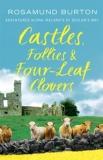
Our guest speaker was the charming Rosamund Burton, author of Castles, Follies and Four Leaf Clovers, a memoir of her journey along the ancient Irish pilgrimage route known as Saint Declan’s Way. She had been been raised in a castle in Lismore, Ireland (her father was employed by the Duke of Devonshire), and presented fascinating slides of the many sacred wells, castles, and the lovely Irish countryside.

The 13 April 2013 meeting will feature “Richard III in the Movies” with our guest Yvette Debergue.

Tags: , , ,

11
Feb

THIS MIGHT INTEREST YOU…

   Posted by: Dorothea Preis    in News

Some articles which might interest you:

Sarah Knight and Mary Ann Lund look at ‘Richard Crookback‘ in The Times Literary Supplement.  Both are lecturers at the University of Leicester and will speak at the Conference organised by the Richard III Society on 2 March 2013.

We all would like to know what the church of the Greyfriars in Leicester looked like at the time Richard was buried there.  Her are some artist’s impressions giving us a pretty good idea.

My thanks go for both these links to Renate!

Tags: ,

5
Feb

SKELETAL REMAINS IDENTIFIED AS THOSE OF RICHARD III

   Posted by: Dorothea Preis    in Greyfriars Dig, News

What an evening!  I am sure that many of our readers followed the press conference in Leicester as spell-bound as I did.  It was a moment we had all been waiting and hoping for which finally came true.

The press conference revealed in a step by step account that the human remains found in Leicester in 2012 are “beyond reasonable doubt” those of King Richard III.

Richard Buckley, the lead archaeologist of the Greyfriars Dig, explained how they found the human remains right at the start of their dig and how the further trenches helped to confirm where in the Greyfriars site the remains had been found.  He also explained that the grave had been dug in a hurry and had actually been too short for Richard.  While his lower body, which apparently had been laid out first, was straight, his upper body was more twisted, as they had tried to fit him into the grave.

The most confronting report was that by Jo Appleby, the osteoarchaeologist of the University of Leicester, who had analysed the skeletal remains.  Her description of the injuries which led to Richard’s death as well as those inflicted as humiliation brought the horrors of a medieval battle into our living rooms.

Dr Appleby also remarked that the king would have had had an unusually slender, almost feminine, figure.   She explained the scoliosis and what it would have meant for him, but stressed that the “withered arm” from the Shakespeare play was not based on fact.

The most anticipated evidence was probably the DNA analysis, presented by Kevin Schürer and Turi King. An analysis of male descendents of Edward III, who was also an ancestor of Richard III, has not been concluded yet.  However, the mitochondrial DNA of Michael ibsen, a descendent of Richard’s sister Anne in an all-female line, was matched to that of another descendent, also in the all female line, and then to that of the human remains.

When Richard Buckley concluded that based on all the evidence it was “beyond reasonable doubt” that these were the remains of Richard III, it was not only the audience in Leicester who started clapping and cheering.  What a truly amazing day for all of us!

The thanks of the NSW Branch of the Richard III Society go to John Ashdown-Hill, Philippa Langley, the team of the University of Leicester and all others that made this wonderful discovery possible.

You can find out more in the Press Release of the University of Leicester and on the brand new website of the Richard III Society.  Now pictures of the facial reconstruction have been published as well and it is certainly a special moment to look into the face of the real Richard.

Tags: , , ,