
Posts Tagged ‘Leicester’

2
Dec

Christmas cheer at the NSW branch

   Posted by: Dorothea Preis    in Meetings, News, NSW Branch News

Our December general meeting will be taking place at our regular venue, the Harry Jensen Centre (17 Argyle Street, Millers Point), on Saturday, 8 December 2012 at 14h00.

We have a whole range of attractions for you to enjoy.  Judy will give an illustrated talk about the triennial conference of the Richard III Society, which she attended at Loughborough earlier this year.   This will be a unique opportunity to see pictures of the real site of the battle of Bosworth, which was visited as part of the conference.  This is on private land and normally not open to the public.

While we are all are waiting for the results of all the scientific tests being carried out on the male remains found in Leicester, there will also be a look back on how these remains were found at all.

And our regulars know that any item presented by Isolde and Julia promises to be great fun.  They told us that this year they will be acknowledging some characters familiar to all Ricardians, but who won’t be receiving Christmas cards from us.  Sounds intriguing.

It will also be an opportunity to pick up your copy of this year’s Chronicles of the White Rose, our branch journal.  In it you can find a variety of presentations from past meetings and some articles which appeared on our website, as not all our members have access to the internet.  And of course the volume also includes an entertaining and challenging quiz.  (The Chronicles will be mailed afterwards to members unable to attend.)

It would be appreciated if members could help to make our Christmas afternoon tea special by bringing a plate, but please do not be over-generous with the plate size!

Looking forward to seeing all our regular friendly faces and perhaps some new ones as well.  As always any guests, curious to find out more about us, are more than welcome.

Tags: , , , ,

20
Nov

Greyfriars Dig: “the evidence is looking really good”

   Posted by: Dorothea Preis    in Greyfriars Dig, News

ArchaeologyThis is what Prof Lynn Foxhall of the University of Leicester said about the ongoing tests which are carried out on the male skeleton found in the former Greyfriars church in Leicester.

However encouraging the statement may look, it would be too early to jump to conclusions.  The various tests are still ongoing and results are only expected in January.

So far we heard most about the DNA testing trying to match the mtDNA of the remains to that of a descendant of Richard’s eldest sister Anne, but this is only one of the aspects investigated.  This descendant’s connection is also being verified and researchers are hoping to establish a second line of descent.

Other tests include the analysis of soil samples from the grave surrounding the skeleton, from which we may not only find out more about the burial practice, but also about the health and diet of the person who was buried there.  This would be in conjunction with evidence gathered from samples of mineralised dental plaque, providing information on the person’s diet, health and living conditions.

Scientists are examining the skeleton in detail trying to get some idea about the person’s age and figure and the scoliosis.  Experts are also trying to establish how exactly the individual died and what kind of weapon would have caused the horrific injuries to the skull.

The remains are also radiocarbon dated in two separate examinations, which will give us an idea of when the person died, to within 80 years.

However, if these remains are indeed those of Richard, the most interesting process would be the CT scan from which a 3-D image of the person can be built.  This would also be the basis for facial reconstruction so that one day we may be able to see what Richard really looked like – remember, none of the existent portrays is contemporary.

All these tests together will provide a detailed image of the person’s lifestyle, his health and even where he grew up, and will thus provide “more assurance about the identity of the individual”.

The process reminds me of the wide variety of information which has been established about Ötzi, the “iceman” found by hikers in the Ötztaler Alps in September 1991.  I have been fascinated by him since he was first discovered and the story of the find was one of the last I wrote about as assistant for a scientific research organization.  Compared to Ötzi’s age of 5300 years, this man’s 500 years seems to be a very short time frame indeed.

More information:

‘‘It’s not like CSI’: the Science of the Search for Richard III’, University of Leicester (15 Nov 2012).

Richard III dig: Results expected in January’, BBC News Leicester (19 Nov 2012).

Tags: , , ,

8
Nov

Richard III, the ‚Bösewicht‘

   Posted by: Dorothea Preis    in Greyfriars Dig, News, Richard III in the Media

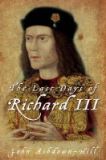
The interest in the findings in Leicester is not limited to the English-speaking world.  One of the two main German TV station, the ZDF (Zweites Deutsches Fernsehen), also reported on it as part of their news and interviewed John Ashdown-Hill for the short feature (approx. 2 minutes).  The dig in Leicester was based on John’s research, outlined in his book The Last Days of Richard III.

So far I had known John only through his books and from photographs, so this was the first time I met him ‘live’.  This was the highlight of the programme, as I was rather disappointed with the reporting around it.

The moderator introduces Richard III as the “probably most hated king in British history”, who also features as the “main character of a Shakespeare drama”.  This gives you a good idea on the line they are going to follow:  history as told by that great “historian”, William Shakespeare.

We learn that Richard had numerous people killed, two brothers and nephews, but also “at least one wife”.  Now, please, even Shakespeare doesn’t give him more than one wife!  It was only his great-nephew Henry VIII, who had the bad track record with multiple wives.

As there is no mention that any view of Richard but Shakespeare’s even exists, it comes as a bit of a surprise when the reporter finishes with “Richard, the villain.  Maybe this part of history now needs to be rewritten.”  Unfortunately finding Richard’s bones will not be not sufficient to change the popular opinion of this king.

And while I am on my rant, there is also a minor point.  In the beginning we see the sundial at the Bosworth Battlefield Centre and the voice over informs us that this is the spot where Richard was killed.  Well, not exactly, the actual battlefield was a bit away.

In my family, ZDF had been the broadcaster of choice, for its accuracy in its news coverage as well as for entertainment.  A pity, but even John Ashdown-Hill cannot make me overlook the shortcomings in this short programme.  I would have expected better!

Watch the programme at http://www.zdf.de/ZDFmediathek#/beitrag/video/1768286/Grab-von-K%C3%B6nig-Richard-III-entdeckt

Tags: , , , , ,

The following Press Release was published by the Executive of the Richard III Society in the UK on 30 October 2012.

DISABILITY IS NOT A DEFORMITY

• Greyfriars dig raises questions over Richard III’s ‘hunchback’ appearance
• Richard III Society calls for reassessment of ‘lazy hunchback myth’
• What is the difference between scoliocis and kyphosis?

It is time to end the lazy acquiescence with the Tudor and Shakespearean myths about Richard III. If the body found at the Greyfriars dig is Richard III, it proves he was no hunchback and if he suffered from scoliosis that is no reason to denigrate him. In this Paralympic year, we celebrate the achievements of all who overcome disabilities, let’s do the same for Richard III…

On 12 September at a press conference in Leicester’s Guildhall, Richard Taylor of the University of Leicester outlined the evidence that points to the skeleton discovered on the site of the Greyfriars being that of King Richard III. He also confirmed that it had a curvature of the spine known as scoliosis.

Scoliosis is a fixed and abnormal sideways curvature of the thoracic and lumbar regions of the spine. It can result in one shoulder being slightly higher than the other, in the case of the Greyfriars skeleton, the right shoulder.

The press conference also made absolutely clear that the skeleton did not have kyphosis, which can result in a hunchback.
So if this is Richard III, he was not a hunchback, contrary to the myths about his physical appearance.

Nowadays severe scoliosis can be corrected by surgery, although those with the condition still face challenges in their lives.

The Scoliosis Society notes that some are inspired by older siblings to overcome such challenges; Richard may well have been similarly inspired by his charismatic elder brother Edward IV. As duke of Gloucester and king Richard led an active life as an effective administrative and military commander, if he had a disability he clearly overcame it.

However there is no contemporary evidence that Richard III suffered from any visible physical problems. The only surviving description of the king is provided by a Silesian visitor, Nicholas van Poppelau, who spent time at Richard’s court in 1484. He described the king as lean, with delicate arms and legs and that he was ‘three fingers taller’ than Poppelau himself.

The legend of Richard’s hunchback began in the early days of the new Tudor dynasty when it was expedient to denigrate the reputation of the dead king; to contemporaries, a deformed body was easily associated with an evil mind. This reached its climax with Sir Thomas More, who described Richard as being ‘little of stature, ill-featured of limbs, crook backed …’.

Tudor chroniclers repeated the legend and provided the basis for Shakespeare’s portrayal of a king who is ‘determined to prove a villain’. It was all character assassination and historical ‘spin’.

-ends-

About the Richard III Society

With a worldwide membership and local branches the Society is actively engaged in original research through its own initiatives and through collaboration with other institutions bodies and scholars. Through the Richard III and Yorkist History Trust, a charitable body established by the Society, we publish important academic works and make research grants. The Society publishes an annual journal, The Ricardian, with original articles on fifteenth century history and a quarterly members’ magazine the Ricardian Bulletin.

Members of the Richard III Society are available for media interview on any topic concerning the life and times of Richard III, the Leicester dig or any related matter.

Richard III Society Press Office
NEW CONTACT DETAILS
Press Officer
Peter Secchi

+44 7780 866225
peter@crunchcommunications.co.uk
www.richardiii.net

Or contact the NSW Branch on:  webmaster@richardiii-nsw.org.au

Tags: , ,

31
Oct

Who is the Mystery Woman?

   Posted by: Dorothea Preis    in Greyfriars Dig, News

ArchaeologyDuring the dig, which has hopefully recovered Richard III’s remains, the archaeologists also found female remains.  Obviously the find (potentially) of Richard overshadowed everything else, but at last there is also some information on the female remains.

Although these have not yet been investigated in as much detail, it has now been suggested that these could be those of Ellen Luenor.  It is thought that she and her husband Gilbert founded the friary in the 13th century.

Her incomplete skeleton was found in a different part of the friary than the male remains.  Archaeologists suggest that the skeleton may have been dug up by a gardener when the site was the garden of a mansion house in the 17th century and then reburied.   The manager of the dig site said: “They were buried at a higher level than the church floor and the bones were not intact, which suggests that someone dug them up by accident and reburied them in a different spot, just not as deep.”

A more thorough investigation of the female skeleton will be undertaken, once the analysis of the male remains has been completed.   They also announced that any identification of the former king’s body is at least two weeks away, with the results likely to be released in the new year, when Channel 4 will screen its documentary of the search.

Tags: , ,

30
Oct

Yes, Minister?

   Posted by: Dorothea Preis    in Greyfriars Dig, News

The last thing I read last night before going to bed was that it had been decided that, if the remains found during the dig in Leicester be confirmed to be those of Richard III, they should be reinterred in Leicester.  According to the BBC, justice minister Helen Grant said:  “Should they be found to be those of Richard III, the current plan is for them to be reinterred in Leicester Cathedral.”  So far so good.  That was the original plan, as also outlined in the June 2012 Ricardian Bulletin.

However, this morning I find that the answer does not seem to be as certain as the BBC thought.  In a move reminiscent of the old TV series Yes, Minister, the Ministry of Justice seems to be backtracking from its minister’s statement.  According to ITV, a ministry spokesman refused  to confirm the plan and instead said:  “We will await the results before any burial arrangements are made.”

It seems we are back to square one.

Tags: , ,

26
Oct

The Commons debate Richard III

   Posted by: Dorothea Preis    in Greyfriars Dig, News

Part of yesterday’s debate in the House of Commons dealt with a topic of great interest to all of us:  where Richard III should be reinterred, if the remains found in Leicester are confirmed to be his.

In the debate both a member for Leicester and one for York argued in favour of their cities.  As a compromise, a MP for Nottinghamshire suggested Worksop as a halfway point between the two.  It seems, however, that Worksop is not in the running.

The MPs for the other rival cities stated their respective claims in a debate which was at times quite humorous.  Jonathan Ashworth for Leicester South argued that the site where Richard had been for 500 years is “a stone’s throw from Leicester cathedral”.

The MP for York, Hugh Bayley, pointed out how well regarded Richard III was in York even 527 years after his death, to be interrupted by another MP asking whether Richard was still on the electoral roll.  Mr Bayley also reminded us that it was not appropriate “to argue on the Floor of this place over his mortal remains [which] is more like medieval cathedrals fighting over saints’ relics.”

MP Tony Baldry answered questions for the Church Commissioners, which seems to tend more to Leicester as “the tradition is that they would be buried and reinterred at the nearest Christian cathedral, which happens to be Leicester Cathedral.”  However, there was not yet a final decision and emphasized that “once those tests are concluded, the nature, place and marking of any reinterment will need seriously to be considered”.

For a more humorous take on the whole issue, watch the Richard III video on ‘David Mitchell’s Soapbox’ in the Guardian.

Our readers will remember that we reported on Philippa Langley being awarded the prestigious Robert Hamblin Award for her dedication and hard work in making the dig possible.  I received an email from Philippa this morning thanking the NSW branch for our message of congratulation.  This is what she said to all our branch members:  “The Robert Hamblin award was very much a shock (and then some!) but I was incredibly honoured to receive it. Please will you pass on my thanks to everyone in NSW, I was so touched to see your message.”

Information on the debate in the House of Commons can be found on the BBC or you can read the transcript of the discussion.

Tags: , , , ,

Everyone in the Ricardian community is waiting for the results of the tests on the human remains found during the dig in Leicester.  And nobody is probably waiting more impatiently than the person, whose research made the whole project possible:  Dr John Ashdown-Hill.

This research was published in his 2010 book The Last Days of Richard III.  This book not only investigates the last 100 days of this king’s life, but also argues that Richard III’s remains could still be found in the place, where they were buried in the Greyfriars church in 1485.  In addition to this he traced Richard’s mtDNA in an all female line descent from Anne of York, Richard’s eldest sister, to a Canadian family.

A member of this family, Michael Ibsen, lives in the UK and has given his DNA to be compared with DNA the scientists are hoping to find in the remains.  Mr Ibsen attended the dig at Leicester and given his possible relationship to the remains described the experience of looking at the grave as “fascinating and spine tingling”.

That human remains were found at the spot where Dr Ashdown-Hill describes they would be, has obviously given him” a great sense of personal triumph, because without [his] prior research, it might never have happened”.

We all share his hope that the tests will confirm what we all see as pretty strong circumstantial evidence that these remains are indeed Richard’s:  “male; right age group and social class; died a violent death; had a twisted spine; found in the right place.”   How many people, who fit all these criteria, would have been buried in a small friary church?

Dr Ashdown-Hill is also planning a new edition of his book including evidence from the dig and more details on the descent of the Ibsen family from Richard’s sister.

The full article from the University of Leicester can be found here.

Tags: , , , ,

17
Oct

This time luck was on Richard III’s side

   Posted by: Dorothea Preis    in Greyfriars Dig, News

ArchaeologyIt seems to be purely by luck that the archaeologists carrying out the dig at Leicester were able to find human remains, which are likely to be those of Richard III,  at all, as they could easily have been destroyed in Victorian times.  It has recently emerged that the head of the remains was found just inches below Victorian foundations.

Site director Mathew Morris said:  “If the Victorians had dug down 30 cm more they would have built on top of the remains and destroyed them.”

The Mayor of Leicester City, Sir Peter Soulsby added:  “They obviously did not discover anything and probably would not have been aware of the importance of the site… If their plans had been just a little different, they could have destroyed a most significant historic find.”

Further information:

Victorian builders came within inches of destroying Richard III bones’, Science Blog.

Body found in Richard III search was almost destroyed’, Science on NBC News.com (16 October 2012).

Tags: , , ,

10
Oct

Congratulations, Philippa Langley!

   Posted by: Dorothea Preis    in Greyfriars Dig, News, Society News

The Richard III Society has awarded Philippa Langley the Robert Hamblin Award, which was established in 2002 to recognise work of outstanding service by a member.  In addition, she was awarded honorary life membership in recognition of the particular merit of the Greyfriars Dig.

We would like to congratulate Philippa on these awards.  Our branch would like to join all Society members world-wide in thanking her for her tireless work in making this dream come true.

You can read the Press Release of the Richard III Society here.

Tags: , , , ,