Posts Tagged ‘Richard III’

7
Jul

‘Garden of Life’ – a Guest Post by Rosalind Broomhall

   Posted by: Dorothea Preis    in News

On Saturday, 5 July 2014, the new Cathdral Gardens in Leicester ‘Garden of Life’ were opened. We are very happy to be able to bring you a report by Rosalind Broomhall, a friend from Leicester, who was able to attend this event. Thank you also to Jo Mungovin for the photo.

Leicester Cathedral Gardens  (Jo Mungovin)

“How do you open a garden?” said Canon Pete “…you ring the bells!” And ring out they did yesterday as, after an anxious night of heavy rain, the sun shone down and Bishop Tim and Sir Peter Soulsby cut the ribbon and celebrations began. Young people from Curve Theatre danced between the newly refurbished statue (sword restored!) and the artwork ‘Towards Stillness’ that tells the story of Richard’s final days and the centuries lost until he was rediscovered that day in 2012. The air of celebration continued with songs from the Emmanuel Gospel Choir and a concert performance of ‘Joseph and his Amazing Technicoloured Dreamcoat’ by the children of DioSing! Inside St Martin’s House, James Butler RA and Juliette Quintero spoke about their work and Dean Monteith posed the question of the relevance of the story of Richard III today. Outside people tried their hand at a drumming workshop and the All Saints dancing troup, young Asian Christians, expressed their faith through dance.

The race to complete the gardens – how many workmen can you get in one space? – had continued flat out all week but paid off magnificently as our new Cathedral Gardens were opened in style.

You can find the programme with further links here.

Tags: , ,

26
Jun

What’s new on 26 June 2014?

   Posted by: Dorothea Preis    in News, NSW Branch News

In Leicester, the restored statue of Richard III will today be installed in its new home in Cathedral Gardens. The statue had been donated by the Richard III Cathedral 34 years ago and until recently stood in Castle Gardens. It was not only cleaned and waxed, but Richard also got a new sword instead of the dagger he used to hold in his right hand. You can find more information here.

Andrew (Dorothea Preis)

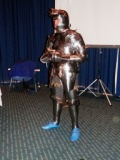
Andrew McKinnon at the 2013 Australasian Convention (Photograph by D Preis)

The other bit of news is closer to home. Our friend Andrew McKinnon, who delighted – in full armour – those attending the 2013 Australasian Convention (and quite a few other people who just happened to be at the hotel, where the Convention took place!), today is the topic of a whole article with wonderful illustrations in the Manly Daily, the local paper for Sydney’s northern suburbs. Andrew will joust at the first ever St Ives Medieval Fair, which will also include a variety of medieval attraction. Mark 20-21 September in your diary to attend this must-see event.


Tags: , ,

11
Jun

THE KING’S SHADOW

   Posted by: Barbara Gaskell Denvil    in Bookworm

A new novel by Barbara Gaskell Denvil, much appreciated member of the NSW Branch, has recently been published.  Barbara shares with us a blurb for her new book.  Having read and thoroughly enjoyed her previous novels Summerford’s Autumn and Satin Cinnabar, I can’t wait to spend some pleasant time in The King’s Shadow

(Page Admin)

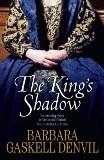
King's ShadowBarbara Gaskell Denvil, The King’s Shadow.  Simon & Schuster Australia, 2014.  ISBN 9781925030068 (Trade Paperback and ebook)

Andrew Cobham is a man of unconventional behaviour, his home is unusually grand, and he answers no questions. But as he keeps his own secrets safe, so he works to uncover those of others.

It is 1483 and King Edward IV sits England’s throne, but no king rules unchallenged. Often it is those closest to him who prove the unexpected danger. When the king dies suddenly without clear cause, then rumour replaces fact – and Andrew Cobham is already working behind the scenes.

Tyballis, when orphaned young, was forced into marriage with her neighbour, a bully and simpleton. When she escapes his abuse, she meets Andrew Cobham, and gradually an uneasy alliance forms. This is a friendship which will take them in unusual directions as Tyballis becomes embroiled in Andrew’s work and the danger which surrounds him. Eventually it is a motley gathering of thieves, informers, prostitutes and children that joins the game, determined to help Andrew uncover treason. Abduction, murder, intrigue and political subterfuge come to a climax as the country is thrown onto the brink of war.

Richard of Gloucester is designated Protector of the Realm, and it is his responsibility to bring peace to England’s troubled land, and discover those who are determined to disturb the peace for their own ends. This book brings light to some of the more troublesome mysteries and the doubts surrounding his decisions, based firmly on what truths are at present known, and especially on those frequently overlooked.

This novel combines history and imagination, but in no place is wilful inaccuracy permitted. These are the facts both as they actually occurred, and as they probably occurred.

But it is also a book about the whole adventure of an uncommon life.

Tags: , , , ,

23
May

RICHARD III WILL BE REBURIED IN LEICESTER CATHEDRAL

   Posted by: Dorothea Preis    in News, Reinterment

The decision of the British High Court in the Judicial Review whether the granting of the exhumation licence for the remains which were later established to be those of Richard III was announced today at 10 am (7 pm in Australia).

The court found that “there are no public law grounds for the Court interfering with the decisions in question. In the result, therefore, the Claimant’s application for Judicial Review is dismissed.” This means Richard will be re-interred in Leicester Cathedral, just a stone’s throw away from where his been for the last 500 years.

At the press conference in Leicester Cathedral it was announced that the reburial is expected for (the northern hemisphere) spring 2015.

You can read the full judgement here and an article from the BBC here.

Tags: , , ,

22
May

BREAKING NEWS

   Posted by: Dorothea Preis    in News, Reinterment

The decision of the High Court on the Judicial Review whether the licence to exhume a skeleton in Leicester, which subsequently was found to be that of Richard III, was valid will be announced tomorrow (Friday, 23 May 2014) at 10 am.  10 am in the UK is 7 pm in Australia.

More information here and here.


Tags: , , ,

18
May

St Mary de Castro in Leicester

   Posted by: Dorothea Preis    in Ricardian Places

A church of special significance for Richard, duke of York:

St Mary de Castro in Leicester

In March 2013, I spent a weekend in Leicester to attend the Richard III conference, but also used my time there to do some sightseeing. I was also lucky to be able to visit the church St Mary de Castro in Leicester. The word “lucky” is appropriate in this context, as visiting hours were limited. And in September 2013, the church had to close completely because of fears the spire might collapse [i] .it only reopened on 24 August 2014 [ii].
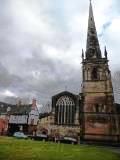
St Mary de Castro in Leicester

St Mary de Castro, from Castle Yard (© D Preis)

The limited visiting hours meant, I a short window of time before having to catch the coach back to Heathrow and the flight back to Australia, but I’m very glad that I did rush back to see it. It is a beautiful church and the people assisting visitors were incredibly friendly and helpful. I’m glad to see that mine was not an isolated experience, because a blogger remarked: “If it’s the same man who opens it up most days as the fellow who did on Saturday, you will get a warm and knowledgeable, but never overbearing welcome” [iii].

1. Early History

St Mary is the church of Leicester castle, hence the Latin ‘de Castro’; it was founded in 1107 as the chapel of the castle by Robert de Beaumont, who was created Earl of Leicester by King Henry I [iv].   Initially, the church was a college of 12 secular canons and a dean.  However, it is possible that a Saxon collegiate church had existed on the site before the Norman conquest of 1066. A wall includes a stone, which might be a Saxon coffin lid and might have come from an earlier Saxon church.
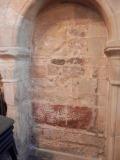
St Mary de Castro in Leicester

Possible Saxon coffin lid in St Mary de Castro (© D Preis)


Robert’s son, Robert le Bossu (the Hunchback), founded Leicester Abbey and called it ‘St. Mary de Pratis’ (St. Mary of the Meadows).  It seems his own foundation was more important to him, as he endowed it with the properties, which up to that point had been set aside to provide St Mary De Castro with an income.  However, a few years later the Abbot and the Earl restored the college, though on a smaller scale.  At the same time, it also served as a parish church, which helped the financial situation of the church.  While the college was dissolved by the Chantry Act of Edward VI in 1548, it continues to be a parish church to this day.

The first Norman church was much smaller than today’s building, only approx. 40m long, without a tower or spire and no glass in the windows. Some arches and the carving of a little figure, which might depict a page or a squire indicated by the kirtle and hairstyle, remain from the 12th century church.
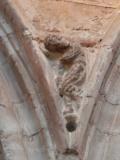
St Mary de Castro in Leicester

Little figure, possibly of a page or squire (© D Preis)

Then Robert de Blanchesmains, third Earl, the son of le Bossu, supported Queen Eleanor and her sons in their quarrel with Henry II, with the unfortunate result that the town was sacked in 1173 and the church severely damaged.

2. Rebuilding in the 12th century

Afterwards the church was rebuilt and in the process made longer and a chancel was built, possibly chapels were added on the sides.
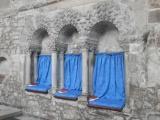
St Mary de Castro in Leicester

Norman sedilia (© D Preis)


Of interest are the sedilia (three seats for the priest and his helpers) in the south wall of the chancel.  They are said to be among the finest examples of Norman work in the country, with double columns, fine chiselled decoration and characteristic chevron moulded round arches.   There was also a piscina (stone basin), but this was mutilated at a later stage and only re-discovered with the aumbries (i.e. the cupboards “for to lay anything in pertaininge to the High Altar”), in the middle of the 19th century.

3. 13th century extension

By the early 13th century with the increased importance and size of the castle, it was decided to extent the church, by enlarging the south chapel, for the use of the parishioners. This aisle had its own altar, dedicated to the Holy Trinity. As a result there were basically two churches under one roof, separated by the original outside wall. The new church also has sedilia (these with pointed arches) and a piscina, built in the south wall, these are in the Early English style.

4. The tower

Possibly before 1300, the tower was fitted inside the church, as on the outside it would interfere with the passage between the castle’s gates in case of attack. In the area underneath the tower is the font. In this area some floor tiles from the 14th century are preserved. The spire was added in 1400 and partly rebuilt in 1685. However, it was discovered to be in a perilous state and was demolished in 2013/14. There is an appeal to raise money for a rebuilding of the spire.
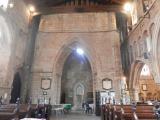
St Mary de Castro in Leicester

Tower inside the church (© D Preis)


5. Famous people with a connection to St Mary de Castro

St Mary De Castro has connections to a number of famous people. In the 14th century, the early dissident and translator of the Bible, John Wycliffe, preached at St Mary. The Lollards continued to have a strong hold in the Leicester area.

St Mary de Castro might be the church where Geoffrey Chaucer married Philippa de Roet, the sister of Katherine de Roet (Swynford), in the 1360s. Their great-grandson John de la Pole, second duke of Suffolk, married Elizabeth, a sister of Edward IV and Richard III, here in 1458. His parents were William de la Pole and Alice Chaucer, daughter of Thomas Chaucer, one of Geoffrey and Philippa’s children.

Katherine de Roet and John of Gaunt, who was also earl of Leicester from November 1362 onwards [v], are among the ancestors of both Edward IV and Richard III as well as the Tudors.

6. The Parliament of Bats

In 1426, the so-called Parliament of Bats was held in Leicester. This was a time of a power struggle between the chancellor, Henry Beaufort, bishop of Winchester, and the Protector, Humphrey, duke of Gloucester. As there was also a disagreement with the London mercantile community over tunnage and poundage, it was decided for parliament to sit in Leicester instead of London. John, duke of Bedford, returned from the war in France to resume his role as protector. The name ‘Parliament of Bats’ has nothing to do with flying mammals, but more with cricket bats. It refers to the lords’ retainers being armed with bludgeons, ‘battes’, although they had been instructed not to carry arms [vi].

At the time King Henry VI was only four years old. It was at St Mary de Castro that on 19 May 1426 Bedford knighted Henry VI, who in turn knighted 36 others. One of them was the then 14-year-old Richard, third duke of York (who was to become the father of Richard III) [vii]. We can only speculate that this must have been a very exciting event for the 14-year-old boy. Of course, at this time nobody could foresee the later disagreement between duke and king, which would lead to what is known today as the Wars of the Roses. All through this period the town was loyal to the Yorkists and send its forces to fight for Edward, Earl of March (later Edward IV), at Towton in 1461 [viii].

7. Richard III and Leicester

His son, Richard III, would have attended mass at St Mary de Castro. He visited Leicester [ix] several times before he became king and might very well have stayed at the castle. We know for sure that during his reign he stayed at the castle twice in 1483. During the first visit, 17 to 20 August, he wrote two letters “from my castle at Leicester”, which are extant. The second visit was 22/23 October, while assembling an army to fight Buckingham’s revolt. He also visited the town twice in 1484, but on these occasions does not seem to have stayed at the castle, which might have been in a poor state of repair by then. During his first visit of 1484, on 31 July, he visited Leicester Abbey and for the second, on 5 November, Edwards says in The Itinerary that he was at the “Town of Leicester”, though we do not know where. And of course, Richard stayed in Leicester 19-21 August 1485, before marching out to fight Henry Tudor’s army at Bosworth, supported by forces from Leicester. We do not know for sure where he stayed on this last occasion, though legend has it that he spent the nights at the Blue Boar Inn.

After his death, his body was displayed at St Mary-in-the-Newarke in Leicester, to show the people of the city who had supported him that he was dead indeed. In the meantime, Henry Tudor celebrated his victory at Coventry, where he stayed the night 24/25 August. Coventry citizens probably felt it was politic to welcome him lavishly, but in the city annals they recorded that King Richard “was shamefully Carryed to Leicester & Buryed their”[x] .

Notes:

i. ‘St Mary De Castro church shut for six months over spire collapse fear’, BBC News Leicester (7 September 2013). URL: http://www.bbc.co.uk/news/uk-england-leicestershire-23985692 Date accessed: 13 October 2013

ii.  Home page of The Collegiate Parish Church of St. Mary de Castro, Leicester.  URL: http://www.stmarydecastro.co.uk/  Date accessed:  10 October 2014

iii. James Alexander Cameron, ‘The medieval churches of Leicester and their many sedilia study trip’, Stained Glass Attitudes (16 April 2013).

iv. Information on the church:
‘The ancient borough: St. Mary’s’, A History of the County of Leicester: volume 4: The City of Leicester (1958), pp. 369-380. URL: http://www.british-history.ac.uk/report.aspx?compid=66579 Date accessed: 31 October 2013

Visitor’s Guide to St Mary de Castro

v. Simon Walker, ‘John , duke of Aquitaine and duke of Lancaster, styled king of Castile and León (1340–1399)’, Oxford Dictionary of National Biography, Oxford University Press, 2004; online edn, May 2008.

vi. ‘The Parliament of Bats, 4 Hen. VI’, The History of Parliament. URL: http://www.histparl.ac.uk/volume/1422-1504/parliament/1426 Date accessed: 12 January 2014

vii. Ralph Alan Griffiths, The Reign of King Henry VI: The Exercise of Royal Authority, 1422-1461. University of California Press, 1981, pp.80-81

viii. Mathew Morris & Richard Buckley, Richard III: The King under the Car Park. University of Leicester Archaeological Services, 2013, p.11

ix. For Richard III’s visits to Leicester see Morris & Buckley, pp.11-12; as well as Rhoda Edwards, The Itinerary of King Richard III 1483-1485. Richard III Society, 1983.

x. DeLloyd J Guth, “Richard III, Henry VII and the City: London Politics and the ‘Dun Cow’”, in: Kings and Nobles in the Later Middle Ages: a Tribute to Charles Ross, ed. by Ralph A. Griffiths & James Sherborne. Sutton, Gloucester, 1986, pp.194-195


Tags: , , , , ,

30
Mar

Talking takes history to a wider audience

   Posted by: Julia Redlich    in Bookworm

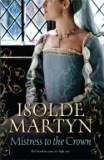
Mistress to the CrownThis is how Isolde Martyn, author, past chairperson of the New South Wales Branch and welcome speaker at our meetings, spent Thursday, March 27th. A guest of the Port Stephens Libraries at Tomaree and Raymond Terrace, she spoke on her novel Mistress to the Crown, her absorbing and well researched story about Elizabeth Lambard (aka Jane Shore). Many NSW Branch members attended the launch of this book last year.

Isolde’s talk gave wonderful insight to Elizabeth the person, the problems and people she had to cope with, as well as a fascinating view of the London in which she lived, loved and – not so well known– ran a successful business. And, no, William Shore was not a goldsmith, and examples of early novels whose covers implied that Elizabeth was a goldsmith’s wife were amusing viewing if bodice-ripper style appealed.

It was, as is often the case, a shame that those attending were quality not quantity, but enthusiastic questions and opinions gave hope that a few more people now realise that history was alive and well long before the Tudors butted in! This will be helped by the sales of the book, as well as those of Isolde’s novel about Harry Buckingham The Devil in Ermine. Richard was mentioned of course, especially his “what fools these mortals be” style letter about Tom Lynom. Another attendee was thrilled to know she shared Richard’s birthday!

We can look forward to another of Isolde’s books titled The Golden Widows that will be published by Mira in August this year. And the identity of the widows? The book opens with this introduction:

It is estimated that between 1450 and 1500, during the struggle for the crown between the Houses of York and Lancaster, 62 of England’s lords and their heirs were slain. Of the 44 noble ladies who were left as widows, 21 remarried.

This is the story of two of those women, Kate and Elysabeth, whose husbands fought on opposing sides. Kate was the sister of the earl known in history as “Warwick the Kingmaker” and Elysabeth became very famous in her own right.

This will be another welcome addition to Isolde’s portraits of medieval England. Each is eminently readable as fiction, excellent for accurate research – andlet’s give a huge plus for the lists of the historically correct characters (a minimum of invented names for lesser ones) and a glossary of medieval terms.

Mistress to the Crown, published by Mira, rrp $25, ISBN 978 1743560211, soon available in a smaller paperback edition.

The Devil in Ermine, an e-book available for Kindle or from Amazon Print on Demand. ISBN: 0-9873 8469-0; ISBN-13: 978-098738460-0-7.

Tags: , , , ,

4
Feb

THE BATTLE FOR RICHARD III

   Posted by: Dorothea Preis    in Greyfriars Dig, News

film_reel smOn Monday, 3 February 2014, BBC 1 broadcast a programme in the UK on what has gone wrong since it was revealed a year ago that the remains found in Leicester are indeed those of Richard III.  It investigates how a High Court hearing will affect the king’s final resting place.  Both parties, Leicester University and Plantagenet Alliance, were interviewed.  While we in Australia cannot watch the programme easily on the BBC iPlayer, some excerpts are available here.

Tags: , , ,

30
Jan

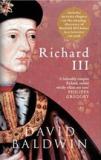
Richard III by David Baldwin

   Posted by: Dorothea Preis    in Bookworm

Book Review:  RRichard III by David Baldwinichard III by David Baldwin

David Baldwin, Richard III.  Amberley Publishing, 2012.  ISBN 9781445601823

This review was presented at NSW Convention in Mittagong in May 2012.  We apologise for the delay in posting it.

Richard III by David Baldwin was published on 28 February 2012, so well before the remains of Richard III were found where they had been buried in the church of the Leicester Greyfriars.  However, it should not be forgotten that Baldwin had as early as 1986 published the hypothesis that his remains were still where they had originally been buried, [1] I had ordered the book as soon as it came out, expecting some new insights. Once I had received it and saw the endorsement by Philippa Gregory on the back, I started wondering though, whether I had not made a huge mistake.

The subtitle is “Ruthless hunchback or paragon of virtue, the true story of the last Plantagenet king”, which does reflect what Baldwin sets out to do.  As he explains in his Introduction “It seems improbable that any human being could be as evil – or alternatively as misunderstood – as Richard, and … somewhere behind all the conflicting argument stands a real man who had both qualities and failings.  Neither black or white, but – like all of us – somewhere in between”. [pp.10-11]  An admirable aim, but we’ll have to see whether he can achieve it.

Baldwin follows a chronological approach.  Starting with Richard’s birth and finishing after Bosworth with a chapter on “Legacy & Legend”.  On the whole he is reasonably fair, the chapter on Richard as Warwick’s heir in the North is a case in point.  Richard has often been blamed for being excessively aggressive in extending his interests during this period, but Baldwin puts this into its historical context and shows that Richard’s behaviour was just normal.  He was no worse than others, but as the king’s brother he had obviously more scope for extending his interests, though they were not necessarily to the detriment of others.  Baldwin also stresses that this was not only the normal behaviour for a medieval nobleman, but would also have been expected of him.

While I have some reservations about Baldwin’s analysis of how Richard III came to the throne, it has to be said that this is unquestionably a period on which views are at their most partisan.  I found his heavy reliance on Thomas More – strawberries and all – and Mancini somewhat limiting, especially – as we shall see later – considering Balwin’s view on the legends surrounding Richard.  He does, however, reject the notion that the crown was what Richard had always wanted, but rather that “he was seizing an opportunity rather than fulfilling an expectation”. [p.104]

On the question of the fate of the princes, Baldwin thinks that the elder, Edward, died of natural causes, while the younger, Richard, survived.  This comes as no surprise, considering that he wrote The Lost Prince five years previously, where he set out to show that the mysterious Richard of Eastwell was in reality the younger son of Edward IV.

Baldwin shows that Richard’s reign was always rather insecure, which was why a nobody like Henry Tudor could actually manage to overthrow him and stay in power.  He explains that Richard’s legacy are the progressive laws of his only parliament, which “affected the lives of Englishmen far into the future”. [p.216]  He concludes that “Richard’s achievements are arguably greater than those of some kings who reigned for longer, and there are indications that they would have been greater still if he had been allowed more time” [p.219]

As for the legends surrounding Richard I agree when he says that “It was perhaps inevitable that a king who both gained and lost his throne in such dramatic circumstances would be become the stuff of legend” [p.228], but that these do not tell us anything about him personally.

On the whole I think Baldwin does quite a good job at showing Richard as a “man who is … both principled and unprincipled, a flawed diamond” [p.228]  I don’t think that he offers much new for someone who knows the period reasonably well, but would be a good introduction.

It is a pity, however, that Baldwin occasionally adopts a fictional approach.  This begins in Richard’s childhood when we meet a boy at Fastolf Place, who “eagerly anticipated trips into the bustling city [ie. London] beyond the wall”.  [p.17]  Later, during the dramatic events of May/June 1483, we learn that “Richard … worried constantly about the future, searched his conscience many times over”. [p.99].  Obviously we have no idea how Richard felt and assumptions like these, which do nothing to explain the events, have no place in a work of non-fiction.

With some reservations I can recommend this new book on Richard, though I would not class it as “must read”.

[1] David Baldwin, ‘King Richard’s Grave in Leicester‘, Transactions of Leicester Archaeological and Historical Society, Vol. 60 (1986), pp.21-24

Tags: , , ,

26
Jan

RICHARD III IN GLASS

   Posted by: Dorothea Preis    in News

A local Leicester artist, Brad Cooke, has been commissioned to create a stained glass window for the visitors’ centre, currently under construction in the building of the former Alderman Newton’s School in Leicester, next to spot where Richard was originally buried in the church of the Greyfriars in 1485.

The window, 2.8m high and 2.3m wide, will feature Richard III, Anne and their son Edward, all life-sized.  As Richard died in battle, he will be shown in a full suit of armour, probably in silver and gold, clutching his sword and crown.

To make the piece “thought provoking” Richard will be slightly separated from his wife and son.  The plan is to display Anne in the colours she was married in and to drape Edward in the national flag of that time.

The window will be back-lit with three lights, which would go off one by one in the order in which the three family members died to relate to the story.

Stained glass has been used in churches since the 7th century, so this craft which Richard would have known in his lifetime is very suitable for a depiction of him and his family.

More information:

Richard III Visitor Centre to get life-sized window of King’, BBC News Leicester (18 January 2014).
Peter Warzynski, ‘Richard III: Knighton artist Brad creating stained glass window of king for visitor centre’, Leicester Mercury (24 January 2014).

Tags: ,