Posts Tagged ‘Richard III’

4
Sep

Memory of Richard III held high in Sheriff Hutton

   Posted by: Dorothea Preis    in News

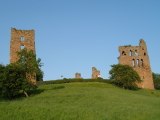
Sheriff Hutton Castle was one of Richard’s main bases in the north and as Lord of the North, he often stayed at the castle.  In 1484 he established there a royal household for his nephew Edward, Earl of Warwick, the son of George of Clarence, in the care of John, Earl of Lincoln, another of Richard’s nephews, the son of his sister Elizabeth. They were later joined by Edward IV’s daughters as well as Richard’s own illegitimate son, John of Gloucester.[1]

On 20/21st October 2012, the town is planning a weekend of talks, music and drama to reveal more of the story of Richard III, his wife Anne Neville and their son Edward of Middleham, Prince of Wales.

On the Saturday evening there will be a concert performance of words and music by the York Waits, playing medieval music on period instruments, and  Deborah Catterall, renowned singer of period music.

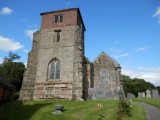
The Sunday will start with a morning service of thanksgiving for Richard III and his family.  Presumably this will take place in the local church, St Helen and the Holy Cross.  In the church, there is a small alabaster chest tomb with the monument of a child, dated to the 15th century.  It has often been thought that this is the coffin of Richard’s only legitimate child, Edward of Middleham [2] (and indeed the local website claims that it is).   However, a careful analysis of the style of the monument makes this unlikely.[3]

The service is followed by a demonstration by the Towton Battlefield Society and the Frei Companie.  In the afternoon, there will be presentations. Our friend, Helen Cox of the Richard III Society, will speak on Ricardian connections – she is the author of The Battle of Wakefield Revisited and Walk Wakefield 1460. Professor Anthony Pollard will speak on the Nevilles in Yorkshire.

And for all your shopping needs there will be Ricardian stalls all over the weekend.

For more info and how to book tickets, visit The Press.

Bibliography:

1.    ‘Sheriff Hutton Castle – Acquired 29 June 1471’, The Richard III Foundation.  URL:  http://www.richard111.com/sheriff_hutton_castle__.htm Date accessed: 26 May 2010

2.    Jane Crean, ‘The Sheriff Hutton Monument:  Part 1’, Ricardian Bulletin (September 2009), pp. 37-39

3.    Jane Crean, ‘The Sheriff Hutton Monument: Part 2’, Ricardian Bulletin (December 2009), pp. 39-41

Tags: , ,

1
Sep

Leicester Update 1.9.12

   Posted by: Dorothea Preis    in Greyfriars Dig, News

As every morning I couldn’t wait today to visit the news update on the Greyfriars project in Leicester.  I was especially curious what the press conference yesterday would have brought.  So here is the latest:

Richard Buckley, the archaeologist leading the dig, stated that “Progress in our search for the body of King Richard III is exceeding our expectations. The first week could not have gone better.”

A part of a wall was found, which could have belonged to the church, but also medieval window tracery, fragments glazed floor tiles as well as of a stained glass window, which might have come from the cloisters walk.  According to the BBC, Richard Buckley concluded that

The dimensions of the walls and the association with certain building materials and tiled floors suggests we are looking at a religious house and a high status medieval building.

One of the walls in particular is getting on for two metres thick and it’s on an east-west orientation, so as far as we can tell, and its still early days yet, it might be one of the walls of the Greyfriars church and if that is the case, we are on the right track.

As at the start of the dig the archaeologists were not even sure, where exactly the friary might have been, this is certainly a find exceeding any expectations.

I have been interested in medieval ceramics for some time, so for me the floor tile fragment was of particular interest.  It is of a type which was limited to high-status buildings and was one of the indications that the discovered remains are those of the church.  A photo of the tile fragment on the page of the University of Leicester.

The team is planning to dig a contingency trench over the weekend to confirm that they have indeed found the church, which would give them a clearer understanding of where to look for Richard’s body.

However, even if the body of the king were not found, the dig is a tremendous boost for our understanding of the historic Leicester.  And as for Richard, it seems to help in publicizing a more balanced viewpoint of Richard III, as a recent article in the Catholic Herald in spite of certain shortcomings shows.

In the Southern hemisphere today marks the first day of spring (though present temperatures could have fooled me).   Maybe the winter of our discontent is over in more ways than the one Shakespeare thought.

Tags: , , ,

31
Aug

Leicester Update 31.8.12

   Posted by: Dorothea Preis    in Greyfriars Dig, News

It has been established that the remains of walls, which have been found during the dig, are indeed from the medieval period.  The next step is to establish the alignment of these walls.  However, otherwise there is “Relatively little to report right now. Richard III still dead”, as the update from the University of Leicester puts it – short and precise.

We are hoping for more info tomorrow, as there will be a press briefing at 11.00 (UK time) today, which means 20.00 EST in Australia.

ITV has also an interesting article and video on the dig on their webpage.  Their remarks on Richard’s supposed deformities are particular welcome.

Tags: , , ,

30
Aug

Leicester Update 30.8.12

   Posted by: Dorothea Preis    in Greyfriars Dig, News

Just heard on the trusted Ricardian grapevine – in this case the Facebook page of the Richard III Society – that due to all our emails urging them to make a documentary about the dig,  Channel 4 has changed its mind and is definitely filming the dig and the documentary will be aired in the UK later this year.

Maybe we could start a similar campaign to encourage our ABC (probably the most likely channel in Australia) to buy and show the documentary here.

A big “Thank you” to all our members and friends who contacted Channel 4!

Unfortunately the archaeologists at the dig were not yet able to assess the remains of walls, which were found on Tuesday, any further, as heavy rain stopped the work.

The University of Leicester has included some photos in its latest update on the dig.  You can find a link in their update of 29 August 2012.

Tags: , , ,

24
Aug

THE day is here: The dig for Richard III’s remains begins

   Posted by: Dorothea Preis    in Greyfriars Dig, News

Today we have really exciting news for all our readers!

After being killed in the Battle of Bosworth by the invading forces of Henry Tudor, the body of King Richard III was brought back to Leicester and eventually buried at the church of the Greyfriars, a Franciscan Friary.  Over time the exact location of the friary was lost, but archaeologists think it might be under what is now a carpark.

After long planning, tomorrow, 25 August 2012, a dig is to start at the site to try and establish the exact location of the former Greyfriars church and to find any remains of those, who were buried in the church.

The dig is carried out in cooperation by the University of Leicester and Leicester City Council in association with the Richard III Society.  It is the first ever search for the lost grave of an anointed King of England.

The work of John Ashdown-Hill has established a descendant in the all-female line of Richard’s mother, Cecily of York, in Canada, whose DNA could be used to establish whether any remains are indeed those of the lost – but not forgotten – king.

For more information, as well as a call on Channel 4 to commission a programme on this historic dig, go to the What’s New page of our parent Society.  Please do support the campaign for the programme!

The official page on the project by the University of Leicester can be found here.

You can read a press release by Richard Buckley of the University of Leicester here.

The search for Richard’s DNA is explained in:  John Ashdown-Hill, The Last Days of Richard III.  The History Press, Stroud, 2010.  ISBN 978 0 7524 5404 7 – also available for Kindle

Tags: , , ,

12
Aug

Duchess Anne of Exeter

   Posted by: Judy Howard    in Medieval Miscellany, Medieval People

It is a tradition in the NSW branch that at the August general meeting we have “Scrabble Talks”.  Once a year, members draw Scrabble tiles out of a bag and then prepare a short talk on a topic starting with their letter.  The following is Judy’s talk on ‘Duchess Anne of Exeter’.  This was a particularly fitting, as the day before our meeting was Duchess Anne’s birthday.

Duchess Anne of Exeter

I’ve been allocated the letter ‘A’ for my talk at the August general meeting of the NSW branch, so I would like to tell you about Princess Anne Plantagenet, better known as Duchess Anne of Exeter, who was the eldest sister of Edward IV and Richard III and apparently Edward’s favourite sibling.  You will be familiar with this memorial brass to Anne and her second husband, which I think is the only likeness of her to survive.


Anne’s story is a very good example of a high born woman who became a pawn in the political manoeuvres of her male relatives.  But we can presume she found happiness towards the end of her life.

Anne was born in 1439 and was the eldest surviving child of the Duke of York and Cecily Neville.  She was betrothed in 1445 at the age of 6 years to Henry Holland, who was 15 years old and the son of the Duke of Exeter.  York paid a huge dowry of 4,500 marks, the largest known in late medieval England. Within five years of this, you will recall, was around the time that the King, Henry VI, began showing signs of his illness and the Wars of the Roses was beginning to seriously foment.  It is believed York’s motive in securing the betrothal was partly political and he was hoping for Exeter’s alliance in his attempt to return to France.  It was also a dynastic move as Exeter was the next closest male relative of Henry VI and descended from John of Gaunt and Blanche of Lancaster.  York took the opportunity to combine two great dynasties but in fact, in both personal and political terms, it was a disaster.

Anne and Henry married soon after their betrothal and Henry inherited his father’s titles and land in 1450 and as the Duke of Exeter and became admiral of England, Ireland & Aquitaine and Constable of the Tower of London.  Their first and only child, also called Anne, was born in 1455, and she went on to marry Elizabeth Woodville’s son, Thomas Grey in 1467.  The young Duke of Exeter, Henry, was described as an unappealing character, violent, cruel and lacking in any real experience and was unintelligent – not the makings of a great husband or political ally!!

During York’s Protectorate in 1453 – 54, young Exeter (York’s son-in-law) played a prominent role in the serious breakdown of local law and order and the uncontrollable violence, particularly in Yorkshire which was York’s biggest challenge during his protectorate, seems to have been perpetrated by Exeter himself.  Exeter planned a major uprising in the north and may have even plotted to murder York by luring him to Yorkshire.

It was unlikely that Duchess Anne was able to escape the animosity Exeter felt towards his wife’s father, given his character.  In addition, York defaulted on the later instalments to her dowry, which is understandable but would not have helped the relationships.  Anne did have a child with Exeter in 1455 but we can presume that the marriage broke down soon after.

Exeter was a staunch Lancastrian during the descent into Civil War and he became a very bitter enemy of York and the Nevilles.  Exeter thought, as the King’s closest relative, he was entitled to a prominent role in government and he was not happy when York began to advance his own claims as King Henry’s heir presumptive. As a committed Lancastrian, Exeter joined forces with Somerset, Northumberland and others in opposition, which culminated in the death of York, his son Edmund and brother-in-law Salisbury at Wakefield in 1460.

In 1461 Exeter fought for the Lancastrians at the battles of Blore Heath, Northampton, St Albans and Towton and even though defeated, he continued to be aligned with the Somerset and the other hard-core Lancastrians.  This caused further and continuing difficulties for the new King Edward in his attempts to establish his rule and find a collegiate solution to the regional turmoil caused by the civil war.  Exeter escaped overseas and was attainted by parliament and his estates were granted to his wife – one advantage of being the new King’s sister.  Exeter lived in poverty during his exile until the Duke of Burgundy gave him a modest pension.  But remember that the Duke of Burgundy was soon to become Edward’s brother-in-law when he married Princess Margaret of York.

Anne at this stage was still married to Exeter and was herself the second lady in the land after the King’s mother, Cecily.

Anne, around this time, began a relationship with Sir Thomas St Ledger who became her lover (who could blame her!!).  Thomas was made an esquire of the body to Edward IV and was granted eight manors in Buckinghamshire and Cambridgeshire, including a royal manor, and received a number of other wardships and grants.  Here, and in the granting of Exeter’s estates to her, Anne benefited considerably from being the King’s sister.

Thomas proved to be a loyal member of the King’s household, he resisted Clarence and Warwick in 1469 – 1470 and he even joined Edward in exile in 1470.

But, not to be forgotten, that flea Exeter returned to England and commanded the left wing of Warwick’s army at Barnet in April 1471 and in doing so opposed his 3 brothers-in-law, Edward, Richard & Clarence.  He was seriously wounded on the battlefield but eventually recovered to be imprisoned in the Tower of London.  Anne finally got her divorce from Exeter and she married her lover Thomas St Ledger the next year.

But Exeter was not to be put down so easily, he was released from custody in 1475 to join Edward’s French expedition but on the return journey he drowned in the English Channel, reputedly thrown overboard with the King’s knowledge.  A fitting end for such a despicable character.  I wonder what Anne thought??

Tragically for Anne, though, her daughter with Exeter died the same year.

The next year in 1476, Anne gave birth to a second daughter also called Anne, but unfortunately Duchess Anne herself died, probably in childbirth.  The infant Anne, whose father was Thomas St Ledger, was to marry George Manners and become the Baroness Ros and have two children, one of whom became the 1st Earl of Rutland. This title has remained in their family until today – Duchess Anne and her lover Thomas had established a very successful and long lasting dynasty.

But to continue the story of the people in Duchess Anne’s life:  after Edward’s death in 1483, Anne’s second husband Thomas St Ledger attended Richard III’s coronation but in July of that year he was dismissed from all posts.  He became closely aligned with Thomas Grey, Marquis of Dorset, and a leader in the Buckingham Revolt around Exeter and held out against the royal forces at Bodmin Castle until mid-November.  Thomas St Ledger was executed a few days after.  How sad for Anne, but we do not truly understand the circumstances of this period and cannot understand the extremes of emotion that Edward’s old household felt given the events which followed Edward’s death and Richard’s subsequent coronation.

We also do not know much about Duchess Anne as a person, which is not unusual for women of this period.  However in 1491 her daughter by her second husband Thomas, founded in her honour the Rutland Chapel, as it is now called, in the north transept of St George’s Chapel at Windsor, just down the aisle from Edward IV’s vault.  The memorial brass to Anne and Thomas is on the east wall of this chantry chapel.

The Chantry, although established for her parents, also contains a fine tomb chest and alabaster effigies of Anne junior and her husband George Manners, the 12th Baron Ros.  These effigies are very fine examples of the period. (You can find photographs of these here)

The Rutland Chantry is a beautiful place to visit and is still used regularly for services at St George’s Chapel.  It has some very beautiful new tapestries hanging within, along with some new furniture and today remains a very peaceful place of worship and contemplation.  A fine memorial to Duchess Anne.

Tags: , , ,

8
Aug

Bosworth at Peace

   Posted by: Dorothea Preis    in Ricardian Places

During our recent European holiday, we visited the Bosworth Battlefield Heritage Centre.  And I have to agree with what they say on their website, it “is a unique day out for all the family”:  My husband, who does not share my interest in medieval history, also enjoyed the experience.

We left Hertford, where we had been staying for our first week, in the morning and travelled via Rugby, for a look at the school which gave its name to the game.  On the way we noticed – and were very impressed by – a Tesco storage facility, which is powered by its own wind turbine to lessen CO2  emissions.   I somehow doubt whether our Woolworths or Coles are as considerate of our environment.

If I have one whinge, it is about the sign posting to the Battlefield Centre.  For such an important attraction, the signage left a lot to be wished for.

We arrived around lunch time and therefore our first stop was the Tithe Barn Restaurant, where we had the pleasure having our sandwiches under the watchful eye of Richard in full armour.

Refreshed we went to have a look at the exhibition.  Though I might have liked some more in depth information, I would say that to visitors without too much previous knowledge it gave quite a good and relatively unbiased overview of the lead-up to the battle.   Some of the events were told by a variety of people involved with the battle, like a mercenaries wife or Lord Stanley (a very shady character!).  My personal favourite was the innkeeper’s daughter from Leicester.  We also did the more touristy things like trying on medieval armour (not particularly flattering!) and minting our own commemorative penny.  The BFI Gallery offered an interesting insight into the methods used by archaeologists.

The Sundial

And then – in warm sunshine (which is worth a special mention after this British summer!) – we walked the battlefield trail.  We admired the new sundial in the form of a medieval billhook, with Richard’s crown dangling from the end.  Near the sundial and white rose bushes are rather uncomfortable looking thrones for Richard and Henry Tudor as well as posts for other people who fought in the battle, like for instance John Howard, duke of Norfolk.   We also sat for a while on the bench donated by the Richard III Society in memory of Paul Murray Kendall.

The walk is well illustrated by informative plaques and exhibits.  While the actual battle site is not part of the trail – it is private property – it is possible to look out over it.  It was difficult to imagine that in this peaceful rural setting, with sheep grazing on lush green grass, such a bloody and decisive battle was fought, where King Richard III and so many others lost their lives.

On our way back to the gift shop, we spotted a lady of Hawkwise Falconry with one of their hawks on her hand, reminding us of the role these birds played in medieval times.

Maybe it reflects my personal bias, but to judge from what was on offer at the gift shop, I got the distinct impression that the battle of the gifts was a decisive win for Richard.  Ricardian themed souvenirs outnumbered those with a Tudor connection.  Needless to say that I was in shopping heaven!

St James, Sutton Cheney

We then went for some quiet reflection to the Church of St James at Sutton Cheney.  The church building dates mainly from the 13th and 14th century, though it may replace an earlier one.  According to local tradition, Richard heard mass here before the battle.  The Richard III Society holds each year on or near 22 August a commemorative service at this church.  During this service wreaths are laid at the memorial plaque, one of which is donated by the Australasian branches.  At the time of my visit (July), last year’s wreath had wilted and had been taken away, but the card which had been attached to it, was still in place.

Richard III Memorial in St James, Sutton Cheney

(The card from the Australasian and Canadian branches is on the shelf on the right hand side)

The connection to Richard at this church is very strong:  not only the memorial plaque, but there is a great number of needlepoint kneelers, which have been stitched by Society members.  Among the designs is the white boar; another shows the entry in the York Records, when they heard of Richard’s death; there is the York rose, but his faithful henchmen are not forgotten either (the cat, the rat and Lovell our dog).

After a day full of travel and lots of new impressions, the church was a quiet and comforting spot.  I hope that it felt the same for Richard, when he came here amid the bustle of the last minute preparations for his final battle.

Further Information:

Phil Stone, ‘Shine out fair sun – and tell us the time at Bosworth’, Ricardian Bulletin (September 2011), pp.10-11

Pewfinder, ‘Sutton Cheney Church – St James’, Leicestershire & Rutland Churches (19 October 2011).  URL:  http://www.leicestershirechurches.co.uk/sutton-cheney-church/  Date accessed:  7 Aug. 2012

All photographs are by the present author.

Tags: , ,

4
Aug

Royal Devotion and Gold – a personal account

   Posted by: Dorothea Preis    in News

We started our recent trip to Europe in the UK and the first item on my agenda was visiting an exhibition at Lambeth Palace Library:  ‘Royal Devotion: Monarchy and the Book of Common Prayer’.   Not being Anglican, rather than the Book of Common Prayer the drawcard for me was a book which predates the Reformation (and hence the Book of Common Prayer) – Richard III’s Book of Hours.

I had pre-booked my ticket for the first slot in the morning after the day of our arrival.  After a pleasant walk along the river, I arrived early and had enough time for a quick look at the beautiful front garden and the shop of the Garden Museum in the old St Mary’s church next door.

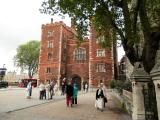
Lambeth Palace Gatehouse (© Dorothea Preis)

Then I joined a growing number of hopefuls waiting outside the main entrance of a brick gatehouse – which I found out later was built by John Morton.  However, it turned out these were members of an arts’ fund and waiting for a tour of the Palace, whereas the entrance to the exhibition was at the side of the complex.  Here a much smaller group of maybe 8 or 9 people was waiting and punctually at 11 the small door opened and we were admitted.

We were each handed a beautifully illustrated exhibition brochure and then our group was lead into the library (I was able to take some photos outside, but photography was not permitted in the exhibition itself) with some explanations on the building and its history.  Though the building itself is neo-Gothic, it creates the right atmosphere for viewing medieval books.

Lambeth Palace Library (© Dorothea Preis)

We were left to view the exhibits at our own pace and it was nice to be able to do so without being crowded.  The exhibition is displayed in 10 cases, the first of which was the most interesting to me, covering “Public & Private Devotion before the Reformation”.

The first book exhibited is the Chichele Breviary (MS 69), which belonged to Archbishop Henry Chichele (c.1362–1443).  It is one of only two books of his which are known to have survived to this day.

The second was the book I really wanted to see:  Richard III’s Book of Hours (MS 474).  A book of hours “was the private book of devotions of the layman in the later Middle Ages and the Renaissance”.  [Sutton and Visser-Fuchs, p.2]

It was open on the calendar page and I could read the entry for 2 October (or rather what the explanation card next to it said, as the original entry was somewhat cut when the book was rebound in the 16th century):

hac die natus erat Ricardus Rex Anglie III apud ffoderingay anno domini Mcc [cc lij]
on this day was born Richard III King of England AD 1452 near Fotheringhay (own translation)

This was added by Richard himself, obviously after 6 July 1483, as he refers to himself as king.  His handwriting is large, though tidy and even.

The manuscript was not made for Richard, but was produced c.1420 for an unknown owner.  As Sutton and Visser-Fuchs state it is “a very useful, solid, unflamboyant and English manuscript for his daily use”. [Sutton and Visser-Fuchs, p.2]

It is believed that he had the book with him at Bosworth and that it was found there after the battle.  In his speech at the opening of the exhibition, the Archbishop of Canterbury remarked:

There’s a personal book of ours belonging to Richard III in this library which does not seem to have brought him a great deal of good fortune, though he carried it at the Battle of Bosworth.

Henry Tudor gave the manuscript to his mother Margaret Beaufort, who seems to have made some half-hearted attempt to scratch out his name at various places, though fortunately not this one.

Standing next to a book, which Richard held in his hands, and seeing his handwriting was certainly a special and moving moment for me.  It was probably the closest I would ever get to the king I have been studying for some time.

The rest of the of the exhibition contained various other beautiful and interesting books, most having some royal connection, from the centuries up to an order of service from the wedding of Prince William and Catherine Middleton in Case 8.  Coming from the Cologne area, I was pleased to meet Hermann von Wied, Archbishop of Cologne from 1515 to 1547, in Case 2.

However, before leaving the library I returned to Case 1 for a last glimpse of King Richard III, represented by his book.

Afterwards I made my way to the Goldsmiths’ Hall to visit another exhibition:  ‘Gold:  Power and Allure’, featuring more than 400 gold items from 2500 BC to the present day.  One of the exhibits was the Middleham Jewel, which is normally on display in York.

The gold lozenge-shaped jewel was found in September 1985 near Middleham Castle. It is beautifully engraved and a large sapphire is mounted on the front.  It is estimated that it was made between 1450 and 1475, certainly for a wealthy person.  Whether there is any connection to Richard III is not known, though it has been speculated that it might have belonged to Richard’s mother, Cecily Nevill.  It was beautifully displayed with both the front and back being visible.

Due to time pressure, I didn’t pay the exhibition the attention it deserved, though I spotted an Angel from the time of Richard’s reign.

I would like to take this opportunity to thank the Facebook page of the Richard III Society for alerting me to both these fascinating exhibitions.

Bibliography:

Duffy, Eamon, Marking the Hours: English People and Their Prayers, 1240-1570.  Yale University Press (2006).  ISBN 9780300117141, p.33

Sutton, Anne F. & Visser Fuchs, Livia, The Hours of Richard III.  Alan Sutton Publishing Ltd (1996).  ISBN 0750911840

‘HRH Prince Charles opens exhibition at Lambeth Palace Library’, The Archbishop of Canterbury (1 May 2012).  URL:  http://www.archbishopofcanterbury.org/articles.php/2469/hrh-prince-charles-opens-exhibition-at-lambeth-palace-library Date accessed:  14 June 2012

‘The Middleham Jewel ‘, The Richard III Society.  URL:  http://www.richardiii.net/2001_archive.htm Date accessed:  3 Nov. 2010

Karl, Werner, ‘Ananizapta and the Middleham Jewel’, Sammelblatt des Historischen Vereins Ingolstadt, 110. Jahrgang (2001), S.57 ff.  Available at URL:  http://www.ingolstadt.de/stadtmuseum/scheuerer/ing/ananiz05.htm Date accessed:  20 March 2010

Tags: , ,

The June branch meeting of the NSW Richard III Society was held on Saturday, 9 June 2012, at the Sydney Mechanics’ Institute. Chair Judith Hughes welcomed all attendees and began by summarising the wonderful Ricardian mini-conference that was held recently in Mittagong, with her special thanks to all of those who had worked so hard to make it the success it was.

Judith then reported on the official book launch for University of Melbourne Professor Stephanie Trigg’s Shame and Honor: A Vulgar History of the Order of the Garter, which several branch members had been able to attend the evening before, hosted by the Sydney branch of the Australian Heraldry Society. The distinguished guest speakers had been fascinating and the amply illustrated book appears very worthwhile reading.

The Treasurer’s report presented by Judy was brief but reassuring, as she reported the branch to be solvent, helped along by proceeds from the recent sale of the last remnants of the branch library at the mini-conference.

Dorothea presented the Webmaster’s report, saying that Annette Carson’s article about Edward V was a recent highlight.  She thanked those members who do contribute to the website on a regular basis, but once again reminded members that more items were needed that would be of interest to the many visitors to our popular website.

Julia presented the Secretary’s report, which included the exciting news that the committee may have found a new affordable, attractive and convenient venue in The Rocks for our branch meetings; details are yet to be finalised and will be widely reported when arrangements have been confirmed.

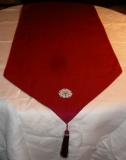
Julia then displayed the lovely table runner with Ricardian colours and insignia, which was a gift to our branch from the Victoria branch at the Mittagong mini-conference.

Julia introduced Yvette Debergue, who is the course leader along with member Isolde Martin, for the University of Sydney Centre for Continuing Education classes focusing on the Plantagenets. She has been able to negotiate with the university administration to offer a 10% discount for Society members who register for the courses. The next all day program is on 30 June 2012 and includes lunch. For more information go to the following link: http://cce.usyd.edu.au/course/TPLG

Kevin sent his apologies for missing the meeting due to illness. But had he been present he would have reminded us that the Winterfest Medieval Fair is coming up on the weekend of 30 June/1 July in Parramatta. Some members may once again brave the cold weather to make their way there this year, though nothing has been organized yet as a group.

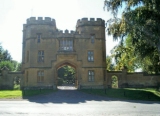
As our scheduled guest speaker unfortunately had to cancel, our branch chair, Judith, came to the rescue with a very interesting presentation about the life and times of Sudeley Castle, the Gloucestershire Castle that was once the home of Katherine Parr, the last wife of King Henry VIII.

The Gatehouse of Sudeley Castle (Photograph taken by Jennifer Luther Thomas; obtained through Wikimedia Commons.)

Dorothea and Lynne also reviewed books they had read recently.  Dorothea spoke about Sumerford’s Autumn by branch member Barbara Gaskell Denvil and Lynne shared her thoughts of the classic The Betrayal of Richard III by V B Lamb with us.

The next meeting will be on Saturday, 11 August 2012, featuring this year’s ‘Scrabble Speakers’, who will be speaking on various medieval topics.

Tags: , ,

6
Jun

Was Edward V Sick?

   Posted by: Annette Carson    in Medieval Miscellany, Medieval People

The following article by Annette Carson, author of Richard III – The Maligned King, was originally published in the March 2012 issue of Ricardian Register, the journal of the American Branch of the Richard III Society.  We are very grateful to Annette for making it available to our branch as well.

In the course of researching and writing my book about Richard III,1 I was struck by an apparently widespread assumption that the boy Edward V was sickly and, if not despatched by nefarious means, probably died of some kind of illness.

Leaving aside storytelling and wild speculation, there are very few respectable sources to which this misapprehension might be traced. Of these, only one was writing at the time of the events he described, and this was the Italian cleric Dominic Mancini, who reported that ‘like a victim prepared for sacrifice … [Edward] believed that death was facing him’.2

It is generally accepted that Mancini had come to England at the behest of his patron Archbishop Angelo Cato, a key figure in the intelligence-gathering circle of Louis XI of France. His visit coincided with a catastrophic breach in Anglo-French relations, on which Cato was doubtless looking for a first-hand report; instead of which Mancini found himself present during a far more interesting series of events: the death of Edward IV, the accession of his son, Edward V, and the latter’s replacement by Richard III.

Mancini gives a very full description of the twelve-year-old Edward V, his graces and accomplishments, physical appearance, whereabouts and general state of mind. This knowledge is attributed to his access to Dr John Argentine, the physician who attended Edward at his lodgings in the Tower of London after his deposition in the summer of 1483. With such a valuable and free-speaking source of information at hand, Mancini’s report would have been a poor effort indeed if he had not winkled out from the boy’s doctor all possible information about his health – a matter of great interest to the French court in those turbulent times, especially if he was ailing or even quite sick.

Yet Mancini’s comment about Edward’s daily confession ‘like a victim prepared for sacrifice’ is conspicuously devoid of reference to any issue of medical health, on which Argentine would have been the prevailing authority. Rather than suggesting that he was physically ill, it sounds like one of those hints Mancini likes to drop that young Edward was set to meet a sticky end.

Some 25 years later, the French chronicler Jean Molinet also wrote briefly of Edward V, describing him as ‘unsophisticated and very melancholy, aware only of the ill-will of his uncle’, a boy who believed that he and his brother were marked for death. Obviously coloured by the then-current assumption that they had been murdered by Richard III, Molinet’s retrospective account depicts Edward as a pathetic figure but undermines its own credibility with the adjective ‘unsophisticated’, which scarcely chimes with the admiring words of Dominic Mancini, who wrote (presumably quoting the physician Argentine): ‘In word and deed he gave so many proofs of his liberal education, of polite, nay scholarly attainments far beyond his age … his special knowledge of literature, which enabled him to discourse elegantly, to understand fully and to declaim most excellently from any work whether in verse or prose that came into his hands, unless it were from among the more abstruse authors’.3

While mentioning John Argentine, by the way, it need not be taken as significant that Edward’s doctor looked after him during his stay in London, as did also a number of other personal attendants, some of whose names are officially recorded. Rather it may be viewed as a sign of the appropriate care and respect given to his royal person. Indeed, since there is no contemporaneous account of his health, we should probably never have heard of his physician had not Mancini enjoyed Argentine’s confidences.

If Mancini’s observations are deficient in crucial specifics, our next source has even less factual evidence to offer. This is Sir George Buck in his History of King Richard the Third written in 1619, over 130 years later. Buck was Master of the Revels at the court of James I, and one of those seventeenth-century antiquaries who made it their business to delve into ancient papers in order to find documentary evidence about times past. Buck was a firm believer that the pretender known as ‘Perkin Warbeck’ was in fact Edward V’s younger brother, Richard. Of Edward he admitted knowing almost nothing, assuming that he must have fallen ill and died while still residing in the Tower of London: ‘[I think the elder] brother Edward died [of sick]ness and of infirmity (for he was weak and very sickly …)’.4

The best argument Sir George could find to support his theory was that Edward’s siblings did not live to make old bones: ‘their sisters also were but of a weak constitution, as their short lives showed.’ It is difficult to construe what kind of lifespan Buck termed ‘short’ for a woman, when death in childbirth was a constant hazard. Certainly some of the sisters lived into their late thirties, and Catherine, Countess of Devon, is said to have died in 1527, in her late forties. Their half-brother, Edward IV’s illegitimate son Lord Lisle, apparently lived to be nearly eighty.

Another basis for Buck’s theory was that no pretender came forward to represent himself as Edward V. This may be so, but very little is known about what lay behind the pretender later dubbed ‘Lambert Simnel’, crowned in Dublin in May of 1487, and supported by the Earl of Lincoln and Edward’s aunt Margaret of Burgundy (and even, perhaps, by his mother Elizabeth Woodville and half-brother Thomas, Marquess of Dorset). Buck may have fallen into the same error as have historians throughout the ages, i.e. the assumption that what he knew then was all there was to know.

Buck’s is the first recorded suggestion in so many words that Edward fell sick and died. But his book about Richard III cannot be said to have been widely read. Indeed for 350 years the only printed version was one in such a bowdlerized form that, until a scholarly edition of the original was produced by Arthur Kincaid in 1979, it was virtually dismissed by historians.

So, I wondered, could it be that the common supposition about Edward V’s ill-health dates from a source that is much more recent? I am referring to something that attracts considerable scepticism nowadays, and that is Lawrence Tanner and William Wright’s 1933 examination of those skeletal remains currently in Westminster Abbey which Charles II decided, in 1674, on no evidence whatsoever, were those of Edward V and his brother.5

The anatomist Professor Wright, and his dental adviser Dr George Northcroft – both of whom agreed enthusiastically with Charles II – identified evidence of a disease of the lower jaw in the elder of the two skulls present, which is visible in their published photographs. Thirty years later another anatomist, Dr Richard Lyne-Pirkis, gave a talk to the Richard III Society in which he stated it as his opinion, on the basis of those photographs, that it was probably ‘a condition known as osteomyelitis or chronic inflammation of the bone, which was quite a common condition in those days’.6 Osteomyelitis would have been extremely painful and increasingly disfiguring, and was very likely to have proved fatal in those centuries before antibiotics.

Other experts in a variety of disciplines have offered alternative diagnoses, the most popular being osteitis, an unpleasant and painful inflammatory disease, though not necessarily fatal in itself; unless, of course, it deteriorated into osteomyelitis.

The Tanner and Wright report concluded that the child whose skull they named ‘Edward V’ suffered from an extensive, chronic condition which had persisted for some years and had spread so far as to affect the temporo-mandibular joints. From the photographic evidence it can be seen to have produced destruction and malformation of areas of the affected bone. The owner of that jawbone would have suffered from inflamed, swollen and septic gums, as well as constant pain and discomfort. However, the problem remained that the Tanner and Wright examination, using the limited means at their disposal in 1933, failed to establish scientifically whether this owner was prince or pauper, boy or girl.7

It seemed to me that the vague assumptions I had encountered about Edward V’s illness must have been assimilated by a kind of reverse-engineering process: in other words, extrapolating backwards from the Tanner and Wright conclusions and superimposing them on to the remarks of writers like Mancini and Buck.

I have always favoured holding assumption up to the cold light of logic, so I decided to make the question of Edward V’s health, and the apparent link with the bones, one of a number of lines of original research that would be unique to my book.8 My starting point was to look at the phenomenon from the viewpoint of his contemporaries. Had a royal child suffered chronically in this way, it must have given rise to comment and concern. Doubtless he would have needed specially prepared food as the illness progressed and teeth were lost or removed. And he would have endured the never-ending attentions of not one but a team of physicians whose ministrations were probably quite as unpleasant as the disease itself.

Yet there is no contemporaneous hint of anything of the kind relating to Edward’s appearance or behaviour. As Prince of Wales he was constantly visible to members of his household, his retainers and the public at large from the age of three when he was first given his own council at Ludlow. As he grew older he was seen regularly at court and was exhibited by his father, Edward IV, to the gaze of his subjects on numerous public occasions.9

Furthermore, Dominic Mancini’s description of Edward at the age of twelve (shortly before his alleged death) speaks of ‘dignity in his whole person, and in his face such charm, that … he never wearied the eyes of beholders.’.10 If Edward had really been the owner of an infected and disfigured jaw, Mancini would surely have made certain in his report, delivered in December 1483, to remark less on the charm of his face and more on the cruelty and heartlessness of Richard III’s treatment of an ailing boy. This would have been music to the ears of Archbishop Cato and the French court, always looking for vulnerabilities in the English regime, especially as England’s most recent Parliament (under Edward IV) had voted funds for renewed Anglo-French hostilities. Yet Dominic Mancini suggests nothing of the sort.

Written material from the fifteenth century is admittedly scanty, and its paucity cannot be held to prove that Edward V was hale and hearty. However, it is equally incumbent on anyone who speaks of his ill-health to back it up with evidence.

It would be fair to expect an exhaustive examination of Edward V’s life and person in a biographical work, of which the only one yet published was written by Michael Hicks. Yet Hicks mentioned nothing of illness or disfigurement, and instead described him as ‘a very good-looking boy’. He also avoided almost all reference to the bones in Westminster Abbey, and on the two isolated occasions where they were briefly mentioned, he showed no sign of being convinced of their identity.11

To conclude my investigation from the standpoint of logic, I turned my thoughts to consideration of how the chronic ill-health of the Prince of Wales would have influenced the way his own heir presumptive – his younger brother – was raised and trained.

Given that diseases of the jaw were not uncommon in Edward’s day, it would certainly have been known that such a chronic infection could worsen progressively and even lead to death. Emotion played no part where questions of inheritance were concerned, and this was a matter that involved succession to the crown of England. Their father the king would surely have stopped at nothing to secure his Yorkist dynasty.

Yet no provision whatsoever seems to have been made for the younger boy, Richard, to receive appropriate training in kingly responsibility. Instead he remained at his mother’s side, never taking charge of his own household, even after the appointment of his own council in 1477. Neither was he placed under the tutelage of a suitable nobleman to learn the arts of arms and chivalry. In May 1483, when his brother arrived in London as king, Richard lurked with his mother in sanctuary.

Such lack of interest in preparing the younger brother for the possibility of kingship seems to point fairly conclusively, I would suggest, to absence of any concern for the health of the elder.

Postscript: There is still considerable room for research into the findings of Tanner and Wright, including the possibility of facial reconstruction, with which I have found it difficult to make progress. I hope to pursue this further now that I have taken up residence again in England.

ENDNOTES

1. Annette Carson, Richard III: The Maligned King (Stroud, 2008, 2009, 2010, 2011).

2. Dominic Mancini, De Occupatione Regni Anglie per Riccardum Tercium Libellus, ed. C.A.J. Armstrong (Gloucester, 1989) p.93.

3. Mancini, p.93.

4. Sir George Buck, The History of King Richard the Third (1619), ed. A.N. Kincaid (Gloucester, 1979) p.140.

5. Archaeologia LXXXIV, 1934.

6. Richard Lyne-Pirkis, Regarding the Bones Found in the Tower; speech given on 27 February 1963.

7. A survey of the principal academic commentaries devoted to the subject of the bones, whether by scientists or historians, can be found in Carson, pp.184-200, from which it will be seen that there is no consensus as to their identity, or sex, or age, or antiquity. What gives rise to most dubiety is that any attempt to calculate the age of the elder child is automatically stymied by the need to adjust computations to take account of retardation of development due to his or her chronic jaw disease, but nobody knows how much allowance to make.

8. For the record, examples of other matters explored in depth and generally overlooked by mainstream biographers include examination and reconstruction of the precise location at the Tower of London where the bones were found; a fresh look at the shifting allegiances which preceded the rebellion of October 1483; questions raised by the death of Edward IV; and Richard III’s proposed second marriage, particularly its implications as reflected in Elizabeth of York’s letter to the Duke of Norfolk.

9. Carson, p.190.

10. Mancini/Armstrong, p.93.

11. Michael Hicks, Edward V (Stroud, 2003) pp.176, 191.

© Annette Carson 2011

Tags: , ,