The following is the first in our collection of Scrabble speakers at our branch’s general meeting on 14 August 2010.
 Introduction
A few months ago, when as a Scrabble Speaker volunteer I drew the letter “U”, I must admit I had no idea what to do a talk on – I could not think of even one Ricardian topic that started with the letter “U”!
But to my great relief our branch’s social secretary, Kevin Herbert, kindly came to my rescue with many suggestions, one of which was the Union of the Hanseatic Merchants, and another was the city of Utrecht.
The Union of the Hanseatic Merchants caught my imagination because Doug and I had, some years back, read a historical fiction series by Dorothy Dunnett, The House of Niccolo [i], which featured several Hanseatic captains’ derring-do on the high seas – and I was eager to learn more of the real history of the organisation.
I was also interested to know how the Hanseatic Union impacted the England of Richard III. Thank you, Kevin! You were a life saver.

Foundation of the Hanseatic League in Hamburg, c. 1241
Origins
Hansa is the old, High German word for fellowship, league or union. The Hanseatic Union was first formed in the middle of the 12th century by German (I use the word loosely since Germany did not yet exist) seafarers and merchants to lend each other mutual aid, and to protect themselves from pirates, Vikings and highwaymen as they travelled on their northern European trade routes by land and sea.[ii]
This was at a time in which there were no national navies to protect such merchants or their cargoes while in transit. There were also no authorities whose responsibility it was to regulate tariffs and trade practices, and few ports had any authorities to oversee their orderly use; people were on their own.
These enterprising German merchants chose to band together to negotiate trade agreements, provide protection for their ships’ personnel and cargo, and to make the ports safer for use by assuring proper maintenance was carried out.
The Connection with Richard III?
Some knowledge of the history of the Hanseatic Union is of interest to us as Ricardians because the Union monopolised all commodities being traded during the era of Richard III, and controlled the sea routes around England, as well as with all of England’s northern trading partners.
When Cecily Neville sent her sons Richard, Duke of Gloucester and his younger brother, George, Duke of Clarence, across the English Channel to the city of Utrecht for safe-keeping after their father Richard Plantagenet, Duke of York, was killed at the Battle of Wakefield in December 1460, the boys were taking refuge in an important Hanseatic city of nearly 200 years standing.
Although at that time they were still children, Richard and George would have learned about the mercantile practices and power of the Union as they grew up, and may have observed the extent of the Hanseatic fleet of ships as they arrived in and departed from Utrecht.
Background
The first attempts at union linked the commercial centre of Lübeck, and several other German towns, but the advantages were quickly noted and taken up by other German towns along their routes – at last encompassing over 100 cities throughout the northern seas, and as far east as the current day Estonia, Latvia and Lithuania. (The actual number differs according to the source.)
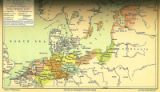
The Extent of the Hanse, c. 1400.
At its peak, the Hanseatic Union merchants secured the control of trade over the entire North Sea and Baltic Sea Regions, and hundreds of miles up the inland rivers of northern Europe and the Low Countries.
When Bruges joined the Union it became its most powerful city, as it was the major trade centre of all Europe in its heyday.
The products they transported were generally various grains, flax for sail-making, hemp for ropes, timber, wax, amber, furs, leather, salt herring and cod.[iii]
Though Hansa relations were primarily economic in nature, the League became very powerful both politically and in military might during the 14th Century. This was when the League waged war against Denmark and won.
The Hanseatic Legislative Assembly
A Hanseatic Diet, or legislative assembly, was established in 1284, but did not actually begin meeting regularly until the year 1356 – about 70 years later! The Diet concerned itself with negotiations with foreign towns and rulers, ratification of trading agreements, blockades, and financial and military issues.
However, some scholars consider the Diet was nothing more than a “meeting” because the Hanseatic Union had no executive officers and no common council.
And, as the scholars point out, the Hanseatic Union deliberately (and rather cagily) avoided classifying itself as a society or corporation, in order to avoid legal action against it. To quote one author:
After having deteriorated since the middle of the 15th century, English relations with the Hansa reached their lowest point when, in the summer of 1468, English ships were seized in the sound by Danish vessels.
King Edward IV straight away imprisoned the Hanseatic merchants in London and confiscated their goods in order to compensate the English merchants. The Hansa, he explained, was a society, cooperative or corporation, originating from a joint agreement and alliance of several towns and villages, being able to form contracts and being liable as joint debtors for the offences of single members.
In the Hanseatic reply the Lübeck syndicate stated that the Hansa was neither a society nor a corporation, it owned no joint property, no joint till, no executive officials of their own; it was a tight alliance of many towns and communities to pursue their respective own trading interests securely and profitably.
The Hansa was not ruled by merchants, every town having its own ruler. It also had no seal of its own, as sealing was done by the respective issuing town. The Hansa had no common council, but discussions were held by representatives of each town. There even was no obligation to take part in the Hansa meetings and there were no means of coercion to carry through their decisions. So, according to the Lübeck syndicate, the Hansa could not be defined by Roman law and was not liable as a body.[iv]
It was reported that when the King Edward IV’s men went to arrest the Hanseatic merchants, the foreigners’ true identities were tested by whether or not they could pronounce “bread and cheese” without a German accent!
Despite this action by Richard’s older brother, in general the English kings found it beneficial to support the Hanseatic Union in exchange for their support against the French.
The English merchants and the Parliament, however, resented the many Hanseatic privileges.
Despite their objections the relationship had precedence, for a Hanse of German merchants had concluded a treaty with Henry II of England as early as 1157 to be allowed to trade at fairs throughout the country.[v] From Richard I they had purchased their freedom from owing certain tolls throughout England some years later.
It was at the height of its prestige that Richard III granted preferential trade status to the Union, and for a century afterwards there was great prosperity for the traders.
Overall the Union was a force for good: it spread new centres of trade and civilisation everywhere it went: it contributed to the development of agriculture, improved commerce, perfected and upheld a standard of weights and measures, constructed canals, lighthouses and highways. And it had such an impressive navy that many sovereigns sought alliances with the Union.
Kontors, the term for these German merchant trading posts, were situated in various regions with some of the most prominent being in Russia, the Island of Gotland (Sweden), Bergen (Norway), Bruges (Flanders) and London (England). The merchants were usually confined to their own areas, with minimal interaction with the public except for trade.
The German Hansa merchants living in England were referred to by the English as “Easterlings”, since they were from the East. In London the Easterlings lived and traded at what was called the Steelyard. The Easterlings’ currency and trade practices were so dependable that, according to some sources, that is the origin of the term “sterling”, meaning quality. As in Easterling.

Hans Holbein, Georg Gisze, a German merchant in London – an Easterling (1532)
The eventual decline of the Hanseatic Union was the result of a number of factors: the growth of Dutch and English naval power, the discovery of the Americas, the founding of a new trade route to India, and the rise of sovereign states throughout other parts of Europe.
Oddly enough, the final revocation of the Hansa designation for the Hanseatic Cities in Germany occurred only in 1934 under the Nazi regime – but on Wikipedia I learned that Hamburg, Bremen and Lübeck still proclaim themselves officially to be „free and Hanseatic cities‟.
 The Holstentor in Lübeck
And I don’t blame them for being proud of their heritage, as the Hanseatic Union was a very impressive medieval organisation.
And it is not forgotten. I found online that there are several board games featuring the Hanseatic League available, and that in the US State of Florida keen re-enactors appear as Hanse merchants at medieval and renaissance fairs around the southern USA.
Summing Up
The Hanseatic League’s power in the economy of England in the 12th through 17th centuries would have been ubiquitous, the daily reality faced by all the monarchs. It is, therefore, worth our while to learn more about them in our mission to understand the world of Richard III.
Notes:
i http://en.wikipedia.org/wiki/The_House_of_Niccol%C3%B2
ii http://en.wikipedia.org/wiki/Hanseatic_League
iii Kurlansky, Mark. Cod: A Biography of the Fish that Changed the World
iv Postel, Prof. Rainer. The Hanseatic League and its Decline. http://www2.hsu-hh.de/hisfrn/hanse.html, accessed 5 August 2010
v Medieval Sourcebook Online http://www.fordham.edu/halsall/source/1194hanse-koln-london.html
Tags: Richard III, Trade

Leave a reply