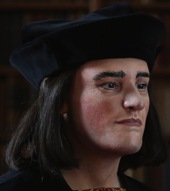
7
Nov
7 NOVEMBER 1448
 Birth of John Plantagenet – son of Richard, duke of York, and Cecily Neville. He died young.
Richard is made justiciar of north Wales for life by his brother, Edward IV
Birth of John Plantagenet – son of Richard, duke of York, and Cecily Neville. He died young.
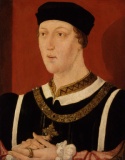 Coronation of Henry VI
 Henry Stafford, second duke of Buckingham, was executed in Salisbury on Sunday, 2 Nov. 1483. Initially, he had been Richard of Gloucester most trusted ally in the summer of 1483. It was probably Bishop John Morton, who was Buckingham’s prisoner at Brecon who persuaded him to become involved in the uprising against Richard III. His part in the rebellion was spectacularly unsuccessful due to atrocious rain, the flooding of the rivers and large-scale desertion of his followers. He was betrayed and executed without trial. In a letter of 12 Oct. 1483, which Richard III dictated to his chancellor, Bishop John Russell, he refers to Buckingham as “the most untrue creature living”
On 28 March 1461, a skirmish at Ferrybridge, West Yorkshire, was fought in the lead-up to the Battle of Towton. Richard Neville, Earl of Warwick (‘The Kingmaker”), received an arrow wound to the leg. John, Lord Clifford, (believed to be responsible for the death of Edward IV’s brother Edmund, Earl of Rutland) fell on the Lancastrian side.
Traditionally the skirmishes at Ferrybridge and Dintingdale (also on 28 March 1461) and the battle of Towton were seen as three separate battles, both in space and time. However, Tim Sutherland argues, that these were rather three interconnected conflicts. He bases his analysis on archaeological finds and a new interpretation of the sources.
Tim Sutherland, ‘Killing Time: Challenging the common perceptions of three medieval conflicts – Ferrybridge, Dintingdale and Towton — ”The Largest Battle on British Soil”’, Journal of Conflict Archaeology, Vol.5 No.1 (2010). Available from URL: http://www.towton.org.uk/wp-content/uploads/killing-time_tim_sutherland.pdf [last accessed 2 March 2020]
A short description of the various battles of the Wars of the Roses can be found on the website of the Richard III Society.
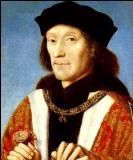
Henry Tudor (portrait at National Portrait Gallery, London)
On 28 January 1457, Henry Tudor was born at Pembroke Castle in Wales, the son of Edmund Tudor, 1st Earl of Richmond, and Margaret Beaufort. Edmund Tudor was the son of Owen Tudor and Henry V’s widow Catherine of Valois. Margaret Beaufort, was a great-granddaughter of John of Gaunt (third son of Edward III) and his third wife and previous mistress Katherine Swynford. The children of this relationship, the Beauforts, were disinherited by Letters Patent of King Henry IV from any claim to the throne. After defeating Richard III at the Battle of Bosworth on 22 August 1485, he took the throne as Henry VII.
Read the History Today article on ‘The Birth of Henry Tudor”.
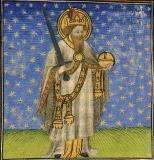
15th century picture of Charlemagne
Charlemagne (Karolus Magnus, Karl der Große) died on 28 January 814 at Aachen. He is buried in Aachen Cathedral.
Karl, from the Carolingian family, was born on 2 April, either in 747 or 748. Nor do we know where he was born. Aachen and Liège are possible, but other towns have also been suggested. His parents were Pepin the Short and Bertrada of Laon (history has given her the rather unflattering nickname ‘Bertrada Boadfoot’).
After Pepin’s death on 24 September 768, the realm was divided between his two sons, Karl and Karlmann (Carlman). The relationship between the two kings did not go smoothly. Then Karlmann suddenly died on 4 December 771 of natural causes. Karl seized the whole realm, which he extended during a number of wars.
On 25 December 800, he was crowned Holy Roman Emperor by Pope Leo III in Saint Peter’s Basilika in Rome. This was the beginning of the Holy Roman Empire, which lasted until 1806.
Traditionally the story went that the Pope unexpectedly put the crown on Karl’s head, while he was praying. However, modern research has shown that this romantic version is highly unlikely. As the position of the Pope was fairly weak, it was probably Karl himself who sought the honour.
Under Karl, the Carolingian Empire was at its largest and most powerful position (the extent is shown on this map on Wikimedia Commons).
After his death, Karl was buried in Aachen Cathedral. He was succeeded by his only surviving son Ludwig (Louis).
More information on Charlemagne from Encyclopaedia Britannica.
Peter Munz, ‘The Imperial Coronation of Charlemagne’, History Today, Volume 9, Issue 7, 1959. URL: http://www.historytoday.com/peter-munz/imperial-coronation-charlemagne [last accessed 2 Jan. 2020]
Kim Rendfeld, ‘Bertrada: Queen Mother and Diplomat’, Kim Rendfeld – Outtakes from a Historical Novelist (21 May 2013). URL: http://kimrendfeld.wordpress.com/2013/05/21/bertrada-queen-mother-and-diplomat/ [last accessed 2 Jan. 2020]
Dorothea Preis
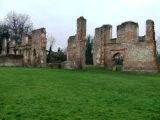
Ruins of Sopwell Nunnery, St Albans (© D Preis)
On 25 January 1533, Henry VIII married Anne Boleyn in secret, possibly at Sopwell Nunnery in St Albans. This is suggested among others on the blog The Tangible Past.
Henry was very much attracted by Anne’s charm and wit. To be able to marry her, Henry wanted to divorce his first wife Katherine of Aragon, to whom he had been married for 24 years. This meant he also had to break with the Church of Rome, who did not accept his reasons for a divorce. Their marriage was only annulled on 23 May 1533, when Thomas Cranmer declared it null and void. On 28 May 1533 he declared the marriage of Henry VIII and Anne Boleyn valid.
However, as Anne did not produce the looked-for male heir, after approx. 1000 days of marriage, Henry ordered Anne’s execution.
You might find Suzannah Lipscomb‘s article on this marriage of interest.
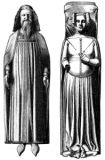
Effigies of Edward III and Philippa of Hainault
On 24 January 1328, Edward III married Philippa of Hainault at York Minster. Their marriage lasted 40 years until Philippa died in 1369. They had twelve children and through them were the ancestors of both the House of York and the House of Lancaster as well as the Tudor line.
Find out more about this marriage from Anne O’Brien’s blog ‘Royal newly-weds 14th century style‘.
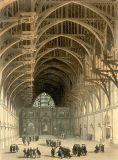
Westminster Hall in the early 19th century
The meeting of Richard III’s only parliament at Westminster in the presence of the King began on 23 January 1484. It had been summoned on 9 December 1483 and would be dissolved on 20 February 1484.
Attending were 37 Lords and 10 Judges (including the Attorney General) as well as 296 members of the Commons. It was opened by a speech from Chancellor Russel. This parliament ratified Richard’s title by Titulus Regius. The rebels from the October 1483 rebellion were attainted.
Of interest are the 15 public statutes of this parliament, which included ending benevolences, protecting land purchase rights, reforming the justice system, preventing commercial dishonesty in the cloth trade, protecting English merchants, and preventing fraudulent collection practices. However, while trying to limit the activities of foreign merchants in England, the statutes included a proviso, exempting all merchants and craftsmen concerned in the book trade from the scope of the Act.
Richard’s Chancellor of the Exchequer, William Catesby was chosen to be the speaker of the Commons; and the receiver of petitions was Thomas Barowe, who had been in Richard’s service since at least 1471, who was also Master of the Rolls.
Christopher Puplick, ‘He Contents the People Wherever He Goes: Richard III, his parliament and government’, The Chronicles of the White Rose: Journal of the New South Wales Branch of the Richard III Society, Vol.2 (2008/09), pp.14-32 (last accessed online 2 Jan. 2020)
Anne Sutton, ‘Richards III’s Parliament’, Richard III Society. URL: http://www.richardiii.net/2_3_0_riii_leadership.php#parliament (last accessed 2 Jan. 2020)
Susan L. Troxell, ‘The Tenth Coin: Richard III’s Parliament and Public Statutes’, Ricardian Register, Vol.44, No.4 (December 2013), pp.8-16 (last accessed online 2 Jan. 2020)
Dorothea Preis