17
Aug
17 AUGUST 1473
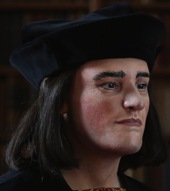
 Birth of Richard of Shrewsbury, second son and sixth child of Edward IV and Elizabeth Woodville, at Shrewsbury.
King Richard III’s remains were reinterred in Leicester Cathedral in a dignified and moving service on 26 March 2015. The service was conducted in the presence of the Most Revd Justin Welby, Archbishop of Canterbury.
The order of the service was designed in cooperation with Dr Alexandra Buckle. Dr Buckle had found a manuscript, which contains details of a medieval service for the reburial of the human remains of a noble person. She was researching Richard Beauchamp, Earl of Warwick, who was reburied in Richard’s presence in 1475. This document served as a basis for Richard III’s reinterment service.
During the service, Richard was also reunited with his Book of Hours, about which I had written on another site, though before Richard’s reinterment.
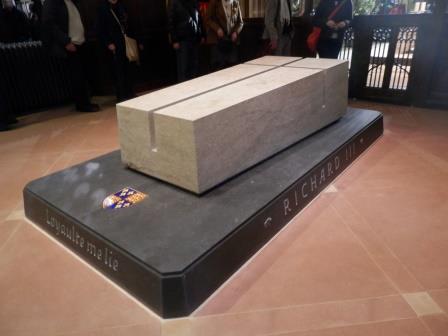
Richard III’s tomb
On the following day, 27 March, Richard III’s tomb was revealed during a service. Together with several friends, I had in the opportunity on that Friday afternoon, to see the tomb in all its glory. For me, the floor tiles with inlaid Yorkist roses were a nice touch.
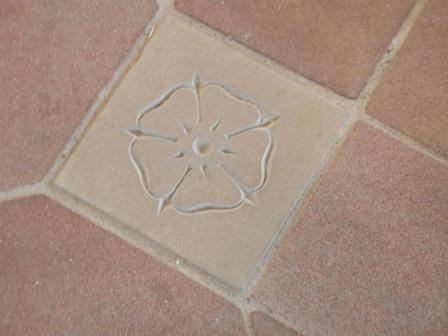
Floor tiles with Yorkist roses
Together with many, many other Ricardians, I was able to spend the Reinterment Week in Leicester, a profound and exhilarating experience. The week started for me by watching the cortege passing at Jubilee Square. On Monday, 23 March, Memorial Service for members of the Richard III Society was held in Leicester Cathedral. I had been lucky in the ballot and received an invitation to this beautiful service. From where I was seated my view of the proceedings was obscured, but I had a clear view of the reason for the service, the coffin of Richard III. It was covered with a beautifully embroidered pall, on the one side displaying figures from the 15th century and on the other side figures involved in the 21st-century discovery of the King’s remains.
The Choir sang In Memoriam: Ricardus Rex by Graham Keitch. Many of us remember this from the 2013 Australasian Convention in Sydney, where we were able to play it by permission of the composer. There can be no doubt though that to listen to it in a church sung by an outstanding choir beats a recording played over a loudspeaker system.
We all would have liked to attend the actual reinterment service in the Cathedral, but space did not allow that. However, along with several of our branch members from NSW, I was able to watch the service on TV live at our hotel in Leicester. The most memorable part for me was a natural phenomenon: It was an overcast grey and drizzly morning, but at the exact moment, when Richard’s coffin was lowered into the ground, the sun broke through. His troubled afterlife had finally come to rest.
It should also be mentioned that the NSW Branch of the Richard III Society made a donation to Leicester Cathedral to help cover the costs of the reinterment. This was received by Revd Peter Hobson with thanks to all members of the NSW Branch in the name of Leicester Cathedral.
Birth of Richard of Shrewsbury, second son and sixth child of Edward IV and Elizabeth Woodville, at Shrewsbury.
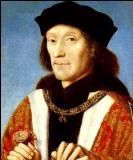
Henry VII (portrait at National Portrait Gallery, London)
On 18 January 1486, Henry VII (Tudor) married Elizabeth of York, eldest daughter of Edward IV and Elizabeth Woodville. It seems Henry needed to be urged by Parliament to make good his promise to marry Elizabeth, before actually doing so. Plans for Elizabeth’s coronation were only made in September 1487 and she was finally crowned on 25 November 1487, more than a year after giving birth to their first son, Arthur.
Elizabeth died on 11 February 1503 at Richmond Palace. Henry died six years later, on 21 April 1509, also at Richmond Palace. They are buried next to each other in Westminster Abbey.
Reference: Rosemary Horrox, ‘Elizabeth (1466–1503)’, Oxford Dictionary of National Biography, Oxford University Press, 2004. (online accessed: 27 January 2011)
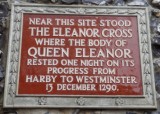 The body of Eleanor of Castile , wife of Edward I, rested for one night at St Albans on her progress from Harby, where she had died on 28 November 1290, to Westminster. Her funeral took place on 17 December 1290 at Westminster.
The plaque in the picture can be found on the fifteenth century Clock Tower in St Albans, which is near the spot where the Eleanor Cross once stood. Originally there were twelve crosses at each of the overnight resting place of the procession for Eleanor’s body, but only three of them remain. Unfortunately the St Albans cross is not one of them, it was demolished in the early eighteenth century. It was located next to the Clock Tower and opposite from the Waxhouse Gateway to the Abbey precinct.
(Photograph © Dorothea Preis)
 Execution of Henry Stafford 2nd Duke of Buckingham at Salisbury after being convicted of treason following his involvement in the 1483 rebellion.
ODNB on Henry Stafford, second duke of Buckingham
Birth of Anne of York, seventh child and fifth daughter of Edward IV and Elizabeth Woodville, at Westminster Palace. Married to Thomas Howard, 2nd Earl of Surrey, the son of Richard’s close associate John Howard. Died 11 November 1511, buried first at Thetford Priory, Norfolk, but relocated after the Reformation to the Church of St Michael the Archangel, Framlingham.
 Birth of Edward, eldest son and fourth child of Edward IV and Elizabeth Woodville, in sanctuary at Westminster Abbey.
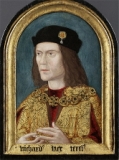 Richard Plantagenet (later Richard III) created 3rd Duke of Gloucester.
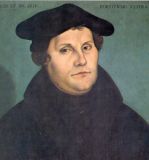 Martin Luther (born 10 November 1483) nails his 95 thesis on the church door in Eisleben in the evening of 31 October 1517, because the next day, 1 November, is All Saints’ Day, when everyone would come to church.
In the 95 theses he explains his view based on the Gospel that salvation is a free gift from God and cannot be earned by good deeds or purchased by buying indulgences . This is often regarded as the starting point of the reformation. While his original aim was to reform the church, the Pope saw it differently, which ultimately led to the split with the Catholic church. As Luther was of the opinion that the Bible was the only source for knowledge of God, he translated it into German to make it accessible to everyone.
31 October is celebrated in the Lutheran church as Reformation Day commemorating Luther’s stand.
Coronation of Henry Tudor as Henry VII