7
Aug

Breaking News

   Posted by: Dorothea Preis   in News, Reinterment

The very Revd David Monteith has just announced at Leicester Cathedral that the reburial of King Richard III will be on 26 March 2015, with event.  The Duke of Gloucester will be the Royal Patron.

You can find the full schedule here.


Tags: ,

5
Aug

Thursday we’ll know more

   Posted by: Dorothea Preis   in News, Reinterment

Leicester Cathedral have just announced on their Facebook page that the date for the reburial of Richard III will be revealed on Thursday, 7 August 2014, at 10.00 UK time (19.00 AEST).  The name of the Royal Patron will also be made public.

There is no doubt that members of the NSW Branch will have much to discuss during their general meeting on the coming Saturday.


Tags: ,

3
Aug

Richard III: The New Evidence

   Posted by: Dorothea Preis   in Greyfriars Dig, News, Research, Richard III in the Media

film_reel smThe discovery of the remains found in the Grey Friars precinct in Leicester and the process of identifying them as those of Richard III were the topic of  two documentaries, Richard III: The King in the Car Park and then The Unseen Story, both shown in the UK by Channel 4 in February 2013 and on SBS in late October of the same year.

Channel 4 has now announced that it has produced another programme on the scientific research which has subsequently been carried out by the University of Leicester. Special emphasis is on the question how a man with such an extreme spinal deformity could have been the prodigious combatant described in historical sources. Their theories could be put to the test as they succeeded in finding a re-enactor who suffers from the same form and severity of scoliosis as Richard III.

I heard that the broadcast of this programme is planned in the UK for Sunday, 17 August, at the end of the Bosworth Anniversary Event. We can only hope that it will make its way to Australia a bit sooner than the first two documentaries did.

You can find more on the programme here and on the Bosworth Anniversary Event here.

Tags: ,

Medieval coin expert and collector David Mee will speak on “Coinage during Richard’s Reign” and display examples from his collection. David is a popular speaker, having addressed many community groups including the Plantagenet Society, and our own conference in Mittagong. His writing has also appeared in a number of numismatic journals.

David Mee

We will also be having a Bring & Buy table for members to recycle their Ricardian books and memorabilia and in turn get something new to read. The only proviso is please be prepared to take anything back home with you if it does not sell, as there is nowhere to store unsold items.

Tags:

28
Jul

Finding Richard III

   Posted by: Barbara Gaskell Denvil   in Bookworm

Book Review:  Finding Richard III – The Official Account

We thank Barbara for making her review of this book available to us.

Finding Richard III : The Official Account
of Research by the Retrieval & Reburial Project

Finding Richard IIIThe Looking for Richard Project team, specifically Philippa Langley (the inaugurator) , John Ashdown-Hill BA, MA, PhD, FSA, FRHistS, Annette Carson, David Johnson BA Hons, MA, PhD, and Wendy Johnson, set out to discover the burial place and human remains of Richard III himself, although these were long considered lost forever. This, the official account, is a clear, precise and riveting summary of facts, not of opinions. However, step by inspired step, we are led past the opinions of many as we follow the unique development of one of the most impressive and amazing archaeological discoveries ever achieved in England.

In early 2009, Philippa Langley launched the search for Richard III’s resting place. She and the team then worked together to meticulously discredit the long held rumour of the desecration of his grave and the tossing of his remains into the River Soar, even though this unsubstantiated rumour was frequently upheld by others, even historians. There have also been years of mistaken belief as to the site of the Greyfriars Priory, considered the probable place of original burial in 1485. Many historical errors and later misjudgements were now researched and carefully corrected by the team, all briefly summarised here. With lucid and detailed explanation, this books covers every aspect, matching medieval probabilities to modern specifics until gradually we feel we have travelled the same journey, walked those 15th century streets, peered into those shadowed mysteries and so can share the team’s inspirational optimism.

With enormous expertise and determination, the team persisted until 2012 when at last, with council permission obtained, funds raised (principally from the Richard III Society) and legal agreements made with the relevant authorities, ULAS (University of Leicester Archaeological Services), were contracted and paid in advance accordingly as demanded, to undertake the digging in the area specified by the Project. Indeed, ULAS had so little belief in the probability of discovering Richard III’s actual remains, that they accepted the commission only when the wording of the contract was amended to specify and limit the dig to the excavation of the Franciscan Priory Church. Philippa Langley then insisted that contractual obligations include provision for the possible exhumation of human remains. The Looking For Richard team’s accuracy was so impressive to seem virtually unbelievable, so even after the leg bones of an adult male were discovered in the designated area on the very first day of the dig, ULAS could not believe they had begun to uncover Richard III himself.

Included in the narrative are the surprising disappointments and the failures of some, in particular the areas where original contractual agreements have not been met by other parties. For instance, the shocking failure of the university to invite John Ashdown-Hill to the official announcement of Richard III’s DNA match, which identified his remains beyond reasonable doubt, even though it was Mr. Ashdown-Hill alone who traced the living descendent used to conclude that DNA match, and Ms. Langley was only invited to speak after the TV coverage had ended. It is also evidently of some concern and against the wording of the original contract, for the remains of this anointed monarch and ancestor of the queen to still be retained by the university instead of having been laid to rest in some prayerful and respectful place until the re-interment process can be conducted. Difficulties with the Cathedral administration are also recorded.

But there is no winter of discontent here, no list of complaints or failures. Indeed, the book is a celebration of a rare and glorious success, leading to a greater knowledge and understanding of this long misunderstood and maligned king, and eventually to a fitting reburial.

Written with impressive clarity and extensive footnotes, without unacademic or emotional emphasis, this short book explains exactly what happened from initiation to conclusion. It is the summary of the search itself, and includes a full list of those who donated to the costs and copies of all the contracts involved. The considerable respect and care shown by Ms. Langley for the legal drafting of the original contractual agreements is precise and impressive. Whether her wishes have been fully complied with since, is another matter.

Although such facts can, as would be expected, seem dry at times, there is not one moment when this book becomes heavy, or can be even momentarily discarded. It is both a fascinating and rewarding read from beginning to end. And FINDING RICHARD III: THE OFFICIAL ACCOUNT covers one more necessary task, that of explaining exactly how the search not only originated with the Finding Richard Project, but was successful owing to their incredible expertise and persistence. In the face of repeated claims and assumptions that Leicester University or ULAS discovered Richard III’s burial place and his remains, it was instead the studious research and ultimate success of The Finding Richard Project, who have now produced this official account to set the record straight.

Tags: , ,

26
Jul

The Visitor Centre opens today

   Posted by: Dorothea Preis   in News

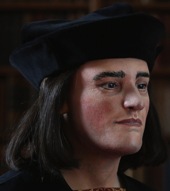
Richard III Facial ReconstructionThe King Richard III Visitor Centre in Leicester will open today, 26 July 2014.  Some journalists, like Sophie Campbell from the Telegraph,  were lucky enough to get a preview of the Centre.  Her article gives a good indication of what the visitors can expect.  There are quite a few articles around offering a glimpse of the Centre, here is another one by the University of Leicester.  We hope to be able to bring you an eye-witness report after the official opening.

And while we wait for our own chance to see the Visitor Centre, you might like to have a look at a reconstruction of the Grey Friars Priory in Leicester, which was carried out by the Digital Building heritage Group at De Montfort University, Leicester.  The fly-through video is not to be missed!

Tags: ,

9
Jul

Towards Stillness – guest post by Rosalind Broomhall

   Posted by: Dorothea Preis   in News

The opening of the new Cathedral Gardens in Leicester last Saturday included talks by both the artist whose work found a home in the new gardens. Our friend Rosalind Broomhall told us already about James Butler and the Richard III statue. Here she concludes her reports about the opening of the gardens by sharing with us the ideas behind Dallas Pierce Quintero’s new artwork.

‘Towards Stillness’ Commissioned by Leicestershire County Council. Designed by Juliet Quintero of Dallas Pierce Quintero.

The artwork ‘Towards Stillness’ portrays the story of Richard’s final days in Leicestershire in a series of 12 steel plates, aligned towards Bosworth and surrounded by tall grasses and marshy plants to evoke the terrain of the battlefield. Juliet Quintero consulted with both Dr Phil Stone (Richard III Society) and Dr John Ashdown-Hill to ensure historical accuracy.

Towards Stillness

The artwork should be read from west to east with the first stainless steel plates representing the battle – the charge, rearing horse, fight on foot and defeat. Juliette took hundreds of photographs of a re-enactor from Les Routier de Rouen to create lifelike images and the sihouettes were water cut* onto the steel. Helped by undergraduates Holly and Freya from Loughborough University, the images were then blurred with lines to create the sensation of movement. The blurring ceases as Richard is slain and carried back to Leicester on horseback and the quality of the steel diminishes to denote the passage of time. The steel was shot blasted in a random way to create a weathering effect and as the centuries pass the height of the sheets falls. Richard is lost. Until that day in 2012 when the archaeologists uncovered the grave.

The clue to this piece is in the title. After more than 500 years, the heat of battle, the hurried interment at Greyfriars and the lost grave, Richard will finally be laid to rest – and be still.

*Watercutting: water mixed with crushed garnets forced at pressure through a sapphire nozzle. Laser cutting would have created too much heat.

Tags: , ,

8
Jul

Richard III statue, Leicester – guest post by Rosalind Broomhall

   Posted by: Dorothea Preis   in News

More from the opening of the new Cathedral Gardens in Leicester by our friend Rosalind Broomhall.  The photo of the statue with its new sword is by Jo Mungovin. Thank you to both of you!

Richard Cathedral Gardens (Jo Mungovin)

Richard III statue. Commissioned by the Richard III Society and sculpted by James Butler RA.
This much loved bronze statue has been moved from its previous home in Castle Gardens to the newly refurbished Cathedral Gardens and James Butler was on hand to talk about it.

Mr Butler’s vision was to sculpt Richard ‘the man’ and to that end, after consultation with the Richard III Society, Richard’s arms were left free of armour and Richard depicted as strong, energetic and courageous. He holds his crown as though picked from the battlefield after losing his helmet and displayed to portray his ambition – to fight for his kingdom. He stands on a plinth above us to drive home that point. (The aggregate used for the plinth is, by the way, from a quarry near Bosworth.) The sword has been newly restored after the statue lived for many years with a dagger – the result of the previous sword being stolen (and recast) 6 times. It portrays a hand-and-a-half sword and has been strengthened and thickened from the original.

Tongue-in-cheek, Mr Butler suggested a very sharp edge and an articulated elbow to deter vandals. (Vandalism is, apparently, an all too common problem with public art.) As Richard would have been riding a horse, his inner leg would have been armour free and the rest of his armour, custom made in Germany or Italy, would have had sliding rivets allowing for freedom of movement.

The statue was unveiled in Castle Gardens in 1980 by Princess Alice of Gloucester and as one observer commented, “It rocks!”


Tags: , ,

8
Jul

Winterfest Medieval Fair

   Posted by: Rachel Allerton   in News, News from Other Organizations

On Sunday 6th July I attended the Winterfest Medieval Fair in Parramatta. There were amazing historical costumes, arms and armour, traditional jewellery, cloaks (and daggers!), as well as sword fighting to see and experience.

Winterfest

I tried traditional spiced mead while watching the Templars combat the Vikings and learnt how to strike a flint to make fire. The birds of prey lecture was fascinating and I now understand a lot more about hawking and falconry! A jousting tournament took place with the riders also pitching themselves against the quintain and hoops. I also discovered how heavy armour is and decided I’d probably make a poor medieval knight!

The next medieval fair will be at St Ives on the 20th and 21st of September.

Tags:

7
Jul

‘Garden of Life’ – a Guest Post by Rosalind Broomhall

   Posted by: Dorothea Preis   in News

On Saturday, 5 July 2014, the new Cathdral Gardens in Leicester ‘Garden of Life’ were opened. We are very happy to be able to bring you a report by Rosalind Broomhall, a friend from Leicester, who was able to attend this event. Thank you also to Jo Mungovin for the photo.

Leicester Cathedral Gardens  (Jo Mungovin)

“How do you open a garden?” said Canon Pete “…you ring the bells!” And ring out they did yesterday as, after an anxious night of heavy rain, the sun shone down and Bishop Tim and Sir Peter Soulsby cut the ribbon and celebrations began. Young people from Curve Theatre danced between the newly refurbished statue (sword restored!) and the artwork ‘Towards Stillness’ that tells the story of Richard’s final days and the centuries lost until he was rediscovered that day in 2012. The air of celebration continued with songs from the Emmanuel Gospel Choir and a concert performance of ‘Joseph and his Amazing Technicoloured Dreamcoat’ by the children of DioSing! Inside St Martin’s House, James Butler RA and Juliette Quintero spoke about their work and Dean Monteith posed the question of the relevance of the story of Richard III today. Outside people tried their hand at a drumming workshop and the All Saints dancing troup, young Asian Christians, expressed their faith through dance.

The race to complete the gardens – how many workmen can you get in one space? – had continued flat out all week but paid off magnificently as our new Cathedral Gardens were opened in style.

You can find the programme with further links here.

Tags: , ,