7
Mar

THE GREYFRIARS DIG: A NEW RICHARD III

   Posted by: Dorothea Preis   in Greyfriars Dig, News

‘The Greyfriars Dig:  A New Richard III?’ was the motto of a conference on the Leicester Dig organised by the Richard III Society, which I had the pleasure to attend in Leicester on 2 March 2013.

A whole day with Richard III!  My Ricardian day started at breakfast in the hotel, when I got talking to two other guests, who as it turned out were also here for the conference.  We made our way together to the University of Leicester and had no problem finding the venue, we just needed to follow the stream of people, many of whom wore Ricardian badges or even Ricardian sweaters.  After being warmly welcomed at reception, we made our way to the bookstall – after all, the chance to purchase some of the excellent Society publications without having to pay postage had to be taken advantage of, though I had to keep the weight limitations of my luggage for the flight back in mind.

Entrance to the Peter Williams Lecture Theatre, University of Leicester (photograph by D. Preis)

The Peter Williams Lecture Theatre was packed with nearly 500 participants, though I heard that there were more than twice as many who had wanted to attend, but could not be accommodated.  So I was glad that I had got my registration in early.  I saw some familiar faces and was able to talk to some, who were old friends via email, but whom I had never met face to face.  Though, due to the amount of people, this was not possible in all cases.

The official part began with a welcome by Dr Phil Stone, Chairman of the Richard III Society.  His announcement that the Greyfrairs Dig had been voted as ‘Research Project of the Year’ was met with general applause.  This prestigious archaeology award is each year decided by a poll of the readers of Current Archaeology magazine, and quite a few of the NSW branch members voted as well.

Dr Stone was followed by the Chair of the conference, the MP Chris Skidmore.  Mr Skidmore is the author of Bosworth: The Birth of the Tudors, which will be published on 23 May 2013.  His research for this book brought him to a deeper understanding of Richard III.  He mentioned that for his book he had examined the manuscript of Vergil’s Anglica Historia in the Vatican archives.  With its corrections, this showed Vergil’s thought process much more clearly than the later printed version, on which present translations are based.  This is just one example of contemporary records being extant in a wide variety of archives, which are not easily available to the wider research community.

He compared Richard III negative image to his own experience, where he is mostly pigeonholed as a Conservative MP.  However, he also warned Ricardians to see Richard as a medieval nobleman, rather than limiting our understanding to those qualities which conform to our present day ideas.  If we were to limit ourselves to these facets of his reign, we would fall into the same trap as his detractors do, just the other way round.

Then Annette Carson and Philippa Langley (Richard III Society) took us in a Q&A style format through ‘The “Looking for Richard Project”’.  Philippa explained what had been necessary to bring the whole project together and about all the hiccups she had faced along the way.  Annette added some more general views on Richard as well as the disappearance of the ‘Princes in the Tower’, stressing that as a disappearance it was a mystery not a murder case.

After a break for morning tea, it was historian Dr John Ashdown-Hill’s turn to talk about ‘The Four Strands of Evidence’.  He also reminded us of how long he had been trying to garner interest and support for an archaeological dig of the Greyfriars site.  The four strands were:  1) evidence that Richard had been buried in the Greyfriars; 2) the similar layout of medieval friaries; 3) dismissal of the misconception that Richard’s bones had been dug up and thrown into the river during the Dissolution and 4) his work in establishing a direct female line descendent of Richard’s mother, Cecily of York.  Dr Stone announced that in acknowledgement of his work, Dr Ashdown-hill had been awarded life membership of the Richard III Society.

‘Richard III, History and Drama’ was presented by Dr Sarah Knight and Dr Mary Ann Lund (University of Leicester).  They looked at how Shakespeare used sources for his play and examined his play in the wider context of other dramatic interpretations of the material during his time.

Then it was time for lunch and more opportunities to make new acquaintances with fellow Ricardians.

Prof Mark Lansdale (University of Leicester) had the unenviable spot to be the first speaker after lunch, but it is highly unlikely that anyone would have nodded off during his fascinating exploration of the ‘Psychological Profile of Richard III’.  He concluded that Richard does not fit the profile of a psychopath, as which he is so often presented.  Instead he suggested that because of the insecurity Richard experienced during his childhood, he showed signs of an intolerance to uncertainty syndrome.  Traits associated with this are piety, a strong sense of right and wrong and loyalty, all traits Richard displayed.  (You can find a summary of his analysis here.)

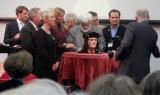
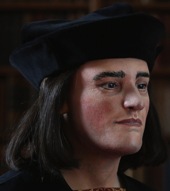
Unveiling the face of Richard III (photograph by D. Preis)

Then our attention was drawn to a square object covered with a velvet cloth.  This was ceremoniously revealed to be the real face of Richard III, the facial reconstruction carried out at the University of Dundee by Prof Caroline Wilkinson.  Prof Wilkinson explained the reconstruction process in general and this one in particular.  This detailed insight into the scientific information on which a reconstruction is based was highly interesting and informative.

The following tea break gave many of us the opportunity to queue up to look into Richard’s face and to take photographs of it.

Then Dr Toby Capwell (Wallace Collection) talked about ‘Harness for the Differently-Abled:  Armour, Scoliosis and King Richard III’.  He speculated on what type of armour Richard might have worn and explained how this could have been designed to accommodate and disguise his scoliosis.

Bob Woosnam-Savage (Royal Armouries) gave a report on how Richard would have suffered the injuries his remains display.  He warned that this was a preliminary report only as the investigation was ongoing and they were continuing to find new evidence.

Sir Peter Soulsby (Lord Mayor of Leicester) looked at ‘The Future of Richard III in Leicester’.  This includes a Richard III Visitor Centre in the old grammar school next to the Greyfriars site as well as a general focus on making historic sites more accessible for pedestrians.  He also suggested thinking about a more appropriate spot for the Richard III statue in Castle Gardens.  This would be very welcome after my own attempts at taking a photograph of it, which were rather disappointing as the sun was always behind the statue.

The conference finished with a ‘Round up and thanks from the Chairman’.

The designers of the proposed tomb, David and Wendy Johnson, were also present, but unfortunately there was no time for them to talk to us.  The sculptor of the tomb, Graeme Mitcheson, showed photographs of his previous work as well as a beautiful carving of Richard’s boar.

I would like to take this opportunity to express my own thanks to all who made the Greyfriars dig and its findings possible, to all the excellent speakers and last but not least to all those who organized this event.  I can only marvel at the organisation which was necessary to make this day with so many participants run smoothly. It all worked out perfectly.

If you were to ask me whether it was worth travelling half-way around the world for one day in Leicester, my emphatic answer would be ‘most definitely!’.

Tags: , , , ,

25
Feb

RESPONSES TO THE SUNDAY TELEGRAPH

   Posted by: Julia Redlich   in News, NSW Branch News, Richard III in the Media

The (Australian) Sunday Telegraph of 10 February 2013 featured an article by Claire Harvey ‘Time to Tell the Truth’, which favoured – to put it politely – a rather traditionalist view of Richard III.  Several of our members as well as friends felt called upon to point out Ms Harvey’s misconceptions.   Two of the letters were printed, though in an abridged format.  We are pleased to make all letters available to you in full.

The first two were published in subsequent editions of the Sunday Telegraph.

While members of the Richard III Society worldwide appreciate that everyone has a right to their own opinion, the New South Wales Branch was disturbed by Claire Harvey’s comments that presented no reference to reliable sources to back up her arguments. The Society originated in 1924 for the following reason: “In the belief that many features of the traditional accounts of the character and career of Richard III are neither supported by sufficient evidence nor reasonably tenable, the Society aims to promote in every possible way research into the life and times of Richard III and to secure a reassessment of the material relating to this period and the role in English history of this monarch.”

The recent archaeological dig in Leicester has helped us in this task by revealing truths (such as he had scoliosis not a hunched back) about Richard that cancel much of the work of Henry Tudor and his spin doctors did to destroy Richard’s character and achievements. The Society’s work will still go on because its members are certainly zealous but not the nerds as described by Ms Harvey.

What happened to the two young princes will probably always be a mystery. There are several options for their disappearance, and they may indeed have been murdered, but there are other prime suspects including the Tudor family. Accessing the Society’s websites and others will provide further information and  suggest reliable sources.

Julia Redlich, Secretary, Richard III Society, NSW Branch

I was interested to read the provocative item by Claire Harvey regarding the recent confirmation of King Richard III’s remains by the University of Leicester. Ms Harvey’s stance is the stock version we all learned at school, and she would have done well to have read some of the more current, measured examinations of the historical facts.

Briefly: after the death of King Edward IV, a retired bishop came forth to admit that he had secretly betrothed Edward to another lady before his marriage to Elizabeth Woodville, therefore, under the laws of that day, rendering that marriage null and void and their children illegitimate. The lady had spent her life closeted away in a convent, and the bishop had remained silent, and in fear of his life, until the King’s death. But as the throne could only be held by one in the legitimate line those children were now a moot point, as they could not by law succeed their father. In other words, the princes were not Richard’s rivals, having been disqualified from the line of succession.
Many scholars believe that the person who would most benefit by the murder of the sons was the Lancaster line, in the person of Henry Tudor. There is no proof that the boys were not still living in the Tower at the time their uncle was overthrown on Bosworth Field, and it would clearly have been in Henry’s interests to get rid of them forthwith.

The further details of the story are far too complex to retell here, but what is true is that it is unfair to judge a man by the writings of his enemy. Richard would never have had a fair hearing during the Tudor dynasty, under whose patronage Shakespeare was writing.

Not all Ricardians are ‘zealots’ or ‘in love with their man’; some of us just want a fair hearing for a man who otherwise had lived an exemplary life and ruled well for his few years. During which time, by the way, the princes’ mother was on good terms with Richard; would that have been the case had she suspected him of murder?

What is needed here is temperance, objectivity and humility before we leap to easy judgement of others, even if they lived 500 years ago. We would request from the editor the publishing of a more nuanced and dispassionate treatment rather than the perpetuation of the default Tudor condemnation of Richard.

That said, we gladly support Ms Harvey’s request that the Tower remains be analysed as carefully as were Richard’s, as the outcome is of utmost historical interest. However, if it is revealed that they were indeed the princes, it would still not reveal who ordered the deed done. And finally, in the English legal system, both Richard III and Henry VII are innocent of the princes’ demise until proven guilty.

Leslie McCawley

Three not used, from Helen Portus, Kevin Herbert (both active members of the NSW Branch) and David Green, a long-standing friend of the Richard III Society.

Dear Editor

Wow!

After all the well-balanced and well-researched articles this week about Richard III in all our major papers, both in Australia and worldwide, out of left field comes an article such as published by Claire Harvey!

Such ignorance! How fascinating!  Whilst Ms Harvey is obviously entitled to her opinions, does the Telegraph not usually prefer their writers to speak the truth?

Statements like:  “Richard III was a killer … a villain”.  Any evidence Ms Harvey??

Helen Portus

I read with unfettered astonishment the article: “Time To Dig Up The Truth” by Clare Harvey.

She is obviously unaware of the various contemporary sources available, none of which, as far as I recollect, actually state unequivocally that:

i ) the princes were murdered;

ii ) that their uncle was definitely responsible, if they were murdered;

iii ) that the bones discovered in 1674 were actually the bones of two lads of the correct age – (apart from the botched examination carried out earlier last century).

Some bones were actually found to be those of Barbary Apes from the Royal Menagerie, established by Henry III;

iv) that even should the bones in question be proven to be that of the unfortunate princes, and it be proven that they were murdered , no D.N.A. testing will indicate who was responsible for their deaths.

I can never understand why it is assumed by some that Richard needed the death of the princes.

They were no threat to him, nor their sisters, since they had all been declared illegitimate by decree of parliament – as specified in the Titulus Regius – a document which Henry VII attempted to destroy completely unread. Unfortunately for him and his supporters not all copies were destroyed.

Henry it was who needed the boys out of the way, since he re-legitimised the children of Edward IV so that his wife’s legitimacy might prop up his own rather dubious claim to the throne.

If his wife were legitimate, so too were all her siblings, including her two surviving brothers if living  whose claims at that time were superior to hers.

Through his mother , Margaret Beaufort, he was illegitimately descended from John of Gaunt (3rd surviving son of Edward III) and his mistress, Katherine Swynford; through his father, Edmund Tudor, he was probably illegitimately descended from the liasion (no proof of marriage has ever been found) between Katherine de Valois (the widow of Henry V and mother of Henry VI ) and Owen Tudor, her Welsh clerk of the wardrobe.

Perhaps the bones which should be re-examined by a similar DNA process are that of the so called Perkin Warbeck and the lad, who raised his standard in Dublin in 1486 and possibly fell at Stoke on Trent (all the dead would need to be examined) to be replaced by Lambert Simnel after the Battle of Stoke on Trent in June 1487 – for I strongly believe that the main two so called Pretenders were who they claimed they were – and not who Henry VII  and his minions claimed they claimed to be.

If Henry wanted to disprove the claims of both Pretenders why didn’t he ever allow his wife and sisters-in-law to examine Perkin Warbeck?  Surely a simple foolproof way of establishing his being an imposter. But he was never called an imposter, as far as I can recall. He was always styled a pretender.

A pretender is one who raises a valid claim to the throne – thus Bonnie Prince Charlie, James Edward, the Old Pretender etc.

I think Clare Harvey would be well advised to check her sources.

Kevin Herbert

I find Claire Harvey’s article on Richard III interesting. Not only for its obfuscation and inaccuracies but also that, despite the many books written on his life and times since the 17th century, such a piece could still be written.

15th century society was separated by class, each section knowing where it stood with its own aims and customs.   Without firm control the magnates across the country tended to rule their own counties or territories not always for the good of the inhabitants.  Family ties were of great importance and sometimes transcended oaths of loyalty to the Crown.  The so-called Wars of the Roses was a result of divisions that had its roots in the reign of Edward III (1312-1377).  A hundred years later Edward IV, a strong king, ruled England with his younger brother Richard governing the North. Edward was a woman-chaser who was troth-plighted (equivalent in customary law to marriage without consummation) to a lady named Eleanor Butler at the time of his secret marriage to Elizabeth Woodville.     His two sons were therefore illegitimate and the account of Edward’s affairs were made known after his death.  All this was published in an Act of Parliament, subsequently suppressed by Henry VII, but an original copy turned up in the Tower records much later.    The Tower of London was a royal palace as well as fortress and the obvious place to house the Princes at the time.

So much for motive.

The fate of the boys has been much debated, whether the bones  which are sealed will ever be examined remains to be seen. Josephine Tey quoted the old proverb, “Truth is the daughter of time”.  Richard’s silence in the face of rumours has perplexed historians, it has been a matter of probabilities discussed in many books and considered in the Trial Of Richard III (1984) which was properly constituted with judge Lord Elwyn Jones and Queen’s Counsel for both Defence and Prosecution appearing. The verdict was ‘Not Guilty’, one factor being the reconciliation between the boys’ mother and the King and another the lack of interest in the matter by his successor Henry VII.

The deaths of certain noblemen, condemned by Richard III were the result of betrayals by the breaking of oaths of loyalty, or direct revolt, which were a  capital offence, a matter not understood today.  He was a good, which means successful, soldier and his parliament enacted several statutes to the benefit of his subjects in property rights and the annulment of the custom of ‘benevolences’ which was another name for fines as a means of extracting money for the royal coffers.

Some of this information could have been aired in your columnist’s article, leaving out mention of Julian Assange who will not be pleased at being written  of in association with Richard III.   If Miss Harvey knows nothing of these matters then I suggest that she visits the library, Paul Murray Kendall’s Richard The Third (Unwins 1955) would be a good start.

David Green

Tags: ,

13
Feb

LEICESTER CONFERENCE: FULL

   Posted by: Dorothea Preis   in Greyfriars Dig, News

Should you still be thinking of going to the conference on the Leicester Dig to be held at Leicester on 2 March 2013 – sorry, to disappoint you.  We just received the following message:

The Conference on 2nd March is now fully booked. All of the unsuccessful applicants will be placed on a date-sequenced waiting list.

We heard that there was enormous interest and that many Ricardians from all over the world are attending.  Looking forward to seeing many old and new friends.

Tags: , ,

11
Feb

REPORT OF THE FEBRUARY GENERAL MEETING

   Posted by: Leslie McCawley   in Meetings, News, NSW Branch News

The first branch meeting of the year was held on Saturday, 9 February 2013, at our usual venue in the Rocks just days after the wonderful announcement about Richard III, which excited members had been eagerly awaiting. As a result of the wide media coverage, there was extraordinary interest in our website and our branch, with hundreds of emails having been received, and a number of new faces at our meeting. We hope to see Amanda, Natasha and Peter again.

Welcoming remarks were offered by our Chairperson, Judith, but departing from our usual routine, the minutes from the previous meeting were not discussed nor were there any of the usual reports presented by the Treasurer, Webmaster, or Librarian. This change was due to this meeting’s emphasis on the final results of the Greyfriars’ dig in Leicester. The results of the osteoarcheological and DNA examinations of the bones, the subsequent facial reconstruction, and the media conference with the research panel from Leicester University, were comprehensively reviewed and summarized by Dorothea for those present. Her excellent coverage can be found on the branch website, as well as the many links she has provided to the various media clips and written reports available on YouTube, BBC, University of Leicester and other websites. Dorothea will also be attending a one-day summing up conference at the University of Leicester in March and will report back to us at the next meeting. Her efforts in keeping all of us to date over the past weeks has been deeply appreciated.

Julia discussed the upcoming conference to be held in July, and encouraged members and guests to register for the exciting speakers and planned social events over that weekend. Also, Sydney’s Genesian Theatre is opening their 2013 season with a production of Shakespeare’s Richard III. After the 10 March 2013 matinee performance, a panel will be convened to discuss the nature of the ‘real Richard’ in light of recent discoveries, for which Julia has been invited to represent the Ricardian point of view. Tickets are available online at http://www.genesiantheatre.com.au

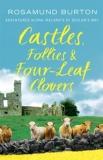
Our guest speaker was the charming Rosamund Burton, author of Castles, Follies and Four Leaf Clovers, a memoir of her journey along the ancient Irish pilgrimage route known as Saint Declan’s Way. She had been been raised in a castle in Lismore, Ireland (her father was employed by the Duke of Devonshire), and presented fascinating slides of the many sacred wells, castles, and the lovely Irish countryside.

The 13 April 2013 meeting will feature “Richard III in the Movies” with our guest Yvette Debergue.

Tags: , , ,

11
Feb

THIS MIGHT INTEREST YOU…

   Posted by: Dorothea Preis   in News

Some articles which might interest you:

Sarah Knight and Mary Ann Lund look at ‘Richard Crookback‘ in The Times Literary Supplement.  Both are lecturers at the University of Leicester and will speak at the Conference organised by the Richard III Society on 2 March 2013.

We all would like to know what the church of the Greyfriars in Leicester looked like at the time Richard was buried there.  Her are some artist’s impressions giving us a pretty good idea.

My thanks go for both these links to Renate!

Tags: ,

6
Feb

CAN WE TRUST THE MEDIA?

   Posted by: Dorothea Preis   in News

The media have been full with coverage of the identification of the human remains found in Leicester as those of Richard III.  Obviously we in the Richard III Society welcome this.

There have been some very accurate and positive reports, looking at Richard III from a variety of angles.  The Shakespeare play, The Tragedy of King Richard the Third, is brought up often enough and certainly has a place in a discussion of the historical person in contrast to the fictional character in the play.  Elissa Blake wrote a very good article, ‘Twisted villain will live on despite grave findings’ on this aspect for the Sydney Morning Herald, where she interviewed among others renowned Shakespeare actor John Bell.

Unfortunately at the other extreme there have also been some very negligently researched contributions.  For example I caught just the tail end of a short programme on the findings in Leicester on SBS World News last night.   The reporter seemed to have made no effort to actually engage with her subject matter and made several slip-ups.  In one of them she informed us that the DNA evidence showed the bones belonged to a man in his late thirties.  Well, that would rule out Richard immediately, as he was only 32 when he died!

The ABC (Australian Broadcasting Corporation) has a very detailed summary on their website, ‘Richard III’s face revealed for first time in 500 years’.  A pity though that this had not filtered through to ABC News Breakfast this morning.  Again a feature, really a mixture of little clips from other stations’ programmes, was presented by a reporter, who seems to have made no effort to familiarise herself with her topic.  However, the worst was probably the attitude of the hosts of the news programme.  Michael Rowland introduced the feature, talking about the “hunchback king”.  No, he was not a hunchback!  If the finding of the bones made one thing clear, it was that he was not a hunchback – scoliosis is a sideways curvature of the spine. The dispute whether he should be reburied in Leicester or York was also mentioned.  Here Michael’s co-presenter, Karina Carvalho, made a flippant remark that maybe they should share the bones, with each getting some.  This was just plain tasteless, we are talking about the remains of a human being, not a bag of sweets!

As a rule I have held coverage by the ABC and SBS in high regard as being fact-based and unbiased, so I found these two examples parrticularly disturbing.  Seeing such lazy reporting full of  half truths and incomplete information, made us wonder how often this might actually be the case.  When it is about a subject we are familiar with, we can detect them easily (and get annoyed by them), but how often are we presented with equally negligent research on other subjects that we do not know much about?   Very often we form an initial opinion about any subject based on media coverage. Nobody has the time to check out everything we read or watch, nor should we be expected to.  I just wonder how often we are misled into forming incorrect opinions – a rather frightening scenario!

Tags:

6
Feb

R.I.P. MARGARET FRAZER

   Posted by: Dorothea Preis   in Bookworm, News

I just heard with great sadness that one of my favourite authors, Margaret Frazer, the pen name of Gail Frazer, passed away last night.

Her meticulously researched medieval detective stories, most of them featuring either Dame Frevisse or Joliffe, have been popular with many of us.  As they played in the mid-15th century, many of the persons of this period we are so interested in came to life in the pages of her novels.  For me, her Alice Chaucer is unforgettable.

Gail will be missed by many of us.

Tags: , ,

5
Feb

SKELETAL REMAINS IDENTIFIED AS THOSE OF RICHARD III

   Posted by: Dorothea Preis   in Greyfriars Dig, News

What an evening!  I am sure that many of our readers followed the press conference in Leicester as spell-bound as I did.  It was a moment we had all been waiting and hoping for which finally came true.

The press conference revealed in a step by step account that the human remains found in Leicester in 2012 are “beyond reasonable doubt” those of King Richard III.

Richard Buckley, the lead archaeologist of the Greyfriars Dig, explained how they found the human remains right at the start of their dig and how the further trenches helped to confirm where in the Greyfriars site the remains had been found.  He also explained that the grave had been dug in a hurry and had actually been too short for Richard.  While his lower body, which apparently had been laid out first, was straight, his upper body was more twisted, as they had tried to fit him into the grave.

The most confronting report was that by Jo Appleby, the osteoarchaeologist of the University of Leicester, who had analysed the skeletal remains.  Her description of the injuries which led to Richard’s death as well as those inflicted as humiliation brought the horrors of a medieval battle into our living rooms.

Dr Appleby also remarked that the king would have had had an unusually slender, almost feminine, figure.   She explained the scoliosis and what it would have meant for him, but stressed that the “withered arm” from the Shakespeare play was not based on fact.

The most anticipated evidence was probably the DNA analysis, presented by Kevin Schürer and Turi King. An analysis of male descendents of Edward III, who was also an ancestor of Richard III, has not been concluded yet.  However, the mitochondrial DNA of Michael ibsen, a descendent of Richard’s sister Anne in an all-female line, was matched to that of another descendent, also in the all female line, and then to that of the human remains.

When Richard Buckley concluded that based on all the evidence it was “beyond reasonable doubt” that these were the remains of Richard III, it was not only the audience in Leicester who started clapping and cheering.  What a truly amazing day for all of us!

The thanks of the NSW Branch of the Richard III Society go to John Ashdown-Hill, Philippa Langley, the team of the University of Leicester and all others that made this wonderful discovery possible.

You can find out more in the Press Release of the University of Leicester and on the brand new website of the Richard III Society.  Now pictures of the facial reconstruction have been published as well and it is certainly a special moment to look into the face of the real Richard.

Tags: , , ,

4
Feb

ARISE, KING RICHARD THE THIRD!

   Posted by: Dorothea Preis   in Uncategorized

It’s official:  the human remains found in last year in Leicester are indeed those of King Richard III.  A dig was carried out in August/September 2012 in the area, where the Greyfriars Frairy used to be in Leicester.  In the process two sets of human remains were found:  a fully articulated male skeleton and a disarticulated female skeleton.

The male one showed many indications that it could be that of Richard III, who was killed at the battle of Bosworth in 1485.  During the last months it went an extensive array of tests and the results have just been announced.  More about this tomorrow.

4
Feb

RICARDIAN COUNTDOWN: TODAY!

   Posted by: Dorothea Preis   in Greyfriars Dig, News

Today is the day of possibly the most important announcement any Ricardian might ever experience:  are the human remains found in Leicester those of Richard III?

All will be revealed at 10h00 UK time and 21h00 AEST.  The results will be available on Twitter (http://twitter.com/uniofleicester) and BBC News will be carrying a live stream, though this might not be available to viewers in Australia.

However, these limitations only exist with television coverage, radio coverage is free world wide.  BBC Radio Leicester will cover the big day from 6h00 (17h00 AEST) onwards.  If you have a smartphone, there is a free app called Tune-In Radio, which allows you to access pretty much any radio station in the world (thanks Jennie for the information!) or you can listen to it over your computer.

The press conference will also be recorded and will be available to watch on the website of the University of Leicester (www.le.ac.uk/) as soon as possible.

Tomorrow morning AEST, Channel 4 will also broadcast the documentary, though again this will not be available to Australian viewers, unless you have some special software.  We certainly hope that the ABC or SBS will buy it as soon as possible and make it available to all of us!

And on Tuesday, 5 Feb 2013, 21h00 in the UK (08h00 on Wednesday morning AEST) the BBC Radio 4 programme ‘Inside Health’ will include a talk on the facial reconstruction ‘of a king’ – which sounds very much like it could be “our” king, as the Richard III Society has funded a facial reconstruction of the human remains found in Leicester (more info on this, see here).

Are you ready to celebrate what we hope will be a historic event?  My bottle of bubbly is in the fridge!

Tags: , ,