GUEST POST BY HELEN COX
Helen Cox, author of two excellent books on the Battle of Wakefield, here shares with us some thoughts about Richard III. We are very grateful to Helen for making this article, which was first published on her website Herstory Writing & Interpretation, available to us.
In Life and Death: Richard III
Events in Leicester last summer have pulled King Richard III from the obscurity of a lost grave and transformed him into the most intimately known of all English monarchs. The forensic archaeological analysis of his skeleton has revealed a grain of truth in the Shakespearean caricature, but he was not ‘hump-backed’ (afflicted by kyphosis) – he was a ‘crook-back’, suffering from severe scoliosis (abnormal lateral curvature of the spine). The degree of normal bone development shows that this was not a congenital defect but began in adolescence, from an as-yet unknown cause (as with 80% of modern cases). So Richard should have enjoyed a normal, active boyhood, and presumably began the customary martial-arts training several years before the onset of his condition. Presumably, too, he continued to practice skill-at-arms despite the back-ache and strain on his heart and lungs imposed by the scoliosis, since at the age of 19 he is recorded as having fought at the Battles of Barnet and Tewkesbury. He then continued a hawkish career in Edward IV’s war-camp, opposing the 1475 Treaty of Picquigny, campaigning in the northern borders, and in 1482, recovering Berwick after mounting a full-scale invasion of Scotland – military achievements remarkable for one of such slender build and with the extreme curvature of his spine in adulthood:

© University of Leicester
However, it is worth noting that the condition appears far more dramatic in the skeleton than it does in the living body, as photographs of modern sufferers show; and based on contemporary images, Richard’s scoliosis seems to have manifested as one shoulder slightly higher than the other. He may also have had an uneven waist and a twist to the torso, barely noticeable when he was fully dressed. Interestingly, modern medical advice is for scoliosis sufferers to remain as active as possible – so in pursuing a military career, he was in fact doing the best thing for his condition. I wonder if he also wore a back-brace, as doctors today advise in some cases?
Aside from this, Richard had no physical abnormalities (contrary to the ‘withered arm’ story related by Sir Thomas More, and the famous ‘Broken Sword’ portrait painted after his death, showing him with deformed fingers). Without scoliosis, he would have stood approximately 5’ 8” (1.73m) tall, an average height compared with the Towton skeletons, but the spinal bend would have reduced his stature somewhat. (Nonetheless, he was still ‘three fingers taller’ than Nicolas von Poppelau, a German knight who met and described him in 1484).
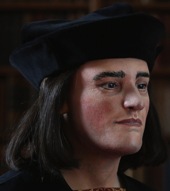
We also know that his teeth, apart from the loss of a few molars, were in good condition and not excessively worn, (consistent with eating well-refined flour); and that he enjoyed a high-status diet rich in animal protein, especially fish – indicating a devout adherence to religious fast-days, and/or a liking for seafood! And the facial reconstruction based on his skull shows that his portraits were accurate: Richard in life was a personable, square-jawed man with a determined nose and chin, dark brown wavy hair, and dark blue-grey eyes.
His skeleton also tells the full, gruesome story of his death and posthumous fate, again with close correspondence to the historical record. Having launched a cavalry charge in an effort to reach and kill Henry Tudor, Richard somehow became unhorsed, possibly because his mount stumbled in marshy ground. The jolt may have flung off his helmet, or it may have been knocked off by a blow that broke the chin-strap, because the concentration of wounds to his skull shows that he must have been un-helmed as he continued to fight on foot, hacking desperately through Tudor’s bodyguard. He received two relatively superficial cuts to his face, one on the right jaw and one on the right cheek, possibly inflicted by a dagger and consistent with close-quarters engagement; then a series of catastrophic head wounds suggesting that he was soon surrounded and overwhelmed (see illustration below).
The first of these probably came from a swordsman on his left, aiming to cleave his head apart with a downward sweeping action. Richard may have seen it coming and tried to side-step or turn away, but the sword caught him a glancing blow on the left-hand side back of the head, shaving away a disc of scalp and the outer layer of skull to expose the porous bone underneath. An injury of such stunning force may well have driven him to his knees, because another assailant was able to strike the top centre of his head, using a square-section weapon consistent with a rondel dagger or war-hammer beak; this penetrated his skull, driving two flaps of bone into the upper surface of the brain. In all likelihood this rendered Richard unconscious so that he slumped forward, exposing the back of his head. Two opponents then stepped in to deliver the coup de grâce; one of them may have been the swordsman who had inflicted the ‘shaving’ wound, and now thrust in his blade from the left with such force that it penetrated all the way through the brain and made a mark on the inner table of the skull. The second assailant, probably armed with a heavy weapon like a poll-axe or halberd, struck from the right, cleaving off a massive slice of bone and cutting into the cerebellum; either of these wounds would have been instantly fatal. A bloody end, indeed – although it could have been over mercifully quickly, with Richard aware of very little after the first major blow.

© University of Leicester: Micro-computed X-ray tomography image showing the fatal sword wound (B) and halberd slice (C) either side of the area (A) where the cervical spine meets the skull.
Richard’s corpse was then stripped, and at least two more injuries inflicted post-mortem: a dagger cut to a right rib and a sword cut to the pelvis, the latter consistent with a stab to the buttock while his body was slung face-down over the horse that carried him back to Leicester. Judging from the position of his hands in the grave they appear to have been bound, (perhaps in order to drag his corpse from the field), and were not later untied; but if his body suffered other wounds and indignities, (as it may well have done, pre- or post-mortem), they have left no trace on his bones.
The last Plantagenet king was then hastily buried by the monks of Grey Friars, without a coffin and in a grave not long enough to accommodate his corpse at full stretch; but since he had lain exposed for three days in late August, covered in blood and open wounds, their haste is perhaps understandable – it must have been a stomach-churning task.And thus Richard III lay undisturbed for 527 years, in a grave lost until August 2012; the rest, as they say, is history.
© Helen Cox
March 2013
Tags: Ricardian Authors, Richard III