Barbara Gaskell Denvil was born in England, grew up amongst artists and authors and started writing at a young age. She published numerous short stories and articles, and worked as an editor, book critic and reader for publishers and television companies. About 10 years ago she began writing medieval novels (mystery, romance, murder-adventure) set principally in 15th century England.
Her first medieval novel Satin Cinnabar is a historical crime adventure set in London during the last months of 1485 in the aftermath of the Battle of Bosworth. It is available for Amazon Kindle and all other ebook readers (Barnes & Noble, Kobo, Sony, ipad etc..)
Her new novel Sumerford’s Autumn is also set during the last years of the 15th century and will make major reference to the fate of both King Edward IV’s sons. It will be published for Kindle later this month or early in April.
Barbara also writes fantasy, though this tends to be more dark and adult. Her fantasy novel Fair Weather is set in medieval England around the early 1200s. There’s a fair chunk of historical content, but the basic plot is pure fantasy. It is also available for Amazon Kindle and from Smashwords in other formats.
Barbara’s novels are gripping and engrossing stories, real page turners, involving believable characters to carry the story along, while maintaining a high level of historical accuracy.
After reading Satin Cinnabar, we asked Barbara to tell us more about the medieval world she describes so masterfully in the novel. This is the second part of her article “Medieval Life”, part 1 was on this site yesterday and part 3 will follow tomorrow. Thank you, Barbara, for sharing this with us.
Don’t forget to visit Barbara’s blog.
———————————————————————————————————————————–
From smells to noise – and here the past was more friendly.
No screech of traffic, no thunder of passing trains, no whine of planes overhead, or the vibrating attack of pneumatic drills, bulldozers or cranes.
Medieval noise was cosy people sized stuff. Church bells, the scuffle of birds and rats, the beat of the wherryman’s oars through the river waters, wind in the trees, the calls from the market stalls, Horses’ hooves, gossip, rumour, an occasional hue and cry, and the hourly reassurance of the Watch.
Friendly bustle then, as long as you lifted your skirts and avoided the gutters, the pigs and the dogs.
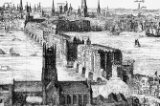 Best avoid the rivers too, unless you knew what you were doing and owned a boat. Banks were not always solid barriers back then, so rivers overflowed and flooded more easily and there were far fewer bridges to aid escape. Over the Thames, for instance, where now nearly two dozen bridges span the waters, there used to be just one. I am often amazed at how many people believe that Tower Bridge is an ancient crossing. In fact it is Victorian. The only bridge in the 15th century was a stone masterpiece, its construction probably completed during the first years of the 13th century. Those nineteen pillars and twenty arches rose from the river bed and supported a solid walkway lined with houses, shops and businesses, many four or five storeys high and jutting out over the water. There was the chapel of Thomas Beckett, a portcullis, and at the southern end the sight of traitors’ heads tarred to preserve them from scavengers and stuck on poles above the gate to deter others.
Indeed, this bridge could become appallingly over crowded, and many people used the boats instead for crossing the river from London to Southwark.
The southern end of this bridge constituted one of the 8 entrances into the city of London, for it, and many other English cities, were protected by great stone walls (sometimes dating back to Roman times) and their gateways were locked each night. Travellers neither entered nor left during the night hours, and who entered at other times could be monitored at least to some extent.
The lack of light must have been one of the principal handicaps of everyday life. Anyone who knows the English climate knows that days of blazing sunshine are not that common, and besides even when the sun shone it did not always enter indoors. Streets were invariably extremely narrow and buildings could be several storeys tall, therefore enclosing most houses in shadow. Windows tended to be very small and the glass, when it could be afforded at all, was thick. The average household used polished horn instead of expensive glass, but this was only translucent rather than actually transparent. Poorer families made do with oiled parchment, or nothing at all. Of course no one expected the brilliance of electric light which we now demand, so no doubt medieval eyes adjusted, but the shadowed gloom must have been difficult to live with. Spectacles existed, came from Venice, were costly, and comprised simple magnification, so there was little escape from peering over your work with your nose to your tools.
Candles were either beeswax – expensive again – or mutton tallow – which stank, smoked and guttered easily. An average household might eat their supper by candlelight, (dinner was taken at midday or earlier) but opening hours, curfews and working routines were frequently (though not always) governed by the seasonal allotment of daylight. It’s getting dark? Well, if you can’t afford candles, then go to bed. Open fires were, however, the normal method of heating and cooking, and these offered more light than any candle, just as long as you could collect, or afford, the firewood.
Nowadays we tend to think of candlelight as perfumed romanticism. That was certainly not the experience of the medieval housewife trying to do her needlework after a long day at the brewery.
It is often supposed that every ordinary citizen in the medieval era was virtually ruled by the doctrines of the church. Indeed, orthodox religion was taken far more seriously then than it often is today and regular church attendance was normal – daily devotion for some, daily prayers for most. Christian orthodoxy controlled many aspects of ordinary life – no meat eaten on Fridays and many other days of religious significance for instance – but even here the people found some interesting escapes. Pleading ill health exonerated you from such severe dieting, and quite a few creatures which we would certainly classify as meat, were conveniently classified as fish back then. Beaver, for instance, duck and water birds.
Nor was the power of the church always as unquestioningly accepted as is now supposed. Since few working folk had the luxury of a private garden, they frequently kept their bulky tools and stored their firewood in the local churchyard. The church complained regularly and laws were brought in – to no avail as usual. What is more, greedy priests and monks abusing their vows and authority, or those whose behaviour was considered flagrantly immoral – not entirely uncommon – could be dragged off by the local people and locked in the stocks, thrown in the river, or generally humiliated. A boring preacher would sometimes be ignored while his congregation chattered amongst themselves, or wandered off entirely. Some churches including St. Paul’s Cathedral in London were often frequented by vendors selling from trays around their necks, beggars slumped against the walls, lawyers touting for trade, and passing shoppers sheltering from inclement weather. The priest trying to conduct a service simply had to ignore the general noise while hoping someone was listening to him. Although the message of the Lord was treated with enormous respect, the Lord’s messengers were only respected when they deserved it. The Bible, being available exclusively in Latin, was not understood by all and although blasphemy was punishable, adultery and fornication outside marriage were considered terrible sins with purgatory or even hellfire the promised penalty for the wicked, in fact the general population cheerfully blasphemed, fornicated and behaved just as wickedly as usual, hoping to escape hellfire by repenting their sins on Sundays and finally on their deathbeds.
They danced on Sundays, they played football through the graveyards and they complained bitterly about any attempts to limit their amusements. And after all, the medieval church did not embrace the puritan strictures of much later times. The Bishop of Winchester, for instance, benefited considerably from the rents of numerous taverns and brothels within his jurisdiction of Southwark.
Travel was slow and exceedingly difficult especially in bad weather. Roads were often unpassable, usually unpaved, thick with ruts and holes, and frequently left in bad repair. Rivers flooded, bridges were few and far between, road signs (stone markers) were mossy and grown over and without any maps it was hard to find the correct route. Maps in those days – if you were lucky enough to find one at all – were simply lists of the townships you should try to reach one after the other, thereby assuring a generally accurate direction leading to where you hoped eventually to arrive. Many travelled in consort or hired guards with a knowledge of the local countryside. Robbers and gangs were a constant danger along isolated roadways, and finding a place to stay overnight and stable your horse was not always that easy either. Inns and hostelries certainly existed, but there was no map telling where to find one, and when you did find one, it was apt to be overcrowded. You expected to share one large bed with several other travellers (of the same sex) whether they snored or no.
Therefore news of what had happened in one part of the country could take a very long time to reach the rest of the population, and the accuracy of that news once it arrived was certainly not guaranteed. Salacious rumour was rife, confusion even more so. With no newspapers in existence, the pulpit was one way of receiving important announcements, but there was no method of knowing whether you heard the actual truth, or simply what someone wanted you to believe. Propaganda had most certainly already been invented. This has made it increasingly difficult to discover what really occurred in the past, for even when rare documentation exists, it cannot always be entirely trusted.
Tags: Church, Medieval Life
 The March 2012 issue of the Ricardian Bulletin has been posted to all our branch members. You should find it in your mailbox shortly.