4
Apr

Medieval Recipes

   Posted by: Dorothea Preis   in Medieval Menu, Medieval Miscellany

Should you be desperate for a new recipe idea to try out over the long weekend, have a look at what the British Library has to offer!  Unicorn sounds pretty special, doesn’t it?

Have a look a at the Medieval and Earlier Manuscripts Blog of the British Library for more information (click here).

(P.S. In case you are wondering, note the date of this post…)

Tags:

1
Apr

Don’t miss Mittagong!

   Posted by: Julia Redlich   in News, NSW Branch News

Thank you to everyone who sent in their registration forms for our day-long conference at Mittagong RSL on Saturday, 12 May. We look forward to seeing you.
If you have suddenly realised that there is a huge blank in your diary that weekend, we don’t have to give the numbers to the RSL until 18 April, so you can let Julia know if you can come by 17 April.

To whet everyone’s appetite: presentations include talks on Eleanor Talbot/Butler, medieval coins, the Neville/Percy feud, Royal Relics – and the previously lauded “Richard III – the Posthumous Hunchback”. A description of Jousting in the time of Richard III will be given by a new member Andrew, who has found time to join us before he heads off to Europe for some serious jousting there.

Of course there will be all the usuals:  a Plantagenet quiz, a raffle with great rewards to win; a book sale; and bring and buy stall. If you are Bringing please make sure you donations are good to look at and not too difficult for Buyers to take home.  That old bar fridge you’re ditching to beat high electricity prices would not be a good idea!

For your $35 you also get morning and afternoon tea and lunch – and the pleasure of Ricardian company.

If you are staying overnight on Saturday please let Julia know if you will be joining those dining at a local Mittagong restaurant, also if you will be part of the expedition to Robertson on Sunday morning. It will be Sunday Markets  in the town that day, plus the galleries and shops to browse through, as well as places for us to enjoy lunch before returning to Mittagong to make our way to our various homes.

Tags: ,

30
Mar

Lost in Castles

   Posted by: Dorothea Preis   in News

Lost in Castles (formerly Loyalty Binds Me), who made the brilliant DVDs of a reconstructed Middleham and Sandal Castle, just let us know that they are not charging any postage until the end of April 2012.  The reason is that in May Royal Mail is set to increase its rates.  So this is a brilliant opportunity to order that Middleham DVD or the Sandal Castle DVD you had wished for.  I’m certainly going to make good use of this offer.

If you want to look at the trailers or see pictures of other castles, go to the Lost in Castles website.

Click on the titles below to reach the Paypal payment page:

Middleham Castle DVD – £9.99

Sandal Castle DVD – £9.99

Life of William Cowper CDs – £7.99

Middleham and Sandal Castle Gift set – £15.99

Enjoy!

Tags: ,

29
Mar

Richard III Today: 29 March 2012

   Posted by: Dorothea Preis   in News, Richard III in the Media

It is good to see that our cause is getting out there.  Yesterday Lyn Gardner reviewed for the Guardian a new play, Iceberg Right Ahead!, written to coincide with 100th anniversary of the Titanic disaster.  While the reviewer’s view of the play itself is not very positive, her comparison to Richard III is spot on:

Sticking to the known facts isn’t always the route to entertaining theatre – Richard III would probably have had much to say about Shakespeare’s doubtful portrayal of him…

Of course, a fair amount of studies have been published, which attempt to show a more balanced view of the last Plantagenet king, but their impact is mostly limited to those interested in the period.  However, finding little unconnected remarks that go against the stereotype is extremely hopeful.  They reach a far wider audience and their impact cannot be underestimated.  There just might be someone reading this review, who had never thought twice about Richard III, whose interest is piqued to find out more about the historical Richard.

Thank you, Lyn Gardner!

Lyn Gardner, ‘Iceberg Right Ahead! – review’, Guardian.co.uk (28 March 2012).  URL:  http://www.guardian.co.uk/stage/2012/mar/28/iceberg-right-ahead-review Date accessed:  29 March 2012

Tags: , ,

28
Mar

Palm Sunday Event

   Posted by: Dorothea Preis   in News

Just a reminder that this coming Sunday (1 April) is Palm Sunday and thus the day to commemorate the Battle of Towton, fought in a snow storm on Palm Sunday 1461 (29 March).  As every year the Towton Battlefield Society is hosting an event to “commemorate those men from the House of York and the House of Lancaster who fell on that fateful day’.

As we have seen before, Helen Cox will be launching her new book Walk Towton 1461 at this event.  We are grateful to Adrian White and theTowton Battlefield Society for providing us with a link to their official programme.  What a pity that for us “down under” it’s just that little bit too far to go round – we can just be jealous of all our readers, who have the opportunity to visit the commemoration with its fascinating shows and walk the battlefield on one of the guided tours.

We all wish all those taking part in the commemoration, whether actively or as a visitor, an interesting day and hope that the weather will be better than on that fateful Palm Sunday 551 years ago.

To find out more and view the programme, visit the page of the Towton Battlefield Society.

Tags: , ,

25
Mar

Future Members?

   Posted by: Julia Redlich   in News, NSW Branch News

The New South Wales Branch of the Richard III Society is encouraged by the number of younger people – ie: those still students at school or university – who have an interest in the varying opinions about Richard III and contact us for more information.

Whereas the two young ones pictured are not even students yet, we hold out great hopes for their future membership. Samantha (nearly two) and Zachary, who was two weeks old at the time of the photograph, are the grandchildren of  Isolde Martyn, one of our Branch’s recent past presidents, and still a welcome and regular contributor to our meetings.

Isolde, of course, is also an author of some repute. Her historical novels* are not only well written but exceptionally well researched, and have won several awards both in Australia and the United States.  We’re looking forward to her next book about Buckingham, as well as a much anticipated novel about Elizabeth Lambert (Jane Shore).

Isolde, we trust you to keep Sam and Zach well and truly in the Ricardian loop!

* The Lady and the Unicorn and The Silver Bride both have a distinct Ricardian connection (in the United States the titles are The Maiden and the Unicorn and Moonlight and Shadow).  The Knight and the Rose is a delightful historical romance set in the time of Edward II.

Visit Isolde at http://www.isoldemartyn.com/

Tags:

23
Mar

Visiting Yorkshire?

   Posted by: Dorothea Preis   in News

Helen Cox, author of the highly acclaimed The Battle of Wakefield Revisited:  A Fresh Perspective on Richard of York’s Final Battle, December 1460, told us about two upcoming events, which would be of great interest to all Ricardians.

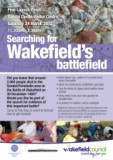
Tomorrow, Saturday 24 March 2012, the event ‘Searching for Wakefield’s Battlefield’ is launched with the aim to find evidence of the battle, which cost Richard’s father, brother and uncle as well as thousands of others their lives.  If you should be lucky enough to find yourself in the area, make sure that you go to the Sandal Castle Visitor Centre and meet Helen in person.  And don’t forget to bring your copy of Helen’s brilliant Walk Wakefield 1460: A Visitor Guide to Battle-Related Sites along!

The feeling among the Yorkists was doubtlessly rather depressed after the loss of the Battle of Wakefield, however, just three months later with the victory of the Battle of Towton on Palm Sunday, 29 March 1461 the Yorkist supremacy seemed complete.

To commemorate this bloody battle (no, I’m not swearing – it is regarded as the bloodiest battle ever fought on British soil) there will be an event hosted by the Towton Battlefield Society on this year’s Palm Sunday on 1 April 2012.  At the event Helen is also launching her new book Walk Towton 1461.  To quote from the flyer:

With Walk Towton 1461, you can follow the Earl’s campaign from his first victory at Mortimer’s Cross to disaster at St Albans, the fierce contests of Ferrybridge and Dintingdale, and the bloody finale at Towton, with an illustrated guide to visiting sites connected with the battles. Each of the four main sections contains a short history, directions to sites (including maps), and information on opening times and admission charges

During the commemoration, you can buy this new book at the TBS Authors Stall in the Barn, Old London Road, Towton for £6.00.  And all of us, who can’t be there, can order a copy of Helen’s latest book as well as of her others from York Publishing Services on www.YPD-books.com for £7.50.

Helen Cox & Alan Stringer, Walk Towton 1461: A Visitor Guide to Battle-Related Sites, Herstory Writing & Interpretation/York Publishing Services, 2012.  ISBN 978-0-9565768-2-8 (Paperback, 70 pages, 20 black-and-white plates, 6 line drawings)

Tags: , ,

17
Mar

Me Fieri Fecit

   Posted by: Dorothea Preis   in News

This is the title of an upcoming symposium at the University of Kent on ‘the role and representation of owners, donors and patrons in medieval art’.

The programme sounds most interesting.  There is a talk ‘“Mon seul desir”: Self-presentation in the patronage of John Talbot, 1st Earl of Shrewsbury’, who was the father of Eleanor Talbot, who is so instrumental in Richard III’s claim to the throne.  And another one on ‘The Changing Image of Plantagenet Kingship: Hagiography and political iconography in the owner figures of St Stephen’s Chapel’.

Once again we probably feel disappointed that we can’t simply go and attend an interesting event like this.  However, in this case we have something to make up for it:  The NSW Branch one day convention on the following Sunday in Mittagong!  An event not to be missed.

For more info on the symposium, click here.

Tags: , ,

12
Mar

Bulletins are on their way

   Posted by: Dorothea Preis   in News, NSW Branch News

The March 2012 issue of the Ricardian Bulletin has been posted to all our branch members. You should find it in your mailbox shortly.

Please remember to keep us informed of any address changes.  Should your details change, please let the Secretary know.

Tags:

8
Mar

MEDIEVAL LIFE – Part 3

   Posted by: Barbara Gaskell Denvil   in Medieval Miscellany

Barbara Gaskell Denvil was born in England, grew up amongst artists and authors and started writing at a young age. She published numerous short stories and articles, and worked as an editor, book critic and reader for publishers and television companies. About 10 years ago she began writing medieval novels (mystery, romance, murder-adventure) set principally in 15th century England.

Her first medieval novel Satin Cinnabar is a historical crime adventure set in London during the last months of 1485 in the aftermath of the Battle of Bosworth.  It is available for Amazon Kindle and all other ebook readers (Barnes & Noble, Kobo, Sony, ipad etc..)

Her new novel Sumerford’s Autumn is also set during the last years of the 15th century and will make major reference to the fate of both King Edward IV’s sons.  It will be published for Kindle later this month or early in April.

Barbara also writes fantasy, though this tends to be more dark and adult.  Her fantasy novel Fair Weather is set in medieval England around the early 1200s. There’s a fair chunk of historical content, but the basic plot is pure fantasy.  It is also available for Amazon Kindle and from Smashwords in other formats.

Barbara’s novels are gripping and engrossing stories, real page turners, involving believable characters to carry the story along, while maintaining a high level of historical accuracy.

After reading Satin Cinnabar, we asked Barbara to tell us more about the medieval world she describes so masterfully in the novel.  This is the second part of her article “Medieval Life”, part 1 and part 2 were on this site previously. Thank you, Barbara, for sharing this with us.

Don’t forget to visit Barbara’s blog.

———————————————————————————————————————————–

However, not everything was risk and danger, and justice was far more readily available than many people now assume.

There was no organised police force of course, but there were sheriffs, constables, judges, law courts, solicitors, lawyers, and a careful system of law and order. This was sometimes open to bribery and corruption (Richard III took pains to try and eliminate some of this corruption) but folk were not generally vulnerable to outright anarchy and destruction. It is sometimes thought, for instance, that while ‘usurping’ the throne by force, Richard III was backed by a marauding army and therefore simply intimidated everyone into supporting him. This is absurd. This sort of thing did not happen either in his case, or for anyone else by the 15th century. Sometimes in some rural backwater the local lord might achieve some fairly horrid results in this manner, but this sort of feudalism was no longer possible to maintain, and criminals were usually brought to justice.

As a deterrent, execution was brutal. Nobility was beheaded, and that could take several strokes of a blunt axe wielded by a slovenly or even drunken executioner. Nobility was, however, often pardoned before the final act, depending on the crime. The common man was hanged, and if his crime was sufficiently heinous, especially if it involved treachery to the crown, he could be hung, drawn and quartered. He could also be cut down from the noose before dead, and publicly castrated. This had been accepted practise in previous eras, but by the mid to late 1400s this practise was dying out. Heretics could be burned, but NOT witches. Witches were not classed as heretics until the 17th century, and during medieval times witchcraft had no association with devil worship. Witches were often herbalists and midwives, wise women and astrologers. As long as they did not attempt to kill anyone or predict the king’s death – a crime punishable by execution – astrology was generally practised and in fact was an acceptable part of diagnosis and medicine.

Public execution is often now depicted as a callous celebration and a good day out for the local citizens, but the public nature of the spectacle was originally designed as a deterrent, not a diversion. Good men dragged along their sons to show them what terrible consequences came from evil living. Women sobbed and hid their eyes. Men offered a last cup of beer to the unfortunate condemned. Those who had been wronged were able to see justice done, and relatives could say goodbye. Some no doubt enjoyed the drama, but this was not the general attitude.

Prisons were appalling places and the conditions for the inmates were atrocious. However, torture was not used. It was entirely illegal in England until Tudor times. The Tower of London, now so closely associated with dungeons, torture and death, was simply a royal palace before the reign of Henry VII. It was used as luxury apartments, as a meeting chamber for the Royal Council, celebrations and feasting, as well as occasionally housing the rare important prisoner. The so called ‘princes in the Tower’ were not imprisoned. They were originally housed in the vast refurbished Royal Apartments while awaiting Edward V’s coronation, and even after this was cancelled, they were removed to other comfortable apartments. Those staying here had servants, access to the gardens and battlements, and could please themselves in many ways, sometimes even those who were denied the freedom to leave. There was even a zoo. Indeed, the Tower was busily occupied with a huge and bustling household. No damp silent stone, no dark secrets, no unlit and unused stairways, torture chambers or haunted corridors.

Unfortunately the Tudor dynasty brought many changes. Under some circumstances the rack was subsequently used, and although special permission was supposed to be given for the use of torture, other methods of persuasion were no kinder.  Confessions during the reigns of Henry VII, Henry VIII and the other Tudor monarchs were frequently obtained under torture and it is high time some of these confessions were seen as the useless and miserable lies they clearly were.

During Henry VII’s monarchy the rising middle classes and the growing independence of women also took a backward step. A great deal of this was due to Henry Tudor’s extremely severe methods of high taxation and his suspicious attitude towards his powerful nobles, whether allies or enemies. Some deterioration of lifestyle was also due to foreign wars and politics which influenced trade, and some was due to the start of worsening weather conditions. Britain and Europe’s warm period was coming to an end and the Earth was cooling. Within a few short years the Little Ice Age was starting to form. Poverty and beggary soared, and prostitution increased due to this growing destitution.

This was in direct contrast to the gradual improvement in living conditions during the reigns of the Plantagenets, in spite of occasional famines and prolonged storms. At that time the country was slowly becoming prosperous and a burgeoning middle class was expanding. Of course, what your actual business was would determine your way of life. Some jobs involved such noxious practises, (and this in a world where strong natural smells were an accepted part of life) they were banned from carrying out their trades within proximity of other dwellings. Other trades remained a struggle with long hours and little pay, but inflation was virtually non existent, and the cost of living remained generally stable.

And the butcher, the baker and the candlestick maker? No trade unions back then of course but the appropriate Guild would protect you, oversee your practises, watch over your apprentices, put on plays at Christmas and generally promote your business.

So before the trials of the Tudor dawn, life was improving for most. It was a small world, a cosy world, friendly, chattering and smelly. The population was so very much smaller than today and it was normal for people to be closely acquainted with all their neighbours. This – and the difficulty in getting hold of accurate news – created another of most people’s favourite pastimes – gossip and rumour.

The friendly neighbourliness could mean protection, someone to watch the children when you had to work, someone to bring you chicken broth when you were sick, someone to share their oats and parsnips when you lost your job, and even someone to adopt the baby if you suddenly died young. But this also carried its disadvantages – for those same friendly neighbours knew virtually everything you did, commented on it, criticised it, and gossiped far and wide about it.

So – the good, the bad, and the ugly!

And the rest is another story ————–

Tags: ,