Posts Tagged ‘Richard III’

24
May

CONTEMPORARY VIEWS OF MR SHAKESPEARE

   Posted by: Dorothea Preis    in News, Richard III in the Media

My Google alert found for me an article in the Daily Mail, quoting the views of Mr Shakespeare’s plays from his “contemporaries”.  They also voice their opinion on Richard III.  Thank you, R.B. from Warwick, for putting the record straight!  Though I can also understand Mary P. from Worcestershire.

These opinions from “Ye Internette” are quoted in an article by Craig Brown,a British satirist.  According to his Wikipedia entry he “characteristically [combines] viciousness and honesty”, but don’t fear, he seems to have a good opinion of Richard III.

So if you need something a bit lighter on this grey winter day (at least here in Sydney), read all the opinions here.

Tags: , ,

21
May

Richard Buckley on Richard III

   Posted by: Dorothea Preis    in Greyfriars Dig, News

ArchaeologyAnother find by our friend Renate – what would we do without her!

On 25 April 2013, Richard Buckley, the lead archaeologist of the Greyfriars Dig, gave a talk on the dig and the discovery of Richard’s remains at the Tower of London.  I am sure you all feel you know all about the project by now, it is an interesting review, which puts some details into bigger context.  You can listen to it here.

Tags: , ,

13
May

Richard III on Trial For Murder

   Posted by: Dorothea Preis    in News

We are very grateful to Dr Phil Stone, Chairman of the Richard III Society, for sharing this information with us.

The Rainham Theatrical Society (RaTS)
are putting on a production of the play

“Richard III on Trial For Murder”

by Michael Bennett

(Mike runs the Richard III Museum in Monk Bar, York)

Performances are on July 18, 19, 20 and 25, 26, and 27

at

the Oasthouse Theatre, Stratford Lane, Rainham, Kent.

The Oasthouse Theatre is situated just off the A2, a few hundred yards past St. Margaret’s Church going towards Sittingbourne. Parking is available in Hidson’s car showroom car park on the A2.

Tickets are £7.50 and can be booked on-line here.

Tags: ,

11
May

RICHARD’S TEETH

   Posted by: Dorothea Preis    in Greyfriars Dig, News, Research

Some of you may have seen a – rather disappointing – article in The (British) Telegraph recently about research into Richard’s teeth.

The author, Richard Gray, starts with the fanciful description that Richard was killed by blows which were so heavy that they  “drove the king’s crown into his head”.  However, Bob Woosnam-Savage explained at the conference in Leicester that Richard could only have suffered the injuries that killed him after his helmet had been removed and also explained by what kind of weapon.

Mr Gray then states that Richard suffered from bruxism or teeth grinding.  For him, this confirms Shakespeare’s portrayal of Richard as “anxious and fearful” and that the reason might be that “he was wracked with guilt over the fate of the Princes in the Tower, who he is accused of murdering to assume the throne”.

Richard Gray based his article on research by Dr Amit Rai, a London dentist, which was published in the British Dental Journal.  It is hardly surprising that Shakespearean flights of fancy are lacking in the original article.

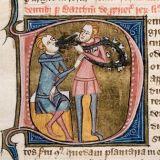
Dr Rai starts with some general information on dentistry in the middle ages.  Dental treatment would have been carried out by skilled barbers or surgeons, though monks were the dentists of the time, but they were not allowed to shed blood.

A professor of medicine and surgery at Bologna earlier in the 15th century, Giovanni de Arcoli, published guidelines of how to look after your teeth, some of which are still familiar to us, for instance that you should clean your teeth after eating, should avoid sweets or not break hard things with your teeth.  To clean your teeth you should use a thin piece of wood “somewhat broad at the ends, but not sharp-pointed or edged”.  Brushes with bristles were only introduced to Europe from China after Richard’s lifetime.

Then Dr Rai looks in more details at Richard’s teeth.  He does find indeed tooth surface loss, which might be the result of stress related bruxism, but thinks it is more likely that it was caused by dietary abrasions and erosion.  He explains that this erosion is not severe, which indicates a more affluent member of medieval society, who would have eaten food made from more finely milled flour.  This is also confirmed by the findings that the individual had eaten a diet rich in seafood – again something that would be expected of someone of a higher social status.

Three teeth were missing, which Dr Rai attributes to caries.  There are signs that the gaps where these teeth would have been have closed, indicating that they had been removed by a barber or surgeon earlier in Richard’s life.  For Mr Gray this was the result of a diet “rich in carbohydrates and sugar”.  Dr Rai, who had just explained that the teeth indicate a protein-rich diet, only mentions that caries would have been more likely in more affluent persons.

Some teeth show mineralised deposits, which probably are a build up of tartar.  As there is less of this on certain teeth than on others, it might indicate that Richard followed Giovanni de Arcoli’s guidelines on cleaning teeth, with a piece of wood, not a brush.

The left central incisor was also missing, which Dr Rai thinks could have been knocked out when Richard was killed “by some of the most advanced military weapons of the time” – not his own crown.

On the whole, Richard’s teeth give us a good idea of the dental hygiene people in those time would have used.

The difference between the information published in a daily paper, with its sensationalist interpretations, and that in a peer reviewed scientific journal is striking.  There is little doubt, which article is more reliable.

Reference:

Rai, A., ‘Richard III – the final act’, British Dental Journal, Vol.214, No.8 (27 April 2013), pp.415-417

Gray, Richard, ‘King Richard III’s teeth and jaw reveal monarch’s anxious life and violent death’, The Telegraph (1 May 2013).  Date accessed:  2 May 2013

Tags: , , ,

5
May

WHERE WILL RICHARD END UP NEXT?

   Posted by: Julia Redlich    in News

I read this in the Sunday Telegraph today:  on the television page about the American remake of House of Cards, which premieres on showcase on Tuesday.

It is a remake of the English1990 Westminster-based drama of deceit and dissemblance. In the original Ian Richardson played Francis Urqhuart, who was nicknamed FU – his character was based on Richard III in Macbeth…

I know Richard did some pretty amazing things in Scotland, but going back a few hundred years to be part of the Macbeth saga is mind-boggling.  Of course, I expect all he wanted to do was show some support for another historical character grossly maligned by Shakespeare!  Perhaps we can ask Philippa to investigate any suitable car parks near Dunsinane where Macbeth may be lying.

PS. I sent a short note to the Sunday Telegraph about Richard and Macbeth. Very short, but never miss an opportunity to say something about ‘Good King Richard’.

Note:  Sydney’s other Sunday paper, the Sun-Herald , gets it right and says that the role of FU was “based on Shakespeare’s Richard III and Macbeth”.

Tags: ,

1
May

SOME DIGNITY AND RESPECT, PLEASE!

   Posted by: Dorothea Preis    in Greyfriars Dig, News

The following are the personal views of the author and do not reflect those of the NSW branch or the Richard III Society as a whole.

A while ago, I was asked by one of our branch members, where and when Richard would be re-interred, as she would like to be there.  Probably to her great disappointment, I had to tell her that I didn’t know.  The original plan was for the reburial to take place in Leicester in May next year, however, with all the controversy and legal challenges it would be better to wait a bit, before making actual travel arrangements.

And unfortunately the situation does not look any clearer so far.  There is the so-called ‘Plantagenet Alliance’, which portrays itself as a group of Richard’s descendents.  They would like Richard’s final resting place to be in York, whereas the exhumation licence granted last August states that any human remains should be reinterred in consecrated ground closest to the place where they were found, ie. Leicester Cathedral.  Therefore they have started to challenge the legality of the exhumation licence.  This week legal papers should be lodged with the (UK) High Court, seeking permission for a judicial review of the original licence to go ahead.  However, it is not sure whether the High Court will even accept the challenge and any decision is expected to take at least several weeks.

Whether the Plantagenet Alliance will have any success seems dubious.  As far as is known, there are no direct descendents of Richard III, his legitimate son had predeceased him and his illegitimate children died without issue, which leaves descendents of his brothers and sisters.  The group apparently consists of 15 of these distant relatives.  After 500 years, this is a surprisingly low number, as the University of Leicester estimates that “many tens of thousands of individuals alive today are descended in this way”.

The legal claim of the Plantagenet Alliance is based on the fact that they were not consulted before the exhumation licence was granted – and we have to remember that at that time it seemed rather unlikely that any human remains, let alone Richard’s, would be found.  They argue the licence was in breach of Article 8 of the European Convention on Human Rights, which grants the right to respect for private and family life.  After 500 years to claim “respect of family life” seems a bit strange, after all we are not talking about a dearly beloved uncle, who used to come round for tea.  The University of Leicester refutes this saying that the obligation to consult living relatives expires after 100 years.

I tried to find out a bit more about the Plantagenet Alliance.  It is a private limited company, with a relatively new website (their archives only go back to March 2013).  They are asking for donations to help fund the day-to-day running of their affairs as well as the legal campaign.

For my part, I rather donated to the Richard III Society’s appeal for funds for a tomb for Richard, than giving money for a business to go to court.

There certainly are valid arguments in favour of a re-interment in York rather than Leicester, however, these are not furthered by challenging the legality of the original licence.  If only all concerned could stop arguing their case with increasing animosity, which, while the media might love it, is very sad and in bad taste.

The Patron of the Richard III Society, Prince Richard, Duke of Gloucester, who shares his name and title with the medieval king before his accession to the throne, has pleaded that his remains “are treated with the utmost dignity”.  I am sure that his discussion partners Dr Philip Stone, chairman of the Richard III Society, and Philippa Langley, who had pushed tirelessly for the dig to take place, share his sentiments completely.  As does the University of Leicester, who pledges to “continue to work with our partners, the Richard III Society, Leicester Cathedral and Leicester City Council to ensure an appropriate and fitting re-interment for England’s last Plantagenet monarch in Leicester.”

HRH Richard, Duke of Gloucester, also attended a lunch with the Richard III Society, whose patron he has been for more than 30 years, at the Tower of London recently.

References:

Kate Liptrot, ‘Richard III legal fight to start next week’, The Press (27 April 2013).

University of Leicester Press Office, ‘Plantagenet Alliance seeks judicial review – statement from University of Leicester’ (26 March 2013)

Duke Of Gloucester Meets With Richard III Society Over King’s ‘Dignity’’, Royal Central (2 March 2013).

Duke Of Gloucester Attends Richard III Society Dinner At Tower Of London’, Royal Central (30 April 2013)

Tags: , , , ,

28
Apr

RIDING FOR KING RICHARD III

   Posted by: Dorothea Preis    in News

Prior to the Battle of Bosworth, Richard III spent the night in Leicester and then rode – on his horse – to the site of the battle.  Swap Richard’s horse for a bike and you can follow in Richard’s footsteps – though probably with a less drastic outcome – and take part in a bike ride, which will be the start of this year’s Sky Ride events.

The Church of St James, Sutton Cheney (photograph by D Preis)

Planned is a 35-mile (approx. 56km) round-trip starting off at Leicester Town Hall Bike Park.  The tour will pass the car park, where Richard’s remains were discovered, then on to St James’ Church in Sutton Cheney, where Richard is said to have attended his last Mass, before dying in battle, and the battlefield itself.   Then riders will return to Leicester, where the ride finishes at the Guildhall, where the Richard III exhibition is being shown.

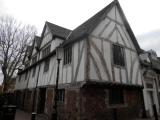
The Guildhall in Leicester (photograph by D Preis)

The ride is classified as ‘Challenging’, but suitable for anyone, though I expect you would have to be reasonably fit and experienced.  The trip is scheduled for 4 May, participation is free.  It starts at 9h00 and is expected to take 4 hours 20 mins (3 hours 20 mins cycling), so you can expect to be back in Leicester by about half past one in the afternoon.

More information:

Tom Mack, ‘Sky Ride event to trace Richard III’s last days‘, This is Leicestershire (25 April 2013).

The Richard III Ride‘ on the Sky Ride website.

Tags: , ,

20
Apr

THE LEICESTER CONFERENCE IS ON YOUTUBE!

   Posted by: Dorothea Preis    in Greyfriars Dig, News

Once again “Thank you” to my friend Renate, who found this!

The various talks from the Greyfriars Dig Conference, which took place in Leicester on 2 March this year, are now available on YouTube.  While you will not be able to experience quite the same atmosphere as the audience did, they are a great way to catch up with – or revisit – the information.

And a very big “Thank you” to the Richard III Society as well, for making this available to us!

You can find the YouTube clipes here.

Tags: , , ,

15
Apr

RICHARD III AT THE GENESIAN THEATRE

   Posted by: Dorothea Preis    in News

Last Sunday, I had the pleasure to attend a performance of Shakespeare’s Richard III at the Genesian Theatre in Sydney.  A friend of mine, who has a subscription to this theatre, knew of a spare ticket and immediately thought of me and my interest in Richard III.

The Genisian Theatre is a non-professional group, named after the patron saint of actors, St Genesius, and is operating from a historic church.  The term ‘non-professional’ might be a bit misleading as the programme tells us that for example  Baz Luhrmann, Bryan Brown and John Bell are alumni of this theatre.

This production was directed by Gary Dooley, who had lately been working in Northampton in the UK.  Another example of  the serendipity we have seen in the whole project of finding Richard’s remains:  he was offered the position at the same time as Richard’s remains were found in Leicester.

At the general meeting of the NSW Branch the day before I saw this Richard III, our speakers had talked about ‘Richard III in movies’, which had been serendipitous as well, as it allowed me comparisons.  Like the McKellan film version, this production was set in a 1940s England.  You can find a short YouTube clip of Gary Dooley talking about his production here.

The title character was played by Roger Gimblett, who dominated the stage, both physically – he was easily the tallest and most strongly built actor in the cast – as well in his performance.  He had all the attributes of Shakespeare’s baddie:  a substantial hump, one arm immobile and in a sling, and limping around the stage.  Of course, we now know that the real Richard was completely different, as well as younger.  And somehow I could not keep recent events out of my thoughts:  when Richard says in the evening before the Battle of Bosworth “Up with my tent.  Here I will lie tonight, but where tomorrow?”  (Act 5.3), I wanted to shout “Under a carpark!”

Another mentionable performance was that of Dominic McDonald, whose Buckingham was wonderfully flamboyant, complete with a cigarette nearly constantly in his fingers (which interestingly never seemed to get any shorter).

Surprisingly, the princes were played by actors with the upper half of life-size dolls strapped to their bodies.  I have to admit that I found this difficult to explain.  Possibly it was to symbolise that they are not individual characters, but just objectified obstacles in Richard’s way to the throne.

It might have been my Ricardian bias, but after all the killing and general deviousness Richard had displayed throughout, I could not help but feel sorry for him during his sleepless night before the Battle of Bosworth with a bottle of red wine and ghosts haunting him.

On the other hand Richmond (Patrick Magee) appears as the superstar, giving his rousing speech on a radio.  However, his speeches seemed not to reflect his true feelings, while his finishing speech in spite of all its conciliatory words – rather like Richard’s earlier speech to the Mayor and Citizens (Act 3.7) – appeared like spin and even had a certain menacing aura about it, as if there was really very little difference between the two.  Or was this just a bit of wishful thinking on my part?

As this is a relatively small theatre, many actors played two or more roles.  It was probably historically quite appropriate to have Patrick Magee play both Richmond and the Bishop of Ely, John Morton.  Earlier in the play, he had also played Dorset and it was amazing how different he was in each role.  Dorset was a lanky youth, Ely a churchman of some standing and Richmond the superstar.

Several of our branch members had attended an earlier performance on 10 March, which was followed by a panel discussion featuring the director, Gary Dooley,  the actor playing Richard (Roger Gimblett) and our branch secretary Julia speaking on behalf of the historical Richard.

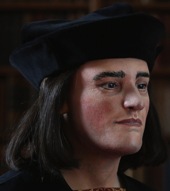
The Genesian Theatre is well aware of the difference between the stage and the historical character.  Gary states in the programme that the play “was never intended to be a history lesson.  If you want to find out about the historical character, read a history book” – or you could give the Richard III Society a try!  In the foyer there is also an information board with information on the historical Richard, with a picture of the facial reconstruction.

A big thank you to Elaine for inviting to this memorable experience!

Tags: ,

14
Apr

Review of 13 April 2013 Richard III Society Meeting

   Posted by: Leslie McCawley    in Meetings, News, NSW Branch News

The NSW Branch of the Richard III Society met on 13 April 2013 at the Harry Jensen Centre in The Rocks, Sydney. Our Branch Chairperson Judith welcomed all the regulars, members from overseas, and a number of visitors, whose interest had been aroused by the recent discovery of the remains of Richard III in the Leicester carpark.

The Committee has been busy since the last meeting with Judith and Dorothea speaking to the Military Historical Society at Victoria Barracks, and Judith and Julia to students at Chifley College who were studying Richard III for their HSC. Julia was a member of a panel discussing the Genesian Theatre’s approach to Richard III in their current production. In addition, of course, the Committee has been finalizing the extensive arrangements for the July conference, with some last minute changes.

Julia presented the Secretary’s report and reminded us that although it is past the official deadline that it is not too late to get our registrations in for the upcoming conference in Sydney on the weekend of 12-14 July 2013. It is going to be a great weekend of learning and social activities with Ricardians, and not to be missed.

Julia also explained that because of full programs for the rest of the year no Scrabble Speakers will be needed. That means that all of our eager public speakers will just have to wait their opportunity next year!

The Minutes from the February 2013 meeting were taken as read. There was no Treasurer’s report as the Treasurer was away. Dorothea presented the Webmaster report. This branch website continues to receive many visitors. Dorothea has also extended the Branch online presence to Facebook, so everyone who has access to the internet should visit and “like” it! It can be found at http://www.facebook.com/pages/NSW-Branch-of-the-Richard-III-Society/269971479692592

Lynne announced the arrival of the new pewter boar pins for those who had pre-ordered them. More may be obtained in the future if there is a demand from members.

An extra feature today was Dorothea reporting on her recent trip to the University of Leicester conference entitled “The Greyfriars dig: a new Richard III”. Dorothea had previously posted elements of her presentation on the branch website for online visitors to read.

The Guest Speakers were Yvette Debergue and Rachel Allerton from the University of Sydney Centre for Continuing Education and the WEA, where they teach medieval courses. Yvette recently completed her PhD at the University of Sydney on the area of Gender and Medieval Heresy. She has taught at the University of Sydney’s Centre for Medieval Studies as well as the Departments of History and Religion; her area of expertise being Heresy in the Middle Ages. For more information on upcoming her courses visit http://cce.sydney.edu.au/course/HAWI Their interesting presentation was on the different interpretations of Richard’s physical presence and character in several film versions of Shakespeare’s Richard III. They referred particularly to those featuring Lawrence Olivier, Ron Cook and Ian McKellen. Sadly the technology was not completely cooperative, so I have attached some of the YouTube clips from their presentation:

Olivier’s version of the soliloquy.

The BBC’s version with Ron Cook as Richard.

Horrible Histories Richard III Song.

The next meeting will be on Saturday, 8 June 2013, and the speaker will be Ben Cross on Medieval Thought and Philosophy.

Tags: , , ,