Posts Tagged ‘Richard III’

11
Apr

GUEST POST BY HELEN COX

   Posted by: Helen Cox    in News

Helen Cox, author of two excellent books on the Battle of Wakefield, here shares with us some thoughts about Richard III.  We are very grateful to Helen for making this article, which was first published on her website Herstory Writing & Interpretation, available to us.

In Life and Death: Richard III

Events in Leicester last summer have pulled King Richard III from the obscurity of a lost grave and transformed him into the most intimately known of all English monarchs. The forensic archaeological analysis of his skeleton has revealed a grain of truth in the Shakespearean caricature, but he was not ‘hump-backed’ (afflicted by kyphosis) – he was a ‘crook-back’, suffering from severe scoliosis (abnormal lateral curvature of the spine). The degree of normal bone development shows that this was not a congenital defect but began in adolescence, from an as-yet unknown cause (as with 80% of modern cases). So Richard should have enjoyed a normal, active boyhood, and presumably began the customary martial-arts training several years before the onset of his condition. Presumably, too, he continued to practice skill-at-arms despite the back-ache and strain on his heart and lungs imposed by the scoliosis, since at the age of 19 he is recorded as having fought at the Battles of Barnet and Tewkesbury. He then continued a hawkish career in Edward IV’s war-camp, opposing the 1475 Treaty of Picquigny, campaigning in the northern borders, and in 1482, recovering Berwick after mounting a full-scale invasion of Scotland – military achievements remarkable for one of such slender build and with the extreme curvature of his spine in adulthood:

© University of Leicester

However, it is worth noting that the condition appears far more dramatic in the skeleton than it does in the living body, as photographs of modern sufferers show; and based on contemporary images, Richard’s scoliosis seems to have manifested as one shoulder slightly higher than the other. He may also have had an uneven waist and a twist to the torso, barely noticeable when he was fully dressed. Interestingly, modern medical advice is for scoliosis sufferers to remain as active as possible – so in pursuing a military career, he was in fact doing the best thing for his condition. I wonder if he also wore a back-brace, as doctors today advise in some cases?

Aside from this, Richard had no physical abnormalities (contrary to the ‘withered arm’ story related by Sir Thomas More, and the famous ‘Broken Sword’ portrait painted after his death, showing him with deformed fingers). Without scoliosis, he would have stood approximately 5’ 8” (1.73m) tall, an average height compared with the Towton skeletons, but the spinal bend would have reduced his stature somewhat. (Nonetheless, he was still ‘three fingers taller’ than Nicolas von Poppelau, a German knight who met and described him in 1484).

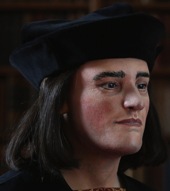
We also know that his teeth, apart from the loss of a few molars, were in good condition and not excessively worn, (consistent with eating well-refined flour); and that he enjoyed a high-status diet rich in animal protein, especially fish – indicating a devout adherence to religious fast-days, and/or a liking for seafood! And the facial reconstruction based on his skull shows that his portraits were accurate: Richard in life was a personable, square-jawed man with a determined nose and chin, dark brown wavy hair, and dark blue-grey eyes.

His skeleton also tells the full, gruesome story of his death and posthumous fate, again with close correspondence to the historical record. Having launched a cavalry charge in an effort to reach and kill Henry Tudor, Richard somehow became unhorsed, possibly because his mount stumbled in marshy ground. The jolt may have flung off his helmet, or it may have been knocked off by a blow that broke the chin-strap, because the concentration of wounds to his skull shows that he must have been un-helmed as he continued to fight on foot, hacking desperately through Tudor’s bodyguard. He received two relatively superficial cuts to his face, one on the right jaw and one on the right cheek, possibly inflicted by a dagger and consistent with close-quarters engagement; then a series of catastrophic head wounds suggesting that he was soon surrounded and overwhelmed (see illustration below).

The first of these probably came from a swordsman on his left, aiming to cleave his head apart with a downward sweeping action. Richard may have seen it coming and tried to side-step or turn away, but the sword caught him a glancing blow on the left-hand side back of the head, shaving away a disc of scalp and the outer layer of skull to expose the porous bone underneath. An injury of such stunning force may well have driven him to his knees, because another assailant was able to strike the top centre of his head, using a square-section weapon consistent with a rondel dagger or war-hammer beak; this penetrated his skull, driving two flaps of bone into the upper surface of the brain. In all likelihood this rendered Richard unconscious so that he slumped forward, exposing the back of his head. Two opponents then stepped in to deliver the coup de grâce; one of them may have been the swordsman who had inflicted the ‘shaving’ wound, and now thrust in his blade from the left with such force that it penetrated all the way through the brain and made a mark on the inner table of the skull. The second assailant, probably armed with a heavy weapon like a poll-axe or halberd, struck from the right, cleaving off a massive slice of bone and cutting into the cerebellum; either of these wounds would have been instantly fatal. A bloody end, indeed – although it could have been over mercifully quickly, with Richard aware of very little after the first major blow.

© University of Leicester: Micro-computed X-ray tomography image showing the fatal sword wound (B) and halberd slice (C) either side of the area (A) where the cervical spine meets the skull.

Richard’s corpse was then stripped, and at least two more injuries inflicted post-mortem: a dagger cut to a right rib and a sword cut to the pelvis, the latter consistent with a stab to the buttock while his body was slung face-down over the horse that carried him back to Leicester. Judging from the position of his hands in the grave they appear to have been bound, (perhaps in order to drag his corpse from the field), and were not later untied; but if his body suffered other wounds and indignities, (as it may well have done, pre- or post-mortem), they have left no trace on his bones.

The last Plantagenet king was then hastily buried by the monks of Grey Friars, without a coffin and in a grave not long enough to accommodate his corpse at full stretch; but since he had lain exposed for three days in late August, covered in blood and open wounds, their haste is perhaps understandable – it must have been a stomach-churning task.And thus Richard III lay undisturbed for 527 years, in a grave lost until August 2012; the rest, as they say, is history.

© Helen Cox
March 2013

Tags: ,

10
Apr

LOOKING FORWARD TO SUMERFORD’S AUTUMN

   Posted by: Julia Redlich    in Bookworm

I just received the advance notice of Simon & Schuster’s June releases.  Almost top of the list is:
Sumerford’s Autumn, by Barbara Gaskell.

Described as:  “Four sons, and four very different personalities, children of the Sumerford Castle and estates, and their father the earl watches their varied interests with misgiving.”

Barbara is a valued member of our branch and we are very happy that her enjoyable books will finally be available in print format, making them accessible to a much wider audience than her self-published ebooks.

You can find Dorothea’s review here.

(Please note, the above was the cover design of the ebook,  The cover of the print book has not been published yet.)

Tags: , , , ,

10
Apr

SKULL-DUG-GERY IN LEICESTERSHIRE

   Posted by: Dorothea Preis    in News

Should you be in Leicester this coming weekend, possibly for the entertainment on 14 April 2013, you might feel the need for some refreshment.  A brewery in Old Dalby, approx. 25 km northeast of Leicester, has introduced a new beer to commemorate the dig for Richard III’s skeleton, which might just hit the spot.

Belvoir Brewery creates a special beer every month and their creation for March/April is called ‘Skull-dug-gery’.  It is described as “a golden amber light, crisp and fruity beer” with a strength of 4%.  The beer had its premiere on 19 March, but was made for the Leicester Beer Festival.  20-23 March, it will be available until the end of April.  One of the co-owners of Belvoir Brewery said: “The beer is our light-hearted way of remembering King Richard III.”  Well, if you have enough of it, you will certainly get light-hearted.

It seems you will now have to go to the brewery to be able to drink it, they do have a restaurant though.  I would have thought it might be the perfect accompaniment to the Wild Boar & Chorizo Burger at O’Neills in Leicester (which I can only recommend) to stay with the Ricardian theme.

Cheers!

More info:  ‘New beer inspired by the discovery of king’s skeleton‘, Melton Times (10 April 2013)

Tags: , ,

5
Apr

MUSIC FOR A KING

   Posted by: Dorothea Preis    in News

Again something for those of us who can be in Leicester this month.  Should your feet be tired after having spent the day  battling for the crown, you an afternoon with medieval music might just be the perfect end to a Ricardian day. Historical entertainment company Blast From The Past are bringing a concert of medieval music in honour of Richard III under the heading ‘Music for a King’.

More information here (you have to scroll down a bit).

Tags: , ,

4
Apr

A BATTLE FOR THE CROWN IN LEICESTER

   Posted by: Dorothea Preis    in News

Should you find yourself in Leicester later this month and at a loss of what to do after having finished the Richard III Trail and all its sights, there is a full day of Richard III-themed events to look forward to.

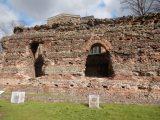
Jewry Wall in Leicester (photograph by D Preis)

When in Leicester, I can only recommend a visit to the Jewry Wall Museum, especially for the beautiful Roman mosaics.  However, on 14 April 2013 in addition to its usual interesting displays, it will also be the setting for a “day of events and activities based around the life and times of King Richard III” under the title ‘Battle for the Crown’.

There will be demonstrations of 15th century warfare and weaponry, dramatic readings from Shakespeare and an exhibition about the Greyfrairs Dig (I am not sure whether this is in addition to the one at the Guildhall).  At 14h00 Michael Morris will be talking about finding Richard’s remains.

According to local legend Richard III stayed the night before moving out to Bosworth at the White Boar Inn, which led the organizers to recreate what his final meal at the Inn might have been like.

We just hope for everyone concerned, organizers and visitors alike, that the weather will be also be in the mood for a party!

You can find more information here.

Tags: ,

Being at the other end of the world has its problems.  We sometimes hear about talks and presentations given in the UK, when we would just love to jump on the next plane to be able to be there and money and time were of no concern.

This is the case when Dr John Ashdown-Hill will present the ‘ 2013 Dudley White Local History Lecture’ at the University of Essex in Colchester on Wednesday 8 May 2013 under the title ‘The Search for Richard III and his Cousin John Howard, Duke of Norfolk’.  Both Richard III and John Howard were killed in the Battle of Bosworth and John is looking at the question what “what was done with their bodies – and where are they now?”

John Ashdown-Hill is the obvious choice for a talk like this.  His research was instrumental in finding Richard’s remains under the now famous car park in the former Greyfriars church in Leicester.  He had demonstrated that the story that Richard’s bones were dug up at the Dissolution of the Monasteries was a later legend, not supported by contemporary evidence.    His success in finding a direct line female descendant of Richard’s sister Anne was what clinched the DNA evidence on the remains.  His research and much more was outlined in his 2010 book The Last Days of Richard III (new edition The Last Days of Richard III and the Fate of his DNA: the Book that Inspired the Dig including information from actually finding Richard’s remains was published earlier this year).  He was leader of genealogical research and historical adviser to the ‘Looking for Richard’ project.

John Ashdown-Hill also has had a long interest in John Howard, duke of Norfolk, resulting in his 2009 book Beloved Cousyn’: John Howard and the House of York.  It explains that John Howard was at first temporarily interred in Leicester, before his family had him buried at Thetford Priory, Norfolk.  However, also in his case the Dissolution of the Monasteries caused a problem.  While it has now been confirmed that Richard’s remains were simply left where they were in the ruins of the former church, it is not clear what happened to John Howard’s remains.  They might have been removed to Framlingham Church along with those of other family members, where an account of an examination of various remains in 1841 offers tantalizing possibilities.  It should be fascinating to hear John talk about these possibilities.

Again, we heard about this event came via the Ricardian grapevine.  According to information received admission is free, but you will need to book your tickets in advance via the Lakeside Theatre website (though at this stage I could not find a link to it).

Note: You can find reviews of The Last Days of Richard III and Beloved Cousyn’: John Howard and the House of York on the ‘Book Shelf’ of this page.

Tags: , ,

29
Mar

RICHARD III (OR ALMOST)

   Posted by: Christopher Puplick    in News

Fellow Ricardians may find a new play by Timothy Daly, Richard III (or Almost), of interest.  A special invitation for members of the Richard III Society is attached (Richard III Society Invite final_final24 3 13).

Timothy is one of Australia’s most successful playwrights (with more of his work done overseas than any other contemporary Australian playwright). This piece was originally performed in France and recently was one of only two Australian pieces at the world famous Avignon festival.

I’ve no doubt it’ll be a great evening in the theatre which our friends would enjoy.

Tags: , ,

22
Mar

A WALKING TOUR OF RICHARD III’S LEICESTER

   Posted by: Dorothea Preis    in Greyfriars Dig, News

For all who cannot get to Leicester to do the Richard III Trail in person, here is a short video that follows the trail.  Even if you have walked around Leicester, it offers inside views of the castle and Wygston Hall, both of which are infrequently open to visitors.

Please note, the video was recorded after the find of the remains, but before they were confirmed to be Richard’s.

http://www2.le.ac.uk/news/blog/2013/march/richard-iiis-leicester-a-walking-tour

Tags: , , , ,

17
Mar

BY FOOT OR BY TRAIN, RICHARD III IS EVERYWHERE

   Posted by: Dorothea Preis    in News

Obviously our friends in the UK have much more opportunities to participate in activities with a Ricardian connection.  Should you be over in Britain on 19 April 2013, you might like to participate in A Royal Banquet with King Richard III.

This is organised by Great Central Railway, you will be travelling in a luxurious Pullman Dining Train, pulled by a steam engine, which has been renamed “King Richard III” (it used to be “King Edward II”).  The train starts in Loughborough for its 16 mile (approx. 26 km) round trip to Leicester, during which you can enjoy a banquet with five removes (courses).

If walking is more your thing, why not consider taking part in a “walk and talk through the history of Grafton Regis”?  The walk, scheduled for four different dates, promises the opportunity to “meet many of the historical figures who lived here, ranging from kings and queens to commoners and from medieval times to the present” and also includes tea and cake afterwards.

More information:

Great Central Railway:  http://www.gcrailway.co.uk/2013/03/king-richard-iii-pullman-train-an-evening-fit-for-a-king/

Grafton Regis:  http://www.grafton-regis.co.uk/Documents/What%27s%20On.html

Tags:

15
Mar

RICHARD III: LEICESTER’S SEARCH FOR A KING

   Posted by: Dorothea Preis    in Greyfriars Dig, News

During my recent stay in Leicester, one of the must-see spots was the exhibition in the Guildhall dedicated to the Greyfriars Dig under the heading ‘Richard III:  Leicester’s Search for a King’.

We went as part of the ‘Richard III Walking Trail’, a plan for which can be obtained from the Visit Leicester Centre.  The trail takes the visitor around eight places, which have connections with Richard III, starting from the site of the Blue Boar Inn and ending with the Guildhall.  Unfortunately, but understandably, No.6 of the tour, the actual Greyfriars site, was not accessible.

We got to the Guildhall later in the afternoon and the queue was not too daunting.  I just turned my back to take another photograph of the Cathedral and we were nearly in.  The real queuing only started inside to see the various displays.

The exhibition details the various aspects of the archaeological research.  Having read extensively about the dig, it did not offer many new insights, but it was nice to see it all ‘face-to-face’.   It also includes 3D prints of Richard’s skull, showing the horrific injuries he suffered, and of the Blue Boar Inn.  Also on display were medieval masonry and bits of tiles found during the dig.

For the general public, who would probably not have been that interested in the dig while it happened, and only heard about it in passing, the exhibition offers a very good insight into the various disciplines which were involved in finding and identifying Richard.

All in all I found the exhibition interesting and well-designed.

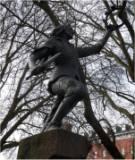
(Photograph of Richard III statue in Castle Gardens, Leicester, by D Preis)

Tags: , ,