23
Jan

Meeting of Richard’s only Parliament

   Posted by: Dorothea Preis   in Events in History

Meeting of Richard's only Parliament

Westminster Hall in the early 19th century

Meeting of Richard’s only Parliament

The meeting of Richard III’s only parliament at Westminster in the presence of the King began on 23 January 1484.  It had been summoned on 9 December 1483 and would be dissolved on 20 February 1484.

Attending were 37 Lords and 10 Judges (including the Attorney General) as well as 296 members of the Commons. It was opened by a speech from Chancellor Russel.  This parliament ratified Richard’s title by Titulus Regius.  The rebels from the October 1483 rebellion were attainted.

Of interest are the 15 public statutes of this parliament, which included ending benevolences, protecting land purchase rights, reforming the justice system, preventing commercial dishonesty in the cloth trade, protecting English merchants, and preventing fraudulent collection practices.  However, while trying to limit the activities of foreign merchants in England, the statutes included a proviso, exempting all merchants and craftsmen concerned in the book trade from the scope of the Act.

Richard’s Chancellor of the Exchequer, William Catesby was chosen to be the speaker of the Commons; and the receiver of petitions was Thomas Barowe, who had been in Richard’s service since at least 1471, who was also Master of the Rolls.

References:

Christopher Puplick, ‘He Contents the People Wherever He Goes:  Richard III, his parliament and government’The Chronicles of the White Rose:  Journal of the New South Wales Branch of the Richard III Society, Vol.2 (2008/09), pp.14-32 (last accessed online 2 Jan. 2020)

Anne Sutton, ‘Richards III’s Parliament’, Richard III Society.  URL:  http://www.richardiii.net/2_3_0_riii_leadership.php#parliament (last accessed 2 Jan. 2020)

Susan L. Troxell, ‘The Tenth Coin: Richard III’s Parliament and Public Statutes’, Ricardian Register, Vol.44, No.4 (December 2013), pp.8-16 (last accessed online 2 Jan. 2020)

Dorothea Preis


Tags: ,

Marriage of Richard of Shrewsbury and Anne Mowbray

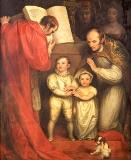
Marriage of Richard of Shrewsbury and Anne Mowbray, by James Northcote

Marriage of Richard of Shrewsbury and Anne Mowbray

On 15 January 1478, Edward IV’s younger son Richard of Shrewsbury was married to Anne Mowbray, the only child of John de Mowbray, 4th Duke of Norfolk (died 17 January 1476) and Elizabeth Talbot (sister of Eleanor Talbot).  The wedding took place in St. Stephen’s Chapel, Westminster.  The bride was 5 years old, the groom 4.  She died on 19 November 1481. Her heirs would normally have been her cousins William, Viscount Berkeley, and John, Lord Howard, but by an act of Parliament in January 1483 the rights were given to her husband Richard, with reversion to his descendants, and, failing that, to the descendants of his father Edward IV.

Tags: , ,

6
Jan

Marriage of Henry VIII and Anne of Cleves

   Posted by: Dorothea Preis   in Events in History

Marriage of Henry VIII and Anne of Cleves

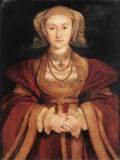
Anne of Cleves by Hans Holbein the Younger

Marriage of Henry VIII and Anne of Cleves

On 6 January 1540, Henry VIII married Anna von Jülich-Kleve-Berg.

Certainly not one of the happiest marriages in history and it was over in six months time.  Henry – of course – blamed Anne entirely as being too unattractive.  Though I doubt that by that stage she found him very attractive either.  However, she managed to come out of the divorce fairly well provided and with the title of the “King’s Sister”.

My interest in Anne was re-kindled after reading Mavis Cheek’s Amenable Women (this review was also published in the Ricardian Bulletin, June 2010, pp. 28-29).

More information:

Antonia Fraser, The Six Wives of Henry VIII.  Phoenix Paperback, UK, 2003.  ISBN 978-1-8421-2633-2 (pbk)

Elizabeth Norton, Anne of Cleves:  Henry VIII’s Discarded Bride.   Amberley Publishing, UK, 2009.  ISBN 978-1-84868-329-7

Mary Saaler, Anne of Cleves:  Fourth Wife of Henry VIII.  The Rubicon Press, UK, 1995.  ISBN 0-948695-41-2

Retha M. Warnicke, The Marrying of Anne of Cleves:  Royal protocol in early modern England.  Cambridge University Press, UK,  2000.  ISBN 0-521-77037-8

Online:

Retha M. Warnicke, ‘Anne [Anne of Cleves] (1515–1557)’, Oxford Dictionary of National Biography, Oxford University Press, 2004 [last accessed online 2 Jan. 2020]

Various articles on The Anne Boleyn Files, URL:  http://www.theanneboleynfiles.com/

Fiction:

Margaret Campbell Barnes, My Lady of Cleves.  (Originally published in 1946, but there are various later editions)

Mavis Cheek, Amenable Women.  Faber and Faber, UK, 2008.  ISBN 978-0-571-23953-5

Dorothea Preis


Tags: ,

5
Jan

Death of Charles the Bold

   Posted by: Michael   in Events in History

Death of Charles the Bold

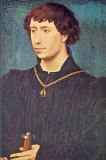
Charles the Bold, by Rogier van der Weyden

Death of Charles the Bold

On 5 January 1477, Charles the Bold of Burgundy died at a battle while laying siege to Nancy in Lorraine.  His heiress was his daughter Mary from his second marriage to Isabella of Bourbon.  After her death in 1465, he married on 3 July 1468  Margaret of York, sister of Edward IV and Richard III. Margaret would after his death become Mary’s most constant advisor.

More on Charles the Bold on Encyclopaedia Britannica.

Tags: ,

3
Jan

Marriage of Margaret Beaufort and Henry Stafford

   Posted by: Dorothea Preis   in Events in History

Marriage of Margaret Beaufort and Henry Stafford

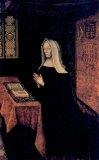
Margaret Beaufort

Marriage of Margaret Beaufort and Henry Stafford

On 3 January 1462, Margaret Beaufort married Henry Stafford, son of Humphrey, duke of Buckingham.

She had been married as a child to John de la Pole, though the marriage was soon dissolved.

She married in 1455 Edmund Tudor, but he died on 1 November 1456 from the plague.  She gave birth to Edmund’s son Henry on 28 January 1457, who would later defeat King Richard III at the battle of Bosworth and take the crown as Henry VII.

Margaret had no further children.  However, her marriage to Henry Stafford seems to have been happy.  He died on 4 October 1471.

In June 1472 she married Thomas Stanley, surviving him for five years until her own death on 29 June 1509, just two months after her son had died.

Reference:

Michael K. Jones and Malcolm G. Underwood, ‘Beaufort, Margaret , countess of Richmond and Derby (1443–1509)’, Oxford Dictionary of National Biography, Oxford University Press, 2004 [last accessed online 2 Jan 2020]

Michael Jones, ‘Lady Margaret Beaufort’, History Today, Volume 35, Issue 8 (August 1985).  URL: http://www.historytoday.com/michael-jones/lady-margaret-beaufort  [last accessed 2 Jan. 2020]

Dorothea Preis


Tags: , ,

3
Jan

Death of Catherine of Valois

   Posted by: Michael   in Events in History

Death of Catherine of Valois

Marriage of Henry V and Catherine of Valois

Death of Catherine of Valois

On 3 January 1437, Catherine of Valois, mother of Henry VI, and grandmother of Henry Tudor, died in London.  She was buried at Westminster Abbey.

More information on Catherine of Valois here.

Tags:

1
Jan

Death of George and Isabel’s Son

   Posted by: Michael   in Events in History

Death of George and Isabel's son

George of Clarence and Isabel Neville (stained glass at Cardiff Castle, © Wolfgang Sauber)

Death of George and Isabel’s Son

On 1 January 1477, Richard, the infant son of George, duke of Clarence, and Isabel Neville, died.  He was born on 6 October 1476.  His mother had died on 22 December 1476, two and a half months after his birth.

For more information on the marriage of George and Isabel you may wish to read Karen Clark’s blog.

Tags: ,

14
Jan

Death of Anne of York

   Posted by: Judy Howard   in Events in History

Death of Anne of York

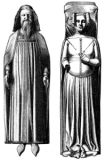
Anne of York and Thomas St Leger (Brass at St George’s Chapel, Windsor)

Death of Anne of York

On 14 January 1476, Anne of York, duchess of Exeter, died soon after childbirth .  She was born on 10 August 1439, the second child and eldest surviving daughter of Richard Plantagenet, 3rd Duke of York and Cecily Neville, and a sister of Edward IV and Richard III.

She was first married to Henry Holland, 2nd duke of Exeter, in January 1446, they were divorced on 12 November 1472.

She later married Thomas St Leger and they had a daughter, also Anne. Michael Ibsen, whose DNA was used to determine whether the remains found in Leicester in 2012 were those of Richard III, is descended in an all-female-line from this daughter Anne.

Reference:  Michael Hicks, ‘Holland, Henry, second duke of Exeter (1430–1475)’, Oxford Dictionary of National Biography, Oxford University Press, 2004.  (accessed online:  27 December 2014)

Tags:

26
Mar

Reinterment of King Richard III

   Posted by: Dorothea Preis   in Events in History

King Richard III’s remains were reinterred in Leicester Cathedral in a dignified and moving service on 26 March 2015.  The service was conducted in the presence of the Most Revd Justin Welby, Archbishop of Canterbury.

The order of the service was designed in cooperation with Dr Alexandra Buckle.  Dr Buckle had found a manuscript, which contains details of a medieval service for the reburial of the human remains of a noble person.  She was researching Richard Beauchamp, Earl of Warwick, who was reburied in Richard’s presence in 1475. This document served as a basis for Richard III’s reinterment service.

During the service, Richard was also reunited with his Book of Hours, about which I had written on another site, though before Richard’s reinterment.

Reinterment of King Richard III

Richard III’s tomb


On the following day, 27 March, Richard III’s tomb was revealed during a service.  Together with several friends, I had in the opportunity on that Friday afternoon, to see the tomb in all its glory.  For me, the floor tiles with inlaid Yorkist roses were a nice touch.

Reinterment of King Richard III

Floor tiles with Yorkist roses

Together with many, many other Ricardians, I was able to spend the Reinterment Week in Leicester, a profound and exhilarating experience.  The week started for me by watching the cortege passing at Jubilee Square.  On Monday, 23 March, Memorial Service for members of the Richard III Society was held in Leicester Cathedral. I had been lucky in the ballot and received an invitation to this beautiful service. From where I was seated my view of the proceedings was obscured, but I had a clear view of the reason for the service, the coffin of Richard III. It was covered with a beautifully embroidered pall, on the one side displaying figures from the 15th century and on the other side figures involved in the 21st-century discovery of the King’s remains.

The Choir sang In Memoriam: Ricardus Rex by Graham Keitch.  Many of us remember this from the 2013 Australasian Convention in Sydney, where we were able to play it by permission of the composer. There can be no doubt though that to listen to it in a church sung by an outstanding choir beats a recording played over a loudspeaker system.

We all would have liked to attend the actual reinterment service in the Cathedral, but space did not allow that.  However, along with several of our branch members from NSW, I was able to watch the service on TV live at our hotel in Leicester.  The most memorable part for me was a natural phenomenon:  It was an overcast grey and drizzly morning, but at the exact moment, when Richard’s coffin was lowered into the ground, the sun broke through. His troubled afterlife had finally come to rest.

It should also be mentioned that the NSW Branch of the Richard III Society made a donation to Leicester Cathedral to help cover the costs of the reinterment.  This was received by Revd Peter Hobson with thanks to all members of the NSW Branch in the name of Leicester Cathedral.

Tags: , , , ,

18
Aug

What we admire most about Richard III

   Posted by: Kevin Herbert   in NSW Branch News

Richard III NSW Branch NewsOur last branch meeting took a completely different format.  Instead of all facing and listening to a speaker, we sat around a table and discussed what we admire most about Richard.

Jan, one of the longest serving members of our branch,  began by reminiscing about the origins of the NSW Branch of The Richard III Society.   Apparently in the 1970s a handful of Ricardians met in someone’s home, but as they became more numerous they ventured to a restaurant to share a meal together instead.  As the membership grew so, too, did the need to become more structured and meet in more formal surroundings, which got us to where we are today.

Our discussion showed that we all admire Richard for his loyalty to his friends and family, for his caring nature and thoughtfulness for the people as expressed by Richard’s innovative laws and justice.  Several members remarked that he worked to better the lives of ordinary people, citing several examples, among them especially the exemption of books and printing from taxation to foster learning.  This led to the idea to include a section on Richard’s achievements on our website, but we have to ensure only to include those reforms and innovations which can be easily proved.

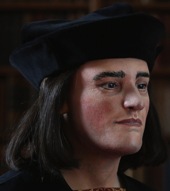
Richard III

Illustration:  © Andrew Jamieson, www.andrewstewartjamieson.co.uk

More individual experiences were also aired.  Kevin was especially impressed by the closeness which seemed to exist between John Neville and Richard, whose mottos, respectively, were:  Loyalty, Honour and Love (John Neville) and Loyalty Binds Me (Richard). Judith commented on what a joy it was to discover medieval history after she had been immersed in Victorian matters previously.  This joy was shared by Win who also spoke of the joy of learning to appreciate medieval history.

Carol shared a special experience with us by thanking Richard and his family for one of her happiest memories in England when she and her husband went to Fotheringhay and enjoyed a perfect day there with a picnic.

She commented on the fact and that his achievements in such a short time were incredible in comparison with other monarchs who reigned for much longer and did comparatively little in the first few years of their reign.

New members Leslie and Doug remarked on how noble a person Richard seemed to be and how wonderful it was to meet up with a group who shared their passion for this great and underrated man.

Everyone felt this discussion was a very worthwhile exercise.  And we were all grateful to him for making his times so interesting to us all – and for bringing us together.

Tags: ,