Recently Denise Rawling was lucky enough to spend a few days visiting Leicester and the Bosworth area and thought it was worth recording a few of her thoughts and observations, especially about the new King Richard III Centre in Leicester.
Bosworth Battlefield
We went out first to the Bosworth Battlefield Heritage Centre. This attractive site, run by the Council, is built around an old farm on Ambion Hill where tradition indicated the battle had been fought. Archaeological work in 2009 now pinpoints an area around three miles (5,000m) from here, although it is thought that the Yorkist forces may have camped around here with at least some sentries posted on the hill.
There was a medieval village in the area, and a well has been preserved with an inscription by a Victorian admirer. The Council have established a trail between the centre and the battlefield which is on private land. The Centre has good facilities and parking is easy. We ate at the excellent up-to- date and atmospheric cafe that incorporates a wonderful donation to the Centre: a heavy wooden frame from a 14th-century tithe barn.
The exhibition is well laid out and informative. Some fictional characters are used in audio-visual presentations that occur throughout the exhibition. They give some continuity and context to help engage visitors’ interest and make the history more personal.
There is a good section on the battle itself, including all the recent research on the actual site. It is fascinating story. There are a small number of artefacts that work well with the information around them to bring the stories to life.
The most exciting story of the search for and discovery of King Richard’s remains makes a fine dramatic ending to a good exhibition.
Later we walked round the hill in glorious soft sunshine, loving the views across the countryside – such a peaceful place for such momentous changes in history.
There seemed to be an attempt to offer a balance of Tudor and Plantagenet images. Both Richard’s and Henry’s flags fly at the top of the hill and there was quite a lot of Tudor memorabilia in the shop. I was surprised. Has this always been the case? Do Tudor tourists come here to celebrate the founding of the dynasty? I was a bit taken back as I had always thought of this as primarily a Ricardian place. Happily the shop offers a tempting choice of things Ricardian.
We dropped by St James Church at Sutton Cheney on the way back. It is believed that Richard III took his final mass here in 1485 before the battle and the church has been associated with the Richard III Society for many years, holding an annual service during the August commemorations. There is a strong Ricardian presence with banners surrounded by white rose wreaths, one from the Australasian branches from the recent memorial service. The kneelers are all needlepoint designs featuring Ricardian images. What a lovely country church in which to remember all those lives lost so long ago.
Leicester
Next day we went into Leicester itself. The town was ‘modernised’ in the 1970s/80s so there are rather bland and slightly tired-looking suburbs, at least on the side from which we drove in. The many roundabouts and high rise parking weren’t too inspiring but, once we made our way into the older centre, that is largely pedestrian only, it got much more interesting. It is as though the old centre has turned its back on the bleakness of the ‘improvements’.
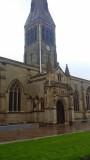
Forming an historic core is The Richard III Centre (formerly Leicester Grammar School) incorporating the original Greyfriars site, the Guildhall and the cathedral (formerly St Martin’s church). The lovely old Guildhall dating back to the mid-14th century has had many roles and would have been known to Richard. The cathedral is of course undergoing extensive changes in preparation for the re-interment there early in 2015. It is not a big church, but I found it very atmospheric even with scaffolding everywhere. We were the only ones there at Evensong except for the two ministers taking the service in a side chapel. There is such a strong feeling of spirituality and continuity in this old place of worship.
Our first real Ricardian encounter was actually outside the centre, with the bronze statue of King Richard by James Walter Butler (1980). This was originally placed in Castle Gardens but has been moved to stand between the centre and the cathedral. The statue was originally commissioned and the cost contributed by members of the Richard III Society. This area has been extensively remodelled to allow easy access between the two buildings. The statue looks fine here and it seems a fittingly triumphant image for this new era.
The King Richard III Centre: Dynasty, Death and Discovery
The Leicester Visitor Centre opened to the public on 26 July 2014. There have been mixed reviews for the new centre, from boring to offensive and a lot in between, so I was wondering what lay ahead for us.
I have had a lot of experience working in museums and galleries, and this one has all the signs of a new set up that is still bedding down. The staff were friendly and helpful but still had an air of not quite knowing how things work. The foyer, although modern and attractive, seems awkward and not yet functioning smoothly. I wonder if there might be some changes made soon.
Passing through the first set of doors from the foyer, the first encounter is a sophisticated audio-visual presentation. Unfortunately it didn’t work for me as I struggled to understand what was happening. Even with my bit of background knowledge, I wondered what a newcomer to the story would make of it all. All this was not helped by a confusion of sounds from the foyer and other audio-visual exhibits. I couldn’t hear well enough to follow all the dialogue. There is screen text but it is hard to read, watch the characters, try to hear what they are saying, and try to put it all together.
There are segments with different characters speaking, such as Richard’s mother, Cecily of York, with a young Richard beside her, Warwick and – most unsettling of all – Richard himself with a naked twisted torso seen from the back as he is dressed in armour. We now know that this was the reality of his physical body, but it is rather confronting seeing it as almost the first image. As he becomes fully armed his difference disappears and a knight emerges, but will visitors who do not yet know the full story be left with this image of the deformed king? The viewer is left with little except the images and only those determined to hear out the whole presentation, read the hard-to -find accompanying texts and give it some thought would leave with more than a jumble of medieval images and a distorted body.
However it does look good and the idea has merit, but it needs a better context to make sense and do it justice. There was an explanation about this “play” as you leave this area but it was “too little too late” for me.
There are various dates related to the history scrolling on the floor but they don’t relate directly to the screen action and for me only added to the confusion. It was a bit of an assault on the senses and not in a good way.
Apparently it could have been worse. On her blog site, in a succinct criticism of some aspects of the centre, Ricardian Annette Carson says “…. it was only by strenuous insistence that we removed the planned visual which was to greet visitors: the central throne was to be drenched in a sickening pool of blood which dripped down to form words written in blood on the floor below.”
The lower levels are an introduction to the general history of the period and the back story for King Richard himself.
Understandably there needs to be a little something for everyone from the clueless to the well-informed. Maybe there is a little too much of everything in an attempt to provide a little for all but it is a reasonable introduction when you consider the very short time frame for getting it all together. All permanent exhibitions are a work in progress and evolve with input from further research and their audience.
This is great history with something that all history does not have – an amazing end story!
And mysteries still not solved….all great ingredients for fantastic story telling.
The provided text states that the princes were probably killed by Richard, though their fate remains a mystery. Further on upstairs there is an excellent touchscreen exhibit showing how King Richard’s reputation was distorted, but surely this statement could have been better handled at this early stage, even taking into account the need for brevity and other myriad considerations of this complex subject.
Annette Carson gives another warning: “… no matter what they claim, do no suppose that the text exhibited at the Visitor Centre has been approved by the [Richard III] Society or by the ‘Looking For Richard Project’.”
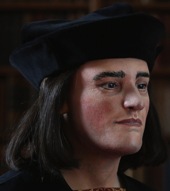
Upstairs I enjoyed a lot of interesting material on the discovery itself and the science around it. Here we can follow the reproduction of the bones, the facial reconstruction and the DNA comparisons among a lot more. I had not read Annette Carson’s critique of the centre at this stage so was not aware of the missing details in the story of the search and the discovery presented there that she has detailed. It does seem a shame that an inclusive path was not followed, with those who have made this a long-term project with a lot of personal and financial investment have not been more properly involved or correctly acknowledged.
If you don’t know the background of the search and the discovery, of course you do not realise what is missing and how what is there is affected by those omissions. It appears to be another example of history being moulded by circumstance, convenience, self-interest and politics.
The air conditioning was freezing cold the day we were there so that might have put me off as we rushed through at the end to avoid frost bite!
The pathway through the exhibition leads the visitor to the actual grave site and dig area at the end of the displays. A simple but stylish wood and glass extension sits beside the older building reaching out into what was originally part of the car park. The grave is left open and the site relatively intact within reason. This was well handled. It will be quite emotional for many and the area has seating and a nice space for just sitting and contemplating the amazing story. Fading in and out, a ghost like projection of the bones shows how they would have lain in the space. This might sound a little odd but actually works quite well. They seem so fragile and insubstantial, and it underlined for me the wonder of their survival at all.
Annette Carson and others find this section offensive, even ghoulish, certainly disrespectful and against undertakings made on the proper handling of the remains. Here is a link to the full article with many worthwhile and thoughtful writings on the site.
The Looking for Richard team has to be admired, to put it mildly, for their dedication, resolution, robustness and general staying power without which none of this would be happening. They are continuing their vigilance and care through all the changes and obstacles.
The grave site seems a reasonable balance between respect and science. Everyone will have a different view based on what they bring to this most amazing and moving site. In a practical sense this is a now a historical tourist attraction which hopefully will engage and enlighten many new to the broader story.
From the moment I saw the first tourist signs on the outskirts of Leicester saying just ‘Richard III’ with an arrow, I felt this most controversial king had entered a new phase of a different kind of propaganda, as a tourist attraction. Perhaps the price of celebrity?
At least now the story is getting some balance and certainly world -wide exposure. King Richard the Third, King of England has weathered many ups and downs in his life and history. One thing is certain, now more than ever before, he is unlikely ever to be forgotten.
Tags: Bosworth, Leicester
 The guest speaker for our Christmas meeting will be the NSW Embroiderers’ Guild President, Wendy Schmid, who will be discussing the history and styles of medieval embroidery that would have been found in the era of Richard III. As it is our Christmas gathering, please consider bringing some festive food to share at afternoon tea (but please remember to take any left-overs home with you).