21
Oct

21 OCTOBER 1449

   Posted by: Dorothea Preis   in Events in History

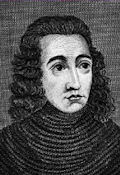
Birth of George Plantagenet, Duke of Clarence, third of the four sons of Richard Plantagenet, 3rd Duke of York,  and Cecily Neville who survived to adulthood.  He was born in Dublin, as his father was at that time lord lieutenant of Ireland.

Tags: ,

The Annual General Meeting of the New South Wales Branch of the Richard III Society was held on Saturday, 11 October 2014, at the Sydney Mechanics Institute.

Opening remarks were made by Chair Judith along with a warm welcome to all the members and visitors present. Thanks were expressed for the work of all the committee members throughout the year.

All of the officers then gave reports for their areas, and then officially stepped down. Margaret conducted the election process for all of the officers of the branch with most returning unopposed to their roles: Judith continues as Chair, Jacqueline as Deputy Chair, Judy as Treasurer, Dorothea as Webmaster, Lynne as Sales Officer, Joan as Tea Lady, Rachel as Secretary, and Leslie & Doug as Editors of the Affinity newsletter.

The program consisted of three ‘Scrabble’ speakers, giving separate presentations on different and very interesting topics.

Maggie told us of her experiences during her recent trip to the UK during which she laid the wreath on behalf of Australian Branches of the Richard III Society during the Bosworth commemoration ceremonies. Afterwards, she informally showed us interesting photos she had taken during the trip.

Dorothea had the letter ‘Y’ and shared her well-illustrated research about the history of the ancient church of St Mary de Castro in Leicester, which has been in existence for more than 900 years. Richard, duke of York, had in 1426 been knighted in this church.

Rachel spoke on the letter ‘R’ for rehabilitation. In an interesting talk entitled “Was Joan of Arc a Witch?” she addressed the charges raised against Joan, her astute responses to them, and the arguments for her defence that could have been made if her trial had been a fairer one, conducted in less prejudicial circumstances.

Our next gathering will be our Christmas meeting scheduled for 13 December 2014, when our guest speaker Wendy Schmid will be discussing medieval embroidery. All of the 2015 speakers will be listed in the next issue of the branch newsletter, Affinity.

Tags: , , , ,

17
Oct

17 OCTOBER 1469

   Posted by: Dorothea Preis   in Events in History

Richard, Duke of Gloucester (later Richard III), is made Constable of England.

Tags:

26
Sep

St Ives Medieval Faire

   Posted by: Dorothea Preis   in News

Last weekend, 20/21 September 2014, the Inaugural St Ives Medieval Faire took place in what the organisers named the Kingdom of St Ives (at less feudal times known as the St Ives Showground) on Sydney’s North Shore. The Showground was the perfect setting for this event.

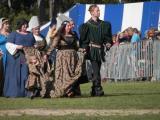
King and Queen of St Ives

The day started with a Grand Parade in the Jousting Arena, in which all participants took part. During the two days, visitors had the opportunity to enjoy a wide variety of displays to get into a medieval mood. For those interesting in browsing and shopping (and be honest, who isn’t?) the stalls, offering mainly items inspired by the middle ages, were a must. This was in some instances combined with a display of medieval techniques, like wood turning or blacksmithing. The 15th century encampment was the home of various retinues. Here, a lady of one the groups explained how bread was baked in a medieval oven – I can now understand why bakeries were such a fire hazard.

However, the main attraction were the display of medieval prowess in various arms. Whether it was combat like in the Viking wars, or the archery display (visitors also had the opportunity to try out their own skills) or the firing of the trebuchet. As it shot watermelons, it probably kept the local birds happy and well fed.

O

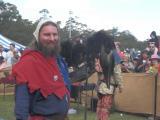
Talking about birds, we should not forget the birds of prey. They performed at 1.30 pm, but could at other times be admired from a closer distance.

O

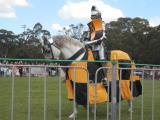
For me the main attraction were the jousting sessions, with knights in full armour on their magnificent horses. The jousts were presided over by the King and Queen of St Ives with their lords and ladies. The crème de la crème of the world’s jousting knights took part in the sessions and it was easy to feel transported back to medieval times.

It was a marvellous day and it is to be hoped that the St Ives Medieval Faire will become a fixture in the North Shore calendar.

Tags: ,

17
Sep

St Ives Medieval Faire

   Posted by: Dorothea Preis   in News, News from Other Organizations

St Ives Medieval FaireJust a short reminder for all our members and friends in the Sydney area. This coming weekend the St Ives Medieval Faire will be taking place. It should be a spectacular event.

Among the attractions are ‘The Jousting Knights of the St Ives Tournament’, including our own Knight in Shining Armour from the 2013 Australasian Convention, who will be matching his skills with the cream of the world’s jousting knights.

You can experience living in the middle ages in the Medieval Encampment. If your interest extends to an earlier time than Richard III, you may be interested in the Viking war. We all have heard about trebuchets, but what do we actually know about them? Here is our chance to learn more. And Full Flight Birds of Prey will recreate medieval hunting and falconry scenarios to demonstrate how birds of prey were used to hunt in Richard’s day.

Should you get exhausted with all these fascinating attractions, a visit to the Medieval Tavern might refresh you. A special medieval beer, called Sir Andrew’s Gruit, is on offer. It is brewed using herbs and roots instead of hops just like in medieval times.

You can still pre-book tickets and save on the website of the St Ives Medieval Faire, but you can also buy them at the gate.

An event not to be missed!

Tags: , ,

17
Sep

The latest research into Richard III’s death

   Posted by: Dorothea Preis   in Greyfriars Dig, News, Research

books-2A new research paper has been published in The Lancet on ‘“Perimortem trauma in King Richard III: a skeletal analysis’ by Jo Appleby and others, describing the wounds Richard received which led to his death.

You can find the original paper here, but Mike Pitts has helped us with a “handy summary”. The links to the article in The Lancet in his blog unfortunately did not work for me that’s why a different link is included here.  Mike Pitts’ summary is highly recommended.

A short visual summary has also been posted by The Lancet on YouTube:  ‘Richard III: how was the king killed?‘.

Tags: , ,

14
Sep

The “Murder” of King Richard III

   Posted by: Dorothea Preis   in Medieval Miscellany, Quotes

York House Books“King Richard late mercifully reigning upon us was thrugh grete treason of the duc of Northfolk and many othre that turned ayenst hyme, with many othre lords and nobilles of this north parties, was piteously slain and murdred to the grete hevyness of this citie”

([f.169v], York House Books, 1461-1490, Vol.1, ed. by Lorraine C. Attreed. Alan Sutton for Roichard II & Yorkist History Trust, 1991, pp.368-369)


When I read the word “murder”, I think of detective novels. One person kills someone else after careful planning trying to hide the fact that he/she is the murderer, sometimes even trying to disguise it as an accident or suicide. In the end, Hercule Poirot, Lord Peter Wimsey, Miss Fisher etc clears it all up and explains what had been going on.

In the above well-known quote from the York House Books, especially as it is used in the same sentence as the alleged treason of the Duke of Norfolk and others, the word “murder” seems to suggest some kind of whodunnit.   However, was this really what the York city officials wanted to say?  After all, a death in battle, though certainly hoped for by the opposing side, is not the result of careful planning, nor would the person responsible try to hide his deed.

When the other day, a friend of mine referred to the “murder” of Richard, my literature professor at uni came to my mind. He was very strict on interpreting any work of literature, be it fiction, drama or poetry, within its historical context. To this end it was important to find out whether the meaning of a word was at the time it was written the same as its modern meaning. So we would make our way to the library, and check in the many volumes of the Oxford English Dictionary.

What applies to works of literature, certainly applies equally to historical records. Checking out “murder” in the online version of the OED first showed me the detective novel explanation: “The deliberate and unlawful killing of a human being, esp. in a premeditated manner; (Law) criminal homicide with malice aforethought (occas. more fully wilful murder); an instance of this.”

However, a bit further down there was another explanation, marked as now obsolete and recorded for the last time in 1590. Here it said: “Terrible slaughter, massacre, loss of life; an instance of this.”

“Terrible slaughter, massacre” are words which describe a medieval battle perfectly and fit in with what we know about Richard’s death. Therefore I would suggest that the city fathers of York used the word in this sense, without any more sinister connotations.

Tags: , ,

7
Sep

Two Archbishops and a King

   Posted by: Dorothea Preis   in News, Reinterment

Leicester Cathedral - CopyIt has just been announced that both the Cardinal Archbishop of Westminster and the Archbishop of Canterbury will be taking part in services in Leicester Cathedral to mark the reinterment of King Richard III.  The Cardinal Archbishop of Westminster is the most senior clergy of the Catholic Church in the UK and the Archbishop of Canterbury is his counterpart in the Church of England/Anglican Church.

Since Richard’s remains were found two years ago, the Anglican Diocese of Leicester has worked closely with the Catholic Diocese of Nottingham, which includes Leicester, to ensure that the reburial will be handled with dignity and honour.

Anglican and Catholic clergy will celebrate at major as well as other services during the week 22 to 28 March 2015.  At the reburial service on 26 March, other Christian denominations as well as the World Faiths will be represented.

It has been occasionally been said that Leicester Cathedral is too modern for a medieval monarch.  While it is true that its modern Cathedral status is relatively new (1927), there were already Bishops of Leicester from the 7th to the 9th century.  The actual church was built by the Normans, replacing an earlier Saxon church.  The Norman church was rebuilt and enlarged during the 13th and 15th century.  So we can assume that Richard would have been very much aware of the church during his visits to Leicester.

You can find the full schedule of the planned services here.

Tags: , ,

7
Sep

Guest Post: Jigsaws, by Kristine Herron

   Posted by: Dorothea Preis   in News

Kris contacted our branch a while ago hoping we might be of assistance in her genealogical research.  We understand that Kris is especially interested in the Durnford link, so if any of readers could help Kris further, please let us know (webmaster “AT” richardiii-nsw.org.au) and we will gladly pass your message on to Kris.

Jigsaws, we have all done them. They are an excellent tool for keeping our minds active and provide challenges for people of all ages, when the pieces start to fit together to complete the picture. In solving Family History puzzles, some surprises can be unearthed!

Firstly I tackled my father-in-laws family, and being from convicts from the First Fleet, they are now known as the Royalty of Australia. That project took about 3 years and resulted in developing a website.

The next family line was my own. The lack of information at times made be almost give up, until I decided to work on my grandmother’s family, the Durnfords. There were lots of rather famous relatives among the Durnfords, many of them highly decorated in the British Military for their prowess on the battlefield, to their ability in engineering new cities in America, Canada and the West Indies.

Along the way, some of them married 3 or 4 times, and had numerous children. The Durnford family is worldwide, and has its own website. One arm of the family became known as the “Military” Durnfords. It is to the line that we Australian Durnfords are related.

While living in the past centuries and reading of their lives with the research that was available, I found that I could research their direct lineage back to King William the Conqueror. That was a shock. But to even be able to go back to the different Royals of the European countries was certainly an experience.

I loved geography when at school, but refrained from studying British History, and suddenly I was surrounded by it day in day out, as I took to the researching almost as a full time job.

Leicester Cathedral - CopyWe decided then to take a 3 month trip and “walk in our ancestors’ footsteps”. We planned a driving route that would take us to many of the towns where I knew these people had lived or died, or where they had fought in a battle or two, or where they had built amazing buildings.

Nothing could have prepared me for what we discovered.

We arrived in Leicester, and on a wet, cold and rainy day, decided to find the Cathedral, because one line of the family Herrick. The hostess an elderly lady told us that the Herrick’s were buried in St Katherine’s Chapel, and she eagerly took us there. I mentioned to her that I had discovered King Richard III was among my family ancestors. She then showed us where King Richard was to be reburied, on a spot immediately outside the chapel.

Cathdral Interior - CopyShe also told me that she didn’t think she had seen any other relatives of the Herricks retracing their lives, and was a bit impressed. She sent us off to the adjoining Guildhall where the Mayor’s offices were.

I was a bit overwhelmed, all the names of Herricks that I had no knowledge of who they all were! The memorials covered the walls of the chapel, which is at the front of the Cathedral to the left hand side (east), it has an altar and beautiful stained glass windows.

But I found the grave stones of Robert Herrick and Elizabeth Manby.

They are my 10th great grandparents.

Herrick Memorial - CopyHere lyeth the bodie of Robert Herick Ironmonger and Alderman of Leicester who had beene thrice Maire thereof. He was eldest sonne to John Herick and Marie, and had 2 sonnes and 9 daughters by one wife with whom he lived 51 years. At his death he gave away 16 pounds 10 shillings a year to good uses. He lived 78 years; and after dyed very godly the 14th of June 1618.

Then I learnt that they owned Greyfriers, the land adjacent to the Cathedral where King Richard III was initially buried after the Battle of Bosworth. Now if that wasn’t an amazing discovery

We returned from our trip with all this new information and an added research purpose to link all the ancestors and write about their lives.

In doing so, I was able to trace our lineage through the La Zouche family, who were the great grandparents (a few times) of King Richard. That line continued to the Herricks.

How ironic that while King Richard III was unceremoniously put to rest on the land later known as  Greyfriers, that he would be re-buried in the same Cathedral, just a few steps away from the owners of the same land.

I am sure they would not have been aware that a long lost King was also a long lost cousin!

The father of Christopher Wren wrote in his diary that he had seen a marker indicating that King Richard III was buried in Leicester on the Herrick’s land.

Why was he there? Because he was a tutor at Oxford and his pupils were none other than Herrick children

This is one piece of my family jigsaw that is of significant historical importance!

Notes regarding Robert and Elizabeth Herrick

From my blog www.edurnford.blogspot.com.au

Eldest son of AId. John Heyrick, mayor in 1557; born at Leic. in 1540, was one of the forty-eight councillors 1567, M.P. for Leic. 1588, a J.P. and alderman, and again mayor 1593 and 1605.

There were 5000 residents for all these councillors!

Ald. Robert Heyrick married at St. Martin’s 11 November 1567 Elizabeth, daughter of Ald. Wm. Manby of Leic., by whom he had a numerous family (vide St. Martin’s registers). For some years prior to his death, he resided in a mansion house within the precincts and grounds of the dissolved Grey Friars monastery, nearly opposite St. Martin’s church.

Here he died 14 June 1618 aged seventy-eight, and was buried at St. Martin’s two days later. M.I. there. Will dated 26 March 1617, was proved in the P.C.C., London, 30 July 1618. His portrait, with that of his younger brother Sir William Heyrick of Beaumanor Park, is still preserved in the Guildhall.

A townsman of note, and one of the most influential and active members of the corporate body of his time. In 1598, in conjunction with his younger brother Sir William Heyrick of London, goldsmith, later of Beaumanor, he obtained a confirmation of the ancient family arms, with the addition of this crest :-A bull’s head argent, the muzzle ears and horns tipped sable, gorged with a chaplet of roses leaved vert. The family motto VIRTUS NOBILlTAT being adopted by later members of the family.

Second son of Thomas Heyrick of Leic., and brother of AId. Nicholas Heyrick (No. 167). He was born in 1513, enrolled a freeman 1534-5, elected a chamberlain 1543-4, and again mayor 1572. He resided in the Saturday market at the corner of Cheapside ; married Mary, daughter of John Bond of Ward End, co. Warwick, who died in 1611, by whom he had five sons and seven daughters.

Here lyeth the bodie of Robert Herick Ironmonger and Alderman of Leicester who had beene thrice Maire thereof. He was eldest sonne to John Herick and Marie, and had 2 sonnes and 9 daughters by one wife with whom he lived 51 years. At his death he gave away 16 pounds 10 shillings a year to good uses. He lived 78 years; and after dyed very godly the 14th of June 1618.
Robert Herrick (also spelled Heyrick, 1540-1618), from a family of successful ironmongers, followed in his father’s footsteps as Mayor of Leicester, holding the position in 1584, 1593 and 1605.

Robert and Elizabeth’s home and its place in history!

Sir Robert Catlyn, Chief Justice to Elizabeth I, acquired the site from Bellowe and Broxholme, and it was later bought by Robert Herrick (Heyrick), three times mayor of Leicester. Herrick built a mansion fronting onto Friar Lane, with extensive gardens over the east end of the Friary grounds.

These gardens were visited by Christopher Wren Sr. (1589–1658) in 1611, who recorded being shown a handsome stone pillar with an inscription, “Here lies the body of Richard III, some time King of England”.

The Herrick family, who also owned the country estate of Beaumanor, near Loughborough, sold the mansion to Thomas Noble in 1711,who, like Herrick 130 years before him, represented Leicester in Parliament.

He was also a Justice of the Peace and at various times the town’s Chamberlain, Coroner and MP.

The Mayoral Roll records: “For some years prior to his death, he resided in a mansion house within the precincts and grounds of the dissolved Grey Friars monastery, nearly opposite St Martin’s church.”

Herrick built a house on the eastern part of the grounds, visited in 1612 by a young man named Christopher Wren, who was tutor to Herrick’s nephew at Oxford. (This was not the famous architect but his father, later Dean of Windsor.)

Wren wrote in his diary that Herrick showed him a stone pillar with an inscription ‘here lies the body of Richard III, some time King of England’. This was the last recorded location of Richard’s body.

Herrick’s daughter Frances married Thomas Noble and one of their descendants (also Thomas Noble, c.1656-1730, later the town’s MP) bought the Greyfriars land in 1711.

His son, yet another Thomas, divided the site into two in 1740 with the appropriately named New Street, along which houses were built, with numerous burials discovered during the building work. Herrick’s house and garden passed in 1743 to Roger Ruding of Westcotes, in 1752 to hosier Richard Garle, and in 1759 to banker William Bentley who built a fine house with the address ‘17 Friar Lane’.

Archaeologists from the University of Leicester who are leading the search for the lost grave of King Richard III announced today that they have made a new advance in their quest.

They have uncovered evidence of the lost garden of Robert Herrick – where, historically, it is recorded there was a memorial to Richard III.

Now the ‘time tomb team’ as they have become to be known has discovered paving stones which they believe belong to the garden.

The University of Leicester is leading the archaeological search for the burial place of King Richard III with Leicester City Council, in association with the Richard III Society.

In 1485 King Richard III was defeated at the battle of Bosworth. His body, stripped and despoiled, was brought to Leicester where he was buried in the church of the Franciscan Friary, known as the Grey Friars. Over time the exact whereabouts of the Grey Friars became lost.


Tags: , ,

1
Sep

Richard III: Elected Monarch or Usurper?

   Posted by: Barbara Gaskell Denvil   in Medieval Miscellany, Medieval People

We thank our branch member Barbara Gaskell Denvil for her kind permission to use this article here.  It was first published on 30 August 2014 on her own website.

richard smlVery little reliable documentary evidence survives from the Middle Ages. The life and times of Richard III therefore remain a period of frustration and fascination for historians, scholars and interested amateurs alike. So why is it – when one very clear contemporary document survives from that period – that so many people choose either to ignore it, or disbelieve it?

This one original and incontrovertible document dates from 1484. It sets forth in plain language (of the time) the entitlement to the throne of the man crowned Richard III, and states that, after certain facts were brought to light which made it clear that King Edward IV’s sons were now considered illegitimate and young Warwick, Clarence’s son, was debarred by his father’s attainder, Richard, at that time Duke of Gloucester, stood next in line.

After lengthy investigation and consideration of the newly disclosed situation by the Royal Council and the members of Parliament originally called to London for the expected coronation of the young prince, (most of whom were present) the agreed conclusion was that the crown should be offered to Richard, who was already ratified as Protector of the Realm. He was petitioned by the three estates, being the Lords Temporal, the Lords Spiritual, and representatives of the Commons who included a good many leading citizens of London. He was officially and legally asked to take the throne. It could actually be said that he was elected. Indeed, the wording of Titulus Regius includes the words ‘this Eleccion of us the Three Estates’, And yet he is consistently accused of being a usurper, and of having ‘seized’ the throne.

The accepted modern meaning of the verb ‘to usurp’ according to the Shorter Oxford English Dictionary, is simply: “To take a position of power illegally or by force.” Using this definition alone, it is perfectly clear that a man who was asked after due deliberation by England’s government to accept the throne, a right which was then ratified by the full parliament, did not in any manner usurp that position.

However, the modern definition of usurpation does not always sit easily in history. After the initial tyranny of kings was firmly established in 1066 with the unarguable usurpation of William I, over subsequent reigns England gradually began to modify and moderate her attitude to the royal rights of inheritance and the power of both kings and lords of the realm. Unlike the French model which continued doggedly with absolute power resting in the hands of royalty, England changed, adapted, and finally adopted a system of government by which an alternative administration could substitute for the rule of her monarch in certain matters when he was considered incapacitated either by age or health.

The Plantagenet line continued to uphold the right of kings to pass down the crown to their sons or grandsons, but clearly this was not always possible and under such circumstances, suitable but less direct heirs were necessarily sought within the bloodline. With this in mind, accusations of usurpation have been levelled against the first Lancastrian king, Henry IV who took the throne in 1399 and even against King Edward IV (1461). This went to the heart of the Wars of the Roses, but it is important to remember that in both cases, i.e. the enforced abdication of Richard II and the crowning of Henry IV as monarch in his place, and later the official acceptance of Edward IV’s father Richard, Duke of York, as the heir to Henry VI, these were actions carried out in circumstances where the monarch of the day had forfeited confidence and support by showing himself to be dangerously unfit to rule. And, of course, both these irregular successions were enacted and confirmed by Parliament. The term ‘usurpation’, therefore, now depends on whose side the speaker is on. Clearly the succession rights of kings were not inviolate and the later opinion (of Tudors and Stuarts, for instance) that an anointed monarch held an unarguable God-given right to absolute power, did not at all apply in the 15th century.

In 1483 following the death of Edward IV, it was expected that his eldest son would inherit the throne as Edward V. Yet shortly before his coronation, Robert Stillington (Bishop of Bath and Wells) announced that Edward IV’s marriage to the mother of the heir to the throne had been, to state it simply, bigamous, and that therefore all his children were illegitimate. Stillington was an important and respected ecclesiastical figure, and a previous Lord Chancellor of Edward IV, so his word would have been taken very seriously indeed. It is hard to see what possible benefit he would have gained from lying. Indeed, a good deal of detriment was the far more likely result had his story been false. His announcement, however, would never have been accepted without enormous investigation. Whatever proofs he offered we can no longer know. There is no surviving record of his exact report, nor of any witnesses called or other evidence shown at the time. But the lady who was named as Edward IV’s first wife was the Lady Eleanor Talbot, daughter of the Earl of Shrewsbury and sister to the Duchess of Norfolk, a widow and member of a noble and highly important family. Not someone to make the subject of ludicrous and improper rumours. The Lady Eleanor was now deceased, but she had been very much alive when Edward married Elizabeth Woodville, the mother of his children. Many close and high-powered members of Lady Eleanor’s family were still alive and would certainly not have stood silent if they knew the lady was being wrongfully slandered.

Some now choose simply to disbelieve Stillington’s claim. Yet they have not one shred of evidence to support this, nor one hint that this first marriage never took place. Certainly direct proofs that it did take place are also lacking. A few bewildered souls ask where’s the marriage certificate? But no such thing existed in 15th century and you could, for instance, take a lady’s hand, vow to wed her, and if she accepted, you then tumbled her into bed to consummate the match – and lo and behold – you were legally man and wife. The church was naturally not happy with this sort of clandestine affair without banns being called and often without witnesses – but it happened all the time and it was legally binding.

That King Edward IV favoured this type of thing was blatantly obvious, because that’s also exactly what happened the second time around. He wed Elizabeth Woodville in secret, in exactly that same manner. Indeed, he is often said to have ‘married for love’ – an unusual thing for a king in those days. But it was a very strange sort of love – for he made no mention of his secret wedding for 5 whole months. During those months the lady was never invited to the palace, she was entirely unacknowledged, her existing sons (she was a widow), instead of being taken in and elevated by the king, were given elsewhere as wards, and the king even sent his courtiers off abroad to start negotiating for a foreign princess to become his wife. But then, quite suddenly after those long silent months, to the bewilderment of almost the entire country and the dismay of most of the lords. King Edward announced the marriage. He brought his suddenly admitted queen to court, and that was that. A clandestine wedding led to a new queen and eventually a parcel of royal children.

So had he done this on other occasions in the past, yet never acknowledged it? Certainly Lady Eleanor Talbot came into some unusual bequests for which there is no known explanation, nor clear manner in which they could have been acquired. She then retired into permanent religious seclusion.

It does seem strange to many that this wronged and misused lady did not complain, did not announce her legal status as queen, nor denounce her legal husband, even when he took another wife. I have no answer to this beyond pointing out the logic of the situation. This was a high-born lady, and ladies, especially of a religious nature, did not whine or openly humiliate themselves by publicising the fact that they had been used, bedded, ravished, and then abandoned. Nor did they try to cause rebellion and unease (in a land so recently returning to peace) by accusing the king of dishonesty and immorality. She also ran the risk, if she made public announcements, that the king might deny the marriage and thus humiliate her further. Instead she accepted his apology and his gifts (my assumption), though continued to act (as in the manner of making her last will and testament) as a married woman with a living husband. And after all, while the king lived, it was a personal matter anyway and did not yet affect government or the people. It was not until he died and his eldest son’s legitimacy was in question, that the truth of this situation became politically imperative.

So with Edward V no longer considered of legitimate royal descent, Richard, Duke of Gloucester, stood as the one direct and legally legitimate heir.

The document itself (Titulus Regius) states clearly that incontrovertible evidence existed and could be forthcoming if and when required. It was later stated that proofs had already been brought before the Council “authentic doctors, proctors and notaries of the law, with depositions from divers witnesses.” Lady Eleanor Talbot’s powerful family surely stood witness. Certainly none of these relatives came forward to deny the claim, or to defend the lady’s honour by refuting the existence of this clandestine marriage. So why doubt such proofs existed? People were no more stupid at that time than they are now and it is highly ridiculous to presume that they would have accepted such a dramatic and inconvenient fact on the eve of the new young king’s coronation, unless they were well and truly convinced.

The frequent modern assumption that Stillington’s claim of bigamy was not only untrue but a clear manipulation by the evil and ambitious Richard III to usurp and seize the throne, is not only a leap of huge unproven prejudice, but it completely and naïvely overlooks the known power and position of the Royal Council and Parliament of the day. Ignoring the delightful genius of Shakespeare’s dramatic fiction, and the less delightful fiction of Tudor chroniclers who supplied the stories he told, we should at least respect the experience and intelligence of the lords, remembering also the obvious precedent of parliamentary decision regarding Richard II and Henry VI as mentioned above.

Stillington’s announcement must have been made during the latter half of May 1483. It is clear that in the following weeks the Royal Council and those representatives of Parliament present in London met in discussion many times.

The supposition that Richard of Gloucester had the power to threaten and bully all those poor cringing medieval lords is frankly laughable. For a start, Richard’s troops were miles away in Yorkshire, whereas most of the lords had their own armed retinues, not to mention huge private armies on which they could call. Many held particular powers and all were men of substance. These were not lords to be easily bullied, nor convinced without very good reason. A figure of 32 lords temporal, 66 knights, 44 lords spiritual with access to the Pope should they feel obliged to call on him, and 30 members of the Commons have been recorded during meetings of four hours or more, although the Royal Council itself was smaller in number.

Are we now arrogant enough to suppose that these were all corrupt fools to be duped or bribed, incompetent cowards to be frightened into compliance, or men without the slightest interest in the future of the land in which they lived and which supported them and their families and property? It appears that many of us completely underestimate the power of the lords, council and parliament during the 15th century and are happy to ignore the legal precedent for the lords and parliament to debate and determine the situation when the king’s rule was, for whatever reason, in question.

Some now argue that even if proved illegitimate, Edward V could still, with parliamentary agreement, have been accepted as king. But it is clear that parliament rejected any such compromise, since the lords logically and clearly preferred the proven competency of a grown man already ratified as Protector of the Realm and known for his leadership quality.

We also need to remember that King Edward IV had several illegitimate children by various mistresses. Making one illegitimate child legally able to inherit the throne, could even possibly have opened a chain of claims by others. Besides, bastardy called into question not only the capability of the bastard himself to inherit, but looking ahead down the generations, even if overlooked in Edward V himself, it invited later questions as to his dynasty.

The often repeated cries of “Bigamy? A pre-contract? No. It couldn’t be true. It was too convenient,” or “Too much of a coincidence,” can come only from those who already assume Richard guilty of ambitious connivance and malicious manipulation. Only by assuming his guilt and duplicity before the fact, can these accusations be made. This is why we cannot take at face value the handful of hostile narratives from those times, because their preconceptions are evident to even the most cursory scrutiny. And significantly, there are no surviving records from the governing council that supported Richard.

Once you set aside any existing bias, it is clear that this was highly inconvenient, and there was no coincidence at all. It threw everybody into chaos. We cannot even be sure if Richard wanted the throne. Perhaps he didn’t. Perhaps he did. It doesn’t matter. He was the remaining heir and he was asked to accept the throne. Thant’s on record. The matter was put to the three estates of English government who decided that Richard of Gloucester had a clear duty to take the throne. Richard accepted. Actually he had little choice.

Conflicting loyalties and self-interest produced protestors as always, but no one at the time actually refuted the accusation of bigamy posthumously directed against Edward IV. Even Elizabeth Woodville, the mother of the ‘princes’ now declared illegitimate, apparently placed no objection. She was now living within the precincts of Westminster sanctuary, comfortably in the Abbot’s house, where she had direct access to the considerable higher authority of ecclesiastical power (her own brother was Bishop Lionel Woodville) and could easily have made a direct plea to the Pope for a church ruling and intervention. She did none of these things. She accepted the ruling, just as if she had already known the truth of the matter.

Therefore whether you like the sound of King Richard or not – one thing is entirely clear. He was officially and legally petitioned to accept the throne of England, and contemporary legal documentation proves this. He did not usurp nor seize anything. He could be said to have been legally elected by Parliament. He was fully acknowledged and anointed as monarch when his coronation was duly attended by virtually every peer in England, even those whose families supported the Lancastrian dynasty.

So those, including those claiming to be ‘open-minded,’ but who begin their articles by calling Richard III a usurper, or stating that he ‘seized’ the throne, are either proclaiming their secret bias, or they should enlarge their area of research.

With thanks to many, and to various sources, but with particular gratitude to Annette Carson and her books “A Small Guide to the Great Debate,” and “Richard III: The Maligned King.”

Tags: