10
Dec

ALL I WANT FOR CHRISTMAS IS …

   Posted by: Dorothea Preis   in News

Should you be or live with one of those strange creatures – a Ricardian – you might wonder what would be a suitable present.  A few things showed up on my Google Alert and other sites lately, showing us something different for the Ricardian that has already got all the books (as if that was possible!).

There are some nice items from the University of Leicester [1] themed for the archaeological dig in which their scientists are playing such a vital role.  What about a mug in a Yorkist blue?  Or a T-shirt, either in blue or khaki?  Not only will this be your very own memento of this exciting period, the profits from the sale will go to support the University’s research commitment.

If the Ricardian in your life not mind Shakespeare’s more questionable portrayal of this king, s/he might like a window transfer [2] showing the image of Richard III falling from his horse, which is a reproduction of the Shakespeare window in Southwark Cathedral in London.  Unfortunately it also bears the famous – but untrue – quote about a horse.

If you want to splash out a bit more what about a coin [3] like the one which sold recently for £ 36,000?  It’s not just any old coin – though it is old, dating from 1484 to be precise.  It is a gold angel in almost pristine condition depicting bearing Richard III’s personal emblem, a boar’s head.  It was discovered earlier this year about 12 miles (about 19 km) south of the Bosworth battle site, but it is unlikely that it was lost by someone going to or coming from the battle.

Another suggestion for the discerning Ricardian might be something like the document bearing Richard III’s signature [4] which was recently auctioned for £ 109,250.  The document was written just a few months before Bosworth settling a property dispute in Warwickshire between a “pooer Subgiet Robert Dalby” by “oone Robert Worsley of Chepyngton”.  Documents signed by Richard as king are very rare as his reign was so short.

Having solved the problem of what to get, you might consider wrapping your present in a suitably themed wrapping paper [5], showing the famous portrait from the National Portrait Gallery in the UK (on the right of this post).

Of course, the celebrations are not all about the giving of gifts, there should be some feasting with family and friends, too.  May we suggest some ‘Richard III Wensleydale’ cheese [6] with a glass of ‘Battle of Bosworth’ wine from McLaren Vale [7]?  The wines are made from organically grown grapes.  To accurately assess Richard III’s brother, George duke of Clarence, might be a bit a sticky problem, but it might be easier with a glass of ‘Clarence Sticky Semillon’.  Though for special occasions like the holiday season the ‘White Boar’ has to be a must.

1.    http://shop.le.ac.uk/
2.    http://www.britishmuseumshoponline.org/homeware/shakespeare-richard-iii-round-window-transfer/invt/cmcn436490/?stylecat=shop_shopby
3.    Peter Warzynski, ‘Collector pays £36k for gold coin found in Leicestershire bearing Richard III emblem’, This is Leicestershire (8 Dec 2012).  URL:  http://www.thisisleicestershire.co.uk/Collector-pays-pound-36k-gold-coin-Leicestershire/story-17525801-detail/story.html Date accessed:  9 Dec 2012
4.    ‘Richard III signed document tops estimate by 628.3%’, Paul Fraser Collectibles (13 June 2012).  URL:  http://www.paulfrasercollectibles.com/News/AUTOGRAPHS/2012-News-Archive/Richard-III-signed-document-tops-estimate-by-628.3pc/11121.page Date accessed:  8 Dec 2012
5.    http://www.etsy.com/listing/112879386/richard-iii-wrapping-papergiftrwrap
6.    http://www.finecheese.co.uk/our-cheeses/richard-iii-wensleydale.html
7.    http://www.battleofbosworth.com.au/

Tags: ,

9
Dec

BOSWORTH AND WARFARE: NEW FINDS, NEW IDEAS

   Posted by: Judy Howard   in Ricardian Places

A report from the 11th Triennial Conference of the Richard III Society,

Loughborough, 20 – 22 April 2012

Well, it is months since I attended the Triennial Conference in the UK and I will say that I enjoyed it immensely and would go again tomorrow if the opportunity arose, but I somehow feel that the events of the more recent months have almost overshadowed my experience.  Within weeks of my return to Australia the Greyfriars Dig commenced and next we have skeletal remains which may well be those of Richard himself.

However, at the Conference we were delighted by the presentations from the two academics who had made such monumental discoveries of the battlefields of Bosworth and Towton, and I will go into these presentations a little more.

Recent years have been good for investigation and discovery regarding Richard, the Yorkists and our Society.

You will already be aware of the programme for the triennial conference and if I was asked to choose which was my favourite it would be a hard call.  However, I think the tour of the new site for the battle of Bosworth was the most thrilling, followed by the presentation by Mark Stretton on the ‘Power and Effectiveness of the Warbow in Battles’.

We were also treated with a presentation by Dr Glenn Foard, the person responsible for identifying the new Bosworth and discovering all the wonderful artefacts which have generally enlightened thought on late medieval warfare.  In his presentation he not only brought the long and arduous investigation to light, but we heard about the importance of the discoveries of the great number of cannon balls found at Bosworth.

In terms of the confirmation of the site, the identification of the marsh, which was confirmed by soil sampling and then the analysis of the landscape, which matched the historical records, meant that the new site was now undisputed.

Dr Foard told us that artillery and guns were known to have been crucial to battle strategy and at the time were known to be important weapons of the future.  It was also interesting to know that there were no arrowheads found in the area, unlike the number of arrowheads found at the Towton battlefield site. In addition, there was not the quantity of evidence at Bosworth that was found at Towton, and Dr Foard thought this was attributed to the fact that the battle of Towton resulted in the deaths in battle of a far greater number of nobles than were killed at Bosworth.  At Bosworth a number of artefacts were found where the action was concentrated, and this was where the silver boar brooch and a fragment of the hilt of a gilded sword were found.

Dr Foard explained that the Bosworth discovery increased the understanding of the use of firepower and there was not much evidence of the use of handguns at Bosworth, unlike on the Continent and in Burgundy. The evidence suggested that a bigger calibre was used at Bosworth, lead with flint, lead with stone and iron with iron.  It is also now thought that the Wars of the Roses were important battles for the development of artillery and the evidence supports this theory.  The findings at Bosworth provided evidence of the battle tactics that were deployed at the time and also that the pressures and temperatures of different materials used to make guns were well understood by the commanders at the time.  For instance they understood muzzle velocity, whether to elevate guns or to fire point blank, that the cannon balls bounced on the ground and the angle of elevation that was needed to maximise the bounce and therefore increase the opportunity of hitting a target. Dr Foard thought that gunpowder was the determining factor in the development of artillery and guns.

The actual battlefield is now a working farm and great pains have been taken to conceal the actual site from the public, to avoid hoards of amateurs using metal detectors and collecting artefacts but who would also damage the site and interrupt the farm.  The farmer and his wife were very charming people who felt honoured and thrilled that such an important historical event occurred on a site they now own.  In this, everyone is very fortunate to have such custodians, who in conjunction with archaeologists and serious academics, will ensure the preservation of the site until it has been thoroughly and scientifically investigated so that all archaeological evidence can be properly collected and studied.  Dr Foard said there was much more work to be done on the site as it had not been fully surveyed, and this could take years of work to complete.

I must say, it was a thrill to visit the site, it was a special occasion where I got a true sense of battle that took place and the spot was pointed out where it was thought the battle was most intense, and where it was suspected that Richard had lost his life.

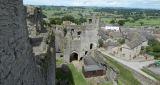
A view of a section of the new battlefield from the trail at the Bosworth Battlefield Heritage Centre which opened up new avenue of research and is awaiting further archaeological investigation. (photo by Dorothea Preis)

The next lecture I most enjoyed was by Mark Stretton on the ‘Power and Effectiveness of the Warbow in Battle’.  This was extremely informative and entertaining. Mark has been entered in the Guinness Book of Records as an archer, he is a master arrowsmith and has made an in-depth study of his craft.  Through study and experimentation Mark has identified the uses for each type of arrow head from the period, its effectiveness in piercing armour and the amount of damage it was intended to inflict.  He told us that the bodkin type of arrowhead was the most commonly used because of its ability to pierce armour and was more likely the type used in battles around this period.  It will be interesting to hear any comments he has to make regarding the arrowhead found in the human remains recently discovered in the Leicester car park as I understand that this arrowhead was of a shape thought to be used for hunting boar (funnily enough!!) and is very different to the bodkin-type arrowhead and apparently not known for its ability to pierce armour.  It will be great to hear any comments about this and whether Mark will revise his thoughts, or indeed have any other comments to make.

Mark also explained that the greatest vulnerability to arrow shot, was in areas of the body where the armour was weakest, that is in the arm pits, elbows, groin and legs.  He also made the further comment that from a tactical point of view, an arrow wound would cause a nobleman to die slowly and when the nobleman was hit, it took the attention of his retainers, giving a tactical advantage to the opposing side.  These are unpleasant thoughts.

And as a last interesting comment, another presenter Tobias Capwell who is the Curator of Arms & Armour for the Wallace Collection in London, gave an interesting presentation on armour and how he thought it was pregnant with meaning – how it was an indication of status and wealth.  He thought Richard, on going into battle, would have worn a surcoat over his armour which was made of rich material, probably silk with gold embroidery.  The armour he wore at Bosworth was probably fully gilded and probably looked like a golden mirror and would have been worth several millions of dollars in modern currency.  This would have been evidence of conspicuous consumption; however this would have been expected of a King.  The armour or the surcoat could also have had jewels and pearls embedded in them.

Tobias explained that a king’s splendid armour was like a beacon on the battlefield, soldiers were drawn to it, he led from the front, the imagery was very important.  But the wealth displayed by the armour worn, by the King or his nobles, even though it caused enemies to be drawn to them on the field, it was also seen as an insurance policy – capture me, don’t kill me, I am worth saving as my ransom will be worth it to you.

The Conference was great and I’m really going to try to get to the next one.  I hope you can too.

Tags: ,

7
Dec

THE CANADIAN CONNECTION

   Posted by: Dorothea Preis   in Greyfriars Dig, News

ArchaeologyI might have mentioned before that Facebook for me has often been a good source of interesting information.  Today, thanks to Joan Szechtman, author of novels about Richard in This Time, I watched a Canadian broadcast about the dig in Leicester.  It is a very interesting programme and it is nice to hear Dr John Ashdown-Hill  talk about the subject that he has researched so extensively.  Enjoy!

Here’s a link:  http://www.youtube.com/watch?v=DVBOIXayfxE&feature=share&list=ELkUpoWD1apic

Tags: , , ,

2
Dec

Christmas cheer at the NSW branch

   Posted by: Dorothea Preis   in Meetings, News, NSW Branch News

Our December general meeting will be taking place at our regular venue, the Harry Jensen Centre (17 Argyle Street, Millers Point), on Saturday, 8 December 2012 at 14h00.

We have a whole range of attractions for you to enjoy.  Judy will give an illustrated talk about the triennial conference of the Richard III Society, which she attended at Loughborough earlier this year.   This will be a unique opportunity to see pictures of the real site of the battle of Bosworth, which was visited as part of the conference.  This is on private land and normally not open to the public.

While we are all are waiting for the results of all the scientific tests being carried out on the male remains found in Leicester, there will also be a look back on how these remains were found at all.

And our regulars know that any item presented by Isolde and Julia promises to be great fun.  They told us that this year they will be acknowledging some characters familiar to all Ricardians, but who won’t be receiving Christmas cards from us.  Sounds intriguing.

It will also be an opportunity to pick up your copy of this year’s Chronicles of the White Rose, our branch journal.  In it you can find a variety of presentations from past meetings and some articles which appeared on our website, as not all our members have access to the internet.  And of course the volume also includes an entertaining and challenging quiz.  (The Chronicles will be mailed afterwards to members unable to attend.)

It would be appreciated if members could help to make our Christmas afternoon tea special by bringing a plate, but please do not be over-generous with the plate size!

Looking forward to seeing all our regular friendly faces and perhaps some new ones as well.  As always any guests, curious to find out more about us, are more than welcome.

Tags: , , , ,

1
Dec

Reminder: Australasian Convention 2013

   Posted by: Dorothea Preis   in News, Society News

A reminder that your completed registration form and deposit for the biennial Australasian Convention in 2013 is due by by 31 December 2012!

‘Richard III:  The Man behind the Myth’

Friday 12 to Sunday 14 July 2013

At Novotel, Darling Harbour, Sydney

All members and friends of the Richard III Society are welcome.

Friday, 12 July 2013 (evening): Informal get-together to welcome Interstate/Overseas guests

Saturday, 13 July 2013, from 9h00: full day of presentations with breaks for morning tea, buffet lunch in Dish restaurant, and afternoon tea

19h00: banquet in the Terrace Room (partners and guests welcome)

Sunday, 14 July 2013, from 9h00: further presentations, plus a business session before our farewell buffet lunch in Dish restaurant.

For further information and/or registration please contact the New South Wales Branch per email at info@richardiii-nsw.org.au.  Please submit your completed registration form and deposit by 31 December 2012.  The balance of payment is only due by 31 March 2013.

Let’s mark the 530th anniversary of Richard and Anne’s coronation with one big celebration!

Tags: ,

29
Nov

The Princes in the Tower?

   Posted by: Judy Howard   in News

While perusing the website of St. George’s Chapel at Windsor, UK, I found on their Archives Blog, an article which is yet another angle on the fate of the Princes in the Tower. I found this particularly intriguing at a time when another skeleton is under scrutiny by a team of archaeologists at the University of Leicester which may prove to be the remains of Richard III.

Apparently in 1789 when the paving was being repaired in the North Quire Aisle of St. George’s Chapel, the entrance to the burial vault of Edward IV was identified.  When they entered the vault they found a lead coffin with the remains of a wooden coffin on top – which were the coffins of Edward IV and his consort, Elizabeth Woodville.  Two further coffins were also found and they were believed to have contained the bodies of George, 3rd son of Edward IV who died in 1479 aged 2 years, and his sister Mary, 5th daughter of Edward IV who died in 1482 aged 14 years.  Both George and Mary were known to have been buried at Windsor.  The vault was not investigated any further and the vault was closed with new a slab.

Then in 1810, two more coffins were found in what is now the Albert Memorial Chapel and the inscription on one of these suggests it is the coffin of George and not the one in the vault near Edward IV.  It is known that when George was buried at Windsor on 22 March 1479, the Quire at St George’s Chapel was still under construction and therefore he could not have been interred in Edward IV’s vault. The written account of Mary’s funeral states that she was buried near her brother George.

In 1813 both of these coffins were moved to the vault near Edward IV.

The question remains however – who did the two coffins found in Edward IV’s vault in 1789 belong to??  They were important because they were buried in a place of honour near Edward IV. There is no evidence to suggest who these two coffins belonged to.

The choir of St George’s Chapel, Windsor (photograph by Josep Renalias, obtained through Wikimedia Commons)

The Assistant Archivist at the College of St George has asked the question whether these two coffins could contain the remains of Edward’s other sons, Edward V and Richard, Duke of York, the “Princes in the Tower”?

In light of the momentous discovery of skeletal remains which could possibly be those of Richard III, how marvellous it would be to take this investigation further and attempt to obtain genetic material to determine:

1.    The identification of the bones in the urn at Westminster Abbey, purportedly those of the two “Princes in the Tower”; and
2.    Identification of the bodies in the two coffins discovered in Edward IV’s vault in 1789.

After more than 500 years surely this is not too much to ask, given the sophisticated technology currently at our disposal.

A mystery would be solved, if only.

Tags: , , ,

20
Nov

Greyfriars Dig: “the evidence is looking really good”

   Posted by: Dorothea Preis   in Greyfriars Dig, News

ArchaeologyThis is what Prof Lynn Foxhall of the University of Leicester said about the ongoing tests which are carried out on the male skeleton found in the former Greyfriars church in Leicester.

However encouraging the statement may look, it would be too early to jump to conclusions.  The various tests are still ongoing and results are only expected in January.

So far we heard most about the DNA testing trying to match the mtDNA of the remains to that of a descendant of Richard’s eldest sister Anne, but this is only one of the aspects investigated.  This descendant’s connection is also being verified and researchers are hoping to establish a second line of descent.

Other tests include the analysis of soil samples from the grave surrounding the skeleton, from which we may not only find out more about the burial practice, but also about the health and diet of the person who was buried there.  This would be in conjunction with evidence gathered from samples of mineralised dental plaque, providing information on the person’s diet, health and living conditions.

Scientists are examining the skeleton in detail trying to get some idea about the person’s age and figure and the scoliosis.  Experts are also trying to establish how exactly the individual died and what kind of weapon would have caused the horrific injuries to the skull.

The remains are also radiocarbon dated in two separate examinations, which will give us an idea of when the person died, to within 80 years.

However, if these remains are indeed those of Richard, the most interesting process would be the CT scan from which a 3-D image of the person can be built.  This would also be the basis for facial reconstruction so that one day we may be able to see what Richard really looked like – remember, none of the existent portrays is contemporary.

All these tests together will provide a detailed image of the person’s lifestyle, his health and even where he grew up, and will thus provide “more assurance about the identity of the individual”.

The process reminds me of the wide variety of information which has been established about Ötzi, the “iceman” found by hikers in the Ötztaler Alps in September 1991.  I have been fascinated by him since he was first discovered and the story of the find was one of the last I wrote about as assistant for a scientific research organization.  Compared to Ötzi’s age of 5300 years, this man’s 500 years seems to be a very short time frame indeed.

More information:

‘‘It’s not like CSI’: the Science of the Search for Richard III’, University of Leicester (15 Nov 2012).

Richard III dig: Results expected in January’, BBC News Leicester (19 Nov 2012).

Tags: , , ,

14
Nov

History as Fiction

   Posted by: Julia Redlich   in Bookworm

Many of us have become wary of enjoying this genre, knowing that many of the plots are based loosely on fact and owe heaps to the inventiveness of the writer. Others are well researched and a tribute to the authors’ imagination as to what might have been. Of course it must be welcomed if it inspires interest in a period or person. Just think what The Daughter of Time has done for Richard!

A Dangerous Inheritance, by Alison Weir, Hutchinson, 2012, rrp AU$32.95, ISBN978009 1926236

Knowing this writer’s tendency to downplay Richard of Gloucester’s good qualities and find plenty of reasons to position him as an arch villain, I opened this with a little trepidation, and closed it with an appreciation of the skilful linking of two periods of time, two intriguing heroines and a connection to history’s most baffling mystery.

The two women are Katherine Grey, younger sister of the ill-fated Lady Jane, and Kate Plantagenet, bastard daughter of Richard III. During Katherine’s early arranged marriage to Henry, heir to Lord Pembroke, she comes into possession of a n old box of letters from the attics of Raglan Castle This was the last home of Kateand these letters reveal her love for her caring father. It is only later that his darker side becomes apparent – and maybe with good reason.

The women have much in common: both love men who are forbidden to them; both face danger. As a potential rival for the throne, Katherine suffers the anger and distrust of her cousin Queen Elizabeth, and for much of her life is confined to the Tower, separated from her second husband and elder son. After Richard’s  unexpected succession, Kate becomes aware of rumours and threats to the family, and tries to seek the truth about what happened her two cousins, the sons of Edward IV.

It’s an intriguing story of two women usually relegated to the background. Enjoy the easy movement between the years, the mystery not just of the princes, but also Kate’s mother, and why and when Kate died and her unexpected lover. Above all, learn about the turbulence of the life when you are far too close to the throne for comfort.

The Kingmaker’s Daughter, by Philippa Gregory, Simon & Schuster, 2012, rrp AU$36. ISBN97 80857207463.

The fourth book in the Cousins’ War series, this is a portrait of Anne Neville, younger daughter of Richard Neville, Earl of Warwick.  Her childhood is warm with the friendship with the powerful Yorkists, including the youngest son, Richard of Gloucester, but this changes rapidly as the  families become enemies. She faces exile in France, and becomes a pawn in her father’s ambition to regain his lost power, forced into marriage to the only son of  Henry VI’s ruthless Queen Margaret. All too soon she is fatherless, widowed, with her mother confined in sanctuary and her elder sister Isabel married to the fickle Duke of Clarence. Danger is never far away even when Gloucester rescues her from Clarence’s hold, marries her and she eventually becomes his Queen for the rest of her life of two short years and the tragedy it brings.

There is always room for more about Queen Anne, and I appreciated the volatile relationship between the two sisters that rang so true to life. But it seems a lot is missing. I wanted more. I hate to think that it was written too swiftly – maybe a publisher’s behest to meet a good sales deadline. What will the next book in the series tell us? Apparently it is about the possible fate of the two princes, part of the story about their sister, Princess Elizabeth of York – Richard III’s secret lover.

Oh dear.

Tags: , , , ,

11
Nov

A Meal Fit for a King

   Posted by: Dorothea Preis   in Medieval Menu, Medieval Miscellany

On this website, Julia has brought us a variety of recipes with a medieval flavor, so when a friend recently posted a link to a YouTube clip of ‘Clarissa and the King’s Cookbook’, I immediately thought of her and all our readers interested in cooking.

In this programme, well-known TV chef Clarissa Dickson Wright investigates The Forme of Cury, a cook book from the court of Richard II, and also tries out some of the recipes.

While with the “cury” of the title, we may think of our favourite Indian or Thai restaurant, here it is simply the Middle English word for “cookery”.  It is one of the oldest cook books in English, compiled by the master-cooks at the court of Richard II (1367-1400).  It is a manuscript scroll made of vellum.  Altogether it contains 196 recipes, from everyday dishes to impressive dishes for banquets, including the spectacular subtleties.

Some of the things on offer sound a bit strange to modern ears, such as whales, cranes, curlews, herons, seals and porpoises. Let’s hope that 600 odd years ago they were more plentiful than today.

On the other hand the spices like caraway, nutmeg, cardamom, ginger and pepper were rare and exotic then, whereas today you find them on any supermarket shelf.  I found the mention of olive oil quite intriguing, as not that long ago most northern Europeans would have regarded olive oil with some suspicion as foreign.

The photograph shows one of a series of reliefs depicting the life of St Martin (1983) at the Bonn Minster by renowned artist Ernemann Sander  (photo by Dorothea Preis)

One of the recipes, Clarissa tries out on the show, is goose with a stuffing of herbs and fruit.  It sounds quite delicious and I could imagine it serving to my family.  Where I come from, goose is the typical meal for the feast of St Martin (11 November – which is why I posted this today) and Christmas.  Not that this was the only treat on this saint’s  feast day.  At primary school we would make lanterns to walk in the St Martin’s procession in the late afternoon, complete with someone dressed up as the saint riding at the front and reenacting the episode of cutting a cloak in half.  Afterwards we would each get a “Weckmann”, a pastry in the shape of a man.

Weckmann (photo by Flammingo, obtained through Wikimedia Commons)

The recipes have been used in a book, To the King’s Taste: Richard II’s Book of Feasts and Recipes Adapted for Modern Cooking.

Tags:

8
Nov

Richard III, the ‚Bösewicht‘

   Posted by: Dorothea Preis   in Greyfriars Dig, News, Richard III in the Media

The interest in the findings in Leicester is not limited to the English-speaking world.  One of the two main German TV station, the ZDF (Zweites Deutsches Fernsehen), also reported on it as part of their news and interviewed John Ashdown-Hill for the short feature (approx. 2 minutes).  The dig in Leicester was based on John’s research, outlined in his book The Last Days of Richard III.

So far I had known John only through his books and from photographs, so this was the first time I met him ‘live’.  This was the highlight of the programme, as I was rather disappointed with the reporting around it.

The moderator introduces Richard III as the “probably most hated king in British history”, who also features as the “main character of a Shakespeare drama”.  This gives you a good idea on the line they are going to follow:  history as told by that great “historian”, William Shakespeare.

We learn that Richard had numerous people killed, two brothers and nephews, but also “at least one wife”.  Now, please, even Shakespeare doesn’t give him more than one wife!  It was only his great-nephew Henry VIII, who had the bad track record with multiple wives.

As there is no mention that any view of Richard but Shakespeare’s even exists, it comes as a bit of a surprise when the reporter finishes with “Richard, the villain.  Maybe this part of history now needs to be rewritten.”  Unfortunately finding Richard’s bones will not be not sufficient to change the popular opinion of this king.

And while I am on my rant, there is also a minor point.  In the beginning we see the sundial at the Bosworth Battlefield Centre and the voice over informs us that this is the spot where Richard was killed.  Well, not exactly, the actual battlefield was a bit away.

In my family, ZDF had been the broadcaster of choice, for its accuracy in its news coverage as well as for entertainment.  A pity, but even John Ashdown-Hill cannot make me overlook the shortcomings in this short programme.  I would have expected better!

Watch the programme at http://www.zdf.de/ZDFmediathek#/beitrag/video/1768286/Grab-von-K%C3%B6nig-Richard-III-entdeckt

Tags: , , , , ,