1
Jan

HAPPY NEW YEAR!

   Posted by: Dorothea Preis   in News

We wish all our readers a very happy New Year, may all your wishes come true.

It cery certainly promises to be an eventful year for Ricardians anywhere.

(Photograph of the fireworks in Sydney taken by Rob Chandler; obtained through Wikimedia Commons)

Tags:

30
Dec

GOOD PLANNING, GOOD LUCK OR A BIT OF BOTH?

   Posted by: Dorothea Preis   in Greyfriars Dig, News

Archaeology

A big ‘Thank You’ to Renate for finding these links for us!

As you might have guessed, I’m talking about the dig in Leicester for the remains of King Richard III.  It was certainly very carefully planned.  The experts had carefully worked out, where the most likely location of the former church of the Greyfriars and where the best spot to start digging would be.  However, there was also luck involved, as the most likely spot was under a carpark – much easier to dig up than if it had been under some building.

And although it was possible to bring the various parties together – City of Leicester, University of Leicester and Richard III Society, thanks to the relentless efforts of Philippa Langley – money and time was limited, while the area originally covered by the friary of the Greyfriars was huge.  As Richard Buckley, lead archaeologist of the dig, said at the beginning of the project:

I would have loved to have had the time and money to dig numerous trenches and excavate large sections of the area, but that’s the way it goes.  We had to put all our eggs in one basket and pick three spots which we thought would herald results.

And we know by now that they hit the jackpot and found a male skeleton, which looks as if it might be Richard’s (tests to confirm this are being carried out).

We had heard that they had found it quite soon after the start of the project.  However, I had not known until now how soon they actually found the remains.  On the first day in the first spot they started digging, site manager Mathew Morris found a leg, just after scooping away a bit of earth.  They followed the leg  – and found the complete skeleton of an adult male who shows signs of having died violently in a battle and having had scoliosis, a sideways curvature of the spine.  Circumstantial evidence which looks most promising.

The find certainly convinced Richard Buckley, who had been sceptical whether they would find anything before the dig.  Now he says:  “As soon as I walked across and saw the skeleton under excavation with my own eyes, that was good enough for me.  Since then, I’ve made no secret to the fact I think it’s him.”

It sounds too good to be true, but in this case it actually is true.  As Philippa Langley, a screenwriter, said in a radio interview:  “If I had written this in a screen play I think it would have been thrown at me Good planning, good luck or a bit of both and said ‘get real’”.

She was there when he – and she is sure it is him – was found.  The exciting find was also filmed by the crew who was on site for the Channel 4 documentary, due to be broadcast in early 2013.

Here is the article describing the actual find:

‘Review of 2012: A year when digging up a Leicester city centre car park sparked worldwide curiosity’, This is Leicestershire (29 Dec 2012).  URL:  http://www.thisisleicestershire.co.uk/Review-2012-year-digging-Leicester-city-centre/story-17710559-detail/story.html Date accessed:  30 Dec 2012

Or you might like to listen to a BBC radio programme, describing the whole process:
http://www.bbc.co.uk/iplayer/episode/p011xpt1/BBC_Radio_Leicester_Documentary_Richard_III/

Tags: , , ,

28
Dec

REVEALING THE FACE OF THE GREYFRIARS SKELETON

   Posted by: Dorothea Preis   in Greyfriars Dig, News

edited on 29 Dec 2012 (thank you, Renate)

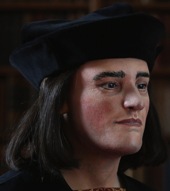
The Richard III Society announced that it is funding the facial reconstruction of the skeleton uncovered during the dig in Leicester, which is at present undergoing all sorts of tests to establish with as much certainty as possible whether these are the remains of King Richard III.

Although these tests have not yet been concluded, those in the know at the Society seem to be fairly confident with what is known so far, if they are prepared to fund a facial reconstruction.  It will be based on a CT scan and be carried out by a leading expert in facial anthropology According to National Geographic this is Caroline Wilkinson of the University of Dundee, Scotland.

It is truly amazing what can be done these days, just remember when last year we were able to see the face of Ötzi, the Iceman, as he himself would have seen it if he had had a mirror 5300 years ago (see for example in this article from the BBC).

The reconstruction of Richard’s face will feature in the Channel 4 documentary which will be broadcast early in 2013 and after that it will be made widely available.

What makes this part of the examination of the remains particularly interesting is that there are no surviving portraits of Richard from his lifetime, nor any detailed description.  The only description we have is by Nicholas von Popplau, who met Richard in 1484:

three fingers taller than I [i.e. von Popplau], but a bit slimmer and not as thickset as I am, and much more lightly built; he has quite slender arms and thighs, and also a great heart.

Though von Popplau’s understanding of English genealogy leaves something to be desired –  he has both Edward IV and Henry VI as Richard’s full brothers – he should be able to give a correct description of a man in whose company he spent some time.

The earliest surviving portraits are those from the Royal Collection and the Society of Antiquaries.  They have been dated to the second decade of the 16th century and were probably based on portraits painted during the king’s lifetime.  X-ray has shown that the Royal Collection portrait has been altered at a later stage, to make one shoulder higher and to give him a meaner expression.  The Society of Antiquaries had also been “updated” at a later stage, but cleaning revealed a more genial expression.

The picture on the right is the portrait which hangs in the National Portrait Gallery in London.  It is suspected to be the copy of a copy of a lost original, and therefore of questionable accuracy.  We might be able to replace this picture at some stage.

Richard III Society chairman, Dr Phil Stone, explained that  the Society is “delighted to provide the financial support for the reconstruction; the revealing of the face will potentially be both an historic and poignant occasion for all who have an interest in this much misunderstood king.”

Philippa Langley, the driving force behind the Leicster dig, added, “To be at the point of seeing what could be the face of the last warrior King of England is an incredibly exciting prospect.”

A sentiment that we all share.

You can find the Press Release in the ‘What’s New’ section on the website of the Richard III Society.

The description of Richard III by Nicholas von Popplau’s description is quoted from:
Livia Visser-Fuchs, ‘He hardly touched his food, but talked with me all the time:  What Niclas von Popplau really wrote about Richard III’, The Ricardian, Vol.XI, No.145 (June 1999), pp.525-530

Tags: , , , ,

25
Dec

CHRISTMAS IN CAMBRIDGE

   Posted by: Dorothea Preis   in News

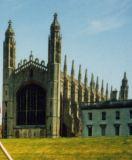
For the festive season here is a special – a segment of  ‘Carols from King’s’ in 2010 at King’s College Chapel, Cambridge, a chapel which was close to Richard’s heart. Beautiful singing in a beautiful setting.

King’s College Chapel, Cambridge (photograph:  Dorothea Preis)

On a visit to the King’s College Chapel in Cambridge more than 20 years ago, I bought a postcard showing “The Kings who built the Chapel”.  In spite of Henry VIII being depicted as the crowning glory, it was the inclusion of Richard III which made me buy the card.

King’s College was founded by Henry VI in 1441.  After Edward IV came to power very little was done to continue and it “suffered severely from [his] hostility”.[Ross, p.135] This changed dramatically, when Richard became King.  He gave instructions that “the building should go on with all possible despatch”.  The result was that by the end of his short reign part of the chapel was in use.[‘History of the Chapel’]

His strong support for the construction of King’s College Chapel was part of Richard’s close and long lasting attachment to the University of Cambridge.  While his connection to Oxford seems to have been cordial enough, his attachment to Cambridge was much closer.  He and his queen Anne Neville had an especially close relationship to Queens’ College, to which they made their first endowment in 1477.

Queens’ was originally founded by Margaret of Anjou and further supported by Elizabeth Woodville, who came to be regarded as a co-founder, which explains the name.  During Richard’s reign, when he made further grants to the College, Queen Anne was also considered a founder, but that was “conveniently forgotten when political circumstances changed in 1485.”[Ross, p.135]  However, Richard is not entirely forgotten:   the badge of the college includes till this day a silver boar’s head.  [‘The College Badge’, Queens’]

When recruiting, Richard displayed a marked preference for Cambridge rather than Oxford graduates.[Ross, pp.132-134]

The special attachment Richard felt to Cambridge was reciprocated by the university and they regarded “King Richard and Queen Anne as liberal benefactors”, who “deserved the annual mass which the university formally established in their honour on the morrow of their state visit in 1484”.[Ross, p.136}

Enjoy the beautiful music.  And may your holidays be happy and peaceful!

Sources:
‘History of the Chapel’, King’s College Cambridge.  URL:  http://www.kings.cam.ac.uk/chapel/history.html Date accessed: 27 July 2010 – This also includes a sketch showing the different construction phases.

‘The Heraldic Arms’, Queens’ College Cambridge.  URL:  http://www.queens.cam.ac.uk/general-information/historical-fun/queens-college/the-heraldic-arms Date accessed: 1 August 2010

‘The colleges and halls: King’s’, A History of the County of Cambridge and the Isle of Ely: Volume 3: The City and University of Cambridge (1959), pp. 376-408. URL: http://www.british-history.ac.uk/report.aspx?compid=66649 Date accessed: 11 March 2010

Charles Ross, Richard III.  Methuen, London, 1988

Tags: , ,

24
Dec

MERRY CHRISTMAS!

   Posted by: Dorothea Preis   in News

Wishing all our readers a very merry Christmas and lots of happiness and peace for the New Year.

The preparations for the holiday season lead us to consider what Richard’s Christmas would have been like, whether it would have been anything like ours.

You would have looked in vain for a Christmas tree in Richard’s family home at Middleham Castle.  For many cultures green branches have symbolised new life and hope for a long time, however, the first record of a Christmas tree can only be found in 1521, in Germany.  The first record for candles on a Christmas tree dates from 1611, when Duchess Dorothea Sybilla of Silesia is reported to have decorated her tree in that way (1).  While it seems that the Christmas tree was introduced to the British royal family by the early 1800s, its use only became widespread in Queen Victoria’s time (2).

And Richard’s son Edward would not have anticipated the arrival of Santa Claus with impatience.  Santa Claus is based on St Nicholas (3) (whose feast day is 6 December, when he leaves sweets and little presents in the shoes of German children).  However, Santa Claus is the predominantly American term for the figure called Father Christmas in England.  His association with Christmas can in Britain only be traced back to the 17th century (4).  While we see Christmas above all as a time for the family to celebrate together, in medieval times it was a time for communities to celebrate together (5).  Nor would the cook at Middleham have served turkey, these were only introduced into Europe from America in the 1520s, and the first record in England dates from 1541 (6).  As you can see, Richard’s Christmas would have been quite different from what we see as typical today. 

adorazione_del_bambino_-_beato_angelicoFra Angelico, Adoration of the Child (1439-43)

The season of Advent would have been strictly observed as a time of fasting, and Christmas Eve in particular was a day without any meat, eggs or cheese.  Only after mass on Christmas Day everyone could enjoy an unrestricted meal again (7).  The Middleham peasants would have expected their lord to provide them with a Christmas meal, often bread, cheese, pottage and two dishes of meat (8).  If you were a nobleman, however, you might be treated to a boar’s head as the main course, served with rosemary and an apple or an orange in its mouth.  If no boar was available [by the 16th century its domesticated equivalent had to be used to keep up with demand (9)], there was goose or venison.   At Middleham you might even have been served swan, smothered in butter and saffron,  as Richard would certainly have been granted the King’s permission –  they are still royal property today (10).

Mince pies did still contain minced meat and at least three spices (cinnamon, cloves and nutmeg)  representing the three gifts given to the Christ child by the Magi (gold, frankincense and myrrh).  The pie shell had an oblong shape to represent Christ’s crib, which is why no medieval person cut a mince-pie with a knife (11).   Our Christmas pudding of today goes back to the medieval ‘frumenty’ (from the Latin word for corn ‘frumentum’), which was made of thick porridge, wheat, currants and dried fruit.  If available, eggs and spices like cinnamon and nutmeg were added (12).

Popular entertainments were liturgical dramas, performed in church, as well as carols (13), which were more communal songs sung at specific feasts rather than in church (14).   Though this was probably changing already, as only 50 years later Martin Luther wrote carols specifically for the church (15).  Christmas gift-giving was usually between people with a legal relationship, such as tenant and landlord (16).

A popular drink was wassail, which comes from the Old English words waes hael, meaning “be well,” “be hale,” or “good health.”   Wassail is a strong, hot drink (usually a mixture of ale, honey, and spices), which was put in a large bowl, and the host would lift it and greet his companions with waes hael, to which they would reply drinc hael, which meant “drink and be well” (17).

And so we wish all of you waes hael for the festive season and the new year!

Notes:

1   “Weihnachtsbaum”. de.Wikipedia. Retrieved 14 December 2009.

“Christmas tree” Wikipedia. retrieved 14 December 2009.

3   Alison Sim, Pleasures & Pastimes in Tudor England.  Sutton Publishing, 2002.  P. 85

4   “Santa Claus”. Wikipedia.  Retrieved 8 December 2009.

5    Sim, p. 85

6    Melissa Snell, “Medieval Christmas Traditions”About.com:  Medieval History.  Retrieved 8 December 2009.

7    Sim, p. 85

8    Peter Hammond, Food & Feast in Medieval England.  Sutton Publishing, 2005.  P. 34

9   Hammond, p. 18

10  Jane Gilbert, “A Medieval Christmas”Time Travel Britain.com.  Retrieved 8 December 2009.

11   Richard Rutherford-Moore, “Christmas traditions in the time of Robin Hood”. BBC Nottingham Feature, December 2002.  Retrieved 8 December 2009.

12  Gilbert

13    Snell

14    “Christmas”Wikipedia.  Retrieved 8 December 2009.

15  For example the lyrics for the popular carol “Vom Himmel hoch, da komm ich her”, based on Luke 2, 9-16, were written in 1535, the melody in 1539, both by Martin Luther.  Evangelisches Gesangbuch, hymn 25.

16  “Christmas”

17    Snell

Tags: ,

23
Dec

RICARDIAN CHRISTMAS SPIRIT

   Posted by: Isolde Martyn   in Meetings, News, NSW Branch News

At the December general meeting of the NSW branch Isolde and Julia entertained us with a variety of sketches with Ricardian themes.  And then it was our turn to get into the swing of things and sing our branch-own Christmas songs.  Here is one of them:

Oh, little town of Middleham,
How still we see thee lie.
But lying more than half a score,
King Richard to decry.
Mancini, Rous and Morton
And Hall and Holinshed
And Henry Tudor added to
The tales to help them spread.

Then Henry’s Polydore Vergil
Had Richard painted blacker,
But Sainted Thomas was a still
More modacious* attacker.
Then up rose Willy Shakespeare,
He too the truth foreswore,
Now we persevere until we hear
Their rotten lies no more.

*Never heard of the word? Neither had we but, being good Ricardians, we realised research was needed and came to the conclusion it is an adjective from the word MODALITY –the capacity to express the speaker’s confidence in the statement he or she is making.
So this might be the
mot juste for Sir Thomas’s history if you believe that he believed it.

(Words: Isolde Martyn and Eileen Larbalastier, a former member.  Photo:  Dorothea Preis)

Tags: ,

15
Dec

JOURNOS V. SCIENTISTS

   Posted by: Dorothea Preis   in Greyfriars Dig, News

Archaeologyedited (16 Dec 2012)

My Google Alert just alerted me to an article from the British Daily Mail, saying that the remains found in Leicester “DO belong to Richard III”.  Please note, I am aware that the Daily Mail might not be the best source, when it comes to accuracy in historical research.

They quote a source with “knowledge of the excavation” revealing that not all evidence was published at press conference in September and that the remains were shown for certain to be those of Richard III.

I have no doubt that not all available information was divulged at that press conference, but the Daily Mail’s assertion that the scientists were holding the news back to achieve greater publicity, sounds to me like too much of a journalist’s approach.  We all know that in the media industry it is vital to get the news out first, no matter whether they later on turn out to be inaccurate.

However, I would think that scientists first want to make absolutely sure that what they announce is actually true.  This point was also made clear by a spokesman of the University of Leicester saying that “everything we were willing to reveal and that we were sure of, we revealed (in September).”

Maybe that just sums up the difference between some journalists and scientists.

There is quite a variety of indications that the Daily Mail’s assertion might very well turn out to be true, and I most certainly hope so, but in the end, I would prefer to have scientific evidence rather than the say-so of some unnamed source with “knowledge of the excavation”.

In response to the Daily Mail story The University of Leicester issued a statement denying that they withheld any additional evidence at the press conference in September.  They stressed that the tests have not yet been completed, but so far they “are yet to find strong evidence to challenge our original hypothesis”.  The results will be published early in the 2013.

They also added that they will not benefit financially from the Channel 4 production, as they value the “complete academic independence in [their] judgement.”   Ricardians are often asked why we care about someone who has been dead for over 500 years.  We care because we care about justice, which can only be based on independent research.

You can find original article here:

Anthony Bond, ‘Human remains found in Leicester car park DO belong to Richard III… but scientists are holding back findings until Channel Four documentary is aired, claims insider’, Mail Online (15 Dec 2012).  URL:  http://www.dailymail.co.uk/news/article-2248448/Human-remains-Leicester-car-park-DO-belong-Richard-III–scientists-holding-findings-Channel-Four-documentary-aired-claims-insider.html Date accessed:  15 Dec 2012

The response is here:

‘Search for King Richard III: Statement from the University of Leicester, 15 December 2012’, University of Leicester (15 Dec 2012).  URL:  http://www2.le.ac.uk/news/blog/2012/december/statement Date accessed:  16 Dec 2012

Tags: , , ,

15
Dec

MUSIC TO MAKE THE WAIT EASIER

   Posted by: Dorothea Preis   in Greyfriars Dig, News

We all often feel that music can make a boring or unpleasant task easier.  An impression that the University of Leicester shares.  To make the wait for the results of tests being carried out on the male remains found during the Greyfriars dig easier, a concert of medieval music “which will tell the story of King Richard III’s life” has been announced.

The idea is to bring together a collection of music from the times and places Richard would have known.   The music is to be performed by a recorder trio, TritonE, led by Janet Forbes.  She has been researching the kind of music which would have been around in England during Richard’s youth, but also music he would have encountered during his time in Burgundy.

Here he might have heard music from the Glogauer Liederbuch, a collection of 3-part instrumental arrangements of popular songs.  These are not songs which would have been used in a liturgical, ceremonial, or political context, but rather is full of tunes to be played for fun by anyone.   The book has been regarded as the first documented intersection of music and the market. [Wallmark]

In addition to songs from the Glogauer Liederbuch there will also be other music from the Franco-Flemish area.  As Janet Forbes said:  “We are trying to pick music from places he visited and pieces written about things he was doing.”

The concert is organized by the archaeological team behind the Leicester dig.  Prof Lin Foxhall, Head of the School of Archaeology & Ancient History at the University of Leicester, said that the concert would offer another perspective of Richard and his times through the sounds he would have heard.  We know that Richard appreciated good music, because his visitor Nicholas von Popplau listened at his court to “the sweetest music he had ever heard”. [Visser-Fuchs]

The concert will take place on 11 January from 18h30 to 19h30.  Tickets are £5 for the general public, however, for most of us in New South Wales the airfare would have to be added to this, making it perhaps a tad pricey to attend.  For our readers, who are in the Leicester area, this should be a great way to spend the time waiting for the results, expected for early next year.

For all of us who cannot attend the concert but may appreciate some music to make the wait easier, here is a song from the Glogauer Liederbuch on YouTube.  It is called ‘Die Katzenpfote’ (The Cat’s Paw).

References:

‘Concert to tell story of King Richard III’s life through medieval music’, University of Leicester Press Office (14 Dec 2012).  URL:  http://www2.le.ac.uk/offices/press/press-releases/2012/december/concert-to-tell-story-of-king-richard-iii2019s-life-through-medieval-music Date accessed:  15 Dec 2012

Dr Livia Visser-Fuchs, ‘Richard III’s personal interests’, Richard III Society.  URL: http://www.richardiii.net Date accessed:  9 Aug 2010

Zach Wallmark, ‚Glogauer Liederbuch‘, The Taruskin Challenge (22 Nov 2009).  URL:  http://taruskinchallenge.wordpress.com/2009/11/22/glogauer-liederbuch/ Date accessed:  15 Dec 2012

Tags: , , ,

14
Dec

REVIEW OF THE GENERAL MEETING ON 8 DECEMBER 2012

   Posted by: Leslie McCawley   in Meetings, News, NSW Branch News

The last meeting of the year was held on Saturday, 8 December 2012, with old members and new, and various friends visiting from other branches. Judith, our branch chairperson, welcomed a full house and was followed by Judy with a brief treasurer’s report. She confirmed that all the renewal fees had been received and were now en route to the UK.

Our branch secretary Julia then discussed the ongoing news from Leicester about the parking lot dig where the suspected remains of Richard III have been unearthed. It is a very exciting time to be a Ricardian and the timing is excellent to pique the interest of the general public for the upcoming convention. The convention deadline is fast approaching so please get your registrations in soon. There is a lot of work involved in putting on an event so all offers of volunteer assistance are welcome, please contact any of the committee members if you can help. Julia also made a plea for a replacement for her role as branch secretary, as she will be leaving soon and needs time to hand over a lot of business to her successor.

The webmaster’s report was then given by Dorothea, who reminded us that it is a lot of work to keep it active and interesting, and she would like to think that all members with an internet connection are reading it regularly. There are still increasing numbers of international visitors to the website, and that is high praise. The website also features book reviews and links to an every growing array of fascinating late medieval oriented websites.

One of Dorothea’s most recent posts was a link to a Canadian TV news report on the progress of the identification of the remains found in Leicester, which was very interesting and well worth watching. Author John Ashdown-Hill was interviewed, along with the forensics experts who reported the skeleton as having scoliosis of the spine, a significant head wound and the presence of an arrowhead near the spine. Also featured was a 17th generation Canadian descendant of Richard’s mother, Cecily Neville, whose maternal DNA will hopefully help to confirm the skeleton as Richard’s.

Dorothea then distributed the always well-written branch journal, The Chronicles of the White Rose, one of the best perks of membership.

Lynne then gave her report regarding the stores of memorabilia, and presented a sample of the appealing pewter boar lapel pins now available on order.

Our program for the day was a very interesting talk by our treasurer Judy about her April attendance at the 11th Triennial Conference at the University of Loughborough, Leicestershire, UK entitled “Bosworth and Warfare: New Finds, New Ideas.” Many experts on late medieval warfare spoke about all aspects of war in the era of interest.  Judy’s detailed presentation is posted on our branch website, and well worth reading, as it was fascinating!

Following Richard’s body from Bosworth to Leicester, Dorothea gave a short update on the dig and the find of male remains as well as the variety of tests being performed on the remains.

A highlight of this holiday meeting was a performance of vignettes written and performed by Isolde and Julia. This included cleverly reworked Christmas carols with Ricardian commentary for group singing (e.g. ‘Away in Some Danger’ and ‘O Little Town of Middleham’); a play about Elizabeth Wydville’s dim prospects as a single mum; and a list of personages never to be invited to a Ricardian Christmas, including Thomas More, Lord Stanley, and Henry Tudor.

The first meeting of the new year will be on 9 February 2013, with invited guest speaker Rosamund Burton who will be talking about the ancient pilgrim path in Waterford, Ireland known as Saint Declan’s Way.

Tags: , , , ,

14
Dec

AMAZING AMAZON JUNGLE DISCOVERY

   Posted by: Julia Redlich   in Bookworm

David Grann, The Lost City of Z, Simon & Schuster, 2009; paperback edition published by Pocket Books. ISBN 978-1- 84739-443-9

Well, not exactly. However, it is strange how very small Ricardian connections can be found in the most unlikely places. Reading a non-fiction book, The Lost City of Z (a must read for lovers of Conan Doyle’s The Lost World and Brian Fawcett’s Exploration Fawcett) I was abruptly stopped in mid-read about lizards, snakes, poison arrows and other must-sees on Amazon exploration by a familiar name. Sir Clements Markham.

We know him, of course, for his Richard III: His Life & Character in the Light of Recent Research and its appearance in Josephine Tey’s The Daughter of Time. So how did he earn a mention here?

Sir Clements, it appears, was at one time a president of the Royal Geographical Society that had sponsored Fawcett and he had been partly responsible for the failure of the Brazilian rubber boom. Markham had “engineered the smuggling of Amazonian rubber tree seeds to Europe”, from where they were distributed to plantations throughout British colonies in Asia where rubber production was easy and cheap and abundant.

And his cunning plan had left once-wealthy Amazonian centres as ghost towns, a fact that Colonel Fawcett discovered after a six-year absence.

A small footstep making its mark in a fascinating book – but a warning about the index in the paperback – an edition that suited my budget admirably – omitted to edit the original index so consequently the page numbers are way out of kilter, thanks to small print and page size. Once realised, you can shuffle back three or four pages to find the reference, but that spoils much of the pleasure of reading and learning.

Tags: ,