18
Mar

Ricardian Bulletin

   Posted by: Dorothea Preis   in News, Society News

The March 2014 Ricardian Bulletin has just arrived in my letter box.  If you haven’t received yours yet, it should get to you within the next days.

As always, the Bulletin contains a wide variety of fascinating articles.  I am especially looking forward to reading the Man Himself section, which investigates ‘The scoliosis of King Richard III’.  The article is by Dr Peter Stride from Queensland, who gave such an insightful talk on this topic at the Australasian Convention in 2013.

There is an interview with Philippa Langley and Wendy Moorhen looks at ‘The new Ricardian era:  the impact of the Greyfriars dig on the Society and its work’.  Another article looks at Richard III’s chapel at Towton and one at ‘How to rebury a medieval king:  a lost rite of reinterment’.   Other treats are an article on George, Duke of Clarence, one on William Hobbys, and so much more.

I have just put the kettle on and am looking forward to some serious reading!


This essay was written by Rachel during the course of her studies towards a Master’s degree at the University of New England.

 “Have you drunk any malificium, that is, herbs or other agents, so that you could not have children?”[1]

Were contraceptives and other means of family limitation such as abortion, infanticide, and child abandonment practised in medieval Western Europe?  If so, what remedies and methods of contraception were used, to what extent, and were they successful?  Early research into the topic concluded that contraception was virtually unknown in the Middle Ages and that medieval people did not have a ‘contraceptive mentality’. [2]  However, more recent investigations have produced a plethora of writing which clearly demonstrates that medieval society not only knew about various forms of contraception and abortifacients; they used them to such a degree that medical texts, church doctrine and the common literature of the time are strewn with references to their use.  Documents are littered with contraceptive recipes and methods and contain warnings and prohibitions against certain herbs, many of these originating in antiquity.  Contemporary research into the history of human fertility control has therefore ceased to ask when contraception became common place and effective, and instead questions how family limitation was practised prior to the eighteenth century.[3] The idea and practice of controlling the number of children conceived and born has been employed across all cultures through time, although the methods and efficacy vary.[4]

Read the rest of this entry »

Tags: , ,

13
Feb

L’Abbeye Royale de Fontevraud

   Posted by: Dorothea Preis   in Medieval Miscellany

This is the second part of the talk Bruce MacCarthy gave at the general meeting of the New South Wales Branch on 8 February 2014.

Fontevraud Abbey is where Henry II, Eleanor of Aquitaine, Richard Coeur de Lion and Isabella of Angouleme were buried.  Today, within the abbey church one can see their recumbent effigies, though their bodies are no longer there.

The Abbey is located in the Pays de la Loire region, approximately 65 km south east of Angers, and about 300 km south west of Paris – 3- 4 hours of driving from Paris (longer if you are cautious about driving on the right hand side of the road.)  It was considered one of the greatest monastic cities in medieval Europe.  The Abbey is impressive both in its size and its originality.

The Order of Fontevraud was founded around the turn of the 12th century by Robert of Arbrissel, an itinerant reforming preacher.  The first permanent structures were built between 1110 and 1119.  There was a group of monasteries.  Saint Marie housed nuns and Saint Lazar housed lepers;  Saint Benoit was for the sick and La Madeleine was for “fallen women.”  Saint Jean l’Habit housed monks.  Interestingly, given the dominance of men in those days, the overall community was managed by an abbess, as had been decreed by the founder, and it became a refuge for women from noble families, especially repudiated queens and daughters of royal and aristocratic lineage.

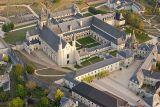
Fontevraud-General view of the complex - smlGeneral view of Fontevraud Abbey (photograph by Pierre Mairé, obtained under the Creative Commons Attribution-Share Alike 3.0 Unported license)

The counts of Anjou had supported the Abbey over the years.  Indeed, one of Henry II’s aunts was Abbess there.  Over the years there were numerous noble abbesses, including members of the Bourbon family.

Given his family long association with the Abbey, it was not surprising that Henry II was buried there after he died in France.  Richard also died in France, and his request to be buried at the feet of his father was honoured.  Eleanor retired to the Abbey and became a nun.  When she died, she was buried beside her late husband.  Although John died and was buried in England, his son Henry III apparently crossed to France to witness the burial of his mother Isabella at the Abbey.  Later, his heart and the heart of John were buried at the Abbey.

With the fall of the Angevin empire, the fortunes of the Abbey suffered.  While it was protected by the Bourbon family during the religious wars of the 16th century, its life as a functioning Abbey ended during the French Revolution.

Following a Revolutionary decree in August 1792 which ordered the evacuation of all monasteries, and the Order of Fontevraud was dissolved.  The last abbess a Madame d’Antin, died in Paris in poverty.  The Abbey was pillaged by revolutionaries in 1793 and the Royal tombs were desecrated.  As far as I am aware, no one knows exactly what happened to the bodies of the Angevins, but fortunately the effigies remain to this day, as I saw to my delight in October 2010.

Prison

The decision by Napoleon to transform the Abbey into a prison in 1804, saved it from destruction.  It remained a penal institution from 1804 until 1963 but, as prisoners were used as labourers on the transition from penal facility to its former life as a monastery, the very last prisoners left Fontevraud as recently as 1985.

Cultural Encounter Centre

The Abbey of Fontevraud is the icon for the UNESCO World Heritage Site of Val de Loire. Today, as a “Cultural Encounter Centre,” the Abbey is a renowned site for concerts, symposiums and exhibitions.  It also plays a role in creative development thanks to artists’ residencies that are welcomed by the abbey.

On offer at the Abbey is a range of thematic visits off the beaten path that can be shared with the whole family: “The underground passages”, “The last days of the Abbey: before the Revolution”, “The Central prison ” and also “The nuns’ daily life”.

Having been a monastic town for seven centuries, the Abbey of Fontevraud has an architectural style rich in terms of spiritual meaning but also punctuated by the manual activities, which were part of everyday life there.  One can walk in the footsteps of the nuns, and explore the Roman kitchens, the cloisters, the dormitories and the large refectory.  It was in the process of being restored when I was there and no doubt it is now in even better shape than it was four years ago.

Staying there

For those who have always dreamt of sleeping in an abbey, the “Hotel du Prieuré Saint Lazare” offers 52 rooms.  Ours was a comfortable ensuite room overlooking an orchard.

The hotel has mod cons like Wifi, and the gastronomic “Saint Lazare” restaurant.  Guests at the hotel are free to enjoy the site and amble around the gardens.

There is so much to see at Fontevraud, that one could spend days wandering around the Abbey and the surrounding town.  I commend it to you as a “must see” visit on any trip to France.

Tags: , , ,

12
Feb

The Angevin Kings and Queens

   Posted by: Dorothea Preis   in Medieval Miscellany, Medieval People

This is the first part of the talk Bruce MacCarthy gave at the general meeting of the New South Wales Branch on 8 February 2014.

Introduction

Today, some historians divide the Plantagenets into four distinct Royal Houses: Angevins, Plantagenets, Lancaster and York but, collectively, the Plantagenet family as they are now known formed the longest-running dynasty in British history, with 14 kings over more than 330 years from 1154 to 1485.  Even if we similarly group together the Hanoverians and their successors, from George I onwards, they have so far provided only 11 kings and queens and are only in their 300th year in 2014.

In my two journeys to Europe, I have always tried to visit places with Plantagenet connections.  For example, I have been to the ruins of Dürnstein Castle, where Richard I was held captive by Duke Leopold of Austria in 1192-3.  In May 2008, my wife and I toured King John’s castle in Limerick.  This castle was built on the orders of King John, and was completed around 1200.  It is well worth a visit for the excellent historical displays.  Of course, we also visited the Richard III Museum in York, when we were there in 2010, and I recall an article on this museum in your 2011 journal.

Read the rest of this entry »

Tags: , , , ,

12
Feb

Review of the February General Meeting

   Posted by: Leslie McCawley   in Meetings, News, NSW Branch News

meetingThe first branch meeting of the new year was convened on Saturday, 8 February 2014, back at the Sydney Mechanics School of Arts building on Pitt Street, after a year of meeting at a venue in the Rocks. There was a very good turnout of members, including a young visitor interested in learning more about Richard for their HSC studies.

Welcoming remarks were offered by our Chairperson, Judith, followed by very brief remarks from the Treasurer, Secretary, and Sales Officer each reporting that all was well in their particular area of responsibility. The Webmaster advised that the branch website had been upgraded and was now working better than ever.

Bruce MacCarthyOur guest speaker was the former Member for Strathfield, Mr Bruce MacCarthy, with an in-depth review of the Angevins and Plantagenets, including the dramas between cousins Stephen and Matilda, the marriage of powerful Eleanor of Aquitaine and Henry II, two of whose sons – Richard and John – both became Kings. He explained that his interest in the Plantagenet dynasty had begun when he was only 5 years old, when his father obtained a copy of his family tree. It had originally been prepared as evidence in an application to the House of Lords for a vacant peerage, sadly unsuccessful. At the top of this family tree he had seen the name of a king – King Edward III. He told us that the claim was not proven, as there was an area of doubt in the late 1600’s; but the idea of having a King as an ancestor had fascinated him. He and his wife paid a visit several years ago to Fontevraud Abbey in France’s Loire Valley, where King Henry II, Eleanor of Aquitaine, and (parts of) King Richard the Lionheart are buried, and he was able to tell us a great deal about the beauty of this place and how much it meant to him. The text of his talk is on our website.

After the excellent presentation, the raffle was drawn with prizes including many fine books kindly donated to the branch by Kevin from his personal Ricardian collection. We then had a lovely afternoon tea augmented with food generously shared by the Australian Chinese Women’s Association, which was meeting in the next room. There was ample time for chatting, and catching up, and it was a good start to another exciting year for Ricardians.

The 12 April 2014 meeting will feature the Dean and CEO of the Sydney College of Divinity and formerly University of Sydney’s Senior Lecturer in Middle English Studies, Dr Diane Speed, on the topic of ‘Medieval storytelling and illustrations’. It is sure to be a wonderful talk, and we hope you will be able to join us.

Tags: , , , ,

5
Feb

MEDIEVAL JEWELLERY

   Posted by: Lynne Foley   in Medieval Miscellany

The following is the text of Lynne’s fascinating talk from the December meeting of the NSW Branch.

The transcendent, timeless beauty of medieval jewels has not diminished with the passage of time.  Made from precious metals – gold, silver and gemstones, the pieces that have come down to the present day still retain their beauty and quality of craftsmanship.

The humbler ranks in society had their jewellery too, but made of base metals, iron, pewter or copper, and  in place of gemstones, coloured glass. The less well-off left no wills or inventories of goods, no portraits so most of our information deals with the upper classes.

Silver was much more common in the 12th and 13th century and rich mines in Germany supplied silver in great quantities.

Gold was the most valued metal of all, and Cheapside, the principal thoroughfare from St Paul’s to the Tower, became the hub of the goldsmithing industry.  Some goldsmiths were in holy orders and monasteries were good customers, in need of chalices, cups, censers etc. used in services.  Abbot Sugur of St Denis, well known for his love of rich vestments and gold pieces, justified the work of goldsmiths at his abbey by saying that such display was to praise God.

Due to a shortfall in gold from the mines of Western and Central Europe, recycling of older pieces was high.  Ancient coins, jewellery or other gold objects were melted down and reused.  We are lucky that in such circumstances, so much has survived.

Gemstones were largely supplied by trade. Travelling merchants obtained   stones  such as rubies, sapphire, emeralds, diamonds and turquoise from the East – India, Ceylon, Arabia and Persia.  Germany and Russia were sources for amethysts.

All metals – base or precious – were worked by a smith beginning with an ingot which was hammered into a sheet for working, or the metal could be heated until molten and poured into a mould. Such a mould was found in Ashill in Norfolk. It was dated to about 1300 but its current location is unknown.

Surface decoration took many forms – engraving of patterns or letters using a fine tool on the front of the piece; the use of a hammer and punch on the back of the sheet, and adding colour by setting the piece with gems.

Another way to add colour was enamelling – this technique is essentially ground glass fired at very high temperature onto the metal surface. A type of enamelling found on medieval jewellery is champlevé, the metal was deeply engraved with a design, filled with ground glass and fired. Basse taille was translucent enamel which allowed light to be reflected from the gold or silver surface, giving a sparkling effect that as Campbell asserts, no modern goldsmith has ever surpassed.

Perfected in Paris as early as 1400, émail en ronde basse, is the technique which allowed objects to be enamelled in the round by fusing molten glass to gold.

An item showing the beauty of enamel work is the Dunstable Swan. It was found on the site of a Dominican priory in Dunstable, Beds. and owned possibly by a member of the De Bohun family, whose sign was a swan.

Until the fifteenth century, gems were polished, not cut, and irregular gems were held in place with a lip of metal or a four or five-pronged claw setting. Pearls were pierced for sewing onto clothing or mounted on a tiny rod projecting from the body of the pearl.

Several hoards of medieval jewellery have been found – the Fishpool Hoard was voted one of the top ten British treasures. The hoard contains 1237 gold coins mainly dating from the reign of Henry VI and gold jewellery.  Possibly it may have been part of the Lancastrian treasury; concealed by a survivor of the Battle of Hexham who may have died of wounds or killed in a subsequent battle before the treasure could be retrieved. The hoard remained secreted in Sherwood Forest until 1966.

One of the most famous hoards is that called the Cheapside Hoard found in a cellar in 1912.  Again death being a probable reason why the pieces were never retrieved.  Although, as it falls at the end of the period under discussion, it deserves a mention.

The hoard is a veritable Aladdin’s cave; the pieces date from the Elizabethan to Jacobean period and are of the highest quality. An emerald watch is not only one of the most spectacular items in the hoard, it is unique. Other medieval watches exist but none like this.

The maker has cut the lid and case out of one rough emerald or two prisms of matching size, colour and translucency. In fact, there is so much light, the case need not be opened to tell the time. The dial features champlevé enamel; Roman numerals mark the hours and the dots half hours. The hands are lost as is the mechanism, but x-rays have revealed how the watch was driven. The loss of the hands and mechanism may be due to the watch being ajar, allowing water to enter.

The salamander was a popular jewellery design throughout Europe, particularly Spain.  The Cheapside example is made of emeralds; its feet and undercarriage display opaque white; it has flecks of black enamel indicating the scaly flesh of a salamander and a coral tongue, though the tip is snapped off – perhaps during recovery.

For any member who may be visiting London from now until the 27 April 2014, the jewels are on at the Museum of London, Docklands.

Two finds of interest to us are the Middleham jewel, found in 1985 and the Middleham ring, found in 1990.

The Middleham Jewel (photograph by Jonathan Cardy, obtained through Wikimedia Commons)

The Middleham Jewel is a lozenge-shaped pendant, engraved with religious scenes and figures. The front has a large sapphire, a Latin inscription and an engraving of the Trinity.  The reverse side has an exquisitely engraved Nativity scene. This piece is dated to the third quarter of the fifteenth century.  It has slots on the side for pearls, which over time have disintegrated.

The Middleham ring is inscribed with 12 letters ‘S’ on the outside and on the inside with the word ‘sovereynly’ which is thought to mean ‘in a lordly manner.’

The significance of medieval jewellery goes beyond its material or decorative value – in medieval times it served many more purposes than today.

Jewellery was used as symbols of affection or to cement alliances such as the betrothal ring sent to Margaret of York by Charles the Bold; stones were thought to  have magical powers; mainly in powdered form, gems were used as medicines. Before the existence of banks, gemstones and jewellery were well regarded as security for loans and were a form of portable wealth. Jewellery served also religious functions and complemented clothing both for adornment and practical application – brooches were useful in pinning together layers of clothing.

For the nobility, gemstones and jewellery were an unmistakable signal of social standing, wealth and influence.

At the highest end of the social scale was the king, who was expected to maintain a grand estate appropriate to his royal dignity. In this, Edward IV did not disappoint.

From surviving accounts we know that Edward’s routine expenditure on jewellery was considerable. In July 1461, he redeemed from the executors of Sir John Falstoff two valuable jewels which had been pledged by the king’s father Duke Richard, who had owned also a jewelled collar valued at £2,666 – a fabulous sum for the times.

Edward spent £125 on a jewelled ornament ‘against the time of the birth of our most dear daughter Elizabeth.’  In 1469, although a cash-strapped Edward was pawning jewels to raise money, he still found spare change of  £930 for jewels supplied by John Barker and Henry Massey, two London goldsmiths.

A bill survives from Cornelius the goldsmith which gives an idea of what purchases comprised. A few examples are: a gold cross set with a diamond, 4 rubies and 7 pearls; a flower shape with a green sapphire; a toothpick of gold, garnished with a diamond, ruby and pearl; and gold rings garnished with 4 rubies.

On another occasion, Ross says that Edward had bid – unsuccessfully – £3000 for a huge diamond and ruby ornament owned by the Grimaldi brothers.

On his accession, Edward not only reformed coinage but also changed the design of the noble. Featuring a king holding a sword standing in a boat. Edward placed a rose on the boat and practically obliterated the cross on the reverse by his sign of a blazing sun and another rose.

Considered to be one of masterpieces of the medieval times, it is the position of the suspension loops that is notable. Suspension with either side showing would render the design either askew or upside down.  Therefore it is thought that the pendant was designed to be held up to the face. The coin was not reissued after 1471 and existing stocks were popular. The surviving example would have been owned by a supporter of the family York or of Edward himself.

Upon Edward’s death a coat of gilt mail with his arms embroidered in pearls, gold and rubies, survived until 1642 when it was destroyed by the Parliamentary soldiers.

King Richard was no less aware than his brother of the need for kingly magnificence and display, but with one exception, it is difficult to find evidence of his ownership and use of jewellery.

The exception mentioned is that as Duke of Gloucester, Richard wished to buy a fine emerald owned by Sir John Pilkington. He refused to sell and Richard had to accept that decision.  In his will, proved in 1479, however, Pilkington stated that “I will that my lorde of Gloucestre shall have a emerald set in gold for which for said lorde would have given me c marc.’

In 1529, Henry VIII gave Ann Boleyn a fine emerald – the same one? We will never know.

Ecclesiastical jewellery was just as beautiful as that made for secular use.  Reliquary rings and pendants were used to house alleged relics whose power was their proximity to the body.

Another well-known example is the Wyckham jewel. Made in Paris about 1400, it is set with a ruby in the middle; it shows the Annunciation and carved into the letter ‘M’ for the Virgin Mary. It was given to New College Oxford by its founder, Bishop William Wykeham.

Nature as a source of design was prominent from the late C14th to the early C15th.  The All Souls jewel, made of sheet of gold shaped into a flower, is covered with opaque white enamel and set with a pink tourmaline is rare in two respects–  the ronde bosse enamel is intact and pink tourmaline was a gem not used in quantity until the19th century.

Campbell suggests that the condition of the jewel was probably due to its coming into the care of All Souls College soon after its manufacture. An extant record shows that it was received by the college in 1466.

I would like to conclude this introduction to the world of medieval jewellery with this thought:

‘Very many people find that a single gem stone alone is enough to provide them with a supreme and perfect aesthetic experience of the wonders of Nature.’
Pliny the Elder, Natural History, Book 37, ‘On Gems.’

Bibliography:

1.   Marion Campbell, Medieval Jewellery. V & A Publishing, 2011
2.   John Cherry, Medieval Goldsmiths
3.   John Cherry, The Middleham Jewel and Ring
4.   Gareth Dean, Medieval York. The History Press
5.   Princely Magnificence: Debrett’s Pty Ltd 1981
6.   Hazel Forsyth, London’s Lost Jewels. Museum of London Publishing 2013
7.   ‘The Will of Sir John Pilkington’ – published by the Richard III Society, 2012
8.   Alan Robinson, Masterpieces:  Medieval Art. British Museum Press  2008
9.   Charles Ross, Edward IV
10. Dora Salley, ‘Medieval Jewelry’, Central European University http://web.ceu.hu/medstud/manual/SRM/jewel.htm#raw

Tags:

4
Feb

THE BATTLE FOR RICHARD III

   Posted by: Dorothea Preis   in Greyfriars Dig, News

film_reel smOn Monday, 3 February 2014, BBC 1 broadcast a programme in the UK on what has gone wrong since it was revealed a year ago that the remains found in Leicester are indeed those of Richard III.  It investigates how a High Court hearing will affect the king’s final resting place.  Both parties, Leicester University and Plantagenet Alliance, were interviewed.  While we in Australia cannot watch the programme easily on the BBC iPlayer, some excerpts are available here.

Tags: , , ,

2
Feb

Our Next General Meeting

   Posted by: Leslie McCawley   in Meetings, News, NSW Branch News

Our Next General Meeting – Saturday 8 February 2014 – 2:00 PM


Our guest speaker will be former Member for Strathfield, Mr Bruce MacCarthy (above), speaking on ‘The Angevin Kings and Queens’. His interest in the Plantagenet dynasty was sparked at the age of 5 when his father was given a copy of their family tree, which was originally prepared as evidence in an unsuccessful application to the House of Lords for a vacant peerage. At the top of this family tree he saw the name of a king – King Edward III.

Bruce explains that the claim was not proven, as there was an area of doubt in the late 1600’s; but the idea of having a King as an ancestor fascinated him as a boy, and sparked his avid lifelong interest in genealogy. In 2010, he and his wife paid a visit to Fontevraud Abbey in France’s Loire Valley, where King Henry II, Eleanor of Aquitaine (above), and King Richard the Lionheart are buried.

PLEASE NOTE: The meeting will be at the Sydney Mechanics’ School of Arts, Level 1, 280 Pitt St, Sydney.

Tags: ,

30
Jan

Richard III by David Baldwin

   Posted by: Dorothea Preis   in Bookworm

Book Review:  RRichard III by David Baldwinichard III by David Baldwin

David Baldwin, Richard III.  Amberley Publishing, 2012.  ISBN 9781445601823

This review was presented at NSW Convention in Mittagong in May 2012.  We apologise for the delay in posting it.

Richard III by David Baldwin was published on 28 February 2012, so well before the remains of Richard III were found where they had been buried in the church of the Leicester Greyfriars.  However, it should not be forgotten that Baldwin had as early as 1986 published the hypothesis that his remains were still where they had originally been buried, [1] I had ordered the book as soon as it came out, expecting some new insights. Once I had received it and saw the endorsement by Philippa Gregory on the back, I started wondering though, whether I had not made a huge mistake.

The subtitle is “Ruthless hunchback or paragon of virtue, the true story of the last Plantagenet king”, which does reflect what Baldwin sets out to do.  As he explains in his Introduction “It seems improbable that any human being could be as evil – or alternatively as misunderstood – as Richard, and … somewhere behind all the conflicting argument stands a real man who had both qualities and failings.  Neither black or white, but – like all of us – somewhere in between”. [pp.10-11]  An admirable aim, but we’ll have to see whether he can achieve it.

Baldwin follows a chronological approach.  Starting with Richard’s birth and finishing after Bosworth with a chapter on “Legacy & Legend”.  On the whole he is reasonably fair, the chapter on Richard as Warwick’s heir in the North is a case in point.  Richard has often been blamed for being excessively aggressive in extending his interests during this period, but Baldwin puts this into its historical context and shows that Richard’s behaviour was just normal.  He was no worse than others, but as the king’s brother he had obviously more scope for extending his interests, though they were not necessarily to the detriment of others.  Baldwin also stresses that this was not only the normal behaviour for a medieval nobleman, but would also have been expected of him.

While I have some reservations about Baldwin’s analysis of how Richard III came to the throne, it has to be said that this is unquestionably a period on which views are at their most partisan.  I found his heavy reliance on Thomas More – strawberries and all – and Mancini somewhat limiting, especially – as we shall see later – considering Balwin’s view on the legends surrounding Richard.  He does, however, reject the notion that the crown was what Richard had always wanted, but rather that “he was seizing an opportunity rather than fulfilling an expectation”. [p.104]

On the question of the fate of the princes, Baldwin thinks that the elder, Edward, died of natural causes, while the younger, Richard, survived.  This comes as no surprise, considering that he wrote The Lost Prince five years previously, where he set out to show that the mysterious Richard of Eastwell was in reality the younger son of Edward IV.

Baldwin shows that Richard’s reign was always rather insecure, which was why a nobody like Henry Tudor could actually manage to overthrow him and stay in power.  He explains that Richard’s legacy are the progressive laws of his only parliament, which “affected the lives of Englishmen far into the future”. [p.216]  He concludes that “Richard’s achievements are arguably greater than those of some kings who reigned for longer, and there are indications that they would have been greater still if he had been allowed more time” [p.219]

As for the legends surrounding Richard I agree when he says that “It was perhaps inevitable that a king who both gained and lost his throne in such dramatic circumstances would be become the stuff of legend” [p.228], but that these do not tell us anything about him personally.

On the whole I think Baldwin does quite a good job at showing Richard as a “man who is … both principled and unprincipled, a flawed diamond” [p.228]  I don’t think that he offers much new for someone who knows the period reasonably well, but would be a good introduction.

It is a pity, however, that Baldwin occasionally adopts a fictional approach.  This begins in Richard’s childhood when we meet a boy at Fastolf Place, who “eagerly anticipated trips into the bustling city [ie. London] beyond the wall”.  [p.17]  Later, during the dramatic events of May/June 1483, we learn that “Richard … worried constantly about the future, searched his conscience many times over”. [p.99].  Obviously we have no idea how Richard felt and assumptions like these, which do nothing to explain the events, have no place in a work of non-fiction.

With some reservations I can recommend this new book on Richard, though I would not class it as “must read”.

[1] David Baldwin, ‘King Richard’s Grave in Leicester‘, Transactions of Leicester Archaeological and Historical Society, Vol. 60 (1986), pp.21-24

Tags: , , ,

26
Jan

RICHARD III IN GLASS

   Posted by: Dorothea Preis   in News

A local Leicester artist, Brad Cooke, has been commissioned to create a stained glass window for the visitors’ centre, currently under construction in the building of the former Alderman Newton’s School in Leicester, next to spot where Richard was originally buried in the church of the Greyfriars in 1485.

The window, 2.8m high and 2.3m wide, will feature Richard III, Anne and their son Edward, all life-sized.  As Richard died in battle, he will be shown in a full suit of armour, probably in silver and gold, clutching his sword and crown.

To make the piece “thought provoking” Richard will be slightly separated from his wife and son.  The plan is to display Anne in the colours she was married in and to drape Edward in the national flag of that time.

The window will be back-lit with three lights, which would go off one by one in the order in which the three family members died to relate to the story.

Stained glass has been used in churches since the 7th century, so this craft which Richard would have known in his lifetime is very suitable for a depiction of him and his family.

More information:

Richard III Visitor Centre to get life-sized window of King’, BBC News Leicester (18 January 2014).
Peter Warzynski, ‘Richard III: Knighton artist Brad creating stained glass window of king for visitor centre’, Leicester Mercury (24 January 2014).

Tags: ,