10 NOVEMBER 1480
Birth of Bridget of York, tenth child and seventh daughter of Edward IV and Elizabeth Woodville, at Eltham Palace, London. She became a nun at Dartford Priory. Died in 1517.
Tags: Edward IV, Elizabeth Woodville, Family
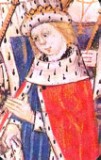
Death of Katherine of York at Tiverton Castle, Devon. Katherine was the 9th child and 6th daughter of King Edward IV and Elizabeth Woodville, born in 1479, probably at Eltham Palace. She was married in 1495 to Sir William Courtenay.
Though a staunch supporter of Henry VII, William was suspected of being involved in the conspiracy of the Yorkist claimant Edmund de la Pole. He was attainted and spent the rest of Henry VII’s reign in prison. He was released after the accession of Henry VIII in 1509 and was created earl of Devon on 10 May 1511. However, he had not long to enjoy his new status and died a month later on 9 June 1511.
The couple had three children, including Henry Courtenay who was executed by orders of Henry VIII in 1539
After her husband’s death, Katherine took a vow of chastity and enjoyed a life of luxury and hunting, but also religious devotion. On surviving documents she called herself ‘the excellent Princess Katherine, Countess of Devon, daughter, sister and aunt of kings’.
She was buried at St Peter’s Church, Tiverton.
Source: ODNB on ‘Katherine, countess of Devon (1479–1527)’ by Margaret R. Westcott.
(Picture of Katherine of York obtained through Wikimedia Commons)
Dorothea Preis
Tags: Edward IV, Elizabeth Woodville, Henry Tudor, Henry VIII
Birth of Bridget of York, tenth child and seventh daughter of Edward IV and Elizabeth Woodville, at Eltham Palace, London. She became a nun at Dartford Priory. Died in 1517.
Tags: Edward IV, Elizabeth Woodville, Family
Richard is made justiciar of north Wales for life by his brother, Edward IV
Tags: Edward IV, Richard III
On 15 January 1478, Edward IV’s younger son Richard of Shrewsbury was married to Anne Mowbray, the only child of John de Mowbray, 4th Duke of Norfolk (died 17 January 1476) and Elizabeth Talbot (sister of Eleanor Talbot). The wedding took place in St. Stephen’s Chapel, Westminster. The bride was 5 years old, the groom 4. She died on 19 November 1481. Her heirs would normally have been her cousins William, Viscount Berkeley, and John, Lord Howard, but by an act of Parliament in January 1483 the rights were given to her husband Richard, with reversion to his descendants, and, failing that, to the descendants of his father Edward IV.
Tags: Edward IV, John Howard, Princes
Birth of Richard of Shrewsbury, second son and sixth child of Edward IV and Elizabeth Woodville, at Shrewsbury.
Tags: Edward IV, Elizabeth Woodville, Family
On 18 January 1486, Henry VII (Tudor) married Elizabeth of York, eldest daughter of Edward IV and Elizabeth Woodville. It seems Henry needed to be urged by Parliament to make good his promise to marry Elizabeth, before actually doing so. Plans for Elizabeth’s coronation were only made in September 1487 and she was finally crowned on 25 November 1487, more than a year after giving birth to their first son, Arthur.
Elizabeth died on 11 February 1503 at Richmond Palace. Henry died six years later, on 21 April 1509, also at Richmond Palace. They are buried next to each other in Westminster Abbey.
Reference: Rosemary Horrox, ‘Elizabeth (1466–1503)’, Oxford Dictionary of National Biography, Oxford University Press, 2004. (online accessed: 27 January 2011)
Tags: Edward IV, Elizabeth of York, Elizabeth Woodville, Henry Tudor
Birth of Anne of York, seventh child and fifth daughter of Edward IV and Elizabeth Woodville, at Westminster Palace. Married to Thomas Howard, 2nd Earl of Surrey, the son of Richard’s close associate John Howard. Died 11 November 1511, buried first at Thetford Priory, Norfolk, but relocated after the Reformation to the Church of St Michael the Archangel, Framlingham.
Tags: Edward IV, Elizabeth Woodville, Family
Birth of Edward, eldest son and fourth child of Edward IV and Elizabeth Woodville, in sanctuary at Westminster Abbey.
Tags: Edward IV, Elizabeth Woodville, Family
A new novel by Barbara Gaskell Denvil, much appreciated member of the NSW Branch, has recently been published. Barbara shares with us a blurb for her new book. Having read and thoroughly enjoyed her previous novels Summerford’s Autumn and Satin Cinnabar, I can’t wait to spend some pleasant time in The King’s Shadow.
(Page Admin)
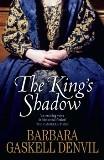
Barbara Gaskell Denvil, The King’s Shadow. Simon & Schuster Australia, 2014. ISBN 9781925030068 (Trade Paperback and ebook)
Andrew Cobham is a man of unconventional behaviour, his home is unusually grand, and he answers no questions. But as he keeps his own secrets safe, so he works to uncover those of others.
It is 1483 and King Edward IV sits England’s throne, but no king rules unchallenged. Often it is those closest to him who prove the unexpected danger. When the king dies suddenly without clear cause, then rumour replaces fact – and Andrew Cobham is already working behind the scenes.
Tyballis, when orphaned young, was forced into marriage with her neighbour, a bully and simpleton. When she escapes his abuse, she meets Andrew Cobham, and gradually an uneasy alliance forms. This is a friendship which will take them in unusual directions as Tyballis becomes embroiled in Andrew’s work and the danger which surrounds him. Eventually it is a motley gathering of thieves, informers, prostitutes and children that joins the game, determined to help Andrew uncover treason. Abduction, murder, intrigue and political subterfuge come to a climax as the country is thrown onto the brink of war.
Richard of Gloucester is designated Protector of the Realm, and it is his responsibility to bring peace to England’s troubled land, and discover those who are determined to disturb the peace for their own ends. This book brings light to some of the more troublesome mysteries and the doubts surrounding his decisions, based firmly on what truths are at present known, and especially on those frequently overlooked.
This novel combines history and imagination, but in no place is wilful inaccuracy permitted. These are the facts both as they actually occurred, and as they probably occurred.
But it is also a book about the whole adventure of an uncommon life.
Tags: Books, Edward IV, Novel, NSW Branch, Richard III
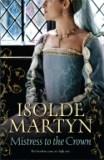
This is how Isolde Martyn, author, past chairperson of the New South Wales Branch and welcome speaker at our meetings, spent Thursday, March 27th. A guest of the Port Stephens Libraries at Tomaree and Raymond Terrace, she spoke on her novel Mistress to the Crown, her absorbing and well researched story about Elizabeth Lambard (aka Jane Shore). Many NSW Branch members attended the launch of this book last year.
Isolde’s talk gave wonderful insight to Elizabeth the person, the problems and people she had to cope with, as well as a fascinating view of the London in which she lived, loved and – not so well known– ran a successful business. And, no, William Shore was not a goldsmith, and examples of early novels whose covers implied that Elizabeth was a goldsmith’s wife were amusing viewing if bodice-ripper style appealed.
It was, as is often the case, a shame that those attending were quality not quantity, but enthusiastic questions and opinions gave hope that a few more people now realise that history was alive and well long before the Tudors butted in! This will be helped by the sales of the book, as well as those of Isolde’s novel about Harry Buckingham The Devil in Ermine. Richard was mentioned of course, especially his “what fools these mortals be” style letter about Tom Lynom. Another attendee was thrilled to know she shared Richard’s birthday!
We can look forward to another of Isolde’s books titled The Golden Widows that will be published by Mira in August this year. And the identity of the widows? The book opens with this introduction:
It is estimated that between 1450 and 1500, during the struggle for the crown between the Houses of York and Lancaster, 62 of England’s lords and their heirs were slain. Of the 44 noble ladies who were left as widows, 21 remarried.
This is the story of two of those women, Kate and Elysabeth, whose husbands fought on opposing sides. Kate was the sister of the earl known in history as “Warwick the Kingmaker” and Elysabeth became very famous in her own right.
This will be another welcome addition to Isolde’s portraits of medieval England. Each is eminently readable as fiction, excellent for accurate research – andlet’s give a huge plus for the lists of the historically correct characters (a minimum of invented names for lesser ones) and a glossary of medieval terms.
Mistress to the Crown, published by Mira, rrp $25, ISBN 978 1743560211, soon available in a smaller paperback edition.
The Devil in Ermine, an e-book available for Kindle or from Amazon Print on Demand. ISBN: 0-9873 8469-0; ISBN-13: 978-098738460-0-7.
Tags: Books, Edward IV, NSW Branch, Ricardian Authors, Richard III